Total THC vs Delta-9: The New Federal Hemp Math
On November 12, 2026, federal law starts counting THCA as THC. The chemistry behind the 0.877 formula, and what it does to your COA.

Professor High
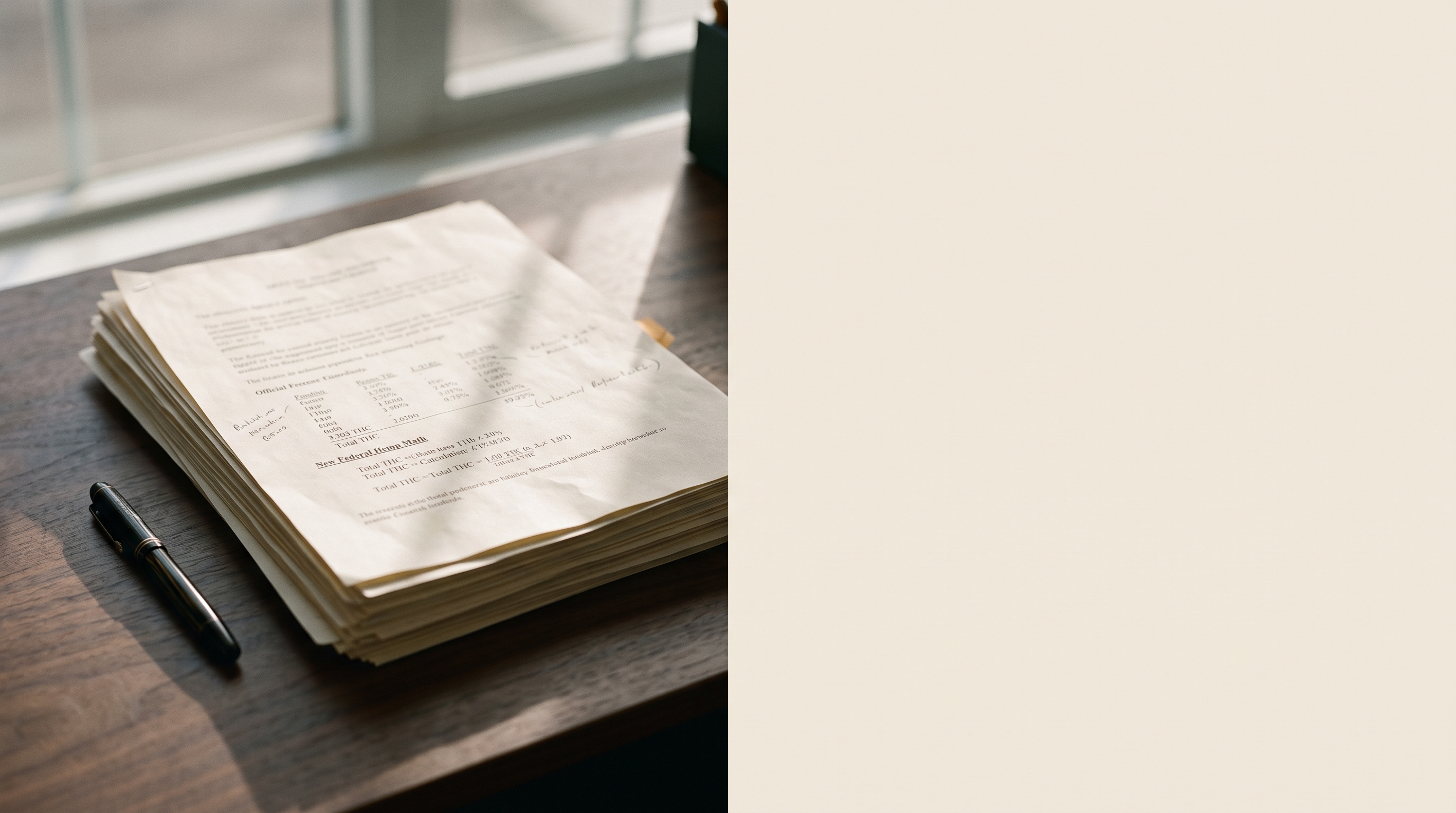
You have probably stared at a certificate of analysis and felt like it was written in two languages at once. There is a big number for THCA, a tiny number for delta-9 THC, and somewhere at the bottom a third number called “total THC” that matches neither. If you have ever bought hemp flower online and wondered how something that clearly gets you high can legally ship through the mail, that third number is the whole story.
On November 12, 2026, it stops being a footnote and becomes the federal definition of hemp.
This is the chemistry companion to the broader 2026 hemp shakeup. It is not really a legal story. It is a story about one carboxyl group, one molecular weight ratio, and what happens when the law finally decides to measure the plant the way a flame does.
Two sentences, forty-four grams apart
Here is the definition of hemp that has governed the United States since the 2018 Farm Bill, written into 7 U.S.C. 1639o(1). Hemp is Cannabis sativa L. and every part of it — seeds, derivatives, extracts, cannabinoids, isomers, acids, salts —
with a delta-9 tetrahydrocannabinol concentration of not more than 0.3 percent on a dry weight basis.
Here is the sentence that replaces it. Section 781 of Public Law 119-37 strikes that paragraph and inserts hemp as the same plant and the same list of parts —
with a total tetrahydrocannabinols concentration (including tetrahydrocannabinolic acid) of not more than 0.3 percent on a dry weight basis.
The threshold does not move. Zero point three percent, before and after. The only thing that changes is what gets counted. And what gets counted is, in raw cannabis, almost all of it.
Why raw cannabis is mostly THCA
The plant does not make delta-9 THC. It makes THCA — tetrahydrocannabinolic acid — and that is what sits in the trichomes of a living, drying, or cured bud. In fresh and properly cured flower, the overwhelming majority of the “THC” a lab finds is actually THCA. Delta-9 shows up only in small amounts, produced slowly as the acid form breaks down over time with heat, light, and age.
THCA and delta-9 THC are nearly the same molecule. THCA carries one extra piece: a
carboxyl group, a -COOH cluster hanging off the aromatic ring. That single
group is the difference between “hemp in the mail” and “a controlled substance,”
and it is also the difference between a mild plant and an intoxicating one.
Why THCA does not get you high
The carboxyl group makes THCA bigger, heavier, and considerably more polar than delta-9 THC. Cannabinoid receptors are fussy about shape. CB1 — the receptor in your brain that mediates the intoxicating effects of THC — has a binding pocket that delta-9 slots into neatly. THCA does not. Its affinity for CB1 is poor enough that eating raw cannabis, juicing it, or brewing it cold does not produce anything resembling a high.
That is not the same as saying THCA does nothing. There is genuine interest in raw acidic cannabinoids and their own activity, and the same acid-versus-neutral story plays out with CBDA and CBD. But on the specific question of intoxication, THCA is a precursor waiting for heat. Our full THCA explainer covers the pharmacology in more depth.
Then you apply heat
Decarboxylation is exactly what the name says: removal of the carboxyl group.
Heat it, and THCA drops its -COOH as carbon dioxide and becomes delta-9 THC.
That is what happens in a lighter’s flame, in a vaporizer’s chamber, and in a 110 °C oven when you are decarbing for edibles. It is a single, irreversible chemical step, and it is the reason the science of activation matters so much for anyone cooking with cannabis rather than smoking it. Raw flower in butter, no heat, no effect.
So: a jar of “THCA flower” that legally tests at 0.25% delta-9 is, the instant you light it, ordinary high-THC cannabis. Nothing about the plant changed. The test was simply looking for a molecule that had not been created yet.
Where 0.877 comes from
Now the arithmetic. The standard total-THC formula is:
Total THC = delta-9 THC + (0.877 × THCA)
That 0.877 is not a policy compromise or a safety margin. It is a molecular mass ratio, and you can derive it in one line.
| Molecule | Formula | Molecular weight (g/mol) |
|---|---|---|
| THCA | C22H30O4 | 358.5 |
| Delta-9 THC | C21H30O2 | 314.5 |
| Carbon dioxide | CO2 | 44.01 |
When THCA decarboxylates, it loses exactly one CO2: one carbon and two oxygens. Check the formulas — C22 becomes C21, O4 becomes O2, and the thirty hydrogens are untouched. Check the masses: 358.5 − 44.01 = 314.5. The books balance.
So one gram of THCA does not become one gram of THC. It becomes:
314.469 / 358.478 = 0.87723
About 87.7% of its mass, with the remaining 12.3% leaving as gas. (The table above rounds to one decimal; the ratio is calculated from the full atomic masses.) Multiply your THCA number by 0.877 and you get the delta-9 THC that material can actually produce. Add the delta-9 already present, and you have total THC — sometimes called “potential THC” or “post-decarboxylation THC” on a lab report.
USDA has used exactly this figure in its hemp production regulations for years. 7 CFR 990.1 spells it out in words, defining the decarboxylated value as a “molecular mass conversion ratio that sums delta-9 THC and eighty-seven and seven tenths (87.7) percent of THC-acid.”
One useful consequence: if a sample contained no delta-9 at all, the most THCA it could hold and still pass would be 0.3 ÷ 0.877 = 0.342%. That is the entire budget. A gram of flower gets roughly three milligrams of THCA before it is no longer hemp.
Worked examples: the same product, two verdicts
This is where the abstraction becomes concrete. Below are five realistic COA readings, run through both tests.
| Product | Delta-9 on COA | THCA on COA | Old test (delta-9 only) | Total THC | New test |
|---|---|---|---|---|---|
| Typical “THCA flower” | 0.25% | 22.0% | Pass | 19.54% | Fail — ~65× the limit |
| Low-end “THCA flower” | 0.20% | 15.0% | Pass | 13.36% | Fail — ~44× the limit |
| Genuine CBD hemp | 0.09% | 0.21% | Pass | 0.27% | Pass |
| Borderline CBD hemp | 0.28% | 0.10% | Pass | 0.37% | Fail |
| Hot-testing crop | 0.31% | 0.05% | Fail | 0.35% | Fail |
Look at rows one and two. Nothing sketchy is happening on those COAs. The lab did its job, the numbers are honest, and the delta-9 figure genuinely is under 0.3%. It is just that 22% THCA is 22% THCA, and multiplying it by 0.877 produces a number sixty-five times over the line.
Row four is the one that will surprise people. That is a real hemp product — a CBD-forward cultivar with barely any THCA — and it still fails, because 0.28% was already almost the entire delta-9 budget and there was no room left for the acid form. Plenty of legitimately grown hemp will land here. This change is not only about the obvious category.
Row three is what compliant hemp looks like after November: low on both, and low enough on both that the sum clears.
How labs actually measure this, and why the method matters
There are two dominant instruments, and the difference between them is the whole reason the 0.877 formula exists at all.
HPLC keeps the acid intact
High-performance liquid chromatography separates compounds in a liquid mobile phase at or near room temperature. Nothing gets hot enough to decarboxylate. THCA goes in as THCA and comes out measured as THCA, reported separately from delta-9.
This is why an HPLC report gives you two numbers and makes you do the arithmetic yourself. It is also why HPLC is the preferred method when you need to know the actual composition of a product — a raw tincture, an edible, anything where what is in the jar is what reaches the consumer.
GC decarboxylates in the injector
Gas chromatography has to vaporize the sample to move it through the column, and the injector port runs hot. THCA entering that port decarboxylates on the spot. By the time the detector sees anything, the acid has already become delta-9.
7 CFR 990.1 describes this directly: with gas chromatography, “THCA is converted from its acid form to its neutral form, THC,” so the test “calculates the total potential THC in a given sample.” The instrument does your multiplication for you, in hardware.
This is the practical trap for anyone reading a COA: if a report gives you a single merged “THC” figure from a GC method, that number may already include converted THCA. Multiplying it by 0.877 again and adding it to itself double-counts. Before you do any math, find the method on the report.
Why the loophole existed in the first place
Here is the part most coverage skips, and it is genuinely interesting.
USDA was already using total THC. Its hemp production rules require a sample collected no more than 30 days before harvest, tested for “total delta-9 tetrahydrocannabinol,” using a method that “must consider the potential conversion of THCA in hemp into THC” (7 CFR 990.24, 990.26).
So the field test was never delta-9 only. But that test is a single gate on a growing crop. Once a lot clears it, 7 CFR 990.26(d) says the lot “may enter the stream of commerce” — and from that point on, the thing governing derivatives, extracts, and finished products was the statute, which said delta-9.
That is the gap. A total-THC standard on the plant in the field, a delta-9 standard on everything downstream. “THCA flower” grew in the space between two documents that did not agree with each other, and its legality was argued over in courtrooms and state legislatures for years. Section 781 does not add a new test. It rewrites the statute so both documents finally say the same thing.
One more wrinkle: measurement uncertainty
The regulation defines an “acceptable hemp THC level” that builds in lab error. If a lab reports 0.35% with a measurement uncertainty of ±0.06%, the true value could be anywhere from 0.29% to 0.41% — and because 0.3% falls inside that range, the sample passes for plan-compliance purposes.
The regulation is careful to note this “affects neither the statutory definition of hemp… nor the definition of ‘marihuana’” under the Controlled Substances Act. In other words: a crop can be fine with your state’s agriculture department and still be over the statutory line. Two different questions, two different answers.
The other number: 0.4 milligrams per container
The statute does not stop at concentration. Section 781 also adds product-level caps, and they use completely different units.
Intermediate hemp-derived cannabinoid products are excluded from “hemp” if they contain more than 0.3 percent combined total of total tetrahydrocannabinols (including THCA) plus any other cannabinoids with similar effects.
Final hemp-derived cannabinoid products — the thing you actually buy — are excluded if they contain greater than 0.4 milligrams combined total per container.
Per container. Not per serving. A 5 mg hemp-derived THC seltzer is 12.5 times that cap. A tin of ten 10 mg gummies is 100 mg in one container, or 250 times. Worth flagging honestly: the text I read does not define “container,” and that ambiguity will matter enormously to how this shakes out.
The same section also excludes products containing cannabinoids “not capable of being naturally produced” by the plant, and cannabinoids that are naturally producible but “were synthesized or manufactured outside the plant.” That language is aimed squarely at the semi-synthetic shelf — the delta-8, HHC, and THCP products that filled the gap left by the 2018 bill. That is its own article.
What this means for reading a COA
Whatever the law does, the skill is the same one that has always separated informed buyers from hopeful ones. If you are new to lab reports, start with our guide to reading cannabis lab results. Then add these five habits:
- Find the method before the numbers. HPLC or GC. It changes whether the headline THC figure already includes converted THCA.
- Do the multiplication yourself. Delta-9 plus 0.877 times THCA. If the report’s “total THC” does not match your arithmetic, ask why.
- Check the date and the batch. A COA describes one lot on one day. THCA slowly converts to delta-9 with time and warmth, so an old jar and its year-old COA are not the same product. Storage matters here.
- Look for measurement uncertainty. A report without an error estimate is telling you less than it appears to.
- Treat the potency number as approximate. Flower labels in particular have a well-documented tendency to run optimistic — a problem we have covered in why your dispensary labels are mostly wrong and why lab testing standards keep failing consumers.
The bigger point: the number was never the product
There is a reason this whole thing turned into a legal argument. We built a regulatory system around a single molecule expressed as a percentage, and then acted surprised when the market optimized against it.
Total THC is a better measurement than delta-9 alone. It is honest about what heat does. But it is still one number, and one number has never told you how a particular plant will land in your particular body. The potency arms race has been chasing that number for a decade, and the result has been higher figures on labels without a matching improvement in how anything actually feels.
A high-THCA cultivar like Gorilla Glue #4 and a balanced one like Harlequin can sit in the same shop under the same testing regime and do completely different things to you. Fiber and CBD cultivars like Cherry Wine and Suver Haze were bred to stay under these limits; nothing about the November change touches them. Meanwhile Blue Dream and Sour Diesel will produce different mornings for two people with identical COAs in hand — which is the entire argument for paying attention to full chemistry rather than a headline percentage, and for thinking in terms of effect families instead of potency alone.
Percentages are a floor, not a forecast. The most reliable data about how cannabis affects you is the record you keep yourself — which is exactly what the High IQ app is for.
FAQ
Does this make THCA flower illegal everywhere on November 12, 2026?
It removes the federal argument the category was built on. As of that date, the statutory definition of hemp counts THCA, and raw high-THCA flower will not clear 0.3% total. State law is a separate layer — many states already banned or restricted the category, and a few regulate it independently. Check your state’s rules.
Is 0.877 an exact number?
It is a rounding of 0.8772, which is the ratio of delta-9 THC’s molecular weight (314.5) to THCA’s (358.5). USDA codified 0.877 in 7 CFR 990.1, so that is the figure labs and regulators use.
Why not just multiply by 1.0?
Because mass leaves the molecule. Decarboxylation releases a CO2 — 44.01 g/mol out of THCA’s 358.5. Using 1.0 would credit the sample with THC that physically cannot exist, overstating potency by roughly 14%.
My COA shows a “total THC” higher than THCA plus delta-9. Is that wrong?
It should never exceed the simple sum, because 0.877 is less than one. If it does, either a different cannabinoid is folded in or there is an error on the report. Ask the lab.
Does the 0.3% total-THC rule apply to dispensary cannabis too?
No. This provision defines hemp under agricultural law. State-licensed marijuana operates under a separate framework, and the federal rescheduling picture is its own tangle. The two systems are converging on the same measurement, not merging.
Where does smoking fit into all of this?
It is the punchline. A flame decarboxylates essentially instantly, which means the delta-9-only test measured the product in a state no consumer ever encounters. The new standard measures what combustion or vaporization will actually deliver.
A note on scope: this article explains chemistry and quotes statutory and regulatory text directly. It is not legal advice. Cannabis and hemp law varies by state, changes quickly, and the practical enforcement of Section 781 will depend on agency rulemaking that has not happened yet. Talk to a licensed attorney in your jurisdiction before making decisions about buying, selling, or growing.
Primary sources
All of the following were read directly from official government text.
- Public Law 119-37, Section 781 — Continuing Appropriations, Agriculture, Legislative Branch, Military Construction and Veterans Affairs, and Extensions Act, 2026 (H.R. 5371). Approved November 12, 2025; Section 781 effective 365 days after enactment. Amends Section 297A of the Agricultural Marketing Act of 1946 (7 U.S.C. 1639o). Page cite 139 Stat. 558–559. govinfo.gov
- 7 U.S.C. 1639o(1) — the pre-amendment definition of hemp, measuring “delta-9 tetrahydrocannabinol concentration.” uscode.house.gov
- 7 CFR Part 990 — USDA Domestic Hemp Production Program. Section 990.1 defines “decarboxylated,” “post-decarboxylation,” and “acceptable hemp THC level”; Sections 990.24 and 990.26 set preharvest sampling and stream-of-commerce rules. ecfr.gov
- Molecular weights — PubChem CID 16078 (delta-9-THC, C21H30O2, 314.5 g/mol) and CID 98523 (THCA, C22H30O4, 358.5 g/mol), National Library of Medicine.
