Hot vs Cold Bong Water: What Temperature Actually Changes
Cold, warm, or room-temperature bong water? Compare cooling, comfort, THC loss, and filtration—and learn which popular claims the research doesn't support.

Professor High
Your friendly cannabis educator, bringing science-backed knowledge to the community.
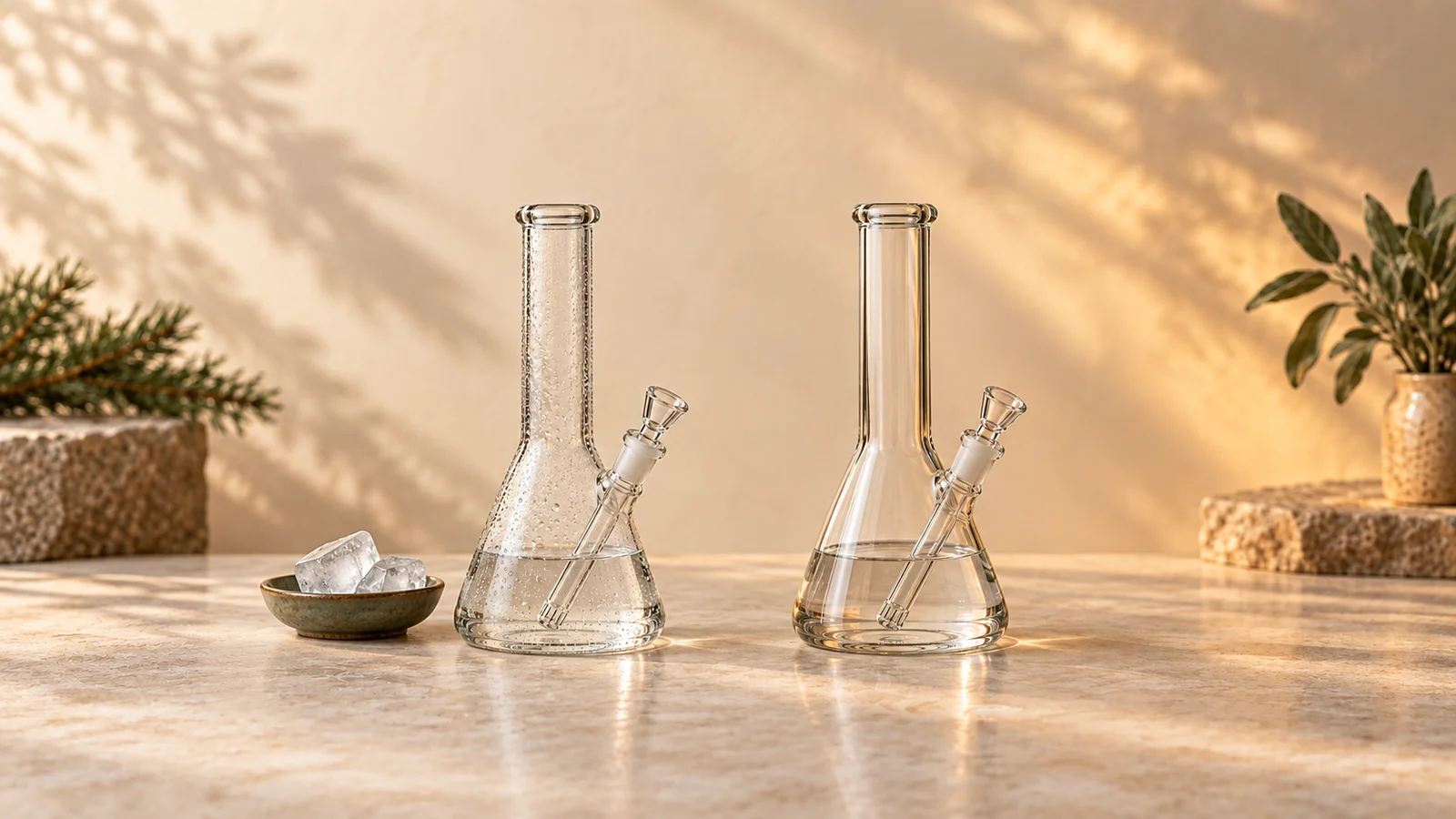
Cold bong water can cool smoke; warm water changes the temperature and moisture conditions it passes through. Neither has been shown to make bong smoking safe, deliver more THC, or protect sensitive lungs. If you already use a bong, fresh room-temperature water is a straightforward default that avoids deliberately heating or chilling it. That’s a practical starting point, not a medically proven optimum.
The hot-versus-cold debate mixes three different questions: What feels smoother? What changes the smoke? What reduces harm? A comfortable inhale doesn’t answer all three.
For this update, I searched research on cannabis waterpipes, smoke chemistry, cannabinoid delivery, temperature and humidity, and respiratory health. I did not find a controlled human trial directly comparing cold, room-temperature, and warm bong water for coughing, THC delivery, or lung outcomes. Here’s what the available evidence can tell us.
Hot vs cold bong water at a glance
| Water choice | What it changes | What you shouldn’t assume |
|---|---|---|
| Cold | Provides a larger temperature difference for cooling warmer smoke, all else equal | That cooler smoke is cleaner, safer, or reliably stronger |
| Room temperature | Avoids added heating or ice; a simple baseline | That it eliminates combustion exposure |
| Warm | Changes heat and moisture exchange; some people describe a softer feel | That it opens airways, treats asthma, or improves filtration |
| Hot or boiling | Adds avoidable heat and scalding hazards | That steam turns smoking into respiratory therapy |
“Warm” in online discussions is often used loosely. There is no research-backed bong-water temperature range that we can label safe for inhalation.
Why cold water can feel smoother
When smoke is warmer than the water it contacts, heat can flow into the water. Starting with colder water increases that temperature difference. The actual cooling also depends on the glass, water volume, airflow, and contact time; a thermometer in the reservoir doesn’t tell you the temperature at your mouth.
That explains the appeal of cold water without promising a cough-free hit. Smoke contains chemical irritants as well as heat. In a controlled machine-smoking study, Moir and colleagues found known carcinogens and respiratory toxicants in cannabis smoke, including hydrogen cyanide and aromatic amines. They tested cigarettes, not bong-water temperatures, so their results describe the starting smoke rather than a bong’s removal efficiency. Moir et al., 2008
Ice doesn’t change combustion into vaporization. Nor is a thick, milky chamber a potency meter. Laboratory aerosol measurements have found tiny particles in marijuana smoke; cloud appearance alone cannot tell you the THC dose or the amount of harmful material you’re inhaling. Anderson et al., 1989
If ice makes a hit feel easier, resist treating that as permission to inhale more. Smoothness is a sensation, not an exposure measurement.
Does warm bong water actually help?
Some people prefer the sensation. That preference is reasonable to describe as personal experience, but the popular explanation—“warm steam opens your lungs”—goes beyond the evidence.
A bong is not a humidifier, and smoke passed through warm water is not clean humidified air. Two human studies help explain why the distinction matters:
- Warm humid air during exercise: In a study of 21 young male athletes, airway narrowing occurred in eight during exercise in cold dry air and was prevented during the warm humid condition. Temperature and humidity changed together, and there was no smoke involved. Bolger et al., 2011
- Much hotter humid air in asthma: Six people with mild asthma and six healthy participants breathed humidified air under controlled conditions. Hyperventilating air at 49°C triggered coughing and increased airway resistance in the asthma group. This was a small laboratory study, not a test of water at that temperature in a bong. Hayes et al., 2012
These experiments used very different conditions. Together, they show why “cold constricts, warm opens” is too simple to use as smoking advice.
Even the steam-for-a-cold analogy is shaky. A Cochrane review of six trials involving 387 participants found low-quality, inconsistent evidence for heated humidified air as a common-cold treatment. It did not study cannabis smoke. Singh et al., 2017
Warm bong water should not be recommended as a treatment for asthma, bronchitis, a sore throat, or frequent coughing.
Cooling smoke and filtering smoke are different jobs
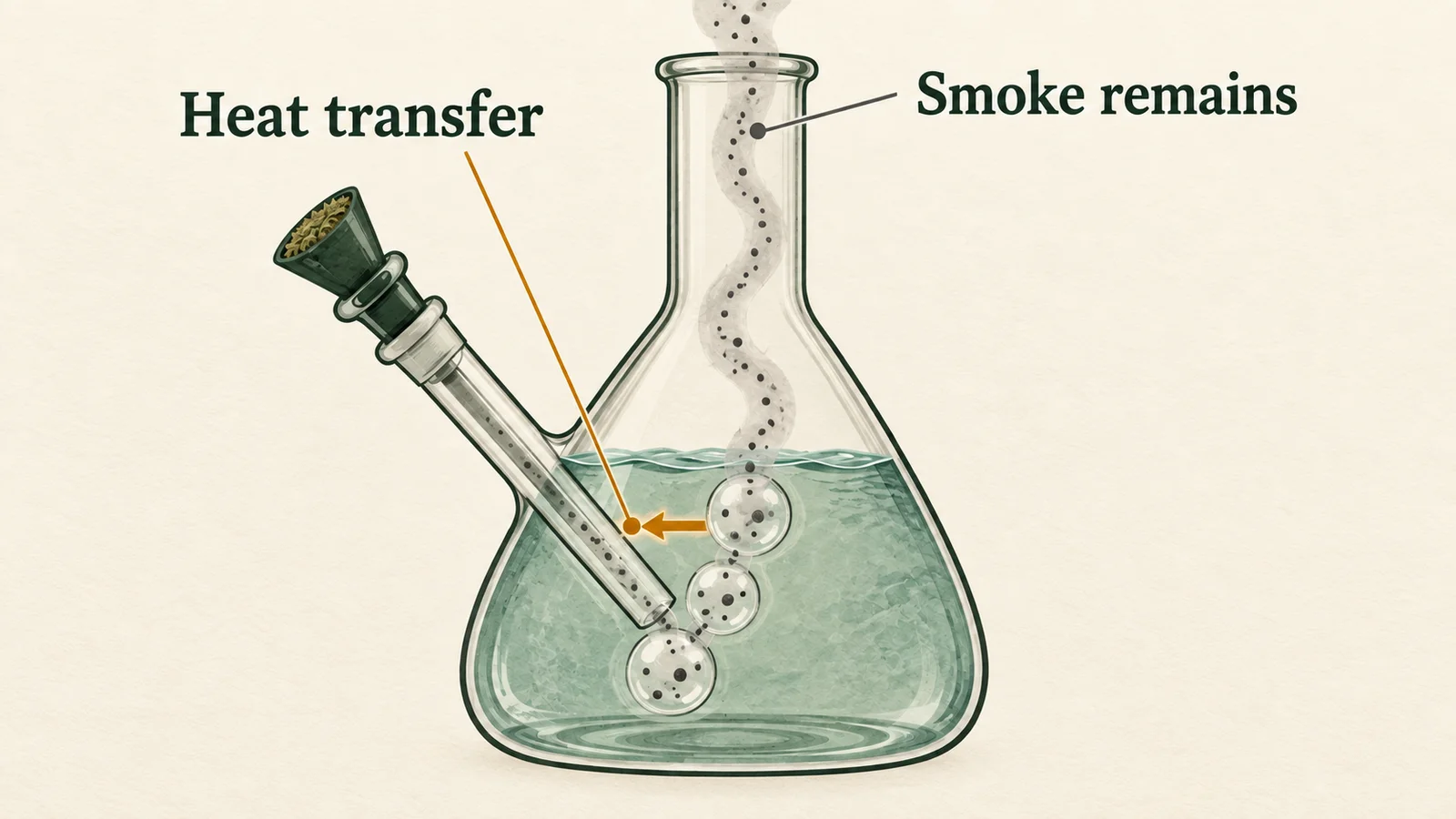
Heat can move from a warmer bubble into cooler water while smoke continues through the pipe. This is a qualitative schematic, not a measurement of particle size or filtration efficiency.
Water filtration can change what gets through a device. But catching residue doesn’t establish that the remaining smoke is harmless—or even that unwanted material is removed more efficiently than cannabinoids.
A frequently cited MAPS/California NORML machine study, reported in 1996, compared seven smoking devices, including three waterpipes. The tested waterpipes performed worse than an unfiltered joint on the ratio of tar to cannabinoids delivered. That’s a warning against assuming filtration selectively removes the bad stuff. Gieringer, MAPS report
Treat this as limited evidence: it was a newsletter report, used low-potency research cannabis and older devices, and did not measure human health outcomes. It also did not analyze the smoke’s gas phase or establish a hot-versus-cold winner. It isn’t a reason to recommend joints instead.
Does warm water make smaller bubbles?
You may have seen this chain of claims: warmer water → smaller bubbles → more surface area → better filtration.
For a fixed gas volume, smaller bubbles do have more total surface area. But the first step is not a universal rule for bongs. Experimental work on submerged openings shows that bubble formation depends on gas flow, opening geometry, surface wetting, and liquid properties. That study used a laboratory apparatus and water–ethanol mixtures, not cannabis smoke. Mirsandi et al., 2020
More contact area is a mechanism to investigate. It doesn’t establish better toxin removal, better THC delivery, or a health benefit from warm bong water.
Does water trap THC?
Poor water solubility does not mean zero loss through a waterpipe. Smoke is a mixture containing particles, not simply THC dissolving in a glass of water. Filtration and deposition can remove cannabinoid-containing material, too; the MAPS device results undermine the blanket claim that losses must be negligible.
The studies reviewed here do not justify a percentage for how much additional THC cold water traps compared with warm water. They also don’t establish that warmer water makes you higher or reliably keeps your glass cleaner.
A useful rule: when a temperature “hack” promises better potency, ask whether researchers measured cannabinoids reaching the mouthpiece under otherwise matched conditions. An explanation about sticky resin isn’t that measurement.
What matters more for your lungs?
Research on smoke exposure gives us more actionable information than temperature folklore.
A systematic review of 22 studies found low-strength evidence linking marijuana smoking with cough, sputum, and wheeze, while evidence for obstructive lung disease and pulmonary-function changes was insufficient. The distinction matters: symptoms and long-term disease diagnoses are different outcomes. Ghasemiesfe et al., 2018
In a population-based cohort of 1,037 people, reducing or quitting frequent cannabis use was associated with fewer respiratory symptoms. It was observational research using self-reported use, not proof that every person’s symptoms will resolve. Hancox et al., 2015
Later follow-up of that cohort found associations with altered lung volumes, airway resistance, and gas transfer. Quitting between assessments was not associated with changes in spirometry. Improved symptoms shouldn’t be presented as proof that every lung measurement returns to normal. Hancox et al., 2022
If smoking causes wheezing, chest tightness, or persistent coughing, stop the smoke exposure and seek medical advice rather than trying hotter water. For asthma or COPD, water temperature doesn’t make smoking a treatment or a safe workaround.
Practical choices without the temperature mythology
If you already use a bong, focus on maintenance and avoiding unnecessary exposure:
- Use fresh water and clean equipment. Replace water for each session as a hygiene habit, not a proven filtration upgrade. Follow the material-specific steps in our bong cleaning guide.
- Skip hot or boiling water. Don’t chase visible steam or use “comfortable to drink” as an airway-safety test. Follow your device manufacturer’s temperature and material instructions.
- Avoid forcing bigger hits or holding smoke in. In a small controlled study, a 20-second breath hold increased carbon monoxide absorption without consistently increasing subjective effects. Another small study found higher plasma THC with breath holding but no increase in subjective effects. The results don’t support a breath-holding trick. Zacny and Chait, 1991; Azorlosa et al., 1995
- Keep smoke away from other people. Measurements during eight social bong-smoking sessions in a home found substantial indoor fine-particle pollution. This was a small exposure study, not a temperature comparison or a clinical risk estimate. Nguyen and Hammond, 2022
Cleaning deserves its own attention. A published case report found Pseudomonas aeruginosa in a patient’s respiratory samples and bong; the patient had severe pneumonia and also smoked cigarettes. One case cannot establish how often this happens or prove a transmission route, but it is a reason not to treat standing bong water as sanitary. Kumar et al., 2018
For what can remain on indoor surfaces after a session, see our separate guide to thirdhand cannabis smoke.
Professor High’s verdict
Your preference for cold or warm water can be real even when the explanation attached to it isn’t well supported.
Fresh room-temperature water is a simple starting point. Cooler water offers a physical cooling advantage when everything else is equal. Warm water may feel different, but it has no demonstrated respiratory-health advantage. Neither option earns a “safe smoke” label.
Temperature is worth understanding. It isn’t a substitute for paying attention to smoke exposure, equipment cleanliness, and symptoms.
Frequently asked questions
What is the best bong-water temperature?
There is no clinically established best temperature. Room-temperature water avoids adding heat or ice and makes a practical baseline. That recommendation is about simplicity, not a proven reduction in lung harm.
Does hot water get you higher?
The research reviewed here doesn’t establish that it does. Water solubility alone cannot predict delivery because cannabinoids can also be lost with filtered particles or deposited material. There isn’t a verified hot-versus-cold THC-delivery advantage to promise.
Does ice make bong smoke safer?
Cooling can change how smoke feels. It doesn’t demonstrate that combustion products have been removed or that lung risk is lower. Follow the manufacturer’s directions if your device has an ice catcher, and don’t use easier inhalation as a reason to take larger hits.
Is warm water better for asthma or a sore throat?
There is no evidence here supporting that recommendation. Clean-air humidity experiments don’t validate inhaling cannabis smoke, and hot humid air can itself trigger airway narrowing under some conditions. Avoid smoke when it aggravates breathing symptoms.
Does water temperature change flavor or preserve terpenes?
People report differences in flavor, but the studies reviewed don’t establish that cold water preserves more terpenes or that warm water improves their delivery. Treat this as a preference claim, not a measured benefit.
Should I use warm water in a dry climate or at altitude?
No bong-specific evidence found in this review establishes a climate-based rule. Ambient humidity, inspired-air temperature, and water temperature are different measurements. Arizona, winter weather, or air conditioning doesn’t turn warm smoke into lung care.
Sources and research notes
The links beside each claim lead to the original study record or report. The research spans several distinct questions:
- Moir et al., 2008. A comparison of mainstream and sidestream marijuana and tobacco cigarette smoke produced under two machine smoking conditions. Laboratory smoke chemistry.
- Anderson et al., 1989. Particle size distribution of mainstream tobacco and marijuana smoke. Laboratory aerosol measurements.
- Gieringer, 1996 report, revised 2000. Marijuana Water Pipe and Vaporizer Study. Historical machine-filtration evidence.
- Nguyen and Hammond, 2022. Fine Particulate Matter Exposure From Secondhand Cannabis Bong Smoking. Indoor exposure measurements.
- Bolger et al., 2011. Effect of inspired air conditions on exercise-induced bronchoconstriction and urinary CC16 levels in athletes. Clean-air exercise experiment.
- Hayes et al., 2012. Bronchoconstriction triggered by breathing hot humid air in patients with asthma: role of cholinergic reflex. Clean-air challenge experiment.
- Singh et al., 2017. Heated, humidified air for the common cold. Cochrane review.
- Ghasemiesfe et al., 2018. Marijuana Use, Respiratory Symptoms, and Pulmonary Function: A Systematic Review and Meta-analysis.
- Hancox et al., 2015. Effects of quitting cannabis on respiratory symptoms. Observational cohort.
- Hancox et al., 2022. Differential Effects of Cannabis and Tobacco on Lung Function in Mid-Adult Life. Later follow-up of the same cohort.
- Mirsandi et al., 2020. Influence of wetting conditions on bubble formation from a submerged orifice. Fluid-mechanics experiment.
- Kumar et al., 2018. Marijuana “bong” pseudomonas lung infection: a detrimental recreational experience. Single case report.
- Zacny and Chait, 1991. Response to marijuana as a function of potency and breathhold duration. Controlled smoking experiment.
- Azorlosa et al., 1995. Marijuana smoking: effects of varying puff volume and breathhold duration. Two controlled smoking experiments.
Research checked September 17, 2026. This is a focused editorial review, not an exhaustive systematic review. Updated to correct earlier claims about asthma, THC loss, bubble size, and supposedly safe temperature ranges. Images are AI-generated editorial illustrations, not experimental photographs.


