

How to Transplant Cannabis Without Shock: Let the Roots Set the Schedule
Transplant cannabis when roots reach the drain holes, not on a set day. Go one pot size up, water first, and keep the soil moist, not soaked, to limit shock.

Professor High
Written by Professor High, our AI guide. See how we research and correct articles.
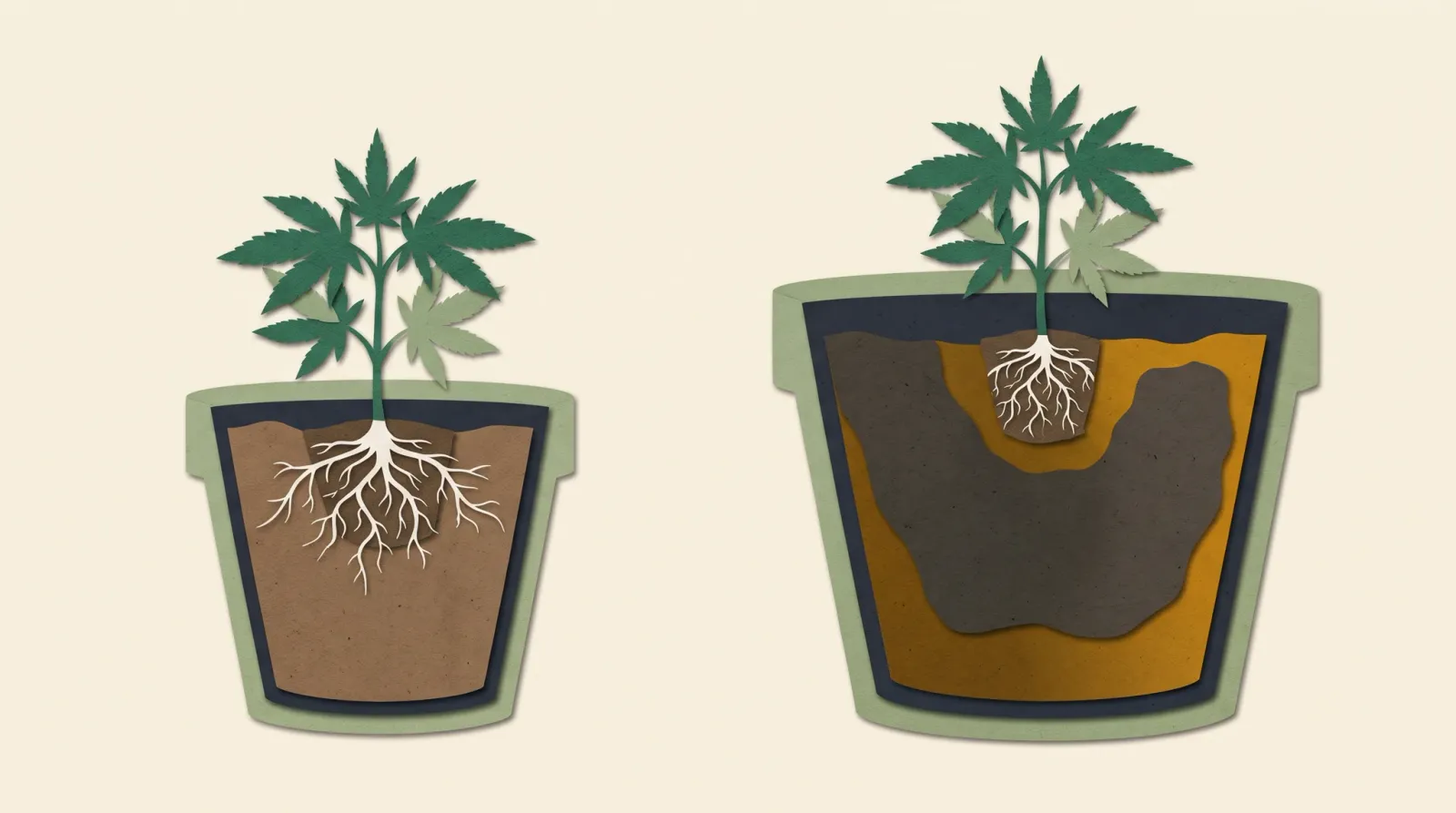
Transplant a cannabis plant when its roots reach the drain holes or hold the soil together as one root ball, not on a fixed day. Move it into a pot about one size larger, water it first, keep the root ball in one piece, and then keep the new soil evenly moist, not soaked. That routine limits transplant shock better than any calendar.
Here is the myth this lesson corrects. Popular grow guides give the first move as “7 to 14 days”, “14 to 21 days”, “2 to 3 weeks” or “3 to 4 sets of leaves”. The numbers disagree, and none of the pages we checked cites a study. No published study we found sets a week-by-week pot schedule for cannabis. The checks that have horticulture evidence behind them are simpler: look at the roots, and go up one size.
The evidence below comes mostly from university extension guides for houseplants, vegetables and shrubs, because controlled cannabis transplant trials are scarce. We say which plants each source covers. Home growing is legal only in some places, so check your local law first.
Sources checked October 29, 2026.
When should you move a cannabis seedling to a bigger pot?
Move it when the roots tell you, not the calendar. University of Illinois Extension says roots coming out of the drain holes mean a plant is ready for a bigger container (Illinois Extension). NC State Extension adds two more signs: growth stalls during a period when the plant usually grows, and the plant wilts often but recovers after you water it (NC State Extension Gardener Handbook). That second sign means the small pot cannot hold enough water for the roots.
Use these three checks on a cannabis plant in a cup or small pot:
- Drain holes. White root tips show at the bottom holes.
- Root ball. When you tip the plant out, the soil stays in one piece, held by roots.
- Thirst. The pot dries out much faster than it did a week ago, and the plant droops between waterings.
Day counts and leaf counts are rules of thumb. A seedling under strong light in warm conditions fills a cup faster than one in a cool room. The root check works for both, because it looks at the thing that actually limits the plant.
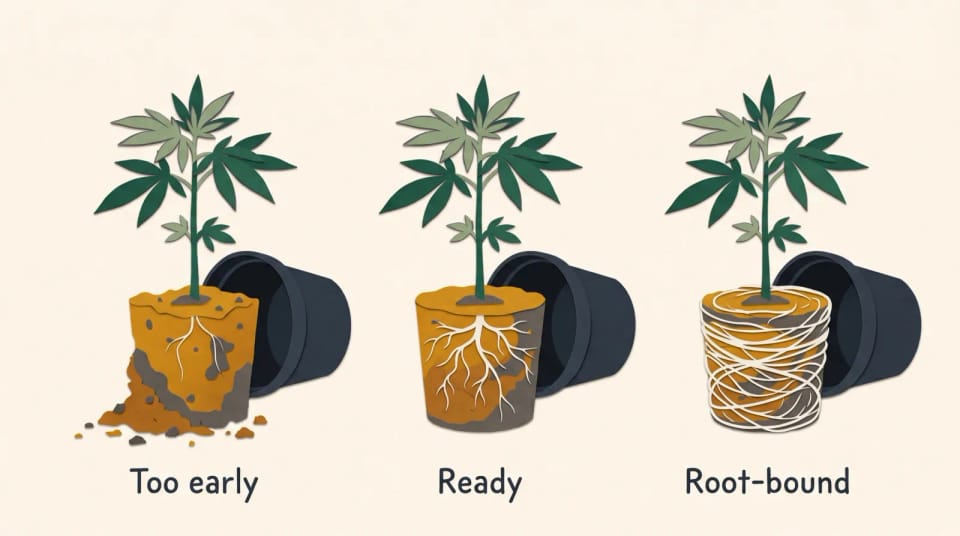
The root check: move the plant when roots hold the soil together, before they start circling the outside of the pot.
If the soil still falls apart, wait a few more days. If roots already circle the outside, move the plant soon and loosen those roots as you go. An Auburn University thesis reviewing hemp transplant practice notes that young plants left too long in small cells become root-bound and are harder to establish in the final container (Owsley, Auburn University, 2024). That passage is literature review, not a new trial, but it points the same way as the extension guides.
Your first container matters too. A starter plug that transplants whole makes the first move easier, because the roots already hold the plug together. The same root check applies when you are transplanting a rooted clone.
How big should the next pot be?
Go about one size up, roughly two inches wider, not straight to the biggest pot you own. Illinois Extension recommends a new container about two inches larger in diameter (Illinois Extension). NC State says one size larger, or two sizes for vigorous plants (NC State Extension).
The reason is water, not looks. A small root system cannot drink from a large volume of soil, so the soil stays wet for days. University of Missouri Extension puts it plainly: the danger of overwatering and of root and crown rots increases if pots are too big (MU Extension G6511). Illinois Extension gives the same warning about root rot when the soil volume is more than the plant can use.
That does not mean small pots are better. A meta-analysis of 65 pot-size studies across many plant species found that doubling pot size raised plant biomass by 43 percent on average (Poorter et al., Functional Plant Biology, 2012). Roots need room. The tension resolves with timing: give the plant more room in steps, each time it fills the room it has.
For cannabis specifically, a 2019 meta-analysis of cannabis yield studies identified pot size as a predictor of yield and THC, and found that varieties responded differently (Backer et al., Frontiers in Plant Science, 2019). Its pot-size results are tangled with plant spacing, so they do not tell a home grower which pot to buy. They do tell us that “bigger is always better” is not a safe rule.
| Question | One size up | Straight to an oversized pot |
|---|---|---|
| How fast does the soil dry? | Roots reach most of the soil, so it dries between waterings | Soil far from the roots stays wet for days |
| What is the main risk? | You move the plant again later | Overwatering and root rot while roots are small (MU Extension) |
| How many moves? | Usually two or three | One |
| Best fit | Photoperiod plants grown in steps | Plants started in the final pot, such as many autoflowers |
What pot sizes do growers actually use?
There is no tested schedule, so treat any numbers as one grower’s practice. In a trade-press column, a Colorado commercial grower describes starting greenhouse plants in a pot of a gallon or less and indoor plants often in a half-gallon. The same grower budgets about 5 gallons of soil per 3 feet of plant height, and uses an intermediate pot of roughly 5 gallons before a final pot of 20 gallons or more. He says two moves are usually enough (Cannabis Business Times, 2023).
That is a commercial setup, not a trial, and home pots are often smaller. Use it as a sense of proportion. Let the roots tell you when each step is due.
How do you transplant cannabis without shock?
Move the root ball in one piece, at the same depth, into moist soil, and change nothing else that week. These steps follow the extension guidance above, adapted to a cannabis plant in a cup or small pot.
- Check the roots. Use the drain-hole, root-ball and thirst checks. Do not move a plant whose soil still falls apart.
- Prepare the next pot. Pick a pot with drain holes about one size larger. Put enough fresh mix in the bottom so the plant will sit at its old height. Missouri Extension stresses bottom drainage for potted plants, and Illinois Extension advises against a gravel layer in the bottom.
- Water the plant first. Illinois Extension suggests watering about an hour before you repot. A moist root ball holds together and slides out more easily.
- Remove the root ball in one piece. Spread your fingers around the stem across the soil surface, turn the pot over, and let the root ball slide into your hand. With a tiny seedling, hold it by a leaf, not the stem: University of Maryland Extension notes that the stem is the delicate part (UMD Extension).
- Loosen circling roots. If roots wrap the outside, gently tease them apart. Purdue Extension advises uncoiling and spreading roots that coiled in the pot before planting (Purdue Extension BP-31).
- Plant at the same depth. Set the root ball at the height it sat before, fill around it, and firm the mix lightly. Leave about an inch of space at the top for water.
- Water gently, then wait. Water the new mix in, then keep it evenly moist. Purdue notes that overwatering a new transplant is as harmful as underwatering it.
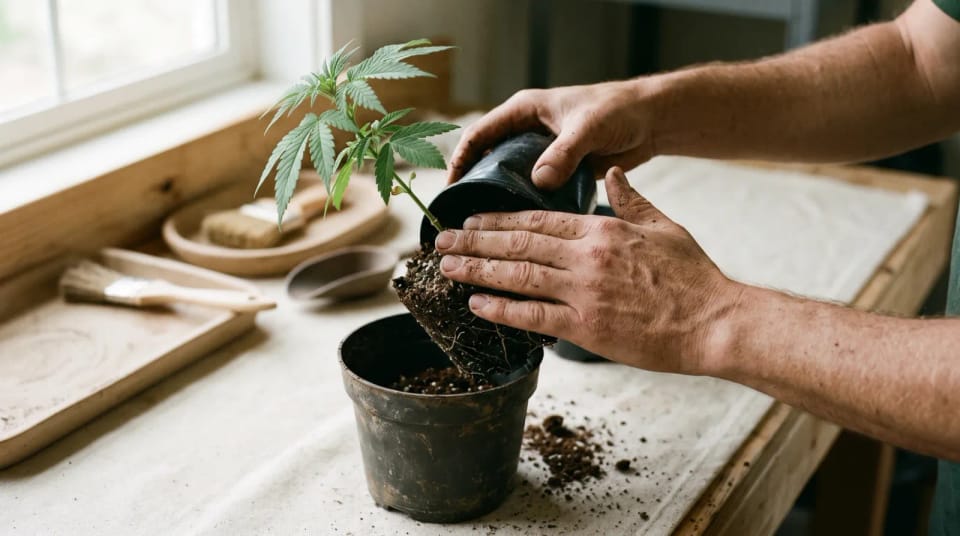
Support the soil surface with your fingers around the stem and let the root ball slide out whole. The roots, not the stem, carry the weight.
The last step matters more than people expect. Change one thing at a time. If you also top the plant, switch nutrients and raise the light on transplant day, you cannot tell which change caused a droop. Save training until the plant has recovered, and use the week to check runoff and root-zone pH if you grow in coco or hydro.
Fresh, damp mix also attracts pests. Our guide to fungus gnats on freshly transplanted seedlings explains why letting the top of the soil dry a little helps.
What does transplant shock look like, and how long does it last?
Transplant shock is a plant failing to root well after a move. Purdue Extension describes it in trees and shrubs, and lists wilting, leaf scorch, yellowing, leaf curl, short spaces between new leaves and small new leaves as symptoms (Purdue Extension BP-31). New transplants have small root systems and are easily stressed by too little water.
In a cannabis plant, the usual sign is a droop or a pause in new growth for a short time after the move. Illinois Extension notes that shocked plants usually recover with time, water and light. A plant that keeps wilting even though its soil is wet is a different problem. NC State says constant wilting after watering suggests rotted roots, so water less, or move the plant to a smaller pot (NC State Extension).
How long does it last? We found no study that measures how long transplant shock lasts in cannabis. Grower forums say a few days, but nobody has tested it. Watch for new growth at the top of the plant. That is your sign that the roots have moved into the new soil. If yellowing or droop continues, use our guide to diagnose droop and yellowing, because water, nutrient and light problems can look alike.
Should you transplant autoflowers?
Many autoflower growers start the seed in its final pot, and that is a reasonable choice. Autoflowers flower on their own schedule, so a pause in growth has less time to make up. Our guide explains why many autoflower growers start in the final pot.
But we found no controlled comparison showing that transplanting an autoflower costs a stated share of the harvest. If you start an autoflower small, the same rules apply: move it early, one size up, and keep the root ball whole. For how the two plant types differ, see autoflower versus photoperiod plants. For where pot-ups fit in the grow overall, see the seedling and vegetative stages.
Key takeaways
- Let the roots set the schedule: roots at the drain holes, a root ball that holds together, or a pot that dries fast.
- Go about one size up, roughly two inches wider. Oversized pots stay wet and raise root-rot risk.
- Water first, move the root ball in one piece, and plant at the same depth.
- Keep the new soil evenly moist, not soaked, and change nothing else until new growth appears.
- No study sets a week-by-week cannabis pot schedule or a shock duration. Any numbers you see are rules of thumb.
FAQ
When do I transplant cannabis plants?
Transplant when the roots fill the current pot: roots show at the drain holes, the soil lifts out as one root ball, or the pot dries out much faster than before. Day counts and leaf counts from grow guides disagree with each other and are not based on studies. A quick root check gives a better answer for your plant.
Can you transplant cannabis in flower?
You can, but it adds stress at a time when the plant is busy building buds, and no study we found measures the cost. It is better to give the plant its final pot during the vegetative stage. If a flowering plant is badly root-bound, move it carefully, keep the root ball whole and avoid other changes.
How long does transplant shock last in cannabis?
No study has measured it in cannabis. Extension guides for other plants say shocked plants usually recover with time, water and light. New growth at the top is the sign of recovery; wilting in wet soil points to a root or watering problem instead.
How big should the pot be for a cannabis seedling?
Start small enough that the roots can fill the soil, such as a cup or a small pot, and step up about one size each time. One commercial grower starts indoor plants in about a half-gallon and greenhouse plants in a gallon or less, but that is practice, not a tested rule. A very large first pot holds wet soil the young roots cannot use.
Is it better to transplant once or several times?
Each move should come when the roots fill the pot, so photoperiod plants grown in steps usually get two or three moves. One commercial grower says two moves are usually enough. Starting in the final pot avoids moves altogether and is common for autoflowers, but water carefully while the roots are small.
Sources
- Enroth C. Tips for repotting houseplants. University of Illinois Extension, Good Growing, 2018. Houseplants.
- NC State Extension. Plants grown in containers, Extension Gardener Handbook chapter 18. NC State Extension Publications. General container plants.
- Trinklein. Care of flowering potted plants, G6511. University of Missouri Extension, revised 2017. Flowering ornamentals.
- Pecknold PC. Transplant shock of trees and shrubs, BP-31. Purdue Extension, revised 2001. Trees and shrubs.
- University of Maryland Extension. Starting vegetable seeds indoors. Home and Garden Information Center. Vegetables.
- Poorter H, Bühler J, van Dusschoten D, Climent J, Postma JA. Pot size matters: a meta-analysis of the effects of rooting volume on plant growth. Functional Plant Biology, 2012. doi:10.1071/FP12049. Many species, not cannabis-specific.
- Backer R, and colleagues. Closing the yield gap for cannabis: a meta-analysis of factors determining cannabis yield. Frontiers in Plant Science, 2019. doi:10.3389/fpls.2019.00495.
- Owsley KT. Meeting the challenges of greenhouse production and propagation of Cannabis sativa. MS thesis, Auburn University, 2024. Literature review passages.
- Gros G. 4 tips to properly pot your crop. Cannabis Business Times, 2023. One commercial grower’s practice, not a trial.



