Cannabis Plant Training: Topping, LST, and SCROG Explained
Learn cannabis plant training the right way: LST, topping, FIM, super cropping, and SCROG to build an even canopy and grow bigger yields.


Here is a truth that trips up almost every first-time grower: left to its own devices, a cannabis plant does the least efficient thing possible. It shoots one tall central cola straight at the light, shades out everything below it, and hands you a single fat top with a skirt of airy “popcorn” buds underneath. You paid for a whole plant. Nature gave you one good bud and a lot of filler.
Plant training changes that. It is, hands down, the highest-impact skill a home grower can develop — no new equipment, no extra electricity, just your hands and a little patience. Done right, the same seed under the same light can yield 20% to 50% more flower. That is not marketing hype; it is basic plant physiology you can steer.
In this guide I’ll walk you through the whole training toolkit — low-stress training (LST), the high-stress techniques (topping, FIM, super cropping), and the screen of green (SCROG) method that ties them all together. Think of this as your overview and map. Each technique connects to deeper guides, and everything builds on the fundamentals in our beginner’s guide to growing cannabis at home.
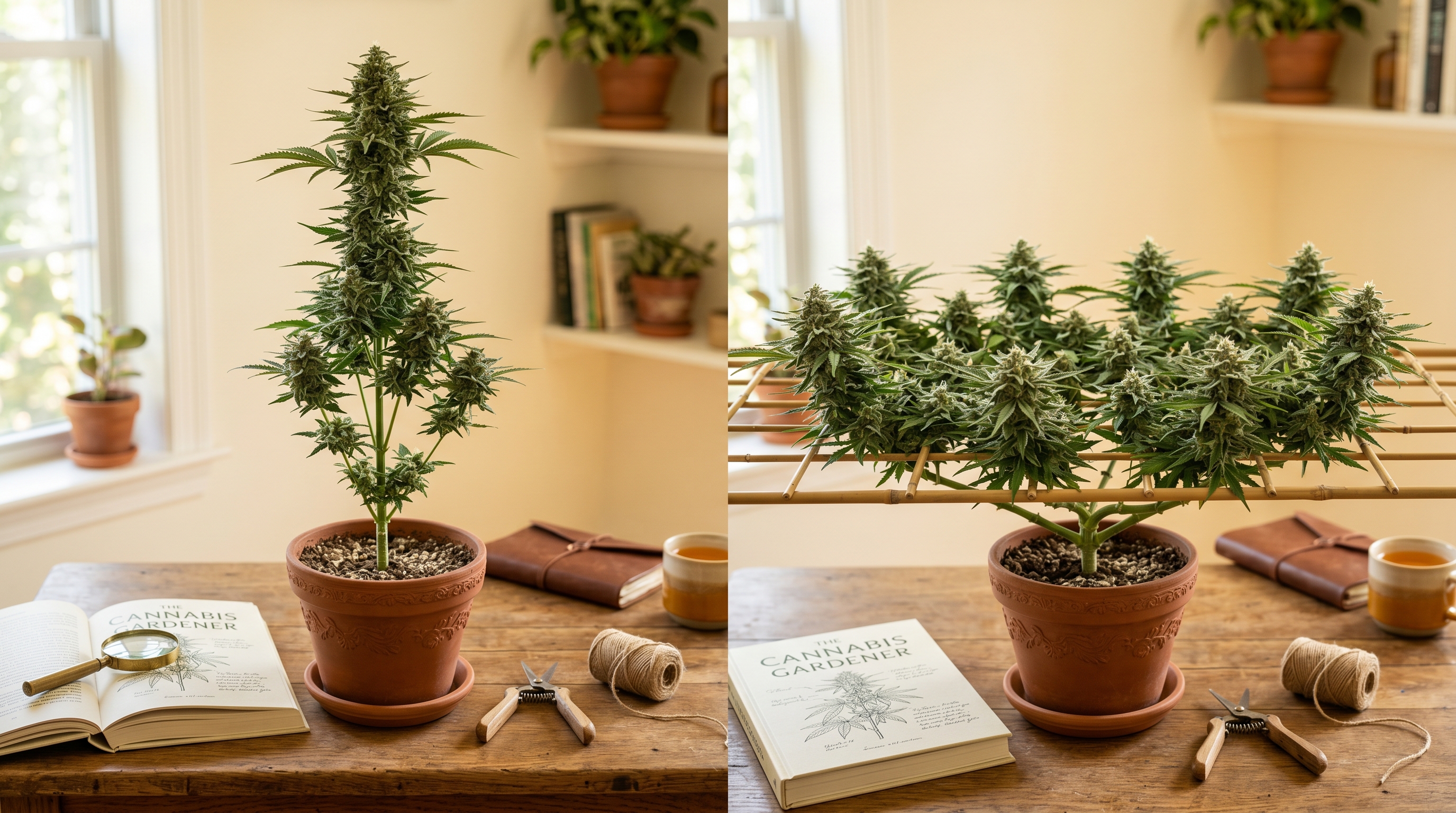
The Goal: An Even Canopy, More Light, More Bud
Before we touch a single stem, understand why training works. It comes down to one piece of biology called apical dominance.
Cannabis is wired to grow one dominant main shoot — the apical meristem at the very top. That tip pumps out a growth hormone (auxin) that tells the lower branches to stay small and subordinate. The plant is racing for the sun, and in the wild that vertical strategy wins. In your grow tent, it loses. Your light is a fixed distance overhead. The top cola hogs all the intensity, and every bud site below it gets progressively less light, which means smaller, fluffier flowers.
Training breaks or redistributes that apical dominance so the plant builds multiple equal colas at the same height. That flat, even canopy does three things at once:
- Maximizes light. Every bud site sits in the bright zone instead of the shade. Light penetration is the single biggest driver of yield. (It’s also why your light matters — see our LED grow lights buyer’s guide.)
- Improves airflow. A spread-out plant breathes better, which lowers the risk of mold and bud rot — a constant battle covered in our guide to common growing problems and how to fix them.
- Controls height. Critical if you’re working in a tight space. Our grow tent setup guide explains why headroom is so precious indoors.
Almost all training happens during the vegetative stage, when stems are flexible and the plant has time to recover. If you’re fuzzy on the timeline, our cannabis growing stages walkthrough lays out exactly when veg ends and flower begins.
Low-Stress Training (LST): Bend, Don’t Break
If you only learn one technique, make it LST. It is the gentlest, most forgiving, and most beginner-friendly method — no cutting, no recovery time, and mistakes are easy to undo. It’s also the only technique that’s universally safe for both autoflowers and photoperiod plants.
The principle is simple: bend stems away from the center and tie them down so the plant grows outward and flat instead of upward and tall. When you pull the dominant main shoot horizontal, you break its hormonal grip, and the previously shaded side branches all surge upward toward the light. Each one becomes its own cola.
How to do it:
- Wait for 4 to 6 nodes (usually around week 3 to 4 from seed). The main stem needs to be green and flexible — older stems turn woody and snap.
- Anchor the base with a clip near the soil line so you’re not torquing the roots, then gently bend the main tip down toward the edge of the pot, roughly 90 degrees.
- Secure it with soft, rubber-coated wire, plant ties, or pipe cleaners to the rim of the pot. Avoid bare string or twine — it bites into the stem as it thickens.
- Tie down the side branches to the same height, building a flat, wagon-wheel shape.
- Revisit every 2 to 3 days. The plant will keep trying to reassert dominance by shooting a branch skyward. Bend it back. Repeat until the canopy is even, and ease off once flowering begins.
LST recovers in roughly 12 to 24 hours because you never wound the plant. That makes it your foundation — most growers layer everything else on top of an LST base.
High-Stress Training (HST): Topping, FIM, and Super Cropping
High-stress training does what the name says: it deliberately wounds or crushes tissue to trigger a growth response. The payoff is bigger and faster than LST alone — but only on healthy, vigorous photoperiod plants, and only during veg. Never HST a stressed, nutrient-starved, or recently transplanted plant, and give it 3 to 7 days of recovery before adding more stress.

Topping
Topping is the classic. You cut off the main growing tip cleanly with sterilized scissors, just above the 5th or 6th node. That removes the dominant auxin signal, and the two nodes directly below rapidly grow into two new main colas of equal vigor. Top those two again later, and you get four. Then eight. Most growers top 1 to 3 times in veg.
Topping also redistributes the plant’s energy more evenly — lower branches grow thicker and the whole structure shifts from a narrow Christmas tree into a wide bush that makes far better use of your light. The catch: topping halts vertical growth on that stem and costs you 5 to 7 days of recovery. Pair it with LST afterward to spread the new tops outward.
FIM (“F***, I Missed”)
FIM is topping’s messier cousin. Instead of removing the whole tip, you pinch or snip roughly 70% to 75% of the new growth, leaving a ragged edge. Done right, this can produce three to four new shoots instead of two — theoretically more efficient. The trade-offs: results are less predictable, and FIM doesn’t reduce height as much as a clean top. Recovery is slightly faster, around 3 to 5 days. It’s a great trick once you’re comfortable, but topping is the more reliable starting point.
Super Cropping
Super cropping is for wrangling stems that are too tall but have already turned woody and stiff. You gently pinch and roll a branch between thumb and forefinger until you feel the inner fibers soften, then fold it to about 90 degrees without breaking the outer skin. Within 3 to 7 days, the plant repairs the wound into a thick “knuckle” that’s stronger than the original stem and actually improves nutrient flow to that branch.
If you accidentally split the outer skin, just wrap it with plant tape and it’ll heal fine. Do super cropping in late veg or, at the very latest, the first week or two of flower — any later and you risk stalling bud development.
SCROG (Screen of Green): The Yield Multiplier
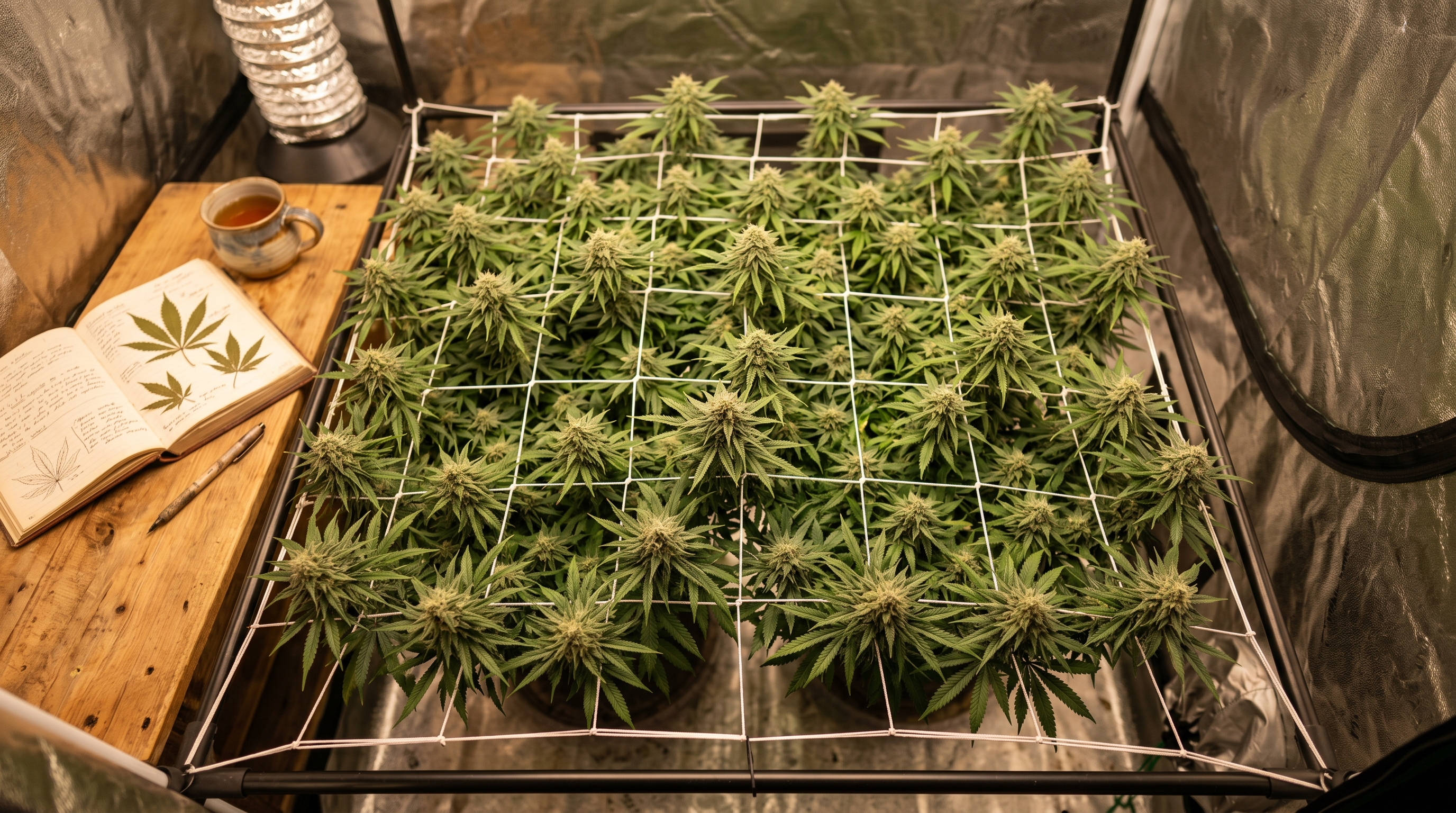
SCROG is widely considered the most effective technique for squeezing maximum yield out of a fixed footprint, and it’s where all the other methods come together. The idea: stretch a horizontal net or screen across your grow space and weave the canopy through it as the plant grows, forcing every branch to fill the screen evenly at one consistent height.
Don’t confuse SCROG with SOG (Sea of Green). SCROG uses as few plants as possible — often just one or two — trained wide to fill the whole screen. SOG packs many small plants flipped to flower quickly. Same flat-canopy look from above; completely different strategy underneath.
Here’s the basic SCROG workflow:
- Install the screen early in late veg, roughly 20 to 40 cm (8 to 16 inches) above the pots, before the tops reach it. The screen should be fixed and unmovable. Use 2-inch mesh squares.
- Top your plant a few times to create multiple main shoots — topping and SCROG go hand in hand. Many growers run “4-way LST,” topping to create four symmetrical arms.
- Weave branches through the squares as tips poke 2 to 3 inches above the screen, then gently tuck them back under and into the next square, radiating outward from the center. Aim for one branch per square; start at the edges and work inward.
- Flip to flower when the screen is 70% to 80% full. That leaves room for the “flowering stretch” — the 2 to 3 weeks of rapid vertical growth right after the flip — to fill the rest.
- Keep tucking through early flower, then let the colas rise vertically once stretch ends. From there, your training work is done.
SCROG commonly adds 30% to 50%-plus to yield, but it demands a longer veg and steady attention. It’s the natural next step once LST and topping feel routine. It also pairs beautifully with strong, even lighting — see how light placement matters in our LED guide — and with tight environmental control from our grow room humidity, temperature, and CO2 guide.
Defoliation and Lollipopping: A Quick Overview
Two more techniques round out the toolkit. Both involve removing leaves rather than bending stems.
Defoliation is the selective removal of fan leaves that block light to lower bud sites or trap humidity in dense pockets. This is precision work, not scorched earth — never strip more than 20% to 25% at once, and do it sparingly in late veg and early flower only. A good rule of thumb: if the remaining leaves “pray” (point upward) afterward, you got it right; if the plant droops, you went too far. Improving airflow this way is one of the best defenses against the mold and rot we cover in common growing problems.
Lollipopping is a specialized form of defoliation that strips the lower third of the plant — the shaded growth that would only ever produce wispy “larf” — so the plant funnels all its energy into the top colas. The classic timing is right before the flip to flower and again around week 2 to 3 of flower (never later, or you risk stressing the plant into producing male parts). For SCROG growers, the rule is simple: remove everything below the screen.
When to Train (and the Autoflower Caveat)
Timing is everything. The window for nearly all training is the vegetative stage, when stems are flexible and the plant has time to bounce back:
- LST: Start at 4 to 6 nodes (week 2 to 4), continue through veg, ease off in early flower.
- Topping / FIM: After the 5th to 6th node, on vigorous plants only, in veg.
- Super cropping: Late veg through the first week or two of flower.
- SCROG: Install the screen in late veg; flip when 70% to 80% full.
- Lollipopping: Pre-flip and early flower.
The hard rule: stop major training once flowering is well underway. After week 2 to 3 of flower, your plant is pouring everything into building buds. Heavy bending or cutting now just steals energy from flower production and can stall your harvest. From there, manage support and airflow and leave it alone — then focus on a clean harvest and proper drying and curing.
The autoflower caveat is critical. Autoflowers run on a fixed genetic timer — they flower based on age, not light schedule, with only 3 to 5 weeks of veg before they switch on their own. They simply can’t afford the recovery time that high-stress techniques demand. The consensus among growers: stick to LST on autoflowers, start gently around week 2 to 3, and pause hard adjustments the moment you see the first pistils. Light defoliation and lollipopping can work on autos if done early and conservatively, but topping, FIM, and super cropping are risky bets that can stunt a plant you can’t afford to slow down. If you’re choosing seeds, our feminized vs. autoflower vs. regular guide explains exactly what you’re signing up for, and our seed bank buyer’s guide covers where to source genetics.
Common Mistakes to Avoid
- Training too early or too late. Bending a brittle seedling snaps it; cutting a flowering plant stalls it. Match the technique to the stage.
- High-stress training a sick plant. HST is only for healthy, vigorous plants. If your plant is fighting nutrient issues, heat, or pests, fix those first — start with our nutrients guide.
- Over-defoliating. Every leaf is a solar panel. Strip too many and you starve the plant. Stay under 25% per session.
- Using string or twine for LST. It cuts into thickening stems. Use soft, coated ties.
- Topping autoflowers. The single most common beginner mistake. Autos don’t have the recovery runway. LST only.
- Forgetting airflow under a dense canopy. A thick SCROG without circulation is a mold factory. Run fans above and below, and keep flower humidity around 40% to 50% per our environment guide.
- Not skipping training when in doubt. A healthy untrained plant beats a butchered trained one every time.
Key Takeaways
The most experienced growers don’t pick one technique — they layer them. The classic indoor recipe is topping + LST + SCROG, with lollipopping before the flip. Topping creates more colas, LST spreads them, SCROG locks them into an even field, and lollipopping cleans up the wasted growth underneath. Each method compounds the last.
But you don’t start there. Start with LST on your first grow — it’s nearly impossible to ruin a plant with it, and it’ll teach you to read your plant: how it stretches, where it crowds, when it needs help reaching the light. That observational skill is what separates a grower who follows steps from one who genuinely understands the plant. Once LST feels natural, add a single topping. Then a screen. Build up.
Whether you’re growing indoors or outdoors, in a living super soil, or dialing in your VPD, the goal never changes: get more light to more bud sites. Train your plant, and it’ll pay you back at harvest.
Frequently Asked Questions
What’s the easiest training technique for beginners? Low-stress training (LST). No cutting, no recovery time, and any mistake is easy to fix by re-tying. It works on every plant, including autoflowers, and adds 15% to 30% yield on its own.
Can I train autoflowers? Yes, but stick to LST. Autoflowers run on a fixed timer and can’t afford the recovery time that topping, FIM, or super cropping require. Start LST gently around week 2 to 3 and stop hard adjustments when you see the first pistils.
When should I top my cannabis plant? After the 5th or 6th node, while the plant is healthy and growing vigorously — always during the vegetative stage, never in flower. Wait 1 to 2 weeks between toppings.
What’s the difference between topping and FIM? Topping removes the entire growth tip and reliably creates two new colas. FIM removes about 70% to 75% of the tip and can create three to four shoots, but the results are less predictable.
Does SCROG really increase yield that much? Many growers report 30% to 50%-plus yield gains versus an untrained plant under the same light, because a flat canopy gets every bud site into the bright zone. It requires a longer veg and regular tucking, but it’s the highest-yield approach for one to four plants.
Will training make my buds more potent? Training mostly increases quantity and consistency by giving every bud site even light. Better light penetration does produce denser, more uniform top-shelf flowers, but it won’t change a strain’s genetic cannabinoid ceiling.
Once your harvest is curing, the real personalization begins. Track how each strain you grow actually affects you — the terpene profiles, the High Family, the effects — in the High IQ app. Knowing why you’re high beats guessing from a label every time.
Sources
- [GrowWeedEasy, 2024] — Complete Guide to Cannabis Plant Training
- [GrowWeedEasy, 2012] — Introduction to ScrOG (Screen of Green)
- [Leafly, 2020] — How to Scrog Marijuana Plants
- [Weedmaps, 2020] — A Guide to the Screen of Green Method
- [Ilgm, 2025] — How to Use High-Stress Training (HST) to Maximize Cannabis Yields
- [Sensiseeds, 2024] — Lollipopping Cannabis: One Sweet Trick to Up Your Yields
- [Autoseeds, 2024] — Can You Defoliate Autoflowers?
- [Weedseedsexpress, 2026] — The Ultimate Guide to Cannabis Training: LST, Topping & ScrOG


