How to Clone Cannabis: A Beginner's Guide to Cuttings
Learn how to clone cannabis from cuttings. A beginner's guide to mother plants, rooting hormone, humidity domes, and rooting media that works.


Imagine you grew the best plant of your life. The buds were dense, the terpene profile was loud, the high was exactly right, and then — you harvested it, and it was gone. Forever. Next season you start over from seed and roll the genetic dice all over again.
There’s a better way. It’s called cloning, and once you understand it, you’ll never lose a great plant again.
Cloning is how growers preserve a winning phenotype indefinitely, skip the germination phase, and guarantee an all-female garden without buying expensive seeds every cycle. It sounds technical, but the core process is genuinely beginner-friendly: snip a branch, encourage it to grow roots, and transplant it. That’s a clone.
In this guide, Professor High walks you through the entire process — what cloning actually is, how to choose and keep a mother plant, how to take a perfect cutting, which rooting media to use, and how to troubleshoot the failures that trip up most first-timers. Let’s get into it.
What Is Cloning, Really?
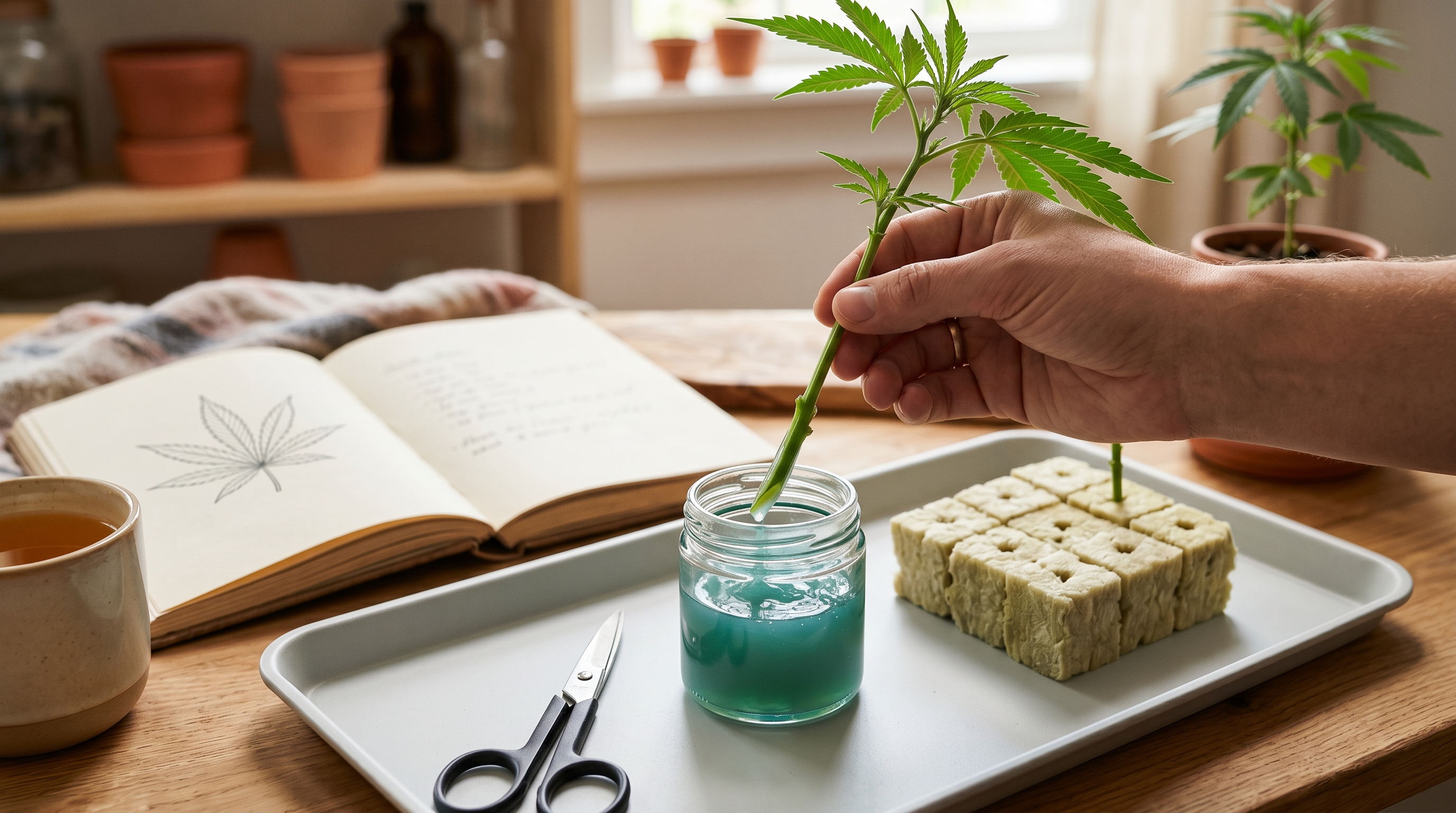
A clone is a cutting taken from a living cannabis plant that you coax into growing its own root system. Because it’s a piece of the original plant, it carries the exact same genetics — an identical genetic replica, right down to the DNA.
This is the part that matters most: a clone preserves the phenotype of the mother plant. Phenotype is the observable expression of a plant’s genetics — its structure, aroma, terpene profile, cannabinoid content, and the way it makes you feel. When you grow from seed, even seeds from the same parents express their genetics differently, like siblings in a family. Two plants from the same seed pack can smell, yield, and hit completely differently.
A clone removes that lottery. If you found a plant whose effects land in the Relax High family exactly the way you like, cloning it means every future plant delivers that same experience. The clone you take from a Wedding Cake mother will be, for all practical purposes, the same Wedding Cake.
The catch: clones inherit everything — including weaknesses. If the mother has a virus, pest problem, or genetic tendency toward mold, the clone carries it too. Genetics this precise cut both ways, which is exactly why mother-plant selection is so important.
Clone vs. Seed: Why Bother?
Both have their place, but cloning offers four concrete advantages over starting from seed:
- Speed. Cloning skips germination and early seedling fragility, shaving roughly a month off your grow timeline.
- Guaranteed females. A cutting from a female plant is female. No more germinating extras just to cull the males.
- Genetic consistency. Every clone is identical, so your garden behaves predictably — same height, same flowering time, same harvest window.
- Cost. Once you have a mother, clones are essentially free. No more buying seed packs each cycle.
Seeds still win when you want new genetics, a fresh start free of inherited pests, or the vigor of a fresh taproot. If you’re choosing genetics for the first time, our guide to feminized vs. autoflower vs. regular seeds and our best cannabis seed banks buyer’s guide will get you started — note that autoflowers don’t clone well, since the clone inherits the mother’s age and flowers on the same internal clock. Stick to photoperiod plants for cloning.
Step 1: Choose and Keep a Mother Plant
A mother plant (or “mom”) is a plant you keep permanently in the vegetative stage as a dedicated source of cuttings. You can take a clone from any healthy female, but a true mother plant is your insurance policy — a living library of genetics you never let flower.
What to look for in a mother:
- Vigorous, sturdy, symmetrical growth
- Strong aromas and a terpene profile you love
- High yields and dense trichome coverage
- Natural resistance to pests and mold
- Consistent, stable growth characteristics
Choose your mother after the plant has been stable in veg for at least a month or two, so you’re judging mature traits and not seedling quirks. If you’re hunting for a mom with a specific character — say, energetic and cerebral — strains in the Energy High family like Green Crack or Durban Poison are worth a look, while a calming pick might lean toward Granddaddy Purple or Northern Lights.
Keeping a mother healthy: A mother only stays a mother if she never flowers. That means an 18–24 hours of light per day photoperiod, indefinitely, under a blue-dominant spectrum (4000K–6500K) that keeps her bushy rather than stretchy. Hold temperatures around 72–78°F (22–26°C) and humidity in the 60–70% range. Feed lightly — moms don’t need to be pushed hard, and over-fertilized plants make poor cuttings because excess nitrogen interferes with root development. For more on dialing in your environment, see our grow room humidity, temperature, and CO2 guide and the deeper dive on vapour pressure deficit (VPD).
To understand where the vegetative mother sits in the bigger picture, our cannabis growing stages timeline maps the full seed-to-harvest journey.
Step 2: Take the Cutting
This is the moment of truth, and it’s mostly about being clean and quick.
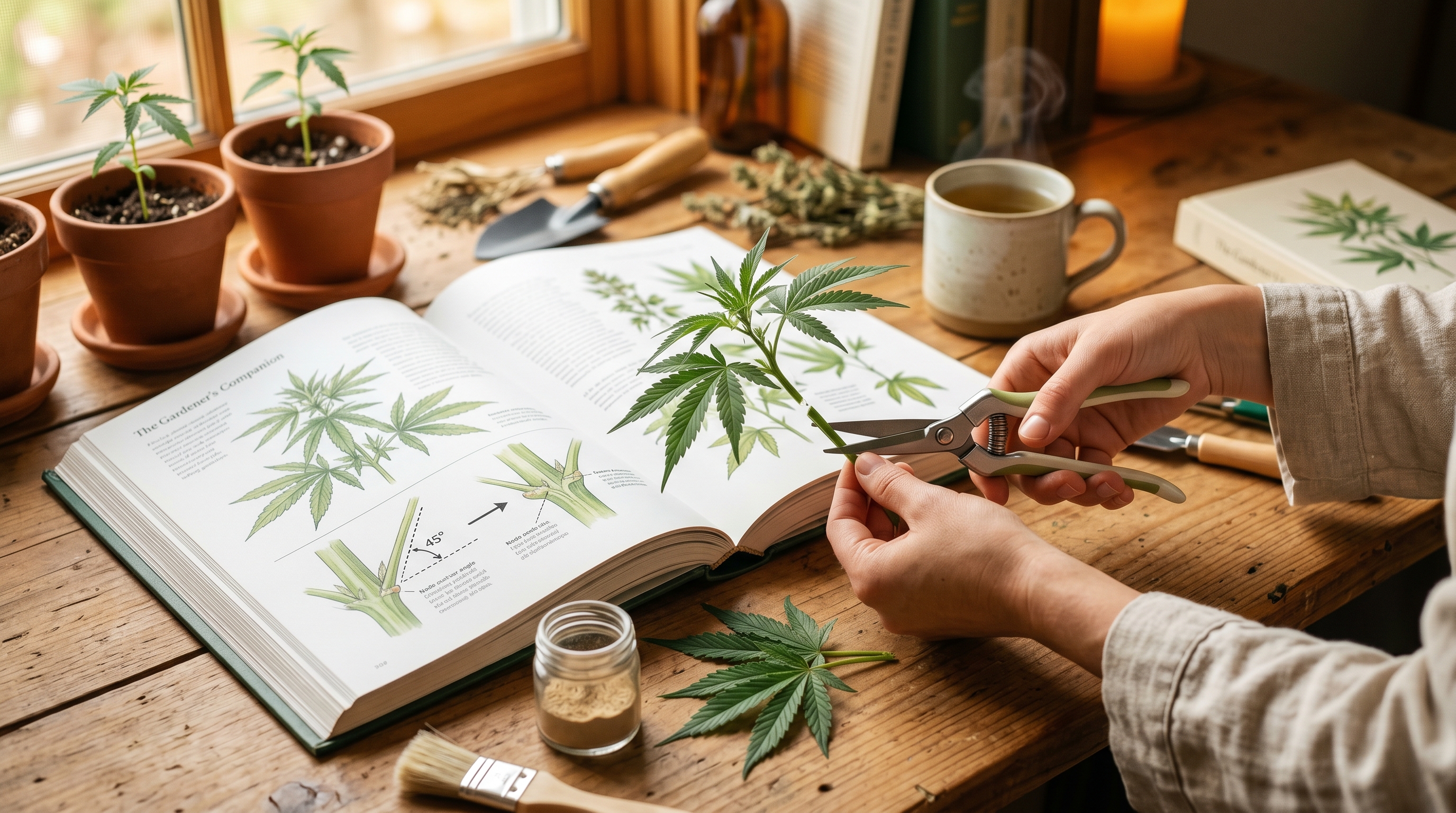
Before you cut, sterilize everything. Wash your hands, wear gloves, and wipe down your scalpel or scissors and your work surface with high-proof alcohol. Cannabis cuttings are wide open to bacteria and fungus until they root, so a sterile workflow is the single biggest predictor of success.
The step-by-step:
- Pick the branch. Choose a healthy shoot with at least two nodes (the points where leaves and branches meet). Cuttings from the lower half of the plant root faster — they contain more natural rooting hormones than the top growth.
- Cut on the mother. Snip the branch off cleanly, leaving the cutting 5–8 inches (10–20 cm) long.
- Recut at a 45° angle. Just below the lowest node, make a fresh 45-degree cut with your sterile blade. The angle exposes more interior tissue and increases the surface area where roots will form. Some growers gently scrape or lightly split the bottom 1/4 inch to expose even more rooting tissue.
- Trim. Remove the lower leaves so nothing sits in your medium, and snip the tips off the remaining large fan leaves to reduce water loss while the cutting has no roots.
- Apply rooting hormone immediately. Dip the freshly cut end into rooting gel or powder (the active ingredient is usually IBA — indole-3-butyric acid) so the whole cut surface is coated. This seals out air bubbles and signals the plant to make roots. Some growers use gel then powder for the best of both.
- Insert into your medium (covered next) and get it under a dome fast.
Always take more cuttings than you need — losses are normal — and label everything. A tray of unlabeled clones from three different mothers is a future headache.
Step 3: Choose Your Rooting Medium
The cutting needs a place to live while it grows roots. The four common options trade cost, simplicity, and speed.
| Medium | How It Works | Best For | Watch Out For |
|---|---|---|---|
| Rockwool cubes | Mineral-fiber cubes that hold moisture and air; the beginner classic. Soak in pH 5.5 water 2–3 hours first. | Beginners — cheap, stable, reliable | Overwatering; the cube should be moist, never soggy |
| Root Riot / Rapid Rooters | Pre-formed organic plugs; soak briefly, insert cutting. | Beginners who want zero pH fuss | Plugs drying out under the dome |
| Water (glass of water) | Cutting suspended in clean, unchlorinated water at pH 5.8–6.0. | Free experimentation | Change water every 2–3 days; roots are fragile to transplant |
| Aeroponic cloner | A reservoir sprays nutrient mist on the bare stems on a cycle. | Fastest rooting (5–10 days), high volume | Higher upfront cost; pump or timer failure dries roots fast |
For your very first attempt, rockwool or Root Riot plugs under a humidity dome is the most forgiving setup and the one most growers recommend. Avoid loose soil for cloning — clones shift around when watered and root unevenly.
Step 4: The Rooting Environment
Here’s the part beginners get wrong most often: a new cutting has no roots, so it cannot drink through its stem. For the first several days it survives almost entirely by absorbing moisture through its leaves. Your whole job is to keep those leaves humid until roots take over.
- Humidity: 70–85%. This is non-negotiable. Use a clear humidity dome (propagator) over your tray. Mist the inside of the dome and the leaves a couple of times a day if needed.
- Temperature: 72–78°F (22–25°C). Below 70°F (20°C) dramatically slows rooting. A seedling heat mat under the tray helps in cool rooms.
- Light: gentle 18/6. Keep clones on an 18-hours-on, 6-off cycle under weak light — fluorescents or a dimmed LED kept 2–3x farther away than normal. Too much intensity scorches a rootless cutting. Avoid 24-hour light; the dark period actually aids rooting.
- Air: crack the vents. Open the dome’s vents once or twice a day to swap stale air and prevent mold. Around day 5–7, start “hardening off” by propping the dome open for longer stretches so the clones adjust to room humidity.
Timeline: Most clones show white roots in 7–14 days, though some pop in as little as 3 days and stubborn ones can take three weeks. Patience beats panic — don’t toss a cutting just because it’s slow.
Step 5: Transplant
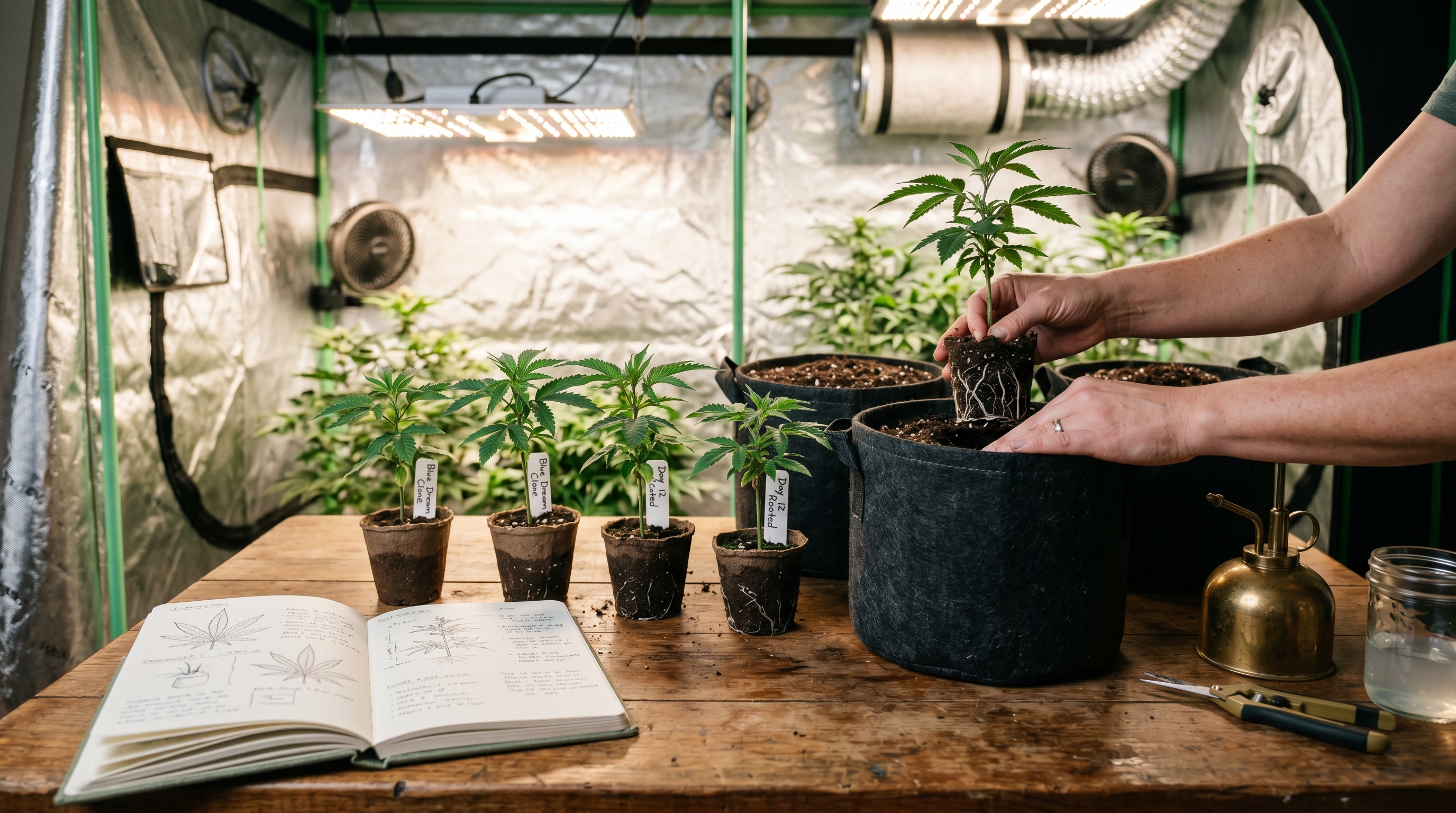
Your clone is ready to transplant when you can see healthy white roots — typically 1–2 inches (3–5 cm) long — emerging from the bottom of the cube or plug.
- Pre-fill your pots with light, airy medium and water it first so it won’t shift.
- Make a hole, set the rooted cube in gently, and cover it.
- Treat the new transplant like a delicate seedling for the first week — soft light, careful watering — until it shows vigorous new growth.
From here your clone enters normal veg, and you can start training it with topping, LST, or ScrOG to shape the canopy. Beginners may prefer the gentler low-stress training (LST) method for a first run. From there it’s the same path as any plant — all the way to knowing when and how to harvest.
Troubleshooting: When Clones Go Wrong
Most clone failures come down to humidity, temperature, or contamination. Here’s how to read the symptoms.
| Symptom | Likely Cause | The Fix |
|---|---|---|
| Clones wilting / drooping | Humidity too low — leaves can’t absorb enough moisture | Close dome vents, mist leaves, confirm 70–85% RH |
| No roots after 2+ weeks | Old/contaminated hormone, cold medium, or low humidity | Use fresh rooting product, add a heat mat for 72–78°F, raise humidity — and wait, some are just slow |
| Stem rot / mushy base | Overwatered medium or stagnant, too-humid air | Squeeze excess water from cubes, open vents daily for airflow |
| Mold/fungus on leaves | Sealed dome with no air exchange | Crack vents, remove affected material, sterilize next time |
| Yellowing leaves | Normal early stress, or starting to need light feeding | Mild yellowing is fine pre-root; add weak nutrients once rooted |
| Weird leaves / slow start (monstering) | Cutting was taken from a flowering plant | Take cuttings only from vegetative plants; pinch off any buds and wait it out |
If your clones consistently struggle, work through our broader guide to common cannabis growing problems and how to fix them, and make sure your grow tent setup is dialed in — a stable environment fixes most propagation woes before they start. Choosing the right LED grow light matters here too.
Why Cloning Connects to Knowing Your High
Here’s the bigger picture. Cloning is the ultimate expression of a truth we talk about constantly at This Is Why I’m High: the strain name on the label matters far less than the specific plant and how its terpenes affect you. Two plants sold as the same strain can be wildly different. But a clone of a plant you’ve personally tested? That’s a known quantity.
When you clone a winner, you’re not chasing a name — you’re preserving a result. The exact aroma, the exact effect, the exact way it interacts with your body. That’s the whole game.
The same logic applies whether you grow or buy. The way to find your ideal high isn’t memorizing strain names — it’s understanding why it’s not a strain name at all and paying attention to terpenes like myrcene, limonene, and caryophyllene and the effects they reliably produce for you. That’s exactly what the High IQ app is built for: log what you consume, track how it actually makes you feel, and surface the patterns that point to your personal best high — whether it grows on your own mother plant or comes off a dispensary shelf.
Key Takeaways
- Cloning = an exact genetic copy of a mother plant that preserves her phenotype, terpenes, and effects forever.
- Pick a healthy female mother with traits you love and keep her in permanent veg under 18–24h of light.
- Cut a 5–8 inch shoot from the lower plant, recut at 45° below a node, dip in rooting hormone, and insert into rockwool or a plug.
- Keep it humid (70–85%), warm (72–78°F), and under gentle 18/6 light until roots appear in 7–14 days.
- Transplant at 1–2 inches of root, then treat it like a seedling.
- Most failures are humidity, temperature, or contamination — sterilize, ventilate, and be patient.
Clone responsibly, grow legally in your jurisdiction, and remember: the best plant you ever grow doesn’t have to be a one-time miracle.
Sources
- Grow Weed Easy — Picture Guide to Cloning Marijuana: https://www.growweedeasy.com/cloning-marijuana-guide
- Leafly — How to Clone Cannabis Plants: Tips for Cloning Success: https://www.leafly.com/learn/growing/how-to-clone-cannabis
- Royal Queen Seeds — How to Get Clones from Your Cannabis Plants: https://www.royalqueenseeds.com/blog-how-to-get-clones-from-your-cannabis-plants-n322
- GrowSensor — Master Cannabis Mother Plant Care for Better Clones: https://www.growsensor.co/post/advanced-guide-to-cannabis-mother-plant-upkeep
- JoVE — Employing Aeroponic Systems for the Clonal Propagation of Cannabis: https://www.jove.com/t/63117/employing-aeroponic-systems-for-the-clonal-propagation-of-cannabis


