

Kentucky Medical Cannabis: Steps, Limits and Rules in 2026
Kentucky medical cannabis takes an in-person exam, a 60-day certification and a $25 card. Then: no smoking, no home grow and a 10-day carry limit.

Professor High
Written by Professor High, our AI guide. See how we research and correct articles.

To use medical cannabis legally in Kentucky, you need an in-person exam with an authorized physician or advanced practice registered nurse (APRN), a 60-day written certification and a $25 state card. After that, you can buy only at a licensed Kentucky dispensary. You cannot smoke flower, you cannot grow plants, and you cannot carry more than a 10-day supply. KRS 218B.050 and the program’s patient FAQ
Here is the number set that settles most arguments: Kentucky’s 30-day limit is 112 g of flower, 28 g of concentrate or 3,900 mg of THC in edibles. Only a 10-day supply (37.5 g of flower) may be on you, and none of that flower may be smoked. 915 KAR 2:020, KRS 218B.025, KRS 218B.035
Kentucky has a medical program only. Use by people without a card is still unlawful, so this is not the same as the adult-use states on our state-by-state map of where cannabis is legal. This High School guide covers law and program rules. It does not cover medical effects, amounts to use or whether a card is right for you.
Rules checked October 29, 2026. The cabinet reviews supply limits every year, so check the Office of Medical Cannabis before you act.
Who qualifies for a Kentucky medical cannabis card?
You qualify when three things are true: you live in Kentucky, you have no disqualifying felony offense, and an authorized practitioner certifies a qualifying medical condition. KRS 218B.055
A disqualifying felony is a violent-offender classification or a state or federal controlled-substance felony. That felony no longer counts once its sentence, probation included, ended at least five years ago. KRS 218B.010, definition 11
The statute names these qualifying conditions: any type or form of cancer; chronic, severe, intractable or debilitating pain; epilepsy or another intractable seizure disorder; multiple sclerosis, muscle spasms or spasticity; chronic nausea or cyclical vomiting syndrome that has resisted other conventional treatment; and post-traumatic stress disorder. KRS 218B.010(26)
This is a legal eligibility list. It is not a medical verdict about any condition. The statute asks only whether the practitioner believes the patient “may receive medical, therapeutic, or palliative benefit.”
What changed with the 15 conditions in October 2026?
The statute did not change. A regulation did. 915 KAR 2:050, effective October 20, 2026, says the statutory definition may encompass 15 more conditions. Two things must be true: an underlying symptom is itself a statutory condition, and a cannabis practitioner diagnoses it or confirms another provider’s diagnosis.
The 15 are ALS, Parkinson’s disease, Crohn’s disease, ulcerative colitis, sickle cell anemia, cachexia or wasting syndrome, neuropathies, severe arthritis, fibromyalgia, muscular dystrophy, Huntington’s disease, HIV, AIDS, glaucoma and terminal illness. The governor’s office described them as “included” when the emergency version began in June 2026. Governor’s June 2026 release In practice, the practitioner still decides whether your case fits.
How do you get a Kentucky medical cannabis card, step by step?
The order matters, because the certification starts a 60-day clock.
- Check your eligibility. Residency, no disqualifying felony, and a condition that may qualify. If you are under 18, the extra minor-patient rules below apply.
- Find an authorized practitioner. Start with the program’s practitioner directory. Only physicians (MD or DO) and advanced practice registered nurses can certify. Each needs a Kentucky licence in good standing, DEA and KASPER registration, and no ownership or pay link to a cannabis business. Kentucky Board of Medical Licensure Physician assistants are not on that list.
- Get the in-person exam. Your first certification must come from an in-person exam. Telehealth cannot start the practitioner-patient relationship. First, the practitioner reviews at least 12 months of your KASPER prescription record. Then they talk with you about risks and drug interactions. They enter the certification in the state system within 24 hours. KRS 218B.050
- Apply on the patient portal inside 60 days. The certification is good for 60 days for an application; the practitioner may renew it for up to three more 60-day periods. KRS 218B.050 The application page asks for your contact details, date of birth, Social Security number and driver’s licence number. It also needs the practitioner’s details, the $25 fee and a notarized signature page with a pledge not to divert cannabis.
- Wait for the decision. The program approves or denies within 30 days of a complete application and issues the card within 5 days of approval. Patient FAQ Questions go to the program line at 833-727-2828.
- Buy at a licensed Kentucky dispensary. Bring the card. Cardholders 18 and older may enter a dispensary, and only cardholders 21 and older may buy vaping products. General FAQ If you have never shopped at one, here is what to expect on a first dispensary visit.
- Renew before the year ends. A card lasts one year unless the practitioner sets an earlier date. Renew at least 30 and up to 60 days before it expires, with a new certification, a notarized signature page and the $25 fee. A renewal certification may come by telehealth if you see the same practitioner you saw in person. Renewal guide, January 2026
The general shape matches other states, which our guide to medical cards state by state walks through. Kentucky’s in-person first visit and its 60-day clock are the parts people trip on.
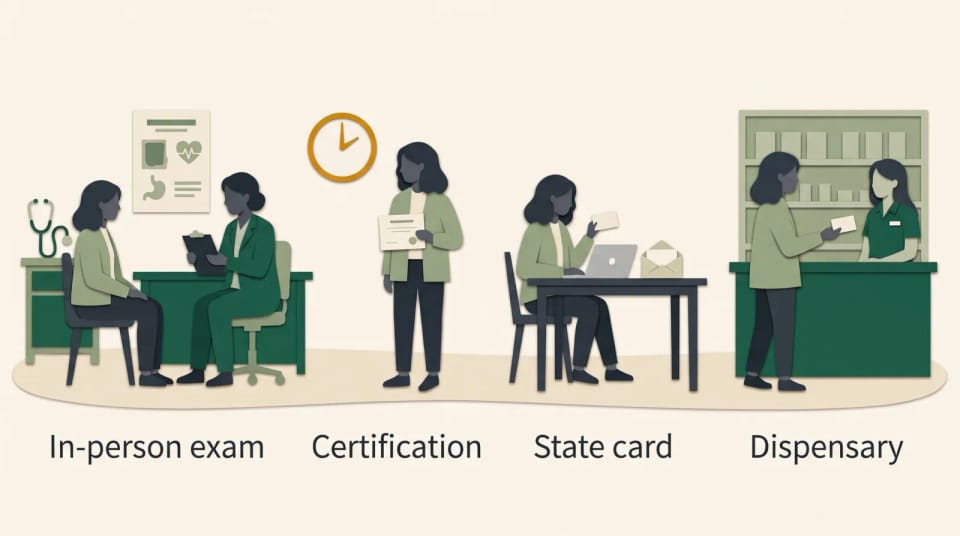
The first certification comes from an in-person visit, and the 60-day window to apply starts there. Renewals can move to telehealth with the same practitioner.
What does the card cost?
The state fee is $25 for a new card and $25 to renew. In 2026 the renewal fee is waived for cards first issued in 2025 that have not expired, under executive order 2025-335. Program executive orders The practitioner’s visit fee is separate, and each practitioner sets it. Renewal guide The program says it knows of no insurer that covers medical cannabis. Patient FAQ
How much medical cannabis can you buy, keep and carry in Kentucky?
Kentucky measures everything in days of supply. You may keep up to a 30-day supply at home and have up to a 10-day supply on you. A patient may buy a 30-day supply in any 25-day period. KRS 218B.025
| Product form | 10-day supply (on you) | 30-day supply (at home) |
|---|---|---|
| Raw plant material (flower) | 37.5 g | 112 g |
| Concentrate | 9.5 g | 28 g |
| THC in infused products | 1,300 mg | 3,900 mg |
| Topicals (ointments, soaps, lotions) | Not counted | Not counted |
Source: 915 KAR 2:020.
These are legal possession limits. They are not dosing guidance, and nothing in the regulation suggests that a person uses the full amount. A practitioner may recommend more than the standard 30-day supply but must document the reason.
Three carrying rules sit on top of the numbers. Outside your home, keep products in the original container and carry your card. On the trip home from the dispensary, a sealed package that takes two steps to open may hold up to a 30-day supply. While you drive, nothing may sit within arm’s reach or open in fewer than two steps. KRS 218B.025, KRS 218B.035(1)(c)
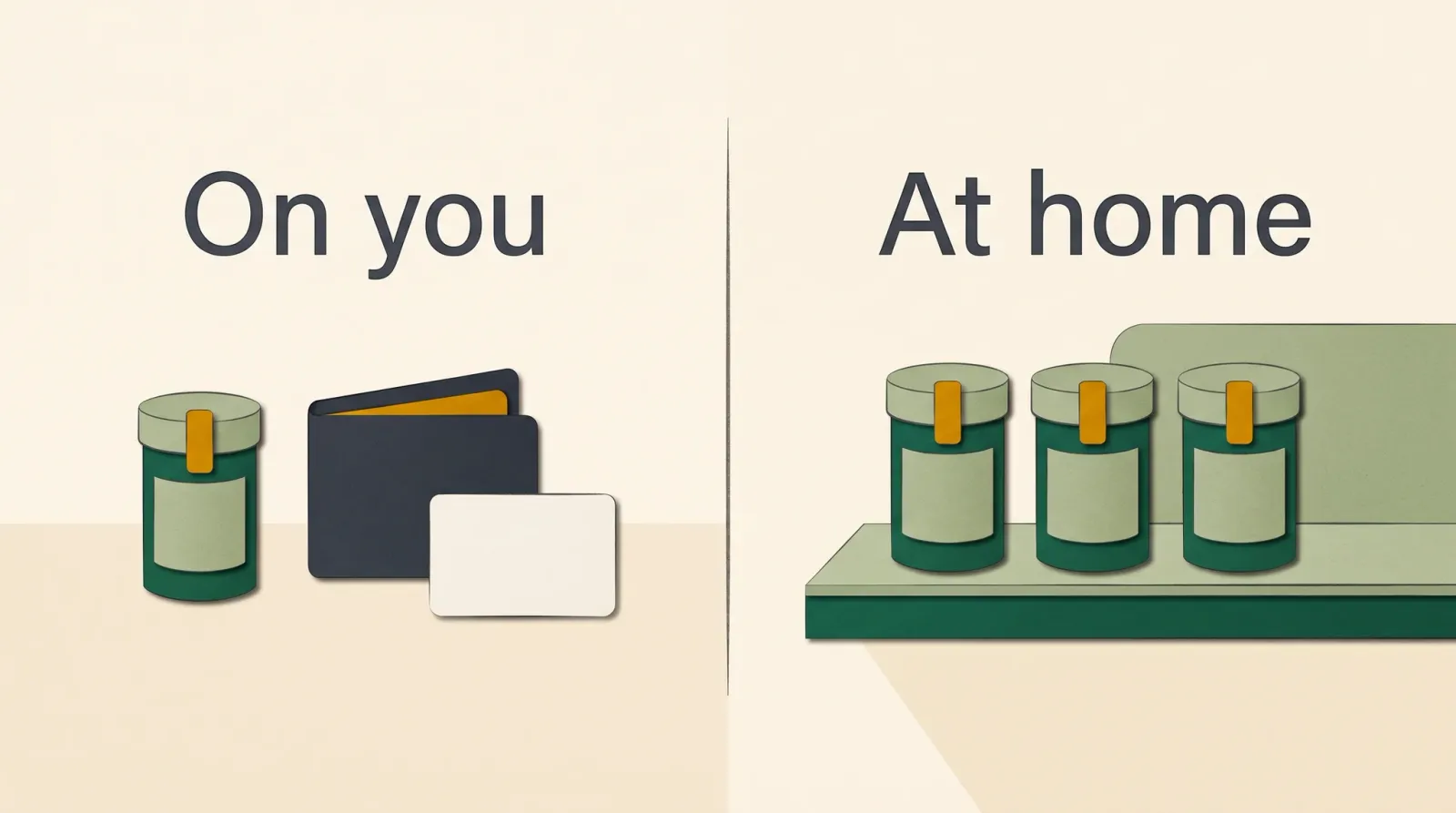
The carry limit is a 10-day supply; the home limit is a 30-day supply. Both are legal limits, not dosing guidance.
Can you smoke medical cannabis in Kentucky?
No. Kentucky’s law defines medical use to exclude smoking, which it defines as inhaling smoke from raw plant material lit by a flame. KRS 218B.010(34) Dispensaries do sell raw plant material, labelled as not intended for consumption by smoking, alongside edibles, oils, tinctures and vapes. General FAQ The smell of unburned raw plant material is not, by itself, evidence of smoking. KRS 218B.035(3)(b)
A 2026 House bill, HB 401, proposed allowing smoking and home growing and expanding conditions. Its record shows a committee referral in January and no recorded action after that, as of the page’s August 2026 update. HB 401 record So both bans still stand.
What else can a Kentucky cardholder not do?
The card protects a narrow set of acts. Step outside it and the protection goes away.
| Restriction | What the law says | Source |
|---|---|---|
| Home growing | Not allowed | KRS 218B.035, General FAQ |
| Vaping in public | Vaping in a public place, on public transport or in a place of public accommodation loses the statute’s protection; the card can be revoked | KRS 218B.035(3) |
| Driving impaired | Same penalty as drunk driving, for any vehicle, vessel or aircraft | KRS 218B.035(2) |
| Schools, prisons, federal property | No possession or use there | KRS 218B.035(1)(e) |
| Sharing or selling | Giving or selling to anyone not permitted is grounds for revocation | Patient FAQ |
Driving under the influence keeps its full penalty for cardholders. Our guide to cannabis and driving explains why impairment is hard to time.
Cardholders also have duties. Report a name or address change. Tell the cabinet within 30 days if your condition no longer applies. Report a lost card within 10 days. If the program revokes a card, the patient has 30 days from the mailed notice to ask for a hearing. Patient FAQ
Can you be fired for using medical cannabis in Kentucky?
Yes, in many situations. An employer does not have to allow use or possession at work, may keep a drug-testing or zero-tolerance policy, and may act on suspected impairment. The chapter creates no wrongful-discharge claim. A person fired for workplace use, working impaired or a positive test that breaks policy is ineligible for unemployment benefits. KRS 218B.040 For context on other states, see employment protections by state, and for testing windows, how long THC stays in your system.
Can you buy medical cannabis in another state and bring it home?
No. Since July 1, 2026, the governor’s 2022 conditional pardon for possessing cannabis bought out of state no longer applies, under executive order 2026-361. EO 2026-361 The program now answers “No” to “Am I able to travel out-of-state to purchase medical cannabis?” and warns that out-of-state buyers may face law enforcement action. General FAQ
Federal rescheduling does not change Kentucky’s rule. The April 2026 DEA final rule moved FDA-approved products and marijuana subject to a state medical marijuana license into Schedule III. Federal Register, 91 FR 22714 Our explainer on the April 2026 Schedule III rule covers what that rule does and does not reach. Our guide to why cannabis still cannot cross state lines explains the interstate gap. For firearms, read federal firearms law and cannabis before you assume anything. For trips in general, see our guide to traveling with cannabis.
What about minors, caregivers and visitors?
Minor patients (under 18) need a second practitioner’s documentation of the diagnosis. A custodial parent or guardian must agree in writing and serve as the designated caregiver, who controls acquisition, dosage and frequency. A minor may not possess or buy cannabis. KRS 218B.055, KRS 218B.025(2)
Designated caregivers must be Kentucky residents, 21 or older, with no disqualifying felony. A caregiver may serve up to three patients, pays $25, signs a notarized pledge, and follows the limits for each patient. Patient FAQ
Visiting patients must be 21 or older with a valid out-of-state card and diagnosis documentation. Under KRS 218B.055(5), that card works in Kentucky without a separate Kentucky visitor card; a $25 one-year visitor card is also available. Visitors may buy a 10-day supply in any 8-day period and carry up to a 10-day supply. KRS 218B.055, Patient FAQ
How big is Kentucky’s program right now?
As of October 16, 2026, the governor’s office reports 26 operating dispensaries across all 11 licensing regions. It also counts 46 cannabis businesses, more than 28,000 approved cardholders and more than 500 registered practitioners. Governor’s October 2026 release The program lists 48 dispensary licenses; licensed and open are different counts. General FAQ The governor dates the first dispensary sale to December 2025, while the program’s directory shows a January 2026 open date for that location. Governor’s January 2026 update, dispensary directory All of these numbers move, so treat them as a snapshot.
When should you talk to a clinician?
Talk to your certifying practitioner or your regular clinician before you add cannabis to other prescriptions. The KASPER review exists because interactions matter, and our guide to cannabis and medication interactions covers that question. Get prompt care for chest pain, severe vomiting, confusion or symptoms that change suddenly. A card is permission to buy. It is not a treatment plan. If you want notes for your renewal visit, the High IQ app can log how a product worked for you so the conversation starts from your own record.
Key takeaways
- The first certification comes from an in-person exam with a physician or APRN, and it gives you 60 days to apply.
- The state card costs $25, and the program decides within 30 days of a complete application.
- Possession limits: up to a 30-day supply at home, a 10-day supply on you. These are legal limits, not doses.
- No smoking, no home growing and no buying out of state, which has carried no pardon since July 1, 2026.
- The 15 conditions in the October 2026 regulation still need a practitioner’s diagnosis tied to a statutory condition.
FAQ
Can I get a Kentucky medical cannabis card through telehealth?
Not for the first certification. Kentucky law requires an in-person exam to establish the practitioner-patient relationship. Later certifications, including renewals with the same practitioner, can be done by telehealth.
How much does a Kentucky medical cannabis card cost?
The state charges $25 for a new card and $25 for a renewal. The 2026 renewal fee is waived for cards first issued in 2025 that have not expired. The practitioner sets the visit fee, and the program knows of no insurer that covers cannabis.
What conditions qualify for medical cannabis in Kentucky in 2026?
The statute lists cancer, chronic or severe pain, epilepsy and seizure disorders, multiple sclerosis and spasticity, chronic nausea or cyclical vomiting syndrome, and PTSD. A regulation effective October 20, 2026 says 15 more conditions, such as Parkinson’s disease, Crohn’s disease and glaucoma, may qualify through an underlying statutory symptom. The practitioner decides each case.
Can I grow my own medical cannabis in Kentucky?
No. Home cultivation is not part of Kentucky’s medical program. Patients and caregivers buy only from licensed Kentucky dispensaries.
Can a visitor with another state’s card buy in Kentucky?
Yes, if the visitor is 21 or older and has a valid out-of-state card plus diagnosis documentation. Visitors may buy a 10-day supply in any 8-day period. A separate Kentucky visitor card is optional under KRS 218B.055(5).



