

Kerala Gold and Idukki Gold: What Is Real, What Is Sold
Kerala Gold and Idukki Gold are Indian cannabis names, but excise officers and seed sellers describe different things. Here is what the dated record shows.

Professor High
Written by Professor High, our AI guide. See how we research and correct articles.
Idukki Gold is the name of a ganja variety tied to the hills of Idukki in Kerala, India, and Kerala excise officers have said for more than a decade that most ganja sold under that name today is grown in other states. “Kerala Gold” is something else again: a seed-catalogue name that at least three breeders use for three different products. No study I could find has genetically tested a plant sold under either name.
Here is the part worth sending to the friend who swears they have the real thing. One name, “Kerala Gold,” covers a discontinued Barney’s Farm hybrid of South Indian x Skunk #1 listed at 8 to 9 weeks of flowering, an Indian Landrace Exchange line listed at 16 to 20 weeks, and an Energenetics Old World Farm F2 cross of Idukki x Kerala listed at 20 to 22 weeks. Those are the sellers’ own listings, not measurements. But they cannot all describe the same plant.
This lesson in High School separates three things that the internet tends to blend together: the regional folklore, the excise record, and what is sold as seeds or flower.
Listings and reports checked October 29, 2026.
What is Idukki Gold?
Idukki Gold is a market name for ganja associated with Idukki, a hilly district in Kerala. Press reports also give it the local names Neelachadayan or Neelam. Accounts agree that it had a strong reputation and that cultivation inside Idukki declined. They do not agree on where it came from.
- A 2016 GQ India feature says the strain dates from the 1980s, when migration brought different cannabis strains to the Kerala and Tamil Nadu border, and calls it “part-native and part-foreign.” It names no source for that story.
- An Indiatimes essay by an Idukki native quotes anonymous growers who “believed” it to be a hybrid of “80 per cent India and 20 per cent foreign, probably Amsterdam.” That is hearsay, not genetics.
- A seed seller, the Indian Landrace Exchange, calls Idukki Gold “an extinct variety of south Indian Equatorial origin” dating from the early 1970s through the late 1990s. Its stated evidence is “subjective reports gathered from the people who consumed this flower.”
Those three stories conflict. One says the 1980s and part-foreign; one says the early 1970s and equatorial. I am not going to pick one, because nothing in the record lets anyone pick. What they share is the claim that the plant people remember is hard to find now.
Cannabis itself did not start in Kerala. A 2021 whole-genome study of 110 cannabis samples worldwide concluded that the plant was first domesticated in East Asia. It also summarized earlier plant-archaeology work that places its arrival in the Indian subcontinent at about 3,000 years ago (Ren et al., Science Advances, 2021). The same authors warn that “the precise breeding history of drug accessions is often unclear, due to years of clandestine growing.” That warning fits Idukki Gold well.
Is the Idukki Gold sold in Kerala today really from Idukki?
According to Kerala excise officials quoted over many years, mostly not. Their statements line up across at least four separate reports:
- 2011: The New Indian Express reported that a top excise official said the ganja operation had moved from Idukki to Andhra Pradesh, Odisha and other states after checking intensified.
- 2014: Excise sources told the same paper that ganja brought in through Idukki border posts was being labelled “Idukki gold” and sold at high prices. One said: “Neelachadayan does not exist now. The pure ‘Idukki gold’ can be cultivated only in the cold climate of Idukki.” (The New Indian Express, May 2014)
- 2015: An excise official named Andhra, Telangana, Odisha and Tamil Nadu as the main supply and said ganja from those states was brought via Idukki so buyers would believe it was Neelachadayan.
- 2020: A senior excise official said ganja was grown in Kerala forest areas “till the early 1990s” and that “Idukki Gold in the market now doesn’t come from Idukki.” (The New Indian Express, November 2020)
A 2016 Onmanorama investigation adds the economics. It reports that Idukki planters took local plants to Odisha, where “the weeds turned out to be of inferior quality.” Smuggled product was then repackaged in Idukki as Idukki Gold. Citing the excise department, it describes a price gap of Rs 1,500 per kilogram in Odisha against Rs 35,000 in Kochi. A gap that large explains why a name would travel.
Two cautions. These are officials’ statements to reporters, not seizure lab data. And they concern ganja smuggled into Kerala, not any seed company. Nothing here says a particular seed packet is fake or real.
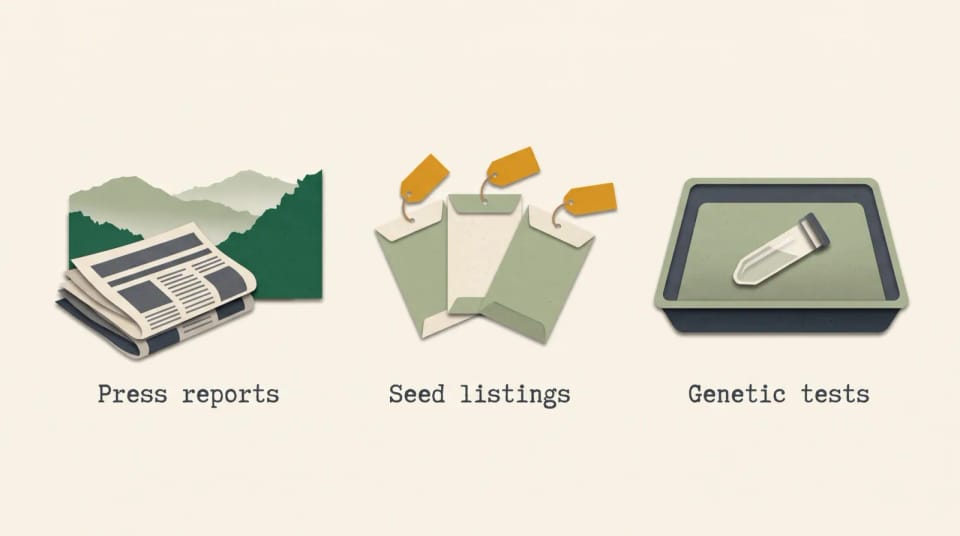
Press reports and seed listings both exist for these names. A published genetic test of a named Kerala Gold or Idukki Gold sample is the piece I could not find.
Is Kerala Gold the same as Idukki Gold?
Not exactly, and “Kerala Gold” is not even one thing. In seed catalogues, the name sits on at least three products with different stated parents and very different flowering times.
| Seller listing | What it says the seed is | Listed flowering time |
|---|---|---|
| Barney’s Farm (discontinued) | “South Indian x Skunk #1; F1 Hybrid” | 8 to 9 weeks |
| Indian Landrace Exchange | “Said to have branched out from Idukki Gold,” collected “from Idukki District, Kerala through a Ganja Farmer in 2014” | 16 to 20 weeks |
| Energenetics Old World Farm | “Idukki x Kerala,” an “F2 Hybrid” from seed sources it names as Idukki and Kerala, both 2017 | 20 to 22 weeks |
A plant that finishes in two months and a plant that needs five are not the same population. One listing crosses South Indian material with Skunk #1, a well-known modern hybrid. The other two claim local Kerala ancestry. Even they differ: one is a single collection, and the other is a cross of two seed lines.
The way Indian Landrace Exchange tells it, Kerala Gold descends from Idukki Gold. That is the seller’s account of one 2014 collection from one farmer. It is a claim about provenance, not a test of it. Copies of that listing on reseller sites drift further. One reseller page labels it “100 % sativa” and lists a shorter indoor flowering window, and also states plainly, “Terpene profile: It has not yet been analyzed.”
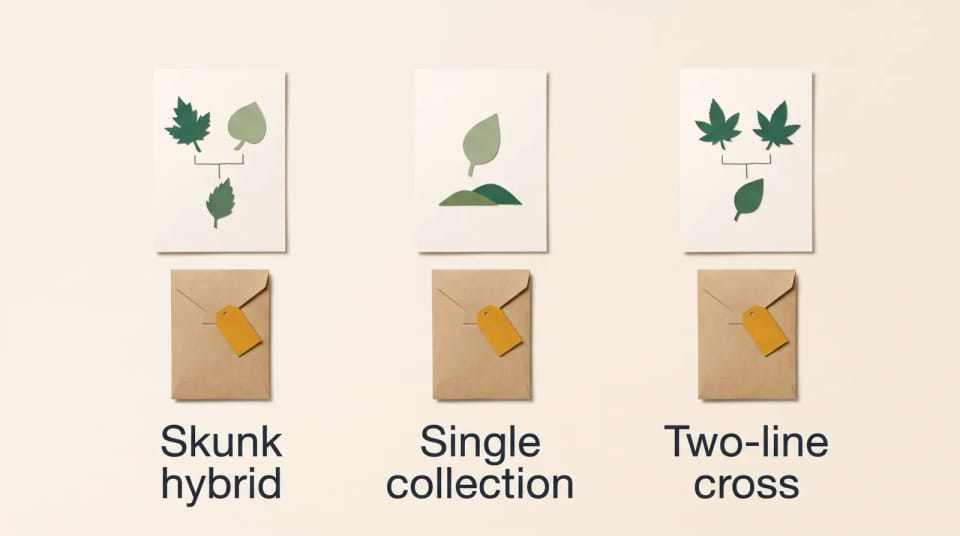
Same name, three stated parentages. The labels summarize what each seller lists; none of them is a genetic test.
Is Kerala Gold a real landrace?
Nobody has shown it either way. A landrace strain is a local population shaped by long selection in one place. Proving that a seed line is one means comparing its DNA with other plants. I found no published study that genotyped or chemically profiled a named Kerala Gold, Idukki Gold or Neelachadayan sample. I also found no lab certificate or herbarium record for either name. That is “I did not find,” not proof that none exists.
The broader research gives good reason for caution. When researchers genotyped commercial strains, a name was a weak guide to the plant. In one study, 35% of same-name comparisons were more similar to differently named samples than to each other (Sawler et al., PLOS ONE, 2015). We cover those genotyping studies of strain names in their own lesson.
Mixing is common, too. A reanalysis of public cannabis sequence data found “extensive” hybridization among collections (Halpin-McCormick et al., 2024). So a landrace label can sit on mixed material.
Indian researchers do study local cannabis. A 2025 study screened 54 samples from tropical and subtropical India for CBD breeding lines (Aftab et al., Biochemical Genetics). Its abstract does not mention Kerala, Idukki or Neelachadayan. The largest recent pangenome paper states that “the C. sativa gene pool remains only partially characterized” (Lynch et al., Nature, 2025). South Indian lines sit inside that gap.
So the honest answer is this: two sellers call their seed a landrace or a landrace cross, and their evidence is collection stories. Place names are a low-signal part of a strain name, and “Kerala” on a packet is no exception.
Is Kerala Gold indica or sativa?
The listings cannot agree. One reseller page says “100 % sativa.” A breeder database describes the Barney’s Farm version as “mostly indica.” A retailer listing for the Indian Landrace Exchange seed says “Sativa Dominant” and “Hybrid” on the same page. That spread is a good example of why the sativa and indica labels tell you little about how a plant will affect you.
The same goes for potency. THC figures for Kerala Gold vary from page to page, and none that I opened linked to a lab report. Treat any number on a listing as marketing until a certificate of analysis backs it.
If you want something more useful than a label, keep your own record. The High IQ app lets you log how a strain actually worked for you, which tells you more than a place name on a packet. And if any cannabis, whatever its name, leaves you with chest pain, fainting, or a racing heart that does not settle, get medical help and tell the clinician what you used.
What does Neelachadayan mean, and how does Sheelavathi fit in?
Neelachadayan is the Malayalam local name most often given for Idukki Gold. Sources gloss it differently: GQ India gives “blue locks,” and the Indiatimes essay gives “blue curly.” I cannot verify the Malayalam myself, so read it as “blue” plus a word for locks or curls.
Sheelavathi (also spelled Seelavathi or Sheelawathi) is the name now attached to ganja from the Andhra Pradesh and Odisha border region. Onmanorama’s 2016 report says Seelavathi “is actually a hybrid of the Idukki variety.” A 2025 Frontline review of Karan Madhok’s book on cannabis in India describes Idukki Gold as “legendary but elusive” and says it “has now been replaced by the Sheelavathi strain grown in the Andhra-Odisha border.” Both are reporters’ statements, not genetic findings.
Is Idukki Gold legal in India?
No. India’s Narcotic Drugs and Psychotropic Substances Act, 1985 defines ganja as the flowering or fruiting tops of the cannabis plant, and it makes cultivating cannabis and possessing, selling or transporting it an offence. That is why this lesson does not cover where to find or grow it. Bhang has a different legal position, which we explain in why bhang is legal in India when ganja is not.
The name still matters culturally. It sits in the same story as the bhang traditions and Himalayan charas covered in our look at cannabis culture in South Asia and our history of Himalayan charas. Idukki Gold is the southern, flower-based chapter of that story, and it is mostly told through memory and excise reports.
Key takeaways
- Idukki Gold is a ganja name tied to Kerala’s Idukki hills; origin stories about it conflict and none is sourced.
- Kerala excise officials said in 2014, 2015 and 2020 that ganja sold under the name is largely grown in other states.
- “Kerala Gold” seed covers at least three different listed products, from an 8 to 9 week Skunk #1 hybrid to a 20 to 22 week cross.
- No published genetic test of a named Kerala Gold or Idukki Gold sample turned up in my searches.
- Sativa, indica and THC claims for these names conflict and are not lab-linked.
FAQ
Is Kerala Gold the same as Idukki Gold?
Not reliably. One seller says its Kerala Gold seed came from an Idukki farmer in 2014 and descends from Idukki Gold, but other Kerala Gold products have different stated parents, including a cross with Skunk #1. No genetic test links any of them to the plant remembered as Idukki Gold.
Is Idukki Gold extinct?
“Extinct” is a seller’s word and an excise official’s 2014 remark, not a scientific finding. Press reports from 2016 and 2020 say cultivation moved out of Idukki and the original is hard to come by. Nobody has a reference sample to check against, so the question cannot be settled from the record.
Is Kerala Gold indica or sativa?
Listings call it 100% sativa, mostly indica, sativa dominant and hybrid, depending on the seller and the product. Those labels conflict and none comes with a lab test. The labels also predict effects poorly in general.
Did the 2013 film Idukki Gold make the name famous?
The film exists: a 2013 Malayalam reunion drama directed by Aashiq Abu, according to its encyclopedia entry. One essayist says it “glamorised” the name. That is an opinion, and I found no evidence that settles whether the film spread the name or simply borrowed it.
What is Sheelavathi?
Sheelavathi is the name now given to ganja grown in the Andhra Pradesh and Odisha border region. Reporters describe it as a derivative or replacement of the Idukki variety. That is a press account, not a genetic result.
Sources
- Ren G, and colleagues. Large-scale whole-genome resequencing unravels the domestication history of Cannabis sativa. Science Advances, 2021.
- Sawler J, and colleagues. The genetic structure of marijuana and hemp. PLOS ONE, 2015.
- Halpin-McCormick A, and colleagues. Examining population structure across multiple collections of Cannabis. Genetic Resources and Crop Evolution, 2024.
- Aftab N, and colleagues. Exploring genetic diversity for high CBD content in Cannabis accessions in tropical and subtropical regions of India. Biochemical Genetics, 2025.
- Lynch RC, and colleagues. Domesticated cannabinoid synthases amid a wild mosaic cannabis pangenome. Nature, 2025.
- Antony T. Fake Idukki Gold doing the rounds. The New Indian Express, 2014.
- Express News Service. Idukki Gold: illegal selling of ganja. The New Indian Express, 2015.
- Antony T. Idukki Gold that isn’t. The New Indian Express, 2020.
- Udayabhanu P, Ilankath U. Psychedelic Idukki Gold, made in Andhra and Orissa. Onmanorama, 2016.
- Government of India. The Narcotic Drugs and Psychotropic Substances Act, 1985. Gazette of India, 1985.



