A Global History of Hash: From Hand-Rubbed Charas to Modern Rosin
Hash is one 800-year-old idea: separate the resin. Trace it from Himalayan charas through Moroccan sift and Afghan press to ice water and live rosin.

Professor High

Walk into a dispensary and the hash case reads like a spec sheet. Six-star. Full melt. Live rosin, cold cured, 90-micron, single source. It sounds like something invented in a lab around 2018.
It wasn’t. Every one of those terms describes a refinement of a single idea that people have been chasing for at least eight hundred years: get the resin off the plant, and leave the plant behind.
That idea has been executed with bare hands on a Himalayan hillside, with silk screens in Central Asian workshops, with a hair straightener in a California garage. The tools changed enormously. The goal never changed once. This is the story of that one idea — including the parts of it that are genuinely uncertain, and the parts that are flatly made up.
The thing everyone is actually after
Cannabis resin is produced in glandular trichomes: tiny stalked structures on the flower bracts that look like mushrooms under magnification. The head of that gland holds the cannabinoids and most of the terpenes. Leaf and stem are packaging.
So every hash method in history is the same sorting problem. Glands are stickier than plant matter, denser than plant matter, and break off more easily. Exploit any one of those differences and you get concentrated resin. Exploit it well and you get something that melts cleanly. That’s the whole technology tree, from a farmer’s palms to a hydraulic press.
Where the written record actually starts
Cannabis itself is far older than hash — the plant runs through South and Central Asian medicine for thousands of years, a story covered in our broader history of cannabis.
Concentrated resin arrived much later, and is much better documented. “Hashish” is Arabic and ordinarily means dried herb or grass; it came to mean cannabis resin through usage. The most careful survey of the early material is Franz Rosenthal’s 1971 study The Herb: Hashish versus Medieval Muslim Society, which works through the Arabic manuscripts and finds the trail beginning around the twelfth century and running through the sixteenth.
Those sources offer their own origin story: the Persian Sufi mystic Sheikh Haydar wandered out on a hot day, ate cannabis leaves, returned transformed, and his order spread the practice. It’s a good story, told about a holy man by his followers in texts written well after the fact, and Rosenthal treats it as legend rather than a datable event. More defensible is the association with wandering dervish orders — particularly the Qalandars — who appear to have spread and refined dry-sieving rather than to have discovered a plant Central Asia already knew perfectly well.
The Assassins story is not history
You will hear constantly that “assassin” comes from “hashishin,” and that the medieval Nizari Isma’ili sect drugged young men with hashish to make them fearless killers.
That is a European literary invention with a traceable date. Marco Polo popularized a “garden of paradise” version, and the modern scholarly form was launched by the French orientalist Antoine Isaac Silvestre de Sacy in a lecture at the Institut de France on 19 May 1809. The historian David A. Guba traced exactly how that lecture built a myth out of thin evidence in a 2016 paper in The Social History of Alcohol and Drugs, later expanded into his book Taming Cannabis.
The likeliest reading of the Arabic term is that rivals used it as an insult — roughly “low-class rabble” — with no implication that anyone was dosing anyone. No contemporary source shows hashish used in assassin recruitment. When a claim about cannabis is this cinematic and this old, that’s usually the tell.
Charas: the hand-rubbed tradition, and a fight over the word
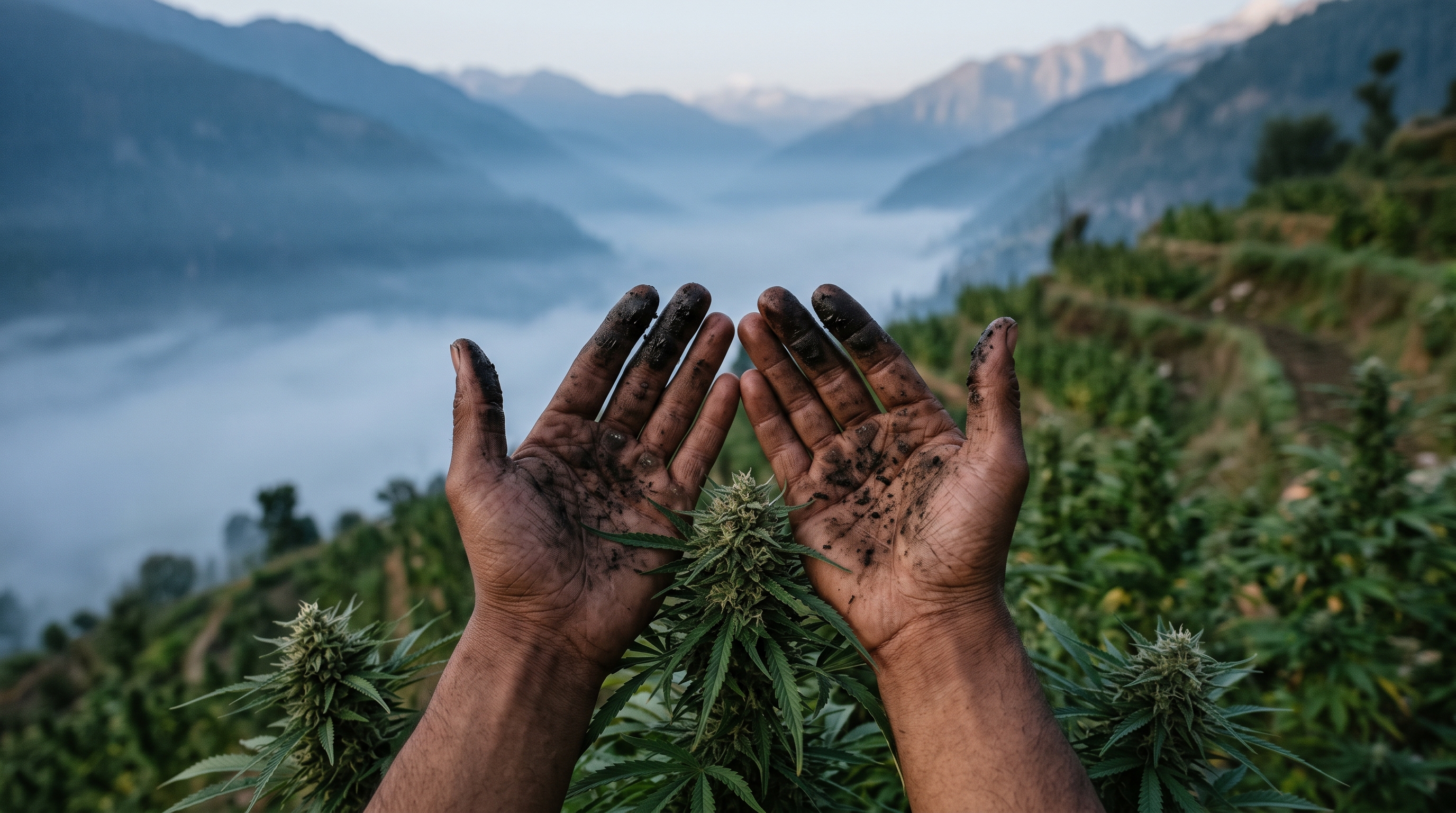
In the Himalayan foothills of northern India and Nepal — Himachal Pradesh, the Parvati and Kullu valleys, the hills above Kathmandu — resin is still collected by hand from living or freshly cut plants. Workers rub flowering tops between their palms until a black tar builds on the skin, then scrape and roll it into balls or fingers. A skilled rubber might produce a few grams in a long day. That labour is exactly why hand-rubbed charas has always been expensive.
Here’s where it gets contested. The common Western definition — charas means hand-rubbed, hashish means sieved — is largely a modern convention, codified in influential recent work such as Robert C. Clarke and Mark D. Merlin’s Cannabis: Evolution and Ethnobotany (University of California Press, 2013). Researchers working on landrace history have pushed back, arguing that in its Persianate origins charas simply meant cannabis resin, most of it sieved, and that the word likely derives from the leather containers the resin was cured and carried in. On that reading, the hand-rub-only definition is a narrowing that happened in English, not in the region.
The colonial record leans the same way. The Report of the Indian Hemp Drugs Commission (1893–94) — thousands of pages, well over a thousand witnesses — documents a substantial charas trade flowing into British India through the mountain passes from Yarkand in Chinese Turkestan, present-day Xinjiang, with traders out of Amritsar and Hoshiarpur running goods to Ladakh and returning with resin. That was an import business at scale, not a hillside cottage craft.
Both traditions are real. Hand-rubbing is a living practice you can watch today; it just probably wasn’t the main event historically, and the dictionary split is cleaner in English than it ever was on the ground.
The genetics behind all of it — Hindu Kush, Afghani, Nepalese, Mazar I Sharif — are the resin-heavy, broad-leaf populations covered in our guide to landrace strains.
The sieving belt: Afghanistan and Lebanon
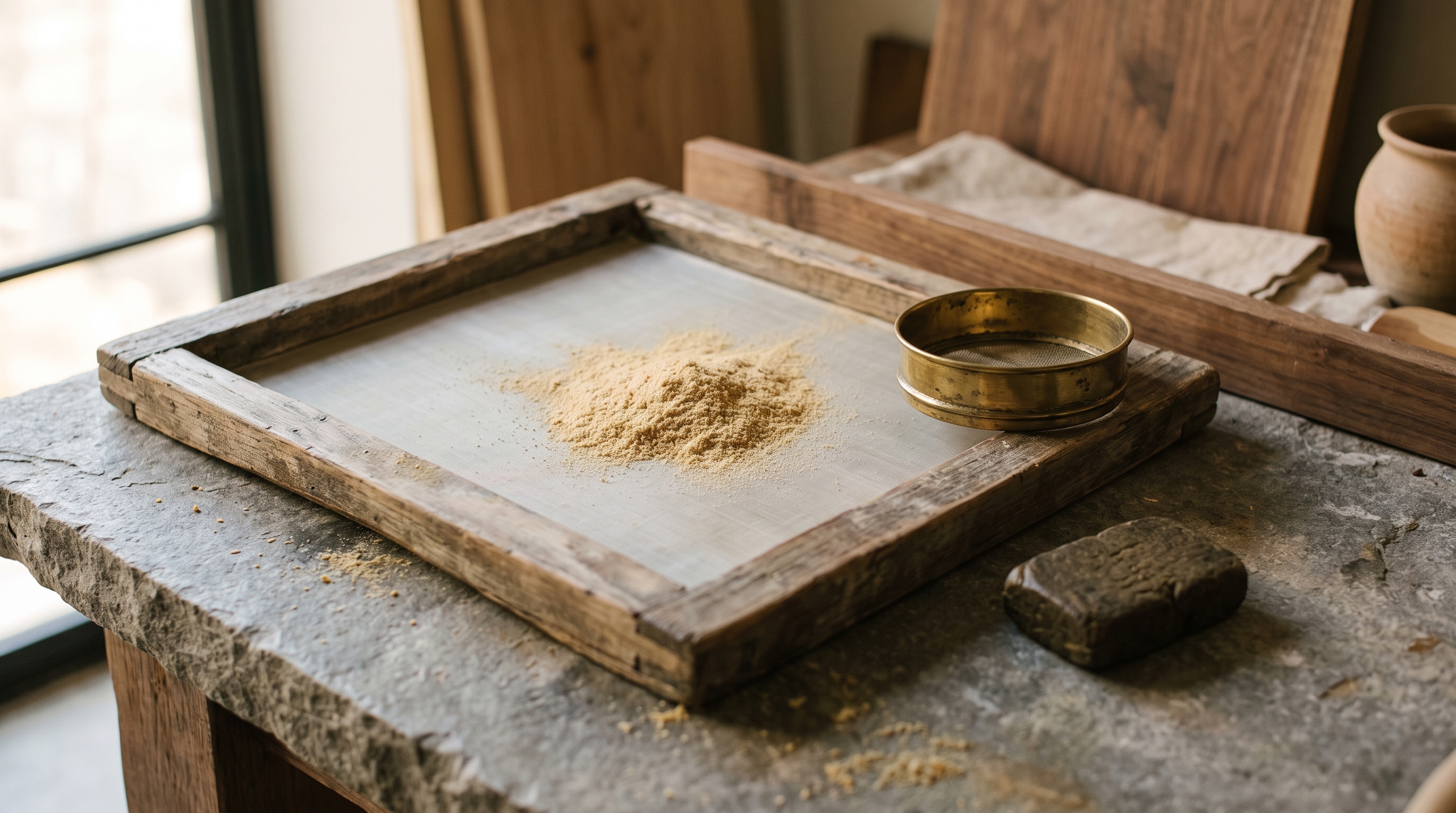
Dry-sieving is the second great method, and mechanically it’s the ancestor of everything modern. Dry the plant, break the glands off by agitation, drop them through a fine screen — historically silk, now nylon or stainless mesh — which passes resin heads and holds back leaf. What falls through is essentially kief. Press it and you have hash.
Afghanistan built the most recognizable version. The Afghanistan Analysts Network’s history of the trade, published in January 2019 by Jelena Bjelica and Fabrizio Foschini, places the country’s sieved-resin tradition as “probably dating back to the nineteenth century” — old, but not ancient, and younger than the confident claims on most product pages. Sharper still: the first report of hashish produced from the broad-leaf Afghan cannabis in northern Afghanistan dates only from 1965, and Afghan output scaled into serious export volumes after China’s 1934 ban removed a competitor. A cottage industry became a large export business from the 1970s onward.
The Afghan finish is the distinctive part. Sieved powder is worked by hand — warmed, kneaded, traditionally with a little water or tea added — until it turns pliable, dark and intensely aromatic. That plasticity is what people mean by “Afghan black.” Same input as a crumbly sift, completely different product, purely because of the working.
Lebanon ran the other famous sieving tradition, in the Bekaa Valley around Baalbek. Producers were sifting and pressing well before the twentieth century, the practice became organized under French administration, and output peaked during the 1975–1990 civil war when state control collapsed. The house styles — “Lebanese blonde,” “red Leb” — came from harvest timing, screen grade and aging, not from any secret. Lebanese hash was famous for craft, not tonnage.
Morocco: an old plant, a young craft
Morocco is now among the largest hashish producers on earth, and it’s where the history is most often told wrong.
Cannabis in the Rif mountains is genuinely old. Kif — chopped cannabis mixed with tobacco and smoked in a long sebsi pipe — is a deep-rooted regional practice with its own etiquette. But making hashish there is a different and much more recent thing.
The geographer Pierre-Arnaud Chouvy, who has published the most sustained academic work on Moroccan cannabis, dates commercial hashish production in Morocco to roughly the 1960s, arriving with foreign visitors and international demand rather than growing out of the kif tradition. He and Kenza Afsahi laid out the modern industry in a 2014 paper in the International Journal of Drug Policy; Chouvy has since argued in GeoJournal (2022) that Moroccan hashish is best understood as a terroir product — a place-specific craft built on local landraces, now under pressure from imported high-yield hybrids that produce more resin but flatten the regional character.
The honest version: Morocco’s cannabis culture is centuries old, Morocco’s hash industry is about sixty years old, and the two get conflated constantly. The Ketama name surviving on menus points at the Rif region that anchored it.
The hash trail, and the door closing
The 1960s and 70s overland route — London to Istanbul to Tehran to Kabul to Lahore to Kathmandu — is where most Western hash literacy came from. Travellers brought back Afghan press, Nepalese temple balls, Moroccan sift, and the tastes that shaped 1960s and 70s counterculture and eventually Western breeding programs.
Nepal shows how fast that door closed. Hashish was sold openly in government-licensed shops in Kathmandu, clustered around what travellers called Freak Street. In 1973, under sustained US and international pressure, Nepal cancelled every one of those licenses; the shops shut essentially overnight, and the Narcotic Drugs (Control) Act of 1976 made it permanent.
The Nepalese temple ball is the artifact of that era: hand-rubbed resin rolled into a dense, glossy sphere and aged, darkening and smoothing as it oxidizes. Charas method, with time layered on top.
Two prohibition dates worth getting right
“Napoleon banned hashish in Egypt in 1800.” He didn’t. Napoleon had abandoned the Army of the Orient and left Egypt in August 1799. The October 1800 ban was issued by General Jacques-François Menou — who had converted to Islam and taken the name Abdallah — while Napoleon was in Paris, some three thousand kilometres away, handling a European war and an assassination plot. Guba’s archival work on the French correspondence is what nails this down.
“Cannabis entered the drug treaties because of Egypt.” This one holds up. Cannabis was not on the agenda at the 1925 Geneva opium conference, convened over morphine, heroin and cocaine. The Egyptian delegate Mohamed El Guindy proposed adding it, argued hashish was at least as harmful as opium, and with Turkish support cannabis was written into the convention. The path from there to America’s 1937 Marihuana Tax Act runs more or less straight.
Ice water: the same idea, a better lever
For most of hash history the sorting lever was stickiness (hand-rubbing) or brittleness and size (sieving). In the 1990s a third went mainstream: density and temperature. Chill cannabis in ice water and the glands become brittle and snap off under gentle agitation. Resin is also slightly denser than water while most plant matter floats or suspends. Run the slurry through a stack of progressively finer mesh bags and the glands sort themselves by size on the way down.
Credit here is genuinely shared and genuinely disputed, so here is the honest version:
- Reinhard Delp developed an ice-water extraction apparatus and held patent rights covering the approach.
- Mila Jansen, working in Amsterdam, built the Pollinator dry-sift drum in 1994 and released the Ice-O-Lator bag system in 1998 — the product that put ice-water hash in ordinary growers’ hands.
- Marcus “Bubbleman” Richardson launched Bubble Bags through his company Fresh Headies in March 1999 after a distribution arrangement with Jansen fell through, and built out the multi-bag micron kits most people use today.
- Delp sued Richardson in 2001. The dispute ran for years and ended in a settlement, with Richardson stating he ultimately paid to license the patent.
Anyone who tells you one person invented bubble hash is flattening a decade-long argument. What’s not disputed is the effect: the mesh-bag kit made high-grade hash reproducible at home. Our ice water extraction walkthrough covers the modern process.
Ice water also created the vocabulary. Bags are labelled in microns, and the fractions from the middle screens — commonly 73 to 120 micron — tend to hold the most intact gland heads. Full melt means hash clean enough to vaporize with essentially no residue, and the informal star rating is the trade’s shorthand for how close a batch gets. Useful scale, no standards body behind it — worth remembering when you’re paying for the sixth star. We break it down in full melt vs. six-star bubble hash.
Rosin: heat, pressure, and no solvent at all
The most recent chapter starts with a hair straightener. In early 2015 a California grower named Phil “Soilgrown” Salazar was flattening some low-grade hash with his wife’s flat iron and noticed oil squeezing out the sides, leaving dry plant material behind. He shared the technique publicly in February 2015, demonstrated it on the Hash Church broadcast on 12 March 2015, and it spread through the solventless community within months.
Salazar is fairly credited with popularizing rosin. Whether he was first is less clear — community accounts point to forum posts describing heat-and-pressure extraction years earlier, and those threads are hard to verify now. “Commonly credited to Salazar, plausibly with earlier precedents” is the accurate framing.
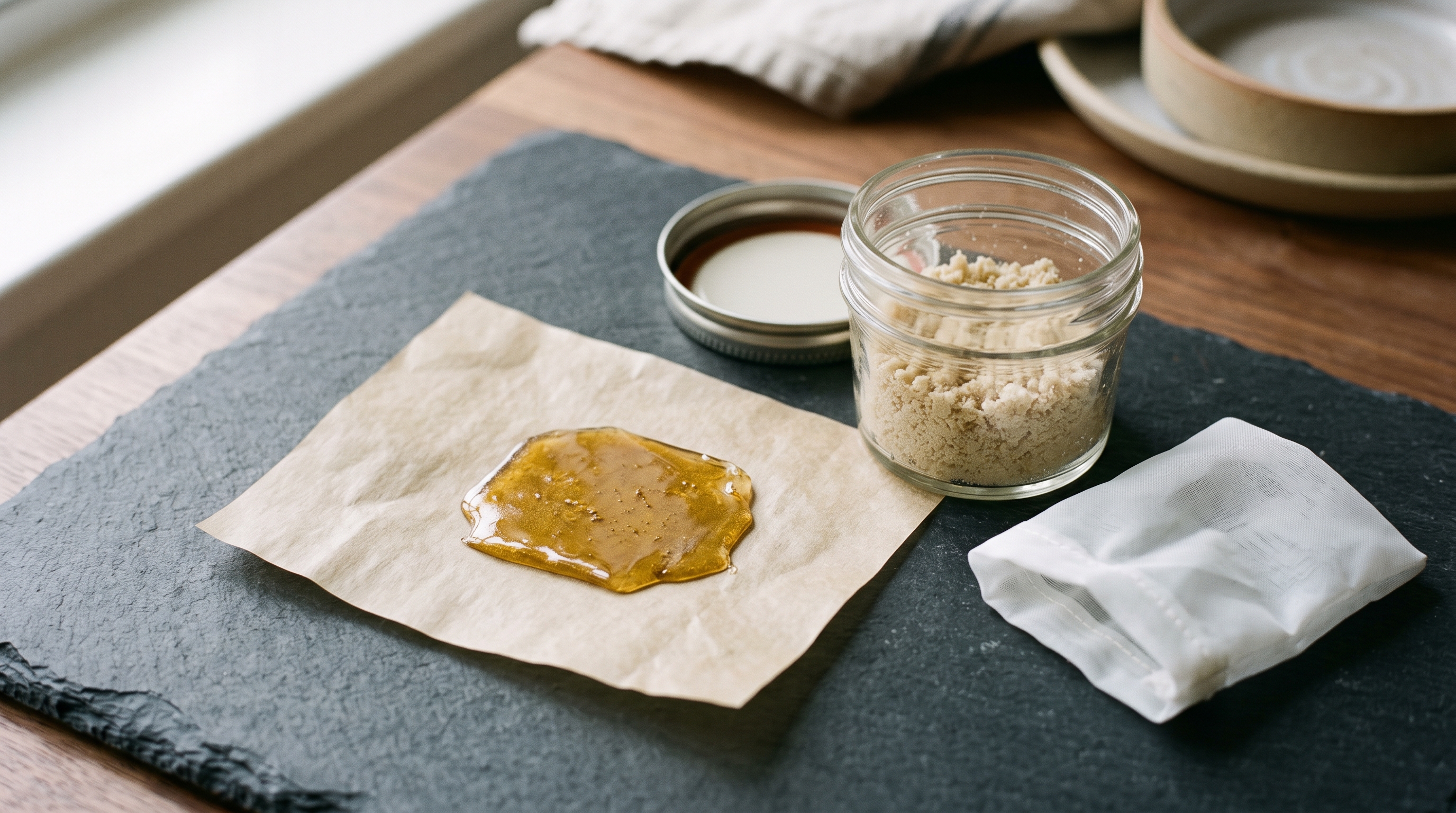
Mechanically, rosin is the simplest method in this article. Heat and pressure liquefy the resin and push it through a filter bag. No ice, no solvent, no purge, nothing to residually test for. What you started with is what you get — which is exactly why rosin is unforgiving: it concentrates the input’s quality, good or bad. Our home rosin guide and press buyer’s guide cover the equipment.
Two refinements followed quickly. Live rosin presses ice-water hash made from fresh-frozen plants rather than dried and cured ones; freezing at harvest preserves volatile terpenes that ordinarily evaporate during drying, which is why live material smells so much louder — see live resin vs. live rosin. Cold cure holds fresh-pressed rosin at low temperature over days until it sets into a stable batter rather than separating: an aging step, conceptually not far from what a Nepalese producer was doing to a temple ball. Details in cold cure vs. fresh press.
What actually changed, and what didn’t
| Method | Where and roughly when | What does the sorting | Result |
|---|---|---|---|
| Hand-rubbing (charas) | Himalayan India and Nepal; living tradition | Stickiness against skin | Soft dark resin, low yield, high labour |
| Dry-sieving | Central Asia, Afghanistan, Lebanon, later Morocco; documented from the 1800s | Brittleness and gland size through mesh | Kief, then pressed blocks |
| Hand-pressing and aging | Afghan press, Nepalese temple balls | Heat, friction, time, sometimes water | Pliable, aromatic, darkening resin |
| Ice-water extraction | Netherlands and North America, 1990s | Cold, agitation, density, micron screens | Graded bubble hash, up to full melt |
| Rosin pressing | California, popularized 2015 | Heat and mechanical pressure | Solventless oil, live and cold-cure variants |
Five methods, several centuries of tinkering, one output category. The difference between a Yarkand trader’s sieved block and a cold-cured live rosin is precision, consistency and scale — not concept.
One honest caveat about “better.” Modern solventless is far cleaner and far more potent, and that’s a real gain. It is also younger: aged Afghan press and temple balls had oxidation and time built into their character in ways a two-week cold cure doesn’t reproduce. Something was gained and something was genuinely lost.
The part that matters when you’re buying
Here’s the throughline from Yarkand to a modern hash case: the name on the label was never the reliable part.
“Afghan black” meant a real regional style until it meant whatever a vendor wanted. “Ketama” was a place before it was a shelf tag. Today strain names are just as unreliable — the same name covers wildly different chemistry depending on who grew it. Hash amplifies this, because a concentrate inherits everything from its input: the limonene, caryophyllene and pinene content, whether it lands closer to a relaxing or balanced profile, whether it produces a heavy body high or something more cerebral.
What survives scrutiny is chemistry and your own recorded response. Two jars both labelled “live rosin” at the same price can behave completely differently, and crowd-sourced reviews won’t tell you which one works for you. Logging what you actually consumed and how it actually landed — in the High IQ app or a notebook — builds the only dataset that reflects your body rather than someone else’s.
New to hash? Start with how hash compares to wax and shatter and the dabbing basics.
FAQ
Is charas the same thing as hashish? In modern English, charas usually means hand-rubbed Himalayan resin and hashish means sieved and pressed resin. Historically that split is much blurrier — good evidence suggests charas originally referred to cannabis resin generally, most of it sieved. Both usages are defensible; just know which one someone means.
Did the Assassins really use hashish? There’s no credible contemporary evidence that they did. The story was popularized by Marco Polo and given scholarly cover by Silvestre de Sacy in 1809. Historians now treat it as an Orientalist myth rather than an account of events.
How old is hash, really? Cannabis use is thousands of years old. Concentrated resin as a documented practice traces to roughly the twelfth century in Arabic sources. Region-specific hash industries are much younger than most people assume — Afghan sieving is probably a nineteenth-century tradition, and Moroccan hashish production dates to around the 1960s.
Is modern rosin stronger than traditional hash? Generally yes. Traditional sieved and pressed hash contains a meaningful amount of non-resin plant material, while well-made live rosin is close to pure resin. Start with a much smaller amount than you would with flower, and see our concentrate comparison guide.
What does “six-star” actually mean? It’s an informal trade grade for how cleanly bubble hash melts and vaporizes, six being full melt. No certifying body, no standardized test — the rating reflects the seller’s judgment. Treat it as a claim to verify, not a specification.
Sources
- Rosenthal, Franz. The Herb: Hashish versus Medieval Muslim Society. Leiden: E. J. Brill, 1971.
- Guba, David A. “Antoine Isaac Silvestre de Sacy and the Myth of the Hachichins: Orientalizing hashish in nineteenth-century France.” The Social History of Alcohol and Drugs, 2016. DOI: 10.1086/shad30010050
- Guba, David A. Taming Cannabis: Drugs and Empire in Nineteenth-Century France. McGill-Queen’s University Press, 2020. DOI: 10.1515/9780228002550
- Chouvy, Pierre-Arnaud, and Afsahi, Kenza. “Hashish revival in Morocco.” International Journal of Drug Policy, 2014. DOI: 10.1016/j.drugpo.2014.01.001
- Chouvy, Pierre-Arnaud. “Moroccan hashish as an example of a cannabis terroir product.” GeoJournal, 2022. DOI: 10.1007/s10708-022-10791-5
- Clarke, Robert C., and Merlin, Mark D. Cannabis: Evolution and Ethnobotany. University of California Press, 2013. DOI: 10.1525/9780520954571
- Bjelica, Jelena, and Foschini, Fabrizio. “The Myth of ‘Afghan Black’: A cultural history of cannabis cultivation and hashish production in Afghanistan.” Afghanistan Analysts Network, 7 January 2019.
- Report of the Indian Hemp Drugs Commission, 1893–94. Government of India, 1894.
Keep reading: the complete concentrates guide, how cannabis culture differs around the world, the history of 420, cannabis connoisseurship, terp pearls and banger vs. nail setups. Resin-heavy genetics: Hash Plant, Afghan Kush, Black Domina, Northern Lights, Skunk #1, Pakistani Chitral Kush.
