Cannabis in World Religions: What the Evidence Shows
A careful survey of cannabis in Hinduism, Rastafari, Sikhism, Buddhism and the ancient Near East — including what the evidence does not support.

Professor High
Search “cannabis in religion” and you will drown in confident nonsense. Jesus anointed people with cannabis oil. The Buddha lived on hemp seeds. Every ancient temple was, apparently, a head shop. Most of it traces back to a handful of decades-old claims repeated so often they started sounding like consensus.
The real story is mixed, and better. Some traditions have used cannabis openly for centuries. Some prohibit it in writing. One has an internal argument still running today. And archaeologists have twice found burnt cannabis residue on actual altars — which settles far less than the headlines suggested.
Here is what the evidence supports, tradition by tradition, and where it runs out.
Hinduism: bhang, Shiva, and a legal carve-out that still stands
Cannabis has its deepest and least contested religious footprint in South Asia.
The Atharvaveda names bhanga among five sacred plants headed by soma, in a verse asking the herbs to release the speaker from anxiety. That is a real passage. The caution is botanical: matching Vedic plant names to modern species is hard, and bhanga in the earliest layer is probable rather than proven. By the classical and Ayurvedic period the identification with Cannabis is solid — the plant appears in medical compendia with described preparations and doses.
Bhang is the preparation that matters: leaves and flowering tops ground to a paste, then worked into milk, almonds, spices and sugar as thandai, or into sweets. It is drunk, not smoked, which gives it the slow onset and long tail familiar from any oral preparation — see high-dose versus microdose edibles.
Shiva’s herb
Bhang is bound up with Shiva. Devotional literature gives him epithets tying him to the plant, and offering bhang at a Shiva temple is an ordinary act of worship, not a fringe one. Theodore Godlaski’s 2012 paper in Substance Use and Misuse, titled simply “Shiva, Lord of Bhang,” traces how thoroughly the association runs through the devotional tradition.
Two festivals concentrate it. At Maha Shivaratri, the night dedicated to Shiva, bhang is offered at temples and consumed by devotees and ascetics. At Holi, bhang thandai is a normal part of the spring celebration across much of northern India.
What is not true: that Hinduism as a whole endorses cannabis. Many devotional and ascetic lineages reject all intoxicants outright. Bhang use clusters in particular Shaiva contexts, among certain sadhu orders, and in regional festival custom. Treating it as pan-Hindu flattens a religion of roughly a billion people into a single habit.
Why bhang is legal in India when ganja is not
This is the part most articles get wrong. India’s Narcotic Drugs and Psychotropic Substances Act of 1985 does not ban the plant wholesale. It defines “cannabis (hemp)” as charas — the separated resin — and ganja, the flowering or fruiting tops. Leaves and seeds are explicitly excluded when they are not accompanied by the tops.
Bhang is made from leaves, so it sits outside the federal narcotics definition entirely. In states such as Uttar Pradesh and Rajasthan you can buy it from a licensed government bhang shop. Others, Assam among them, prohibit it under their own excise laws. Cultivation remains restricted regardless.
It is a legislative accommodation of a practice too embedded to criminalise — the closest thing in the world to a religious carve-out written into a national drug law.
Rastafari: ganja as sacrament
Rastafari emerged in Jamaica in the 1930s, and ganja became central to its practice as both sacrament and act of resistance. We have a full article on the movement’s history, so this section stays on the religious logic and the law.
The scriptural reasoning
Rastafari reasoning draws on a small set of biblical passages: Genesis 1:29 on every seed-bearing herb given for food, Psalm 104:14 on herb for the service of man, and Revelation 22:2 on leaves for the healing of the nations.
Be precise about what this is. None of those verses names cannabis. The identification is an interpretive move made by the community, the same way every tradition reads scripture through a lived practice. That does not make it illegitimate — it makes it interpretation rather than proof text, and Rastafari elders have generally been clearer about that than outside commentators are.
The practice matters more than the citations. Ganja is used in reasoning sessions and grounations — communal settings with structure and elders present — framed as an aid to insight and to livity, not as recreation.
Legal recognition
Rastafari have won real, specific legal ground:
- Jamaica, 2015. The Dangerous Drugs (Amendment) Act decriminalised possession of up to two ounces and allowed adherents aged 18 and over to use ganja sacramentally, with Rastafari organisations able to apply to cultivate for religious use.
- Antigua and Barbuda authorised Rastafari cultivation for sacramental use, and St Vincent and the Grenadines has made comparable provision.
- South Africa cuts the other way, instructively. In Prince v President of the Law Society of the Cape of Good Hope (2002), the Constitutional Court split five to four and held that the constitution did not oblige the state to exempt bona fide religious cannabis use. Sixteen years later, in Minister of Justice and Constitutional Development v Prince (2018), the same court decriminalised private adult use — on privacy grounds, not religious ones. Rastafari got the outcome without the principle.
That distinction repeats worldwide: courts have been far more willing to decriminalise cannabis for everyone than to grant a religious exemption to anyone.
Sikhism: a contested tradition, told honestly
This one requires care, because the internal disagreement is genuine and both sides deserve accurate representation.
The mainstream position is unambiguous. The Sikh Rehat Maryada, the official code of conduct, forbids intoxicants and names hemp explicitly alongside opium, liquor and tobacco. The Guru Granth Sahib treats intoxication as an obstacle to spiritual clarity. By the letter of Sikh law, cannabis is prohibited.
Against that stands a practice among some Nihang orders — the martial Sikh tradition — of consuming sukha or shaheedi degh, a cannabis preparation. Nihang accounts describe it as puratan: an ancient warrior practice for inducing bir ras, the warrior spirit, and for enduring wounds and long campaigns, with claimed lineage back to Guru Hargobind or Guru Gobind Singh. It has been associated with Hola Mohalla.
The dispute has been fought openly. In 2001 the Akal Takht — the highest temporal authority in Sikhism — banned bhang as part of an anti-addiction campaign. Jathedar Santa Singh of the Budha Dal, with a group of Nihang chiefs, refused to accept it, arguing that shaheedi degh was part of Sikh history. Both the Budha Dal and the Tarna Dal later moved toward phasing the practice out. The Tarna Dal’s framing is worth noting: it accepts shaheedi degh as a wartime tonic and analgesic while holding that being intoxicated is forbidden.
So the accurate summary is narrow. A minority practice, within one order, defended on historical rather than doctrinal grounds, disavowed by the central authority, and in retreat. “Sikhs use cannabis religiously” is not a true sentence.
Buddhism: the fifth precept and a stubborn myth
The fifth of the five precepts reads surā-meraya-majja-pamādaṭṭhānā veramaṇī sikkhāpadaṃ samādiyāmi — an undertaking to abstain from surā and meraya, fermented and distilled drink, which are a basis for pamāda, heedlessness.
Translators have argued over a real grammatical question here: whether majja, meaning intoxicant, qualifies the drinks named or forms an additional category. If the first, the precept is about alcohol. If the second, it extends to intoxicants generally. The monastic Vinaya’s explicit rule on the subject names fermented and distilled drink; cannabis is not mentioned.
But the precept states its own reason inside the rule — heedlessness — and on that reading the substance is beside the point. That is how the large majority of contemporary teachers across Theravada, Mahayana and Vajrayana traditions apply it: recreational cannabis is out.
Now the myth. You will read everywhere that the Buddha subsisted on one hemp seed a day. The source is real: the Lalitavistara, a legendary biography of uncertain date around the third or fourth century CE, describes the prince during his austerities eating one grain of hemp and one grain of rice a day, and related Chinese and Sanskrit texts echo it. Three problems. It is hagiography, not biography. Hemp seed is food and contains essentially no THC. And the point of the episode is that extreme asceticism failed — the Buddha abandoned it for the Middle Way. Citing it as evidence of religious cannabis use inverts the story.
Cannabis does appear in some Himalayan tantric material, and Mia Touw’s 1981 survey in the Journal of Psychoactive Drugs covers the Tibetan references. The texts are real; how widely they were practised is much harder to establish.
China and the Taoist texts
The Chinese material is older than almost anything else and mostly medical. The Shennong Bencaojing, the foundational Chinese pharmacopoeia, discusses ma fen and includes a line about excessive use producing visions and long-term use allowing one to communicate with spirits and lighten the body.
That sentence gets quoted constantly, usually stripped of context. E. Joseph Brand and Zhongzhen Zhao examined these passages in Frontiers in Pharmacology in 2017, asking which traditional indications plausibly map onto known cannabinoid effects. Their reading is measured: the corpus overwhelmingly treats cannabis as a fibre, seed and food crop and as a medicine for specific complaints, and translations of the “spirits” line vary widely depending on how you handle the classical vocabulary.
On the Taoist side, a sixth-century compendium refers to cannabis added to incense burners, and Touw’s survey traces the thread. That is genuine evidence of ritual fumigation. It is not evidence of a widespread Taoist cannabis practice — the surviving material is thin.
Zoroastrianism and ancient Iran: the bang problem
Here is where careful reading pays off.
Middle and New Persian bang, appearing in Book Pahlavi as mang and Arabicised as banj, names a narcotic plant. In the Ardā Wīrāz Nāmag, Wīrāz drinks a mixture including mang before his visionary journey through the afterlife, and the Wištāsp legend refers to mang ī Wištāspān as part of an illuminating drink.
The catch: in older Arabic and Persian sources, banj is applied to at least three different plants — hemp, henbane (Hyoscyamus niger) and jimsonweed (Datura stramonium), as the Encyclopaedia Iranica entry on the word sets out. Those produce wildly different experiences, which may itself explain why descriptions of bang in the Middle Persian texts vary so much.
So “Zoroastrians used cannabis for religious visions” is a claim the philology cannot carry. Something psychoactive was used; which plant is open. The related haoma debate is separate and also unsettled, but there cannabis is a distinctly minority proposal — ephedra has the strongest support from both the textual descriptions and the archaeology.
The archaeology: two sites that changed the conversation
Textual arguments run forever. Residue chemistry does not, and two finds reset the discussion.
Jirzankal Cemetery, Pamir Plateau
Ren, Tang, Wu, Spengler, Jiang and Yang published in Science Advances in 2019 on ten wooden braziers recovered from eight tombs at the Jirzankal Cemetery in the eastern Pamirs, dating to roughly 500 BCE. The braziers held stones with obvious burn traces.
Cannabinol — CBN, an oxidative breakdown product of THC — was detected on residues from all but one of the brazier interiors and on two of the stones. Control samples from the vessel exteriors showed no cannabinoids, the kind of methodological detail that makes a result credible.
Two conclusions follow. Cannabis was deliberately burned during mortuary ceremonies here. And the plants used produced meaningful levels of psychoactive compounds — higher than typical wild Central Asian cannabis, which is a striking finding on its own about early human selection of the plant.
What it does not tell us: who inhaled, what they believed, or whether any of it resembled modern ritual use.
Tel Arad, Kingdom of Judah
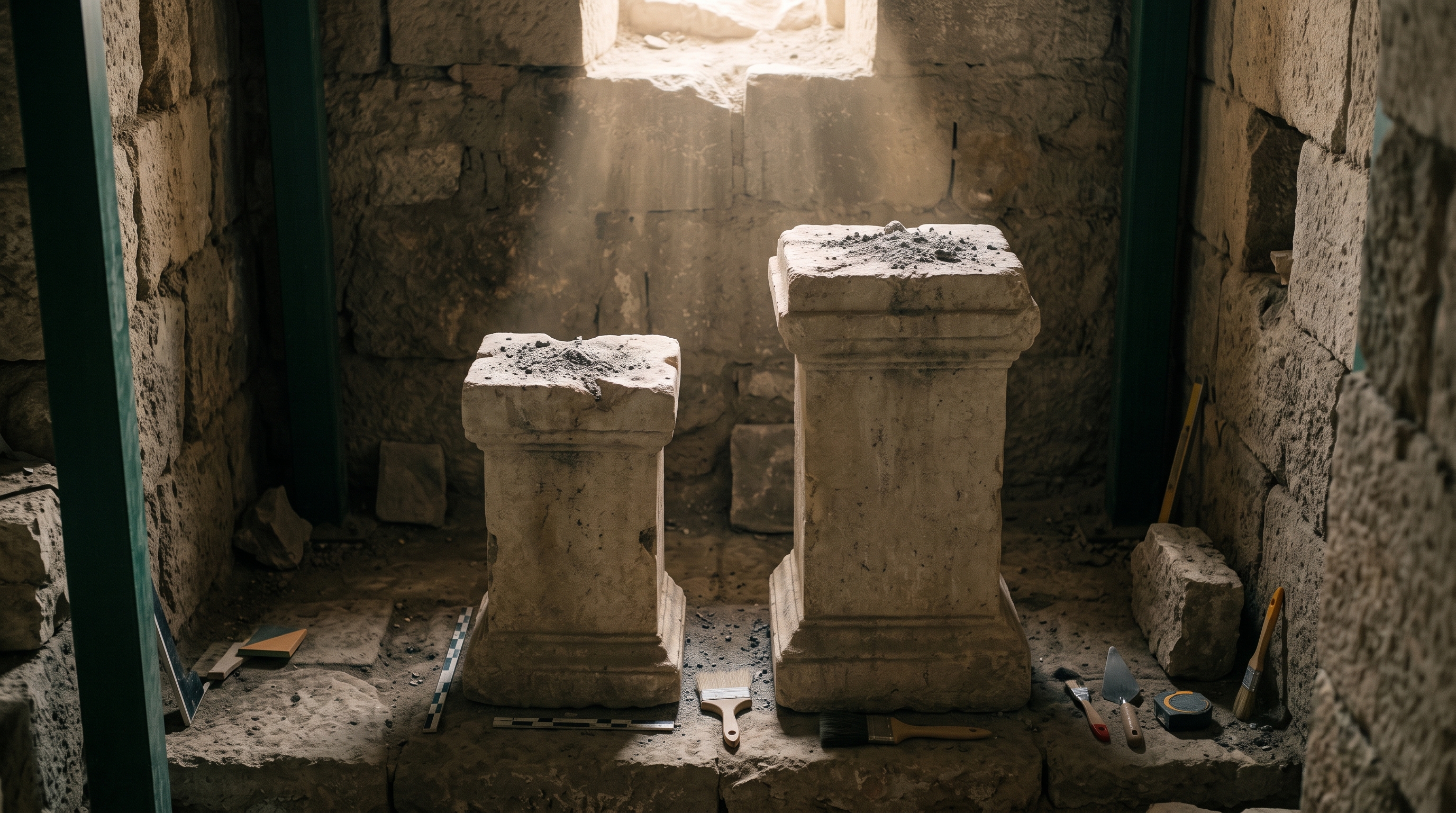
Eran Arie, Baruch Rosen and Dvory Namdar published in Tel Aviv in 2020 on two limestone altars from the inner shrine at Tel Arad, dated to the eighth century BCE. The larger altar carried frankincense mixed with animal fat. The smaller carried THC, CBD and CBN, along with animal dung — which the authors read as a fuel chosen to heat the material at moderate temperature rather than incinerate it. They describe it as the first known evidence of a hallucinogenic substance in the Kingdom of Judah.
Take the caveat seriously. Residue analysis identifies what burned, not intent. The reading that this was deliberate psychoactive use in worship is a reasonable inference from the dung fuel and the placement — and still an inference.
Kaneh-bosem: the argument that refuses to settle
Which brings us to the most-cited and least-resolved claim in the whole subject.
Exodus 30:23 lists qaneh-bosem among the ingredients of the holy anointing oil. It has traditionally been rendered “fragrant cane” or “sweet calamus,” pointing to Acorus calamus or a lemongrass species. The Greek Septuagint translated it as calamus, and English versions followed.
In 1936, and again in 1967, the Polish anthropologist Sula Benet argued that qaneh-bosem was cannabis, linking Hebrew qaneh to Akkadian qunnabu and treating the calamus rendering as an ancient mistranslation.
The mainstream response has been consistently negative. Standard biblical Hebrew lexicons do not identify qaneh-bosem with cannabis. Greek kannabis is not etymologically derived from Hebrew qaneh. And qaneh alone means reed or cane, appearing in plenty of contexts where cannabis makes no sense.
Tel Arad raised the temperature without resolving anything. It proves cannabis was physically present in Iron Age Judahite cult practice, which is not nothing. But Arad’s cannabis was burned as incense, and the qaneh-bosem of Exodus is an ingredient in an anointing oil. Presence at a shrine does not identify a word in a recipe.
Honest verdict: unresolved, with the burden sitting on the cannabis reading and a clear majority of Hebraists unconvinced. Anyone who tells you it is settled — in either direction — is selling something.
What the surveys actually have in common
Look across all of it and the pattern is not “everyone got high.” It is that where cannabis entered religious practice, it entered with structure around it.
Bhang has a recipe, a season and a temple. Rastafari reasoning has elders, a setting and a purpose. Nihang shaheedi degh, in its defenders’ own account, had a specific martial function. The Jirzankal braziers were used in a mortuary ceremony, not casually. Every case that lasted long enough to leave a trace had a container: dose, preparation, occasion, company.
That is the lesson modern consumers keep relearning the expensive way. What determines your experience is what is actually in the plant and what you bring to it — not the label on the jar. Names drift, get reused and get invented, which is why we wrote about what strain names actually mean and why crowd-sourced reviews mislead. Chemistry carries over. A high-myrcene cultivar in the Relax High family — Granddaddy Purple or Northern Lights — reads as heavy and sedated whatever it is called, while a linalool-forward or CBD-balanced chemovar such as Harlequin or ACDC tends to land closer to calm, the profile people usually want for meditation and sound baths or yoga.
If contemplative use is the goal, the practical advice mirrors the historical pattern: small doses, consistent preparation, a fixed setting, and a record of what actually happened. That last part is where most people fall down. Tracking your own responses — the cultivar, the cannabinoid ratio, the dose, the outcome — in the High IQ app turns anecdote into a pattern you can act on.
Frequently asked questions
Is bhang really legal in India? Largely yes, because of how the 1985 NDPS Act is written: it defines cannabis as the resin and the flowering tops, excluding leaves and seeds. Bhang is a leaf preparation, so it falls outside. States regulate it separately — some license bhang shops, some prohibit it. Cultivation is still restricted.
Does the Bible mention cannabis? Not in any translation, and the underlying question is contested. It turns on whether qaneh-bosem in Exodus 30:23 means cannabis or fragrant cane; most Hebrew scholars say the latter. The Tel Arad excavation showing cannabis at a Judahite shrine is a separate and better-established fact.
Do Sikhs use cannabis? As a rule, no. The Sikh Rehat Maryada explicitly forbids hemp along with other intoxicants. A minority practice exists in some Nihang orders (sukha or shaheedi degh), defended as a historical warrior tradition, banned by the Akal Takht in 2001, and now largely being phased out by the major Nihang bodies themselves.
Does Buddhism forbid cannabis? The fifth precept names fermented and distilled drink and gives heedlessness as its reason. Whether the wording extends to other intoxicants is a real translation question, but nearly all contemporary teachers apply it to recreational cannabis. The “Buddha ate hemp seeds” story is a legend about extreme fasting he ultimately rejected.
Is it appropriate to call my own cannabis use sacramental? Your call, but two things are worth knowing. Rastafari sacramental use sits inside a specific community with elders, structure, and a history of persecution for the practice — including decades of drug-war enforcement that fell hardest on Black communities. Borrowing the vocabulary without the context is what people mean by appropriation. Wanting your own use to be intentional is a fine goal on its own; mindful consumption does not require borrowing anyone’s liturgy.
Sources
- Ren, M., Tang, Z., Wu, X., Spengler, R., Jiang, H., Yang, Y. “The origins of cannabis smoking: Chemical residue evidence from the first millennium BCE in the Pamirs.” Science Advances, 2019. doi:10.1126/sciadv.aaw1391
- Arie, E., Rosen, B., Namdar, D. “Cannabis and Frankincense at the Judahite Shrine of Arad.” Tel Aviv, 2020. doi:10.1080/03344355.2020.1732046
- Godlaski, T. M. “Shiva, Lord of Bhang.” Substance Use and Misuse, 2012. doi:10.3109/10826084.2012.684308
- Touw, M. “The Religious and Medicinal Uses of Cannabis in China, India and Tibet.” Journal of Psychoactive Drugs, 1981. doi:10.1080/02791072.1981.10471447
- Brand, E. J., Zhao, Z. “Cannabis in Chinese Medicine: Are Some Traditional Indications Referenced in Ancient Literature Related to Cannabinoids?” Frontiers in Pharmacology, 2017. doi:10.3389/fphar.2017.00108
- Russo, E. B. “History of Cannabis and Its Preparations in Saga, Science, and Sobriquet.” Chemistry and Biodiversity, 2007. doi:10.1002/cbdv.200790144
- Encyclopaedia Iranica, entry “BANG” (Middle and New Persian; Book Pahlavi mang; Arabicised banj). Reference-work entry on the identification of the plant. iranicaonline.org
- Prince v President of the Law Society of the Cape of Good Hope [2002] ZACC 1, Constitutional Court of South Africa. saflii.org
- Minister of Justice and Constitutional Development and Others v Prince [2018] ZACC 30, Constitutional Court of South Africa. saflii.org
Related reading: the long history of cannabis from ancient medicine to modern science, how cannabis culture differs around the world, cannabis in music from jazz clubs to hip hop, the 1937 Marihuana Tax Act, the history of 420, and from prohibition to precision.
