DNA Testing Cannabis Strains: Do the Names Match the Genetics?
Geneticists have sequenced commercial cannabis for a decade. Same name, different plant is normal. Here's what DNA testing can and can't tell you.

Professor High
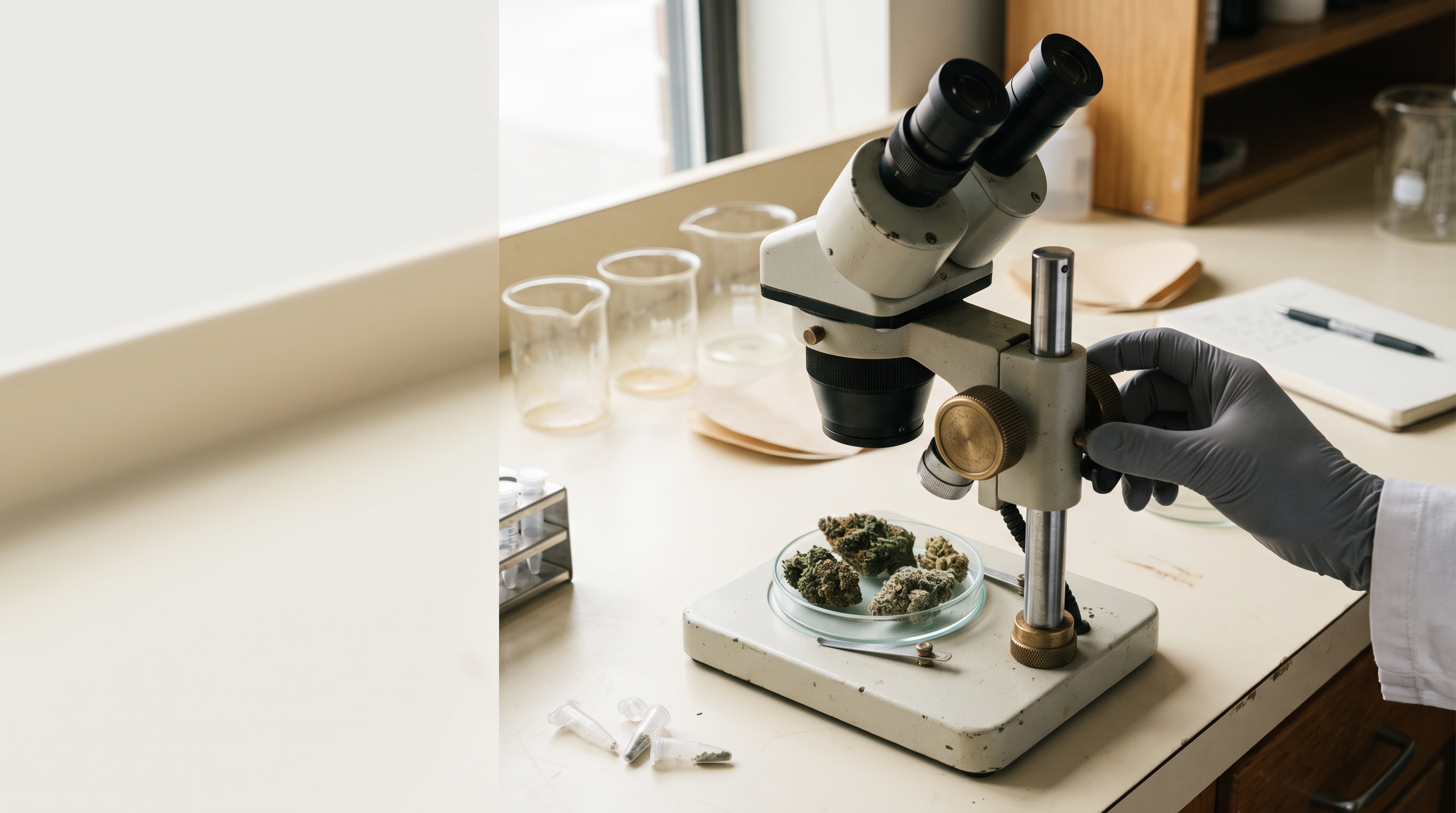
You bought the same strain twice. Same name on the label, two different shops. One jar made you sleepy and one made you jittery, and you spent the rest of the week wondering whether you’d imagined it, or built a tolerance, or just had a bad day.
You didn’t imagine it. Researchers have been running DNA on retail cannabis for over a decade, and the finding keeps repeating: two products sold under the same strain name are frequently not the same plant. Sometimes they are not even close relatives. Meanwhile, plants sold under completely different names sometimes turn out to be genetically near-identical.
This is the single most useful thing to understand about buying cannabis, and almost nobody selling it to you will say it out loud. So let’s go through what the genotyping studies actually found, why names drift the way they do, what a DNA test can and cannot tell you, and what to use instead.
What the genotyping studies actually found
2015: the first genome-wide look at strain names
Sawler, Stout, Gardner, Hudson, Vidmar, Butler, Page and Myles genotyped 81 drug-type and 43 hemp samples at 14,031 single-nucleotide polymorphisms and published the results in PLOS ONE. They confirmed that hemp and drug-type cannabis really are distinct at a genome-wide level — that part of the folk taxonomy holds up.
The strain names did not. The authors found only a moderate correlation between a strain’s genetic structure and its reported C. sativa / C. indica ancestry, and concluded that strain names “often do not reflect a meaningful genetic identity.” One of their more awkward findings: hemp turned out to be genetically more similar to indica-type drug cannabis than to sativa-type strains. If you have ever wondered why the indica versus sativa framework keeps collapsing under scrutiny, this is where the modern evidence starts.
2019: same name, different plant
Schwabe and McGlaughlin, at the University of Northern Colorado, did the study consumers had been waiting for. They built ten microsatellite markers from the Purple Kush genome and used them on 30 strains bought from dispensaries across three states — deliberately sampling the same strain name from different facilities.
Two things came out of it. First, the samples did split into two statistically supported genetic groups, but those groups did not correspond to the sativa / hybrid / indica types listed in online databases. Second, and more directly useful to you: they found genetic inconsistency within strains, with most strains containing at least one genetic outlier. Their conclusion was blunt — consumers “could be provided inconsistent products.”
Worth noting the nuance, because honest reporting matters here: after removing the obvious outliers, many strains showed considerable genetic stability. This is not a claim that strain names are pure noise. It is a claim that you cannot rely on a name to be the same plant twice.
2021: indica and sativa are genetically indistinct
Watts, McElroy, Migicovsky, Maassen, van Velzen and Myles published a short, sharp paper in Nature Plants. They took over 100 cannabis samples, measured terpene and cannabinoid content, and genotyped them at more than 100,000 SNPs.
Sativa-labelled and indica-labelled samples were genetically indistinct on a genome-wide scale. The labels weren’t tracking ancestry at all.
But the paper didn’t stop at debunking. It found that labelling was associated with variation in a small number of terpenes — compounds whose concentrations are controlled by genetic variation at tandem arrays of terpene synthase genes. In plain terms: when people call something “indica,” they are mostly responding to how it smells, and smell is heritable. The label is a smell proxy wearing an ancestry costume. That is a big part of why terpene profiles predict your experience better than the leaf shape does.
2020: 396 names, three chemovars
Reimann-Philipp, Speck, Orser, Johnson, Hilyard, Turner, Stokes and Small-Howard took a different route in Cannabis and Cannabinoid Research. Instead of genotyping first, they analysed the lab chemistry of 2,662 cannabis flower samples collected in Nevada between January 2016 and June 2017.
Principal component analysis of the terpenoid data produced three well-defined clusters. Those three chemical groups carried 396 different breeder-reported names between them. The researchers then genotyped representative samples and found twelve distinct genetic clades — still nowhere near 396, and, notably, the genotypes did not correlate with the chemotypes.
The authors were careful about that last point: it could mean their DNA markers were too narrow to separate the plants properly, or it could mean environmental factors contributed more to the chemical profile than genetics did. Either way, their conclusion stands — 396 names on three chemovars “imply a false sense of diversity.”
2022: the chemistry is real, the labels aren’t
Smith, Vergara, Keegan and Jikomes analysed cannabinoid and terpene content of commercial samples across six US states for PLOS ONE. Their finding is the constructive half of this whole literature: distinct chemical phenotypes (chemotypes) are reliably present in the commercial market. The chemistry is not chaos. There is real structure to find.
The commercial labels just don’t consistently align with it. Certain labels did show a biased association with specific chemotypes — a name is weak evidence, not zero evidence — but the market’s naming system and the plant’s chemical reality are, in the authors’ phrasing, “often divorced.”
| Study | Sample | Core finding |
|---|---|---|
| Sawler et al. (2015) | 124 samples, 14,031 SNPs | Strain names often don’t reflect a meaningful genetic identity |
| Schwabe & McGlaughlin (2019) | 30 strains, 3 states | Most strains contained at least one genetic outlier |
| Reimann-Philipp et al. (2020) | 2,662 Nevada samples | 396 names collapsed into 3 terpenoid chemovars |
| Watts et al. (2021) | 100+ samples, 100k+ SNPs | Sativa and indica labels genetically indistinct |
| Smith et al. (2022) | Commercial samples, 6 states | Chemotypes reliable; labels don’t consistently align |
Five studies, five research groups, five methods, one answer.
Why the names drift
None of this is a conspiracy. It’s what happens when a plant with no registration system meets a market that rewards recognisable names.
Clone-only lines get renamed on the way through. A cutting passes from a breeder to a grower to another grower. Somewhere in that chain it picks up a house name, or loses one. There is no chain-of-custody document. The plant is genetically identical to what it was three names ago, and nobody can prove it. Cloning is the only way to preserve a specific plant exactly, and paradoxically it is also where a lot of naming drift happens.
Seed-grown plants sold under one name are never one plant. When you pop a pack of seeds, every seedling is a different individual — that’s the entire point of phenotype hunting. Growers who sell every keeper from a pack under the pack’s name are shipping genuine siblings that can differ substantially in aroma and chemistry. Vergara, Feathers, Huscher, Holmes, Haas and Kane demonstrated the underlying problem in PeerJ: across 297 individuals from a cross between two diverse lineages, many traits widely assumed to travel together showed no relationship at all. Leaf morphology did not predict chemistry. Once a lineage is hybridised — which describes essentially the entire modern market — the visual shorthand stops working.
Popular names get deliberately borrowed. When a name sells, the name spreads faster than the cutting does. This is the most cynical driver and the least documented, because nobody publishes a paper admitting they relabelled their flower. But it explains why the market’s most famous names are also its least consistent. OG Kush, the genetic backbone of half the modern catalogue, is attached to plants that cannot all be the same thing — and the same pressure lands hardest on the other perennial bestsellers like Gelato, Girl Scout Cookies, Wedding Cake and Gorilla Glue. The more a name moves units, the more units get given that name.
There is no registry, anywhere, with teeth. Schwabe and McGlaughlin pointed at the structural cause in 2019: unlike other crops, cannabis is excluded from the US Department of Agriculture’s plant variety registration framework. Distinctive varieties cannot be formally registered, so they cannot be formally verified. Every other commodity crop you eat has a cultivar registry. Cannabis has vibes and a sticker.
Breeding terminology is used loosely too. Schwabe and Havill noted in a 2026 Trends in Genetics piece that misuse of “F1” in cannabis marketing “obscures expectations of uniformity” — a real F1 hybrid should be uniform, and much of what’s sold as F1 isn’t. If you want the actual definitions, we covered them in the F1, F2 and backcross guide.
What DNA testing can and cannot tell you
This is where a lot of marketing gets ahead of the science, so let’s be precise.
A DNA test can tell you:
- Whether two samples are the same genetic individual, or close relatives, or unrelated.
- Whether a sample is an outlier against a consensus genotype for that name — exactly the method Schwabe and McGlaughlin used.
- Broad population structure: hemp versus drug-type, and which lineage cluster a plant sits in.
- Whether a grower’s “mother” plant today is the same one they had two years ago.
A DNA test cannot tell you:
- How much THC or CBD will be in the finished flower.
- What the terpene profile will be.
- How the product will make you feel.
That last group is the important one, and it isn’t a limitation of the technology. It’s biology. Two genetically identical clones grown differently produce different chemistry. Dilena, Hunt and Close showed this cleanly in Scientific Reports in 2025: growing a single CBD-type cultivar at five different nitrogen levels, THC and CBD concentrations in the leaves decreased significantly as nitrogen went up, and the CBD-to-THC ratio shifted with it. Same genotype. Fertiliser changed the numbers.
Reimann-Philipp’s group reached the same wall from the other direction when their twelve genetic clades failed to line up with their three chemovars — one of their two candidate explanations was simply that environment mattered more than genetics for the chemical profile.
So genetics sets the range of what a plant can make. Cultivation, harvest timing, drying, curing and storage decide what actually ends up in the jar. A perfect genetic certificate would still not tell you what you’re about to consume.
There is one lovely piece of evidence that the genetic differences are real and not an artefact of lab technique. Schwabe, Naibauer, McGlaughlin and Gilbert genotyped 32 samples across four strains, identified the genetic outliers, then had 55 untrained sniff panelists rate 15 of those samples against 40 odour descriptors in Frontiers in Psychology. Within a strain, the genetic outlier’s aroma profile was frequently at odds with the consensus samples — and ordinary people could smell it. Your nose was not lying to you at the counter.
Chemovar: the framework that actually works
If names don’t work and DNA alone doesn’t predict the experience, what does? Chemistry.
Hazekamp and Fischedick made the argument in Drug Testing and Analysis back in 2012 under a title that has aged extremely well: “Cannabis — from cultivar to chemovar.” Hazekamp, Tejkalová and Papadimitriou followed it with a metabolomics-based classification in Cannabis and Cannabinoid Research in 2016. The idea is simple: classify the plant by what it contains, not by what someone named it.
At the coarsest level that means chemotype: THC-dominant, CBD-dominant, or balanced. A CBD-dominant plant like ACDC is a genuinely different product from a THC-dominant one, and that single distinction predicts more about your experience than the entire indica/sativa vocabulary does. Below it sits the terpene profile, which is where the interesting variation lives — the myrcene-forward heavy ones like Granddaddy Purple and Northern Lights, the limonene-bright ones, the pinene and terpinolene sharp ones such as Jack Herer and Durban Poison, the linalool and caryophyllene calm ones. Those chemistry-led groupings map onto real reported outcomes — calm, focused, sleepy — far more reliably than a name does.
This is the reasoning behind our High Families system: group cannabis by measured chemistry into Relax, Uplift, Energy, Balance, Relief and Entourage, and let the name be decoration. A 2025 German chemovar study of 140 strains supplied a lot of the underlying logic.
The catch — and it is a real one — is that this only works if the lab numbers are trustworthy. They often aren’t. Schwabe, Johnson, Harrelson and McGlaughlin ran HPLC on 23 samples from 10 Colorado dispensaries and compared results to the packaging. Average observed THC potency was 14.98%, roughly 23% lower than the lowest label figure and 35.6% lower than the highest. About 70% of samples came in more than 15% below the label. Three samples had half the stated maximum. That’s why THC percentage is a terrible way to choose cannabis, why lab testing standards are failing consumers, and why learning to read a certificate of analysis properly is worth an afternoon.
Terpene numbers, incidentally, are usually more honest than THC numbers — nobody has a financial incentive to inflate them.
What’s being built to fix this
There is movement, and it’s worth knowing about even though none of it protects you today.
Genetic certification. Schwabe and Havill proposed a framework in Trends in Genetics in 2026: DNA fingerprinting plus a registration system, aimed at securing breeder intellectual property, verifying cultivar identity, and improving transparency for growers and consumers. This is the most direct fix — it makes “is this actually Gelato” an answerable question. Note the authors’ own disclosure: Schwabe is chief science officer of a cannabis genetic verification company. The proposal is sound and the conflict is declared.
Appellations. Modelled on wine, a few US regions — Mendocino County and the wider California “Origins Council” effort are the best known — have pushed for place-of-origin designations that certify where and how a crop was grown. These regulate provenance and practice rather than genetics, which is a genuinely different guarantee: an appellation tells you about the farm, not the plant’s DNA.
Better public genomics. The reference material keeps improving. Ren, Zhang, Li, Ridout, Serrano-Serrano, Yang, Liu, Ravikanth, Nawaz, Mumtaz and colleagues published a large-scale whole-genome resequencing study in Science Advances in 2021 reconstructing the plant’s domestication history, and Hillig’s earlier work in Genetic Resources and Crop Evolution had already established genetic evidence for real divergence within Cannabis. Vergara, Huscher, Keepers, Pisupati, Schwabe, McGlaughlin and Kane also demonstrated in Frontiers in Plant Science that governmentally produced cannabis poorly represents the genetic variation available in state markets — which is why so much US clinical research has struggled to say anything about what people actually buy.
None of this is enforceable at your dispensary counter yet. Treat it as a direction of travel, not a solution.
So what do you actually do?
Here’s the honest practical answer.
- Stop treating the name as a specification. Treat it as a hint about aroma family, roughly as reliable as a paint colour name. Strain names mostly encode lineage, flavour and marketing, not a guarantee.
- Read the terpene panel before the THC number. If there’s no terpene data, that itself is information about the operator.
- Note the grower, not just the strain. A specific cultivator’s Blue Dream is a far more repeatable purchase than “Blue Dream” in the abstract. Consistency lives with the grower who keeps the mother plant.
- Trust your nose. The sniff-panel study says untrained people can detect within-strain genetic differences by smell. If the jar smells wrong for the name, it probably is a different plant.
- Record what happened. Batch, grower, terpene profile, dose, effect. Three months of that data will out-predict any strain name you could look up.
The part nobody in the industry wants to print
A strain name is a marketing label. It carries no guaranteed relationship to genetics, and no guaranteed relationship to chemistry.
That’s not cynicism, it’s the accumulated result of a decade of genotyping work by independent groups who kept finding the same thing. Names are not useless — Smith and colleagues showed some labels are biased toward particular chemotypes — but they are a weak signal wrapped in strong packaging.
What actually predicts your experience is the measured chemical profile of the specific product in your hand, and your own individual response to that profile. Those two things vary between people in ways no label can anticipate. The same caryophyllene-heavy chemovar that settles one person flat will leave another wide awake, and your own genetics and metabolism are part of why.
Which is exactly why tracking your own responses beats chasing names. If you log what you consumed, what was in it, and what it did, you build the one dataset that is actually about you — and that’s the thing High IQ was built to keep. Start with the personal cannabis intelligence case if you want the longer argument, or the journaling guide if you’d rather just begin.
Frequently asked questions
If I buy the same strain from the same grower, will it be consistent? Much more consistent, yes — that’s the best available proxy for genetic continuity. But even a single mother plant’s clones vary between harvests, because nutrients, light, harvest timing and cure all move the chemistry. Dilena and colleagues showed nitrogen alone shifting the CBD-to-THC ratio in one cultivar.
Can I get my own cannabis DNA tested? Commercial cannabis genotyping services do exist, mostly serving breeders and cultivators rather than consumers. A test would tell you which genetic cluster your sample belongs to and whether two samples match each other. It would not tell you the potency, the terpene profile, or how you’ll respond — so for a consumer it’s an expensive way to answer a question that a lab panel answers better.
Does this mean indica and sativa are completely meaningless? Genetically, as ancestry labels for retail flower, the evidence says they’re not doing the job — Watts and colleagues found the two label groups indistinct across 100,000+ SNPs. But the labels do weakly track certain terpenes, which is presumably why they’ve survived. Use them as a rough aroma signal and nothing more. We went deeper on this in the indica versus sativa breakdown and in hybrid dominance labels.
Are landrace strains more genetically reliable? Landrace populations are regionally adapted and less hybridised, so they tend to be more internally coherent than modern polyhybrids. But “landrace” on a dispensary shelf is itself an unverified claim, and most material sold under landrace names in Western markets has been through generations of selection elsewhere.
Will genetic certification actually happen? The technology has been ready for years; the obstacle is regulatory. Cannabis’s exclusion from federal plant variety protection is the root problem, and the 2026 framework from Schwabe and Havill is a proposal, not a rule. Expect voluntary, private certification to arrive well before anything mandatory.
What should I do with the strain names I already love? Keep them, but treat them as a bookmark rather than a promise. Look up what was actually in the batch you liked — the terpene profile and chemotype — then use that as your search criteria. You’ll find good matches under names you’ve never heard of, which is more or less the whole point of tracing strain family trees and of the flavour-family framing.
Sources
- Sawler J, Stout JM, Gardner KM, Hudson D, Vidmar J, Butler L, Page JE, Myles S. “The Genetic Structure of Marijuana and Hemp.” PLOS ONE 10(8):e0133292, 2015. doi:10.1371/journal.pone.0133292
- Schwabe AL, McGlaughlin ME. “Genetic tools weed out misconceptions of strain reliability in Cannabis sativa: implications for a budding industry.” Journal of Cannabis Research 1:3, 2019. doi:10.1186/s42238-019-0001-1
- Reimann-Philipp U, Speck M, Orser C, Johnson S, Hilyard A, Turner H, Stokes AJ, Small-Howard AL. “Cannabis Chemovar Nomenclature Misrepresents Chemical and Genetic Diversity; Survey of Variations in Chemical Profiles and Genetic Markers in Nevada Medical Cannabis Samples.” Cannabis and Cannabinoid Research 5(3):215–230, 2020. doi:10.1089/can.2018.0063
- Watts S, McElroy M, Migicovsky Z, Maassen H, van Velzen R, Myles S. “Cannabis labelling is associated with genetic variation in terpene synthase genes.” Nature Plants 7:1330–1334, 2021. doi:10.1038/s41477-021-01003-y
- Vergara D, Feathers C, Huscher EL, Holmes B, Haas JA, Kane NC. “Widely assumed phenotypic associations in Cannabis sativa lack a shared genetic basis.” PeerJ 9:e10672, 2021. doi:10.7717/peerj.10672
- Vergara D, Huscher EL, Keepers KG, Pisupati R, Schwabe AL, McGlaughlin ME, Kane NC. “Genomic Evidence That Governmentally Produced Cannabis sativa Poorly Represents Genetic Variation Available in State Markets.” Frontiers in Plant Science 12:668315, 2021. doi:10.3389/fpls.2021.668315
- Smith CJ, Vergara D, Keegan B, Jikomes N. “The phytochemical diversity of commercial Cannabis in the United States.” PLOS ONE 17(5):e0267498, 2022. doi:10.1371/journal.pone.0267498
- Schwabe AL, Naibauer SK, McGlaughlin ME, Gilbert AN. “Human olfactory discrimination of genetic variation within Cannabis strains.” Frontiers in Psychology 13:942694, 2022. doi:10.3389/fpsyg.2022.942694
- Schwabe AL, Johnson V, Harrelson J, McGlaughlin ME. “Uncomfortably high: Testing reveals inflated THC potency on retail Cannabis labels.” PLOS ONE 18(4):e0282396, 2023. doi:10.1371/journal.pone.0282396
- Dilena E, Hunt I, Close DC. “Optimal nitrogen rates and clonal effects on cannabinoid yields of medicinal cannabis.” Scientific Reports 15:12341, 2025. doi:10.1038/s41598-025-96761-6
- Schwabe AL, Havill JS. “A proposed framework for genetic verification and cultivar protection in cannabis.” Trends in Genetics 42(5):396–399, 2026. doi:10.1016/j.tig.2026.01.016
- Hazekamp A, Fischedick JT. “Cannabis — from cultivar to chemovar.” Drug Testing and Analysis 4(7–8):660–667, 2012. doi:10.1002/dta.407
- Hazekamp A, Tejkalová K, Papadimitriou S. “Cannabis: From Cultivar to Chemovar II — A Metabolomics Approach to Cannabis Classification.” Cannabis and Cannabinoid Research 1(1):202–215, 2016. doi:10.1089/can.2016.0017
- Hillig KW. “Genetic evidence for speciation in Cannabis (Cannabaceae).” Genetic Resources and Crop Evolution 52:161–180, 2005. doi:10.1007/s10722-003-4452-y
- Ren G, Zhang X, Li Y, Ridout K, Serrano-Serrano ML, Yang Y, Liu A, Ravikanth G, Nawaz MA, Mumtaz AS, et al. “Large-scale whole-genome resequencing unravels the domestication history of Cannabis sativa.” Science Advances 7:eabg2286, 2021. doi:10.1126/sciadv.abg2286
