

Ohio SB 56 Hemp THC: Can You Still Buy It Outside a Dispensary?
No. Under Ohio SB 56, hemp with over 0.4 mg THC per container counts as marijuana, and a September 25 order narrowed the federal court shield.

Professor High
Written by Professor High, our AI guide. See how we research and correct articles.

No. Since March 20, 2026, Ohio law classifies a hemp product with more than 0.4 mg of total THC per container as marijuana, and only a licensed dispensary may sell it. The one federal court order that pushed back has been cut down. Since a September 25 Sixth Circuit order, it shields only the companies that sued, and only from Ohio’s rules that tie selling to growing or processing inside Ohio. It no longer bars the state from applying the 0.4 mg line to them while the appeal runs. R.C. 928.01 · N.D. Ohio order of October 7, 2026
Here is the fact to send the friend who still thinks “ten companies won in court.” That July order once covered those companies and anyone selling or buying their products. Today it blocks one thing: Ohio’s in-state sourcing and processing requirements, for the named plaintiffs alone.
Court records and statute checked October 29, 2026. The Sixth Circuit heard argument on October 22 and had not ruled when this lesson was written. We will update it when the court does.
This High School lesson covers Ohio only. For the dispensary side of the state’s law, such as possession limits and home grow, see Ohio’s adult-use rules after SB 56.
What does Ohio SB 56 say about hemp?
SB 56 rewrote the definition of hemp in Ohio Revised Code 928.01. It took effect on March 20, 2026. Ohio Legislature, SB 56
The plant itself is still hemp when its total THC, including THCA, is no more than 0.3 percent by dry weight. The change is in what the law strips out of that definition. A final hemp-derived product is not hemp if it contains any of these three things: R.C. 928.01(C)(4)
- Cannabinoids that the cannabis plant cannot produce naturally.
- Cannabinoids that the plant can produce, but that were “synthesized or manufactured outside the plant.”
- “Greater than four-tenths of a milligram combined total per container” of total THC, including THCA, plus other cannabinoids the state lists as having THC-like effects.
Anything that falls out of the hemp definition lands in the marijuana definition. Ohio’s drug code defines “marihuana” to cover the plant and its derivatives, but “does not include ‘hemp’” as 928.01 defines it. R.C. 3719.01
The Division of Cannabis Control put it plainly four days after the law took effect: “any product containing more than 0.4mg of total THC per container is considered marijuana and is prohibited from being sold outside of a cannabis dispensary licensed by the Division.” Ohio Department of Commerce, March 24, 2026
The law also reaches drinks. Reporting on the effective date noted that the ban covers THC and CBD beverages sold outside dispensaries. Ohio Capital Journal
What counts as a “container” under the 0.4 mg rule?
The container is the innermost package that touches the product. The statute lists examples: “a jar, bottle, bag, box, packet, can, carton, or cartridge.” It excludes bulk shipping containers and outer wrappings that are not essential to the retail sale. R.C. 928.01(A)
So in a four-pack of seltzers, each can is a container. In a bag of gummies, the bag is the container, and every gummy inside counts toward the same 0.4 mg.
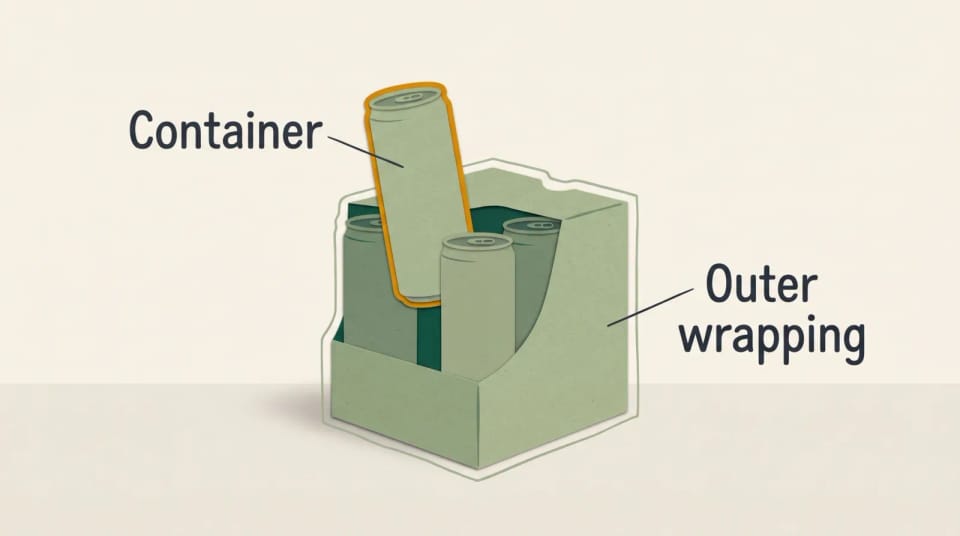
Ohio counts THC per container, which the statute defines as the innermost package touching the product. In a four-pack, that is each can.
The math gets lopsided fast. A 10 mg THC seltzer holds 25 times Ohio’s line (10 divided by 0.4). That is our arithmetic; the 0.4 mg figure comes from the statute. Our explainer on the 0.4 mg per-container cap runs the same math for 2, 5 and 50 mg products under the federal rule.
The limit counts THCA, not only delta-9 THC. If that distinction is new to you, start with total THC instead of delta-9.
Didn’t a court block Ohio’s hemp ban?
A court blocked part of it for a while, and most of that block is now paused. The fight has run on two tracks: state courts and federal court.
| Date (2026) | Court | What happened |
|---|---|---|
| March 20 | None | SB 56’s hemp definition takes effect |
| April | Franklin County Common Pleas | Temporary order lets two businesses keep selling to adults 21 and older (Ohio Capital Journal) |
| June 4 | U.S. District Court, N.D. Ohio | Ten out-of-state hemp companies sue nearly 100 county and city prosecutors’ offices (Cannabis Business Times) |
| June 15 | N.D. Ohio | Temporary restraining order for the ten companies |
| June 24 | Franklin County | A magistrate denies a preliminary injunction; the 10th District Court of Appeals had already stayed the earlier state order (States Newsroom) |
| July 13 | N.D. Ohio | Preliminary injunction in Titan Logistics Group v. Tischler |
| August 7 | N.D. Ohio | A second group of plaintiffs wins a restraining order in Delta Beverages v. Canepa (Justia) |
| September 4 | N.D. Ohio | Preliminary injunction in Delta Beverages |
| September 25 | Sixth Circuit | Stays most of the Titan Logistics injunction pending appeal |
| October 7 | N.D. Ohio | Stays the Delta Beverages injunction on the same terms |
| October 22 | Sixth Circuit | Oral argument in the Titan Logistics appeal (CourtListener audio) |
The federal plaintiffs have no physical presence in Ohio. Their argument is about the dormant Commerce Clause, the constitutional rule that a state may not favor its own businesses over out-of-state ones. In July, Judge Jeffrey Helmick described SB 56 as a law that “exclude[s] federally legal intoxicating hemp products from Ohio’s statutory definition of hemp, redefine[s] them as illegal marijuana, and then … prohibit[s] any company from cultivating or selling those products unless the company has a physical presence in the State of Ohio.” States Newsroom
Every one of these rulings is preliminary. A judge found the plaintiffs likely to succeed; no court has decided the case on its merits. In June, the same judge also recognized “the state’s strong interest in maintaining consumer safety.” Cannabis Business Times
What did the Sixth Circuit change on September 25?
It shrank the injunction to a sliver. Here is what the July order said, side by side with what survives.
| Question | July 13 injunction | Since September 25 |
|---|---|---|
| Who is protected? | The named plaintiffs, “or any person or organization possessing, selling, distributing, or consuming Plaintiffs’ products” | “The named Plaintiffs only” |
| From what? | Any enforcement that “relates to the statutory definition of ‘hemp’ as amended by Senate Bill 56” | Only Ohio’s “geographic sourcing restriction” and any rule that “conditions Plaintiffs’ market participation on cultivation or processing operations taking place in Ohio” |
| Can Ohio apply the 0.4 mg definition to them? | No, for federally legal hemp products | The injunction is stayed “in all other respects pending appeal” |
Sources: the July 13 order and the district court’s October 7 order, which quotes the Sixth Circuit’s September 25 order word for word.
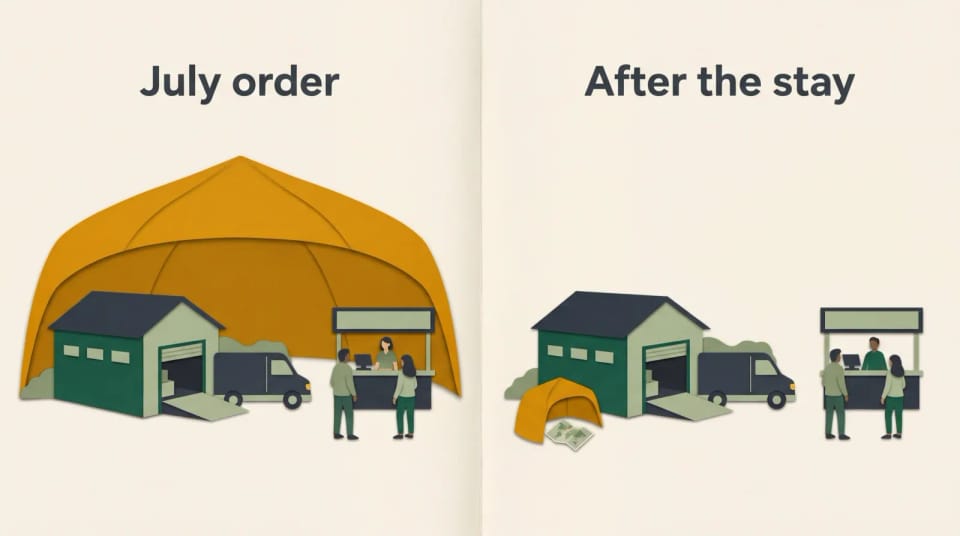
In July, the injunction covered the plaintiffs and anyone selling or buying their products. Since September 25, it covers only the named plaintiffs, and only against Ohio’s in-state sourcing and processing rules.
On October 7, Judge Helmick applied the same limits to the Delta Beverages injunction. He found that Ohio had shown “a strong likelihood of success on the merits of part” of its appeal. N.D. Ohio, October 7, 2026
A stay pending appeal is not a final ruling. It does not mean the courts upheld SB 56. It means that, for now, the broad version of the order is not in force.
Can stores, bars or gas stations still sell hemp THC in Ohio?
Not above 0.4 mg per container, unless they hold a dispensary license. The state’s rule, in its own words, is that such a product “is prohibited from being sold outside of a cannabis dispensary licensed by the Division of Cannabis Control.” Ohio Department of Commerce
The remaining court order does not change that answer for shoppers. Its protection for “any person or organization possessing, selling, distributing, or consuming Plaintiffs’ products” is the part the Sixth Circuit stayed. N.D. Ohio, October 7, 2026
We can’t tell you which shops follow the law today. We found no public enforcement data and no list of current sellers. What you can check is the product and the store.
How can you check a product before you buy it?
Use the label and the state’s own tools. The Division of Cannabis Control points buyers to its dispensary map and its seal. Ohio Department of Commerce
- Find total THC per container. Look for total THC, including THCA. If the label lists THC per serving, multiply by the number of servings in the innermost package.
- Compare it with 0.4 mg. Above that line, Ohio classifies the product as marijuana, which only a licensed dispensary can sell.
- Check the seller. Look the store up on the Division’s dispensary map and look for the Division’s seal at the entrance.
- Check the package. The Division says its seal on packaging shows the product met state safety standards.
The High IQ app can scan a label so you have the cannabinoid numbers in one place, but the legal test is the per-container figure and a licensed seller.
If a hemp product makes you feel unwell, such as a racing heart, confusion or vomiting, stop using it and talk to a clinician or your local poison center. This lesson is about the law, not medical care.
Why did Ohio say it passed the ban?
The state’s stated reason is consumer safety, especially for children. The Division’s March release described banned products that “were untested and sold outside of Ohio’s regulated cannabis market,” including beverages and items “marketed as candies, cereals, and gummies to appeal to children.” Ohio Department of Commerce
For the research behind that concern, see the child-safety case for tighter hemp rules. For how Ohio’s move fits next to other states, see the 2026 hemp-versus-cannabis landscape and the state-by-state delta-8 table.
What happens next?
The Sixth Circuit will decide the Titan Logistics appeal. Argument took place on October 22, 2026, and we found no ruling as of October 29. CourtListener We won’t guess the outcome or the timing.
Federal law is also changing. Most federal hemp changes take effect on December 11, 2026; our guide to federal hemp dates explains which date applies to what. Ohio’s 0.4 mg line already applies now, whatever happens federally.
Key takeaways
- Since March 20, 2026, a hemp product with more than 0.4 mg of total THC per container is marijuana under Ohio law.
- Only a dispensary licensed by the Division of Cannabis Control may sell it.
- The “container” is the innermost package: each can, each bag, each cartridge.
- Since September 25, the federal injunction protects only the named plaintiffs, and only from Ohio’s in-state sourcing and processing rules.
- The protection for buyers and resellers of plaintiffs’ products is stayed. The appeal is argued and undecided.
FAQ
Is THCA flower legal in Ohio after SB 56?
Not outside a dispensary. Ohio counts THCA toward total THC, and the state classifies any product above 0.4 mg of total THC per container as marijuana. Even one gram of flower at the 0.3 percent plant line holds about 3 mg of total THC (1,000 mg times 0.003), our arithmetic. Our guide to THCA flower rules covers the federal side.
Is CBD oil still legal in Ohio?
A CBD product can still be hemp under Ohio law if it stays at or under 0.4 mg of total THC per container. It must also contain no cannabinoids that were synthesized or made outside the plant. Products that miss either test fall into the marijuana definition. Check the per-container total THC on the label, and do not assume every CBD product passes.
Can you still buy THC drinks at an Ohio store or taproom?
Not if a drink holds more than 0.4 mg of total THC per can or bottle, unless the seller is a licensed dispensary. The Division of Cannabis Control says such products are prohibited from sale outside a licensed dispensary. Licensed dispensaries may sell marijuana beverages that meet the Division’s testing, packaging and labeling standards.
Does the injunction protect me if I buy a plaintiff’s product?
Not anymore. The July order covered anyone “possessing, selling, distributing, or consuming” the plaintiffs’ products. The Sixth Circuit stayed that part on September 25, so the order now covers the named plaintiffs only.
Did a court rule Ohio’s hemp ban unconstitutional?
No. The district court found the plaintiffs likely to succeed on part of their claim, which is a preliminary finding. The Sixth Circuit then stayed most of that injunction, and the appeal is still pending.



