Is THCA Flower Legal After December 11, 2026?
Is THCA flower legal after December 11, 2026? A typical 20% THCA bud tests near 17.7% total THC, about 59 times the federal hemp line.

On December 11, 2026, a typical high-THCA flower bud and a THCA pre-roll no longer meet the federal definition of hemp.
Last checked: October 8, 2026. This is a High School lesson, not legal advice. A later statute, rule, or court order can change the picture after this date.
People call the change a THCA flower ban. The statute does the work by rewriting what hemp is. A jar can still say 0.2% delta-9 and hold a bud near 20% THCA. Count that THCA, and the same bud lands near 17.7% total THC. That is about 59 times the federal 0.3% hemp line. The arithmetic is below, with the statute next to it.
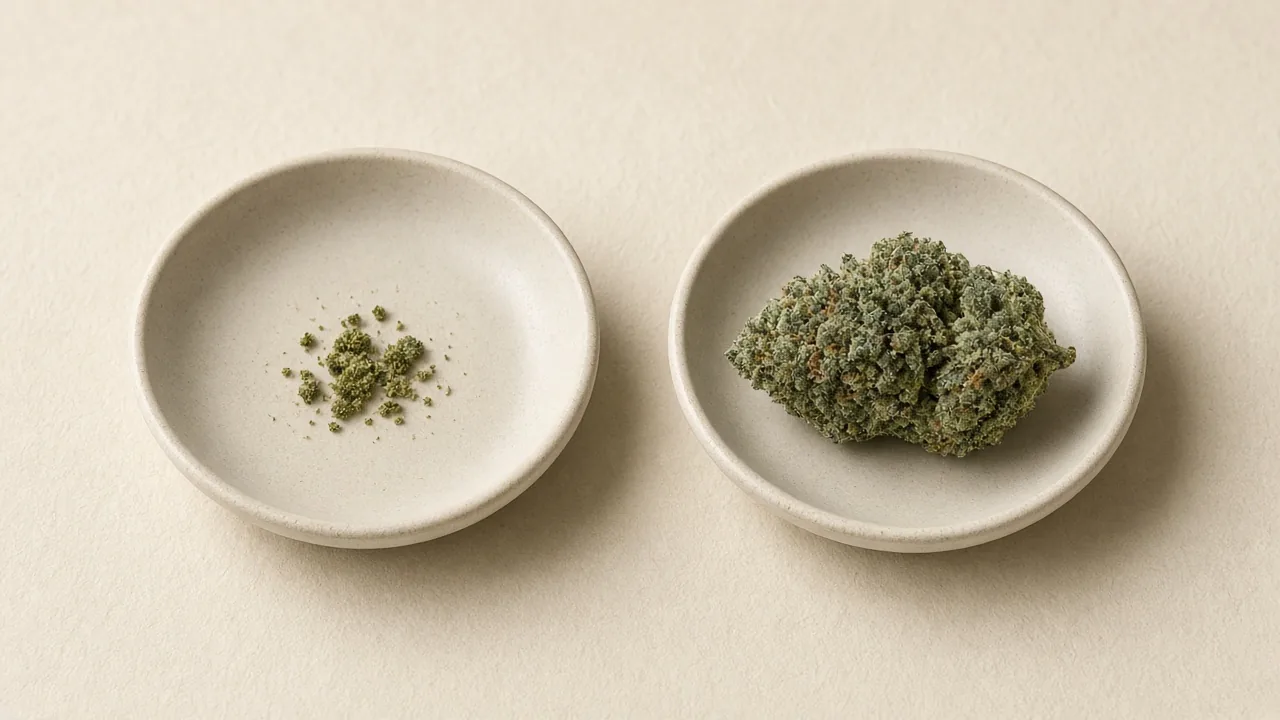
The photo at the top is a scale picture, not a weighed lab sample. The pinch stands in for how small the federal hemp ceiling is next to a typical high-THCA bud. It is not a photo of 0.3% beside 17.7%.
What happens to THCA flower on December 11, 2026?
Two federal tests land on the same day for plant-made cannabinoids. Both come from section 781 of Public Law 119-37, at 139 Stat. 558–561. That section amends section 297A of the Agricultural Marketing Act, which is 7 U.S.C. 1639o.
The first test is the hemp definition itself. Hemp means the plant Cannabis sativa L. and any part of it, including cannabinoids and acids, with a total tetrahydrocannabinols concentration, including THCA, of not more than 0.3 percent on a dry weight basis. A high-THCA bud is a part of the plant. If its total, counting THCA, is over 0.3 percent, it misses this definition.
The second test is a finished-product cap. A final hemp-derived cannabinoid product is outside hemp if it holds more than 0.4 milligrams combined total per container of total tetrahydrocannabinols, including THCA, plus any other cannabinoids that have similar effects, or are marketed to have similar effects, as determined by the Secretary of Health and Human Services. The statute lists inhalation as a way a person can use that kind of product. A pre-roll is made to be inhaled.
THCA is the acid form made in the plant. Heat drops a small chemical piece and leaves delta-9 THC. That reaction is chemistry, not a health claim. The mechanism is in our research note on THCA decarboxylation.
The wider map of the 2026 law sits in the November hemp-law lesson. This page stays on flower and pre-rolls. Converted delta-8 has its own lesson, with federal dates and a state table: Is Delta-8 Legal? Federal Dates and a State-by-State Table.
Why did the date move from November 12?
Section 781 was written to take effect 365 days after Public Law 119-37 was enacted. That enactment date is November 12, 2025, so the original date was November 12, 2026.
Congress then passed Public Law 119-103, the Continuing Appropriations and Extensions Act, 2027. The enrolled act is dated September 2, 2026, and it is H.R. 6500. Section 2019, at 140 Stat. 1003, says that until December 11, 2026, the section 781 amendments apply only to products described in paragraphs (1)(C)(ii)(I) and (1)(C)(iv)(I). Read section 2019.
Those two slices cover intermediate products and final products that contain cannabinoids the cannabis plant cannot naturally produce. THCA is made by the plant. Flower and THCA pre-rolls are not in that November 12 slice. For them, the new hemp text waits until December 11, 2026.
The 2026 hemp landscape lesson walks the wider split between hemp rules and state cannabis rules. The date on a flower jar is the narrower question here.
How can a 20% THCA bud miss a 0.3% line by about 59 times?
Start with a made-up label, not a jar this page tested. Say the certificate of analysis shows 20.0% THCA and 0.2% delta-9 THC. A reader who only checks delta-9 still sees a number under 0.3%. That habit is the old hemp test.
The number 0.877 is not printed in section 781. It lives in the USDA hemp production rule, 7 CFR 990.1, checked on October 8, 2026. For liquid chromatography, that rule says total THC equals 0.877 times THCA, plus THC. The factor is the share of the THCA molecule that remains after the acid group leaves. The chemistry of that step is the point of Total THC vs delta-9. How to read a lab result shows where those two lines sit on a certificate.
Apply the USDA lab factor to the example:
- 0.877 times 20.0 equals 17.54.
- 17.54 plus 0.2 equals 17.74.
- 17.74 divided by 0.3 equals 59.13.
Round the headline to about 17.7% total THC, and about 59 times the 0.3% line. The unrounded steps are the ones to trust.
The statute’s own words are even stricter if a lab refuses the 0.877 factor. Section 781 says to include tetrahydrocannabinolic acid in the total. Gram for gram, 20% THCA is already far over 0.3%. The factor is how USDA has measured potential delta-9. It is not a discount the new statute prints.
The live eCFR page for 7 CFR 990.1 still defines hemp, in that production rule, as total delta-9 of not more than 0.3%. That sentence is the older program text. It is not a rewrite of section 781. Use the public law for the December 11 definition, and use 990.1 for the lab factor.
One more USDA sentence matters. The same rule defines an “acceptable hemp THC level” for plan compliance. A lab applies its measurement uncertainty, and the sample can pass the plan if the range still includes 0.3% or less. The rule gives an example of 0.35% plus or minus 0.06%. It then says this plan tool affects neither the statutory definition of hemp in 7 U.S.C. 1639o nor the definition of marihuana in 21 U.S.C. 802(16). A result near 17% cannot fall inside a range that includes 0.3%.
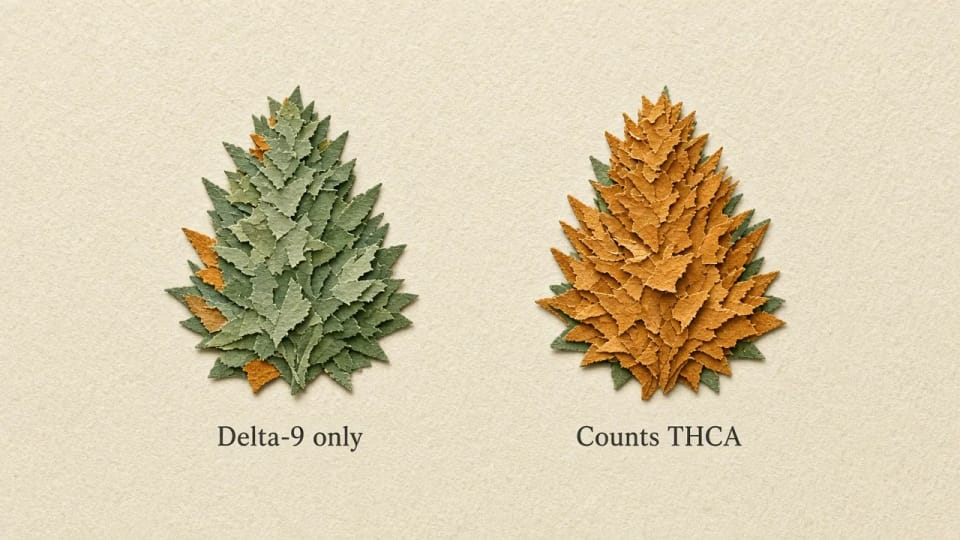
The left label is the old delta-9 habit. The right label is the December 11 idea: count THCA. The image has no percentages. The table has the math.
| What the test counts | This 20% THCA example | Where it lands |
|---|---|---|
| Delta-9 only | 0.2% delta-9 | Under the old 0.3% habit |
| USDA lab total THC | 0.877 × 20.0 + 0.2 = 17.74% | About 59 times the 0.3% line |
| THCA, gram for gram | 20% THCA | Still far over 0.3% |
| Finished-product cap | 200 mg THCA in 1 gram | Over the 0.4 mg container cap |
The container math is a separate exclusion, and section 781 does not print 0.877 inside the milligram sentence. One gram is 1,000 milligrams. Twenty percent of that gram is 200 milligrams of THCA. The cap is 0.4 milligrams per container. 200 divided by 0.4 is 500. If someone still applies 0.877 first, 175.4 milligrams divided by 0.4 is about 438. Either reading, a gram of this flower misses a 0.4 milligram cap by a huge margin.
THCA flower and delta-9 flower explains why the two plants can look alike while the lab lines differ. The legal line in this lesson is the new one.
Does a THCA pre-roll follow the same rule?
Yes. A pre-roll is flower in a finished form, meant for inhalation. Section 781 defines a hemp-derived cannabinoid product as something that contains cannabinoids and is meant for human or animal use, including inhalation. A pre-roll fits that description when it is sold as a finished hemp product.
The statute also defines the container. It is the innermost wrapping in direct contact with the final product for retail sale. The examples include a jar, bottle, bag, box, packet, can, carton, or cartridge. A tube or packet around one pre-roll is that kind of container. An outer shipping box is not. The flower inside the pre-roll still has to face the 0.3% plant-part test on its own.
A shopper cannot solve this by moving the same bud into a new bag. The plant part still has to be at or under 0.3% total, counting THCA, and the finished container still has to be at or under 0.4 milligrams combined total. This page does not describe a workaround.
What is still legal, and where?
Industrial hemp, as section 781 defines it, stays inside the hemp term when it matches that definition. The covered uses include the stalk and its fiber, non-cannabinoid stalk derivatives, whole grain, seed oil, cake, nut, hull, and other non-cannabinoid seed compounds. They also include microgreens and edible leaf from an immature plant grown from seed that itself clears the viable-seed THC limit, research plants that do not enter commerce at a college or an independent research institute, and viable seed grown only to produce those materials.
A finished cannabinoid product can also remain hemp if it clears every exclusion. That includes the 0.3% total for the material, counting THCA, and a combined total at or under 0.4 milligrams per container. It also has to avoid cannabinoids the plant cannot naturally make, and plant cannabinoids that were synthesized or manufactured outside the plant. The Health and Human Services lists that name those cannabinoids were not published as of the September 28, 2026 Congressional Research Service update, and an October 8 search did not find a later FDA list.
CBD is not named as a banned cannabinoid in section 781. A CBD product still has to pass the same tests. Flower sold as CBD flower, with high THCA, does not pass. An isolate with no THCA is a different product, and it still has to meet the container cap if any counted cannabinoids are in the package.
State-licensed adult-use flower and medical flower were never hemp. Section 781 does not close those state programs. It also does not make them legal under federal criminal law. Once a product falls outside the hemp definition, the hemp exclusion in the federal marijuana definition no longer covers it. That exclusion is in 21 U.S.C. 802(16). Congressional Research Service In Focus IF13136, updated September 28, 2026, reads the excluded products as marijuana under the Controlled Substances Act. Section 781 itself does not use the word “illegal,” and it does not set a prison term. This page does not invent one.
Where a state already runs licensed sales, the shopper’s path on December 11 is the licensed shop, under that state’s rules. A familiar dispensary flower such as Blue Dream is an example of that regulated flower, not a hemp product and not a legal pass. If you sort dispensary flower by the feel of the product, Balance is one High Family class. That class is a product label. It is not a legal status, and it is not a prediction of a medical effect.
Texas is ahead of December 11 on sales. Adopted rules in 25 TAC Chapter 300 took effect March 31, 2026. They define total delta-9 THC as 0.877 times THCA, plus delta-9 THC. Consumable hemp offered for sale or manufacture has to show total delta-9 at or under 0.3% on a dry weight basis. A 20% THCA flower cannot pass that sale test. The rule is about sale and manufacture. It is not, by itself, a possession statute. The Texas 2026 law guide holds the wider state picture.
A July 2026 Texas Register notice, after the Texas Supreme Court decision in the Sky Marketing case, reinstates schedule definitions that except hemp up to 0.3% delta-9 under the Texas Agriculture Code. The notice does not name “THCA flower.” The Texas Department of State Health Services says the schedule change that affects delta-8 took effect July 31, 2026. Do not read that notice as a line that says THCA flower is Schedule I by name.
Possession is a separate, unsettled question in Texas. On September 15, 2026, KUT quoted Department of State Health Services spokesperson Lara Anton: the agency does not regulate possession of consumable hemp products. The same report said local agencies do not give one answer. Some litigation over the sale rules was still active. This page does not turn that news report into a possession rule.
Rhode Island has already told its licensees what December 11 means for retail hemp products. Cannabis Office Bulletin 2026-7, issued September 11, 2026, and listed on the state bulletins page, says hemp-derived products that are made, processed, distributed, or sold at retail, including online, may not contain more than 0.4 milligrams total THC per container. The bulletin says a product over that line is noncompliant and can draw administrative penalties, including fines, unless the federal government directs otherwise. It tells licensees to remove those products from licensed facilities before December 11. It also says those products cannot be transferred to a licensed cannabis retailer and sold as cannabis. Growing, planting, sampling, and harvest testing under USDA and Rhode Island rules are unchanged. The bulletin is guidance for licensees, and it says it is subject to further federal guidance. It is not a new criminal code.
Other states will not copy Texas or Rhode Island. The state-by-state legal map is the place to start for a home state, and it still has to be read beside the federal date.
Can shops still ship THCA flower after December 11?
The mail path for this flower ran through the hemp definition. On December 11, a typical high-THCA bud no longer meets that definition, so it is not a hemp shipment. State-licensed cannabis flower is sold inside the state’s licensed system. Section 781 does not create a new right to ship marijuana across state lines.
This page does not explain how to pack, mail, or carry cannabis from one state to another. A reader who wants a legal product after the date looks to a licensed in-state seller, or to a hemp product that actually clears the 0.3% total and the 0.4 milligram cap.
What is still unknown?
The FDA lists are unpublished. Section 781 told the FDA to publish, within 90 days of enactment, lists of cannabinoids known to be naturally produced by the plant, THC-class cannabinoids known to occur naturally, other cannabinoids with similar effects, and more detail on the word “container.” Ninety days from November 12, 2025, was February 10, 2026. The public law text spells two words in that duty as “know” and “tetrahyrocannabinol.” This page does not silently correct them. CRS In Focus IF13136, updated September 28, 2026, said the lists were not out. An October 8, 2026 search did not find an FDA list published after that CRS date. That search is not proof the lists can never appear.
Several bills were still pending in that same CRS update. CRS said the House-passed fiscal year 2027 agriculture appropriations bill, H.R. 8646, does not delay the hemp change. CRS said H.R. 7024, H.R. 7010, and S. 3686 would delay the change by two more years, and H.R. 6209 would repeal it. CRS also noted other bills that would set a different limit or a regulatory framework. This page did not re-check each bill’s floor status on Congress.gov on October 8, 2026. A bill is not a delay until it is enacted. Congress has already moved the main date once, from November 12 to December 11, in Public Law 119-103.
Section 781 does not say which agency will enforce flower sales, and it does not publish a fine schedule. The USDA uncertainty cushion in 7 CFR 990.1 cannot pull a 17% result back to 0.3%.
Key takeaways
- On December 11, 2026, federal hemp law counts THCA in the 0.3% dry-weight definition and applies a 0.4 milligram per-container cap to finished hemp cannabinoid products.
- November 12, 2026, remains the date only for products that contain cannabinoids the plant cannot naturally produce. THCA flower is in the December 11 group.
- A sample label of 20% THCA and 0.2% delta-9 is about 17.7% total THC under the USDA 0.877 lab factor, or about 59 times the 0.3% line. Gram for gram, 20% THCA still misses 0.3%.
- One gram of that flower holds 200 milligrams of THCA, hundreds of times the 0.4 milligram container cap. A THCA pre-roll is a finished inhaled product in a container.
- Industrial hemp that matches the statute, a finished product that clears every cap, and state-licensed dispensary flower are different things. Texas already fails high-THCA flower on a sale test. Rhode Island has told licensees to clear products over 0.4 milligrams before December 11.
- FDA cannabinoid lists were still unpublished at the last check. Pending bills cited by CRS on September 28, 2026, are not a second delay unless they become law.
FAQ
Is THCA flower legal right now?
On October 8, 2026, the new federal total that counts THCA has not taken effect for plant-made cannabinoids. That part waits until December 11, 2026. States can be stricter today. Texas sale and manufacture rules have used the 0.877 total-delta-9 formula since March 31, 2026. “Right now” means the date at the top of this page, not a promise about next month.
Does this ban CBD?
Section 781 does not name CBD as a banned cannabinoid. A CBD product still has to stay inside hemp. Plant material has to be at or under 0.3% total, counting THCA, on a dry weight basis. A finished hemp cannabinoid product has to stay at or under 0.4 milligrams combined total per container. High-THCA flower sold as CBD flower misses those tests. A CBD isolate with no THCA is a different product. Similar-effect cannabinoids can face more limits after FDA publishes the lists the statute requires.
Will adult-use dispensary flower change on December 11?
Licensed adult-use flower and medical flower were already outside the hemp program. December 11 does not convert that flower into hemp, and section 781 does not shut the state shop down. Federal law can still treat non-hemp cannabis as marijuana. The change hits products that were using the hemp definition, especially high-THCA flower and THCA pre-rolls sold as hemp.
Could Congress delay December 11 again?
It can pass another law. As of the September 28, 2026 CRS update, bills that would delay or repeal the change were not enacted. Public Law 119-103 already moved most of section 781 from November 12, 2026, to December 11, 2026. Until a new statute is enacted, December 11 is the date for THCA flower.
Does the new rule change a drug test?
No. A drug test looks for THC breakdown products in the body. A hemp label does not change that chemistry. Whether a bud was sold as hemp or as marijuana, the test reads the same kind of result. The drug-test lesson covers what common screens look for.
Sources
All legal limits, dates, and penalties below are tied to the page that states them. Access date for each: October 8, 2026. No DOI applies to these statutes, rules, or agency documents.
- Public Law 119-37, section 781, enacted November 12, 2025, 139 Stat. 558–561. Hemp definition, 0.3 percent total including THCA, 0.4 milligram container cap, industrial hemp, container, and the FDA list duty. GovInfo text.
- Public Law 119-103, section 2019, approved September 2, 2026, 140 Stat. 1003. Until December 11, 2026, section 781 applies only to paragraphs (1)(C)(ii)(I) and (1)(C)(iv)(I). GovInfo text.
- USDA, 7 CFR 990.1, eCFR as checked October 8, 2026. Total THC formula 0.877 times THCA plus THC, and the measurement-uncertainty plan rule. Amended at 86 FR 5680 and 88 FR 82236. eCFR.
- 21 U.S.C. 802(16), marijuana definition and the hemp exclusion, via the Legal Information Institute. Section 802.
- Congressional Research Service, In Focus IF13136, updated September 28, 2026. Delay to December 11, unpublished FDA lists, and the pending bills named in that update. Updated CRS file.
- Texas Register, adopted rules for 25 TAC Chapter 300, effective March 31, 2026. Total delta-9 formula and the consumable-hemp sale standard. Adopted rules.
- Texas Register notice, July 10, 2026 issue. Schedule definitions after the Sky Marketing mandate. Does not name THCA flower. Notice PDF.
- Texas Department of State Health Services, Consumable Hemp Program page. Schedule effective date July 31, 2026, and the adopted rules. DSHS page.
- Nathan Bernier, KUT, September 15, 2026. DSHS statement on possession, and conflicting local agency answers. News reporting, not a statute. KUT.
- Rhode Island Cannabis Control Commission, Cannabis Office Bulletin 2026-7, issued September 11, 2026, listed on the bulletins page. Licensee guidance on the 0.4 milligram cap, administrative fines, and unchanged plant testing. Bulletins page.


