Is Delta-8 Legal? Federal Dates and a State-by-State Table
Is delta 8 legal? The federal path for converted delta-8 points to December 11, 2026, and many states already restrict it. Here is the state table.

As of October 14, 2026, converted delta-8 sold as hemp still leans on the 2018 Farm Bill, the federal text points that product to December 11, 2026, and 19 states already ban the hemp channel.
Last checked: October 14, 2026, for the Texas, Pennsylvania, California, and Colorado rows. The other rows were opened on October 13, 2026. This is a High School lesson, not legal advice. A later statute, rule, or court order can change a row after this date.
The count from the table below is the sendable specific. Nineteen states ban hemp-channel delta-8. Four keep it in the licensed marijuana market. Fifteen allow it with rules such as age, testing, licensing, or a potency cap. Five jurisdictions have no delta-8-specific rule in force today. Eight are unclear because the opened official texts conflict or do not name retail delta-8. That is 51 rows: 50 states and the District of Columbia. “Restrict” in a headline is not the same thing as a ban. The split is the number to use.
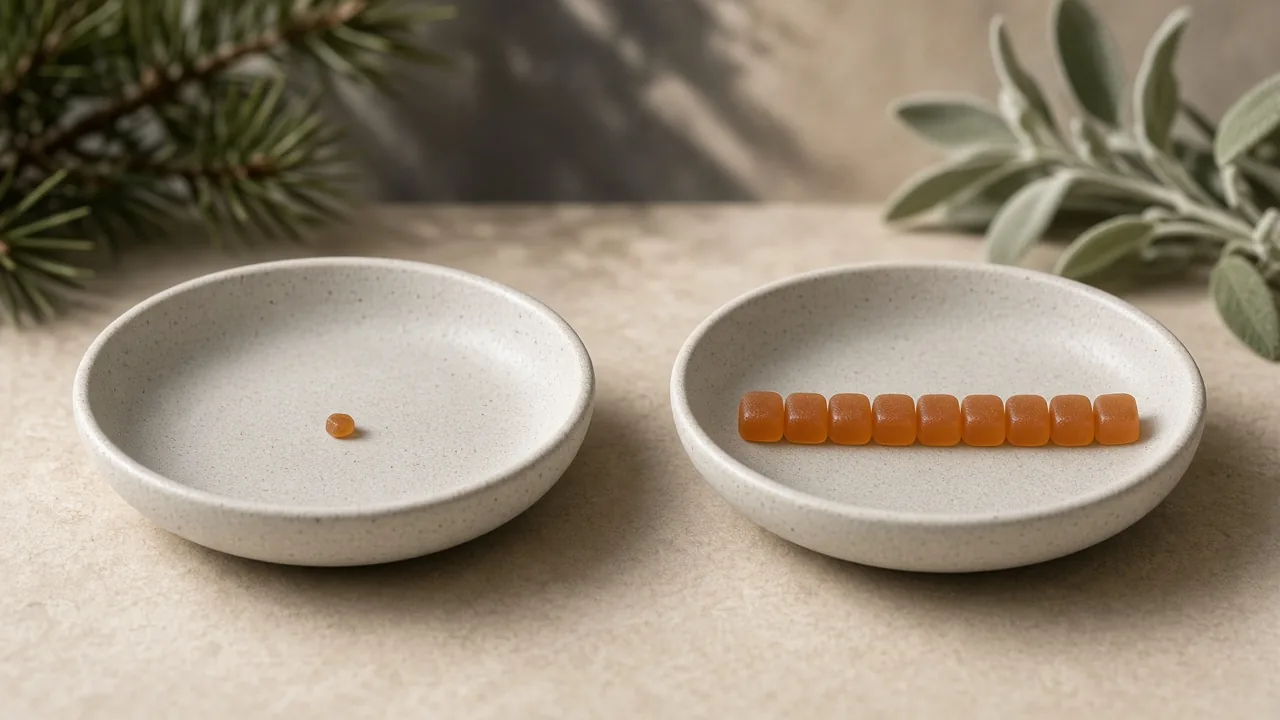
A labeled 12-gummy pack at 25 mg delta-8 each is 300 mg on the label, or 750 times the federal 0.4 mg per-container cap. The assumption is spelled out below. The photo is a scale picture, not that pack and not a weighed sample.
Is delta-8 legal under federal law right now?
On October 13, 2026, no new federal sentence says “delta-8 is legal.” Commercial delta-8 is usually CBD converted outside the plant. Sellers have called that product hemp under the 2018 Farm Bill when delta-9 stays at or under 0.3 percent.
In AK Futures LLC v. Boyd Street Distro, LLC, 35 F.4th 682, opinion filed May 19, 2022, the Ninth Circuit held that the plain text of the 2018 Farm Act covered those delta-8 products. Read the opinion. It was a trademark case, not a possession statute.
Section 781 of Public Law 119-37 rewrites hemp in 7 U.S.C. 1639o. It excludes cannabinoids “synthesized or manufactured outside the plant,” and it sets a 0.4 milligram per-container cap on total tetrahydrocannabinols in a final hemp product. The date map is the November hemp-law lesson. The molecule, apart from the statute, is delta-8 versus delta-9.
What changes for delta-8 on November 12 and December 11, 2026?
Public Law 119-103, section 2019, says that until December 11, 2026, the section 781 amendments apply only to paragraphs (1)(C)(ii)(I) and (1)(C)(iv)(I). Read section 2019. Those slices are cannabinoids the plant cannot naturally produce.
Converted delta-8 is the other prong. The plant can make a trace. The shop product is made outside the plant. Section 2019 does not move that prong to November 12. The text points it to December 11, with the total-THC test and the 0.4 mg cap. THCA flower uses that December date. Hemp THC drinks use the same cap.
FDA had to publish cannabinoid lists. CRS In Focus IF13136, updated September 28, 2026, said they were still unpublished. CRS file. A search on October 13, 2026, did not find a later list. That is not proof a list can never appear. Until the lists exist, the date for one jar is contested.
| Date | What the opened federal text does |
|---|---|
| Today, October 13, 2026 | Converted delta-8 sold as hemp still leans on the 2018 definition, as read in AK Futures. |
| November 12, 2026 | Only cannabinoids the plant cannot naturally produce. |
| December 11, 2026 | Converted delta-8, the total-THC test, and the 0.4 mg per-container cap. |
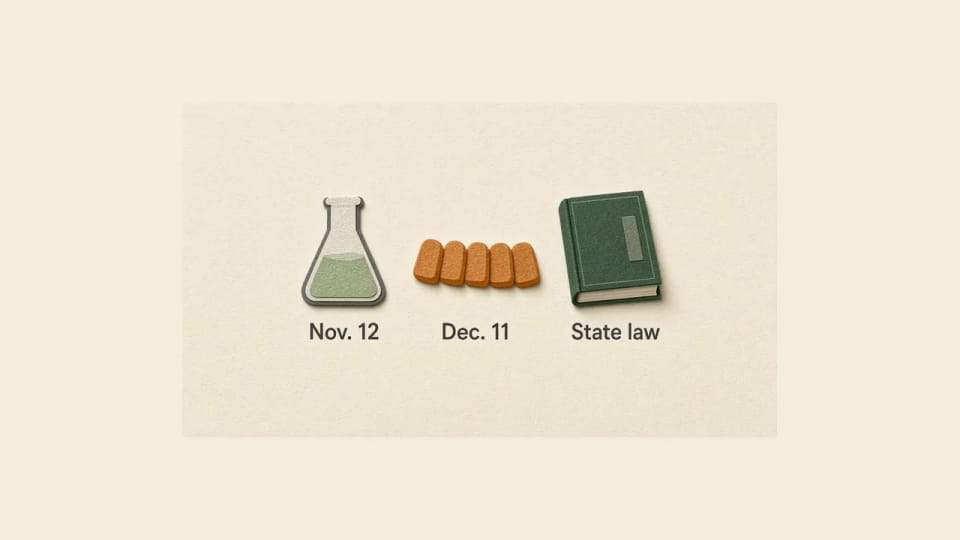
The drawing puts the gummies under December 11, not November 12. The flask stands in for cannabinoids the plant cannot make. The book is state law, which can be stricter on any date. It is a map of authorities, not a product that passed a lab.
Does the 0.4 mg cap cover a delta-8 gummy pack?
Section 781 covers it if you read the cap as written. A final hemp-derived cannabinoid product is outside hemp when it holds more than 0.4 milligrams combined total per container of total tetrahydrocannabinols, including THCA, plus any other cannabinoids that have similar effects, or are marketed as having similar effects, as determined by the Secretary of Health and Human Services. Delta-8 THC is a tetrahydrocannabinol. The container is the innermost wrap that touches the product for retail sale. Total THC versus delta-9 is the dry-weight lesson. This paragraph is the milligram lesson.
Akpunonu and colleagues described a gas-station package of 12 gummies labeled 25 mg delta-8 each. Twelve times 25 is 300 milligrams on that label. Three hundred divided by 0.4 is 750. The labeled pack is 750 times the cap.
Assumption, stated on purpose: this page counts those labeled milligrams as the container total of delta-8 THC. It does not multiply by 0.877, because the label says delta-8 THC, not THCA. The 300 mg figure is the label in the case report, not a weighed assay of every gummy. The report is a pediatric poisoning case. It is not a dose, and it is not a suggestion to buy or eat anything.
The photo at the top is only a scale picture. The crumb stands in for how small 0.4 milligrams is next to a retail row. It is not a photograph of that 12-piece pack.
FDA says these products have not been evaluated or approved for safe use in any context. From December 1, 2020, to February 28, 2022, FDA received 104 adverse-event reports. FDA consumer update. The exposure context for parents is hemp-derived THC and emergency care. This page does not give medical advice.
Indexed Research Hub notes, with no new numbers added here: delta-8 awareness in national surveys, hemp-labeled THC edibles, and cannabis exposures in young children.
HHC is a different molecule. What HHC is stays on that page.
Is delta-8 legal in my state?
State law can ban, cabin, or regulate delta-8 while the federal date is still in the future. The 2026 hemp landscape is the wide map. Where licensed marijuana is legal is a different question from the hemp shop. Single-state guides for Texas, Colorado, Minnesota, Ohio, and Florida sit beside this table. They do not replace a row.
Commercial state roundups were used only to find the statute. They disagree with each other. Every row below was checked against the linked official page. Texas, Pennsylvania, California, and Colorado were rechecked on October 14, 2026. Every other row was last opened on October 13, 2026.
| Status in this table | What it means here | Count |
|---|---|---|
| Banned | The opened hemp-channel text prohibits converted or hemp-sold delta-8. | 19 |
| Licensed market only | Hemp-shop sale is out. A licensed marijuana seller is the path the opened text leaves. | 4 |
| Regulated | Sale can be lawful if age, license, testing, or a potency cap is met. | 15 |
| No specific rule | No delta-8-specific rule was in force in the text opened today. | 5 |
| Unclear | The opened texts conflict, or they never name retail delta-8. The reason is in the row. | 8 |
| Jurisdiction | Status | What the opened text says | Source | Last checked |
|---|---|---|---|---|
| Alabama | Regulated | Age 21, an ABC license, and testing. Edibles and beverages are capped, and chemically converted cannabinoids are prohibited. | Act 2025-385 | Oct 13, 2026 |
| Alaska | Banned | The division lists delta-8 as prohibited because it is chemically modified from CBD. No opened text authorizes a licensed-marijuana sale of that product. | 11 AAC 40.400 | Oct 13, 2026 |
| Arizona | Licensed market only | The attorney general opinion says Arizona law does not permit sale of delta-8 and other hemp-synthesized intoxicants by anyone Health Services has not licensed. | Opinion I24-005 | Oct 13, 2026 |
| Arkansas | Banned | Schedule VI includes delta-8 and hemp products made by a synthetic process into delta-8, delta-9, or delta-10. A later act was certified after the injunction was reversed. | Act 629 of 2023 | Oct 13, 2026 |
| California | Banned | Converting CBD into any tetrahydrocannabinol is a synthetic cannabinoid. That definition is operative July 1, 2026, and a person may not sell a product that contains one. From January 1, 2026, hemp extract in a food, drink, or supplement must be a CBD or CBN isolate above 99 percent purity, with no THC and no synthetic cannabinoid. Until January 1, 2028, a licensee may not sell industrial hemp. | AB 8, chaptered | Oct 14, 2026 |
| Colorado | Banned | Delta-8 THC is an intoxicating cannabinoid. A hemp product may not contain one, and chemical conversion of a cannabinoid for use as a hemp product is prohibited. Only a marijuana research-and-development licensee may manufacture a semi-synthetic cannabinoid, and that license may transfer only to another research facility. | 6 CCR 1010-24 and 1 CCR 212-3 | Oct 14, 2026 |
| Connecticut | Regulated | THC includes delta-8 whatever the source. A moderate-THC hemp product is 0.5 mg to 5 mg total THC per container, sold at 21-plus by a registrant. Above that, it is high-THC hemp. | Chapter 420j | Oct 13, 2026 |
| Delaware | Banned | Schedule I covers preparations with any quantity of tetrahydrocannabinols. The hemp exception opened here is the plant and its parts at or under 0.3 percent delta-9, not an extract or an isomer. | 16 Del. C. 4714 | Oct 13, 2026 |
| District of Columbia | No specific rule | The schedule entry for a substituted delta-8 is a further-substituted class, not plain hemp-derived delta-8. No opened line lists plain tetrahydrocannabinols as that product. | D.C. Code 48-902.04 | Oct 13, 2026 |
| Florida | Regulated | Hemp-derived cannabinoids are not controlled when they meet section 581.217. Ingestion and inhalation are 21-plus, with a lab certificate. The section does not use the words delta-8. | Fla. Stat. 581.217 | Oct 13, 2026 |
| Georgia | Regulated | Sale of consumable hemp to anyone under 21 is unlawful. The opened rules require a license and a certificate that reports delta-8, and they cap total delta-9 by product type. | Rule 40-32-5 | Oct 13, 2026 |
| Hawaii | Banned | The health rule prohibits sale of an artificially derived cannabinoid and gives CBD converted into delta-8 as the example. A naturally extracted cannabinoid is a different, capped product. | HAR 11-37 | Oct 13, 2026 |
| Idaho | Unclear | The schedule exception is tied to industrial hemp at 0.3 percent total delta-9 and includes isomers. A state page says retail products must be zero percent THC. The opened 2026 bill does not set a delta-8 number. | Idaho Code 37-2705 | Oct 13, 2026 |
| Illinois | Regulated | Until November 12, 2026, sale to anyone under 21 is barred for products synthesized outside the plant or over 0.4 mg THC per container. The Industrial Hemp Act repeal lands the same day and is not today’s rule. | P.A. 104-463 | Oct 13, 2026 |
| Indiana | Banned | The schedule covers tetrahydrocannabinols regardless of the numerical designation of atomic positions. The attorney general opinion places delta-8 in that entry. Low-THC hemp extract cannot contain another controlled substance. | Opinion 2023-1 | Oct 13, 2026 |
| Iowa | Banned | The hemp exclusion fails if THC, including isomers and synthetics, exceeds 0.3 percent. Registrants may not sell a synthetic consumable hemp product, and the rule names delta-8. | Iowa Code 124.204 | Oct 13, 2026 |
| Kansas | Regulated | A final hemp product must stay at or under 0.3 percent combined tetrahydrocannabinol, including optical isomers. Cigarettes, teas, and vaporizer forms are unlawful. | K.S.A. 65-4105 | Oct 13, 2026 |
| Kentucky | Regulated | Adult-use cannabinoid products, and delta-8 is listed, are not sold to anyone under 21. Registration is required. A non-intoxicating ratio has its own milligram ceiling. | 902 KAR 45:021 | Oct 13, 2026 |
| Louisiana | Regulated | THC means any tetrahydrocannabinol. A permit is required, buyers must be 21, and servings are capped. Inhalable products and floral hemp are not an approved retail form. | La. R.S. 3:1482 | Oct 13, 2026 |
| Maine | Regulated | Delta-8 is listed as a potentially intoxicating cannabinoid. Products in that class are not sold to anyone under 21, and an ingestible needs the applicable license. | 7 M.R.S. 2231 | Oct 13, 2026 |
| Maryland | Regulated | More than 0.5 mg THC per serving or 2.5 mg per package cannot be sold for consumption or inhalation unless the seller is licensed under the cannabis title. Cannabinoids not from naturally occurring constituents are prohibited. | Alc. Bev. 36-1102 | Oct 13, 2026 |
| Massachusetts | Banned | The opened health page says the state hemp program does not allow hemp-derived delta-8 THC products to be processed or sold. No statute that itself uses the words delta-8 was opened. | MDAR position | Oct 13, 2026 |
| Michigan | Licensed market only | A business without the proper license may not make, possess, or sell delta-8 THC. THC includes any tetrahydrocannabinol, natural or artificial. Over 0.3 percent in the form sold, it is marihuana. | CRA notice | Oct 13, 2026 |
| Minnesota | Banned | An approved cannabinoid for lower-potency hemp edibles is hemp-derived delta-9. An artificially derived cannabinoid includes THC created from CBD. The old edible-cannabinoid section was repealed. | Minn. R. 9810.2100 | Oct 13, 2026 |
| Mississippi | Unclear | The schedule covers THC structures, then says tetrahydrocannabinols do not include hemp regulated under the hemp-cultivation sections. No opened section names retail delta-8. | Miss. Code 41-29-113 | Oct 13, 2026 |
| Missouri | No specific rule | The new section that would treat hemp-derived cannabinoids, including ones made outside the plant, as marijuana is labeled effective November 12, 2026. It is not in force today. | RSMo 195.900 | Oct 13, 2026 |
| Montana | Banned | A person may not manufacture or offer a synthetic cannabinoid. Synthetic includes a cannabinoid produced artificially. A separate hemp cap on total delta-9 does not authorize that synthetic product. | MCA 16-12-117 | Oct 13, 2026 |
| Nebraska | Unclear | The hemp statute says hemp shall not be considered a controlled substance when delta-9 is at or under 0.3 percent. The attorney general has sued over chemically converted delta-8. No controlling judgment was opened. | Neb. Rev. Stat. 2-503 | Oct 13, 2026 |
| Nevada | Banned | A person shall not sell a synthetic cannabinoid. Synthetic includes one not taken from the plant without a chemical reagent. The THC definition includes delta-8. | NRS 453.572 | Oct 13, 2026 |
| New Hampshire | Unclear | The sentence in force says the chapter does not authorize sale of hemp products with THC over 0.3 percent, including delta-8. The sentence that says such products are prohibited is not effective until January 1, 2027. | RSA 439-A:4 | Oct 13, 2026 |
| New Jersey | Banned | From April 13, 2026, sale of a final hemp product that contains a cannabinoid synthesized or manufactured outside the plant is unlawful unless another authorization applies. A separate beverage path for named licensees was also in the opened act. | P.L. 2026, c. 7 | Oct 13, 2026 |
| New Mexico | Unclear | A hemp facility may not sell a semi-synthetic cannabinoid, defined as one cannabinoid chemically converted into another. The opened rule’s “hemp facility” does not clearly include every hemp retailer, and a retailer-sale bill died. | 20.10.2 NMAC | Oct 13, 2026 |
| New York | Banned | Cannabinoid hemp products offered for retail shall not contain cannabinoids created through isomerization, including delta-8 and delta-10. Adult-use rules also bar artificially derived cannabinoids other than decarboxylation. | 9 NYCRR 114.8 | Oct 13, 2026 |
| North Carolina | No specific rule | Schedule VI includes tetrahydrocannabinols except those in a product with delta-9 at or under 0.3 percent. The section does not name delta-8. A bill that would add delta-8 is not law. | G.S. 90-94 | Oct 13, 2026 |
| North Dakota | Banned | A person may not sell hemp or a hemp product that contains a chemically derived cannabinoid or delta-8 tetrahydrocannabinol. The THC definition includes delta-8. | N.D.C.C. 4.1-18.1 | Oct 13, 2026 |
| Ohio | Licensed market only | Hemp does not include a final product with a cannabinoid synthesized or manufactured outside the plant, or with more than 0.4 mg combined total per container. What is not hemp is marihuana. A licensed dispensary may sell adult-use marijuana to people 21 and older. | Ohio Rev. Code 928.01 | Oct 13, 2026 |
| Oklahoma | No specific rule | The amended definition that would fold hemp-derived tetrahydrocannabinols into the controlled-substance definition is labeled effective November 1, 2026. It is not in force today. | 63 O.S. 2-101 | Oct 13, 2026 |
| Oregon | Banned | The cannabis commission says products with artificially derived cannabinoids cannot be sold to Oregon consumers outside the licensed marijuana system, and licensees also may not sell an impairing artificially derived cannabinoid. | OLCC hemp page | Oct 13, 2026 |
| Pennsylvania | Unclear | The 1972 Act lists tetrahydrocannabinols in Schedule I. The text opened here does not use the words delta-8 and contains no hemp exception. The agriculture FAQ defines hemp by the federal delta-9 test, including cannabinoids and isomers, and says there is no state retail license. That page is a guide, not a legal interpretation, and it does not settle a hemp-shop delta-8 sale. | PDA hemp FAQ | Oct 14, 2026 |
| Rhode Island | Regulated | Total THC, including isomers, may not exceed 1 mg per serving, 5 mg per package, or 0.3 percent by dry weight. Sale is to people 21 and older by a licensee, with required testing. | 560-RICR-10-20-1 | Oct 13, 2026 |
| South Carolina | Unclear | The hemp act defines hemp by the federal delta-9 level and says marijuana does not include tetrahydrocannabinol in hemp. A 2021 attorney general opinion read that act as not legalizing delta-8. A 2026 ban bill did not become law. | S.C. Code 46-55-10 | Oct 13, 2026 |
| South Dakota | Banned | No person may convert cannabidiol into delta-8 tetrahydrocannabinol, or sell or distribute an industrial hemp product that contains chemically derived cannabinoids. | SDCL 34-20B-118 | Oct 13, 2026 |
| Tennessee | Regulated | Hemp-derived cannabinoid includes delta-8. Sale over 0.3 percent total THC is unlawful. A license and age 21 apply, and a package may not exceed 20 servings or 300 mg of hemp-derived cannabinoids in the aggregate. | Public Chapter 526 | Oct 13, 2026 |
| Texas | Banned | Health and Safety Code chapter 443 and 25 TAC §300.701, effective March 31, 2026, regulate consumable hemp with testing, a delta-9 cap, and age 21. Those rules do not name delta-8. The July 10, 2026 schedule puts tetrahydrocannabinols in Schedule I except up to 0.3 percent delta-9 in hemp, including isomers regardless of numerical designation. Sky Marketing, No. 23-0887 (May 1, 2026), held the 2019 hemp statute decontrolled only the exceedingly trace delta-8 that occurs naturally in the plant. | July 10, 2026 notice | Oct 14, 2026 |
| Utah | Regulated | A cannabinoid product may include a THC analog such as delta-8 only inside the serving and package caps, and only under the percentage tests. A chemical conversion that changes the molecule is an adulterant. | Utah Code 4-41-102 | Oct 13, 2026 |
| Vermont | Licensed market only | Making or selling a hemp-derived intoxicating cannabinoid, including delta-8 created by chemical manipulation, is prohibited except a product registered and taxed as cannabis or an authorized medical or FDA product. | CCB Rule 2.17 | Oct 13, 2026 |
| Virginia | Regulated | A hemp product offered for retail may contain no more than 0.3 percent total THC and no more than 2 mg total THC per package. Tetrahydrocannabinol includes isomers. | Va. Code 4.1-600 | Oct 13, 2026 |
| Washington | Unclear | One statute prohibits synthetically derived cannabinoids and also requires a license to sell a cannabis product. The liquor and cannabis board page says unlicensed stores may not sell any detectable THC, including hemp-derived delta-8. Those official texts do not settle whether a licensed shop may sell converted delta-8. | RCW 69.50.3251 | Oct 13, 2026 |
| West Virginia | Regulated | Hemp-derived cannabinoid includes delta-8. The statute’s purpose is limited regulated access for adults 21 and older, with a permit and testing. The Schedule I listing does not apply to a product lawful under that chapter. | W. Va. Code 19-12E-12 | Oct 13, 2026 |
| Wisconsin | No specific rule | Tetrahydrocannabinols are scheduled except those contained in hemp. Hemp includes cannabinoids and isomers when delta-9 is at or under 0.3 percent, or the federal maximum up to 1 percent, whichever is greater. Neither section names delta-8. | Wis. Stat. 94.55 | Oct 13, 2026 |
| Wyoming | Banned | No person or licensee may include a synthetic substance in hemp or a hemp product. THC includes psychoactive isomers, and the schedule expressly lists delta-8. | 2024 SF0032 | Oct 13, 2026 |
If a product you already have sits under a row that is about to change, a simple log of what you used, when, and how much is the useful record. How to build a cannabis journal that actually helps is the method. This page does not add a shop, a price, or a launch date.
What does “unclear” mean in this table?
Unclear means the official pages opened for that row do not answer the retail question. Idaho, Mississippi, Nebraska, New Hampshire, New Mexico, Pennsylvania, South Carolina, and Washington are in that cell. Each row states the conflict in one line. The label is not a wink that the product is allowed.
A future effective date is also not today’s law. Missouri’s marijuana reclassification is dated November 12, 2026. Oklahoma’s tetrahydrocannabinols amendment is dated November 1, 2026. New Hampshire’s prohibition sentence is dated January 1, 2027. Illinois still has a hemp-act rule today, and a repeal on November 12, 2026. Those dates are written in the rows so a reader does not treat next month as this morning.
Key takeaways
- As of October 13, 2026, converted delta-8 sold as hemp still leans on the 2018 Farm Bill reading in AK Futures. That case is a trademark decision, not a possession statute.
- November 12, 2026, is the federal date only for cannabinoids the plant cannot naturally produce. The opened text points converted delta-8, the total-THC test, and the 0.4 mg cap to December 11, 2026.
- FDA’s cannabinoid lists were still unpublished in the September 28, 2026 CRS update. The date for one product stays contested until those lists exist.
- A 12-count pack labeled 25 mg delta-8 per gummy is 300 mg on the label, or 750 times 0.4 mg. That math uses the label, not a weighed assay, and it is not a dose.
- The table counts 19 hemp-channel bans, 4 licensed-market limits, 15 regulated states, 5 jurisdictions with no delta-8-specific rule in force, and 8 unclear rows. State law can be stricter than the federal date.
FAQ
Is delta-8 legal in all 50 states?
No. The October 14, 2026 table counts 19 states that ban the hemp channel, 4 that leave it to the licensed marijuana market, 15 that allow it only with rules, 5 jurisdictions with no delta-8-specific rule in force, and 8 where the opened text is unclear. A national “yes” does not survive that split.
Which states have banned delta-8?
The banned rows are Alaska, Arkansas, California, Colorado, Delaware, Hawaii, Indiana, Iowa, Massachusetts, Minnesota, Montana, Nevada, New Jersey, New York, North Dakota, Oregon, South Dakota, Texas, and Wyoming. California classifies CBD converted into tetrahydrocannabinol as a synthetic cannabinoid and prohibits sale of a product that contains one. Colorado classifies delta-8 as an intoxicating cannabinoid that cannot be sold in a hemp product, and only a research-and-development licensee may manufacture a converted cannabinoid. Hawaii’s ban is on artificially derived cannabinoids, with CBD-to-delta-8 given as the example. A trace extracted from the plant is a different sentence in that rule. Massachusetts rests on the hemp program’s own page, because no statute using the words delta-8 was opened. Texas stays banned for manufactured delta-8 above a natural trace. Its age-21 consumable-hemp rules do not authorize that product. Pennsylvania is unclear, not banned.
Is delta-8 federally legal?
As of October 13, 2026, converted delta-8 sold as hemp is leaning on the 2018 definition, the reading in AK Futures. Public Law 119-37 section 781 excludes cannabinoids synthesized or manufactured outside the plant, and Public Law 119-103 points that prong to December 11, 2026, not November 12. FDA lists that would settle edge cases were still unpublished in the September 28, 2026 CRS update.
Is delta-8 legal after December 11?
Section 2019 of Public Law 119-103 points converted delta-8 and the 0.4 mg per-container cap to December 11, 2026. That date is contested. It is subject to implementation and to litigation, because FDA’s cannabinoid lists were still unpublished in the September 28, 2026 CRS update. A product the plant cannot naturally produce is already in the November 12 group. A state ban does not wait for December 11. A state license does not expire because the federal hemp definition moves. Congress can pass another delay. No such delay was enacted in the sources opened for this page.
Will delta-8 show up on a drug test?
A hemp label does not change what a drug test measures. The screen looks for THC breakdown products. Whether delta-8, delta-10, or HHC can trip a common test is the subject of the drug-test lesson. This page does not add a new lab result.
Sources
All limits, dates, and status labels below are tied to the page that states them. Access date for the federal sources: October 13, 2026. Texas, Pennsylvania, California, and Colorado were rechecked on October 14, 2026. Statutes and agency pages do not have a DOI. The case report does.
- Public Law 119-37, section 781, enacted November 12, 2025, 139 Stat. 558-561. Hemp definition, the synthesized-outside-the-plant exclusion, the 0.4 milligram container cap, and the FDA list duty. GovInfo text.
- Public Law 119-103, section 2019, approved September 2, 2026, 140 Stat. 1003. Until December 11, 2026, section 781 applies only to paragraphs (1)(C)(ii)(I) and (1)(C)(iv)(I). GovInfo text.
- AK Futures LLC v. Boyd Street Distro, LLC, No. 21-56133, 35 F.4th 682, 9th Circuit, opinion filed May 19, 2022. Trademark holding that the 2018 Farm Act text covered the delta-8 products in that case. Opinion PDF.
- Congressional Research Service, In Focus IF13136, updated September 28, 2026. Delay to December 11, and cannabinoid lists still unpublished as of that update. CRS file.
- U.S. Food and Drug Administration consumer update, 5 Things to Know about Delta-8 Tetrahydrocannabinol. Products not evaluated or approved for safe use. Adverse-event count is the agency’s own figure for December 1, 2020, through February 28, 2022. FDA page.
- Akpunonu P, Baum RA, Reckers A, Davidson B, Ellison R, Riley M, Trecki J, Gerona R. Sedation and Acute Encephalopathy in a Pediatric Patient Following Ingestion of Delta-8-Tetrahydrocannabinol Gummies. American Journal of Case Reports. 2021. Twelve gummies labeled 25 mg delta-8 each. doi:10.12659/AJCR.933488
- Texas Register, July 10, 2026, TRD-202602610. The notice reinstates Schedule I tetrahydrocannabinols except up to 0.3 percent delta-9 in hemp, including isomers regardless of numerical designation. Notice PDF. Texas Department of State Health Services v. Sky Marketing Corp., No. 23-0887, opinion delivered May 1, 2026. The 2019 hemp statute decontrolled only the exceedingly trace delta-8 that occurs naturally in the plant. The temporary injunction was reversed. Opinion PDF. 25 TAC §300.701, adopted in the March 20, 2026 Texas Register and effective March 31, 2026, bars sale of a consumable hemp product to a person under 21. The adopted text does not use the words delta-8. Adopted rules.
- Pennsylvania Department of Agriculture, Hemp Program FAQs, opened October 14, 2026. The page is a guide, not a legal interpretation. It defines hemp by the 2018 Farm Bill delta-9 test, including cannabinoids and isomers, and it says Pennsylvania has no state license for retailing hemp products. It does not use the words delta-8. FAQ. The 1972 controlled-substance act still lists tetrahydrocannabinols and, in the text opened here, contains no hemp exception. Act 64 of 1972.
- California Assembly Bill 8, Chapter 248, Statutes of 2025, chaptered text opened October 14, 2026. Business and Professions Code section 26001(bf), operative July 1, 2026, defines a synthetic cannabinoid to include any tetrahydrocannabinol produced by conversion of CBD. Section 26070.2(d) prohibits sale of a product that contains a synthetic cannabinoid. Section 26000.5, until January 1, 2028, prohibits a licensee from selling industrial hemp. Health and Safety Code section 111921.1, operative January 1, 2026, limits food, drink, and supplement hemp extract to a CBD or CBN isolate above 99 percent purity with no THC and no synthetic cannabinoid. Chaptered compare.
- Colorado Department of Public Health and Environment, 6 CCR 1010-24, effective January 14, 2024, opened October 14, 2026. Delta-8 THC and its isomers are intoxicating cannabinoids. A hemp product may not contain an intoxicating cannabinoid, and chemical conversion of a cannabinoid for use as a hemp product is prohibited. Rule PDF. Marijuana Enforcement Division, 1 CCR 212-3 Rule 3-335(G.5), in the version effective January 5, 2026, allows only a marijuana research-and-development licensee to manufacture a semi-synthetic cannabinoid. That license may transfer marijuana only to another research facility under section 44-10-507. Rule PDF. Senate Bill 23-271 is the statute those rules implement. Session law.
- Each state and District of Columbia row links the statute, rule, or regulator page used for that status. Secondary compilations were discovery only and are not cited as the rule.


