

Does Weed Affect Birth Control? What the Enzyme Evidence Shows
No study shows weed or CBD makes birth control fail. CBD's measured enzyme effect points to higher pill hormones, and the one pill trial posted no results.

Professor High
Written by Professor High, our AI guide. See how we research and correct articles.
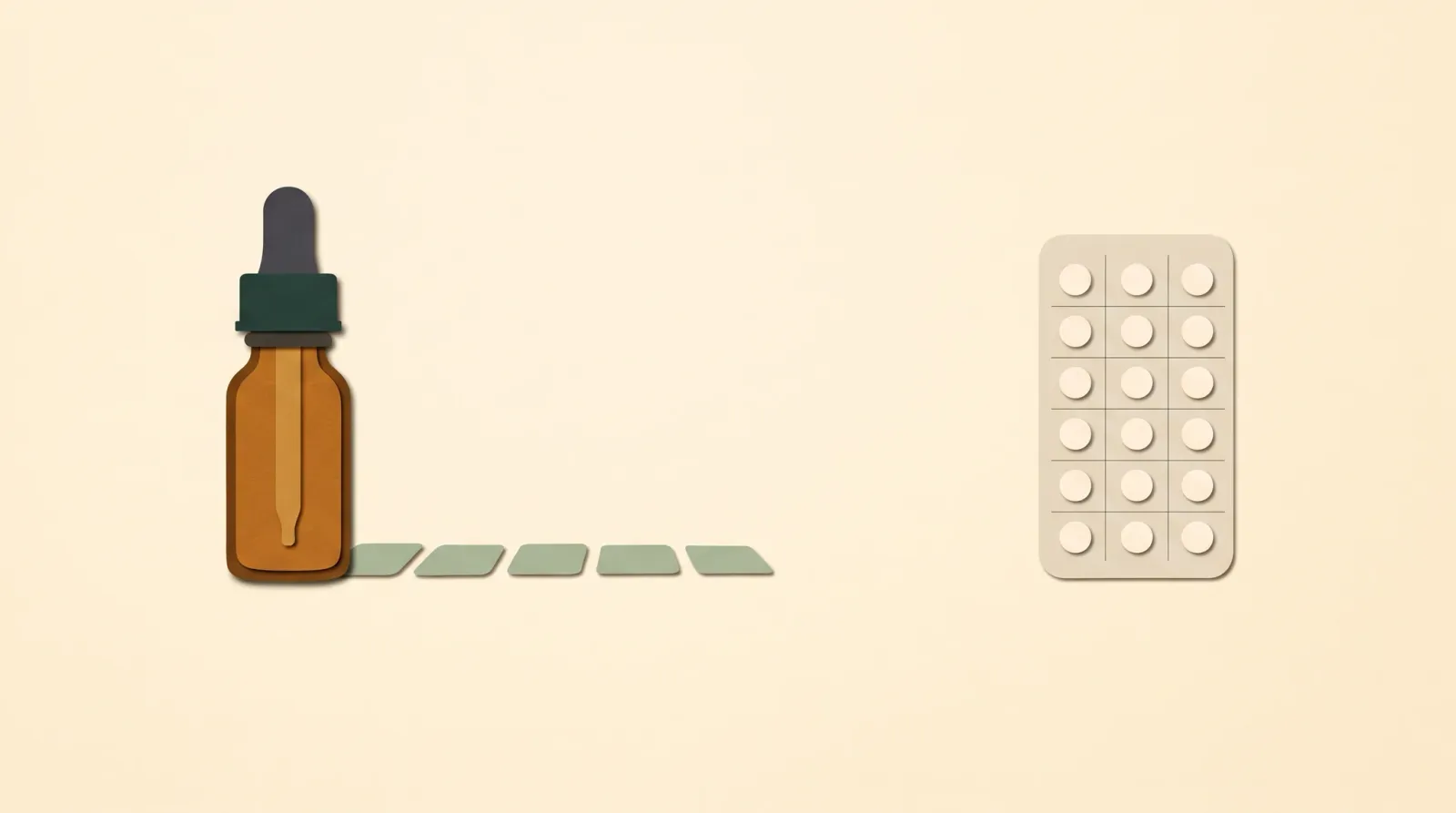
No study has shown that weed or CBD makes hormonal birth control fail. The one relevant effect measured in people, a large single dose of CBD slowing the liver enzyme that clears pill hormones, would be expected to push hormone levels up, not down. But the only trial that gave CBD alongside a real birth control pill finished in 2022 and has never posted a result.
So both of the confident answers you see online go past the data. “CBD blocks the pill” has no outcome study behind it. “CBD definitely does not touch the pill” has no published pill measurement behind it either. Here in High School, we will walk through what has been measured, how big the effects of known interacting drugs really are, and what to ask your prescriber.
Sources checked October 29, 2026. This article explains evidence; it is not medical advice about your contraception.
What has actually been tested?
Here is the short version, with the scale that matters. A US Food and Drug Administration review of pill interaction studies gives the effect sizes for drugs that are known to change pill hormones (Li et al., 2023). The CBD rows come from separate studies that did not use a contraceptive at all.
| What was given | What it does to the enzyme | Measured change | Source |
|---|---|---|---|
| Strong inducers (rifampin, carbamazepine, phenytoin) | Speeds it up | Progestin exposure cut by about half; drospirenone by 86% | Li 2023 |
| Low-dose rifampin, a weak inducer | Speeds it up a little | Levonorgestrel and norethindrone exposure cut by 17% and 12% | Li 2023 |
| Ketoconazole, a strong blocker | Slows it down | Ethinyl estradiol exposure raised by 40% | Li 2023 |
| One 640 mg oral CBD dose with 20 mg THC | Slows it down | Midazolam (a test drug, not a hormone) exposure raised by 56% | Bansal 2023 |
| Prescription CBD, 750 mg twice daily | No net change seen | Midazolam concentrations did not change | Epidiolex label |
| CBD 400 mg daily with an actual pill | Unknown | No result posted | NCT04396730 |
Read the table from the bottom up. The row that would answer your question is empty.
Can you smoke weed on birth control?
No study has measured pregnancy, ovulation or breakthrough bleeding in pill users who smoke weed. Our searches also found no case series of pill failure blamed on cannabis. That is a gap, not proof that the risk is zero.
What exists is enzyme work. In a randomized crossover study of 18 healthy adults, a 20 mg oral THC brownie on its own slowed none of the five liver enzymes tested (Bansal et al., 2023). That study used an edible, not smoke, and one dose, not daily use. No source we found measured THC together with a contraceptive in people.
If you want the general background first, our guide to how cannabinoids change liver enzyme activity covers the enzyme family across many medicines. This article stays on hormonal contraception.
How do liver enzymes change pill hormone levels?
Most pills pair an estrogen, ethinyl estradiol, with a progestin such as levonorgestrel, norethindrone or drospirenone. The liver enzyme CYP3A does much of the work of clearing them. Ethinyl estradiol also leaves the body through two other routes, sulfation and glucuronidation (Li 2023; Rodrigues 2022).
Direction is the part most explanations skip. A drug that speeds up the enzyme clears the hormones faster, and the FDA reviewers tie that to unintended pregnancy and irregular bleeding. A drug that slows the enzyme leaves more hormone in the blood, and the same review flags a possible clotting risk from higher exposure (Li 2023).
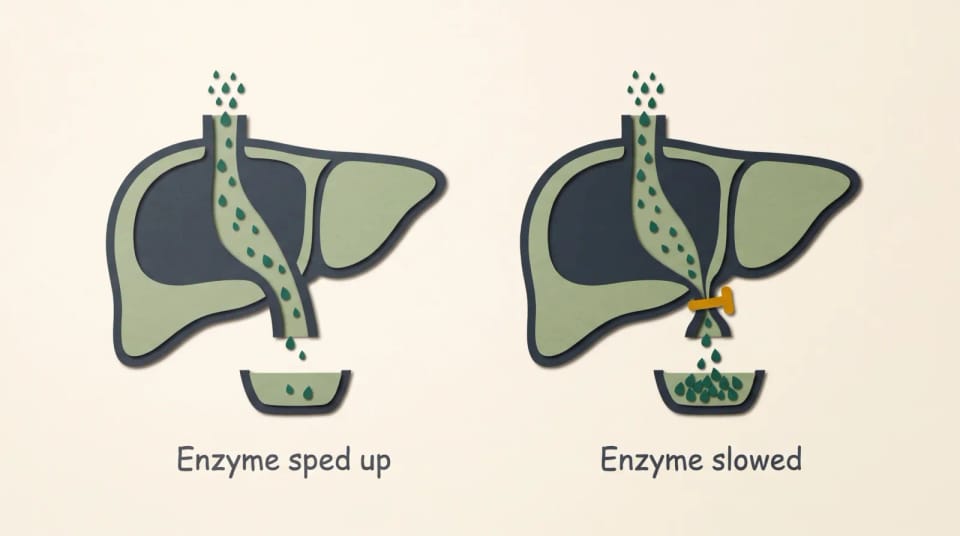
Speeding the enzyme lowers hormone exposure, the route to pill failure. Slowing it raises exposure. CBD’s measured effect in people has been on the slowing side, but no study has measured pill hormones with CBD.
Scale matters too. Even ketoconazole, one of the strongest CYP3A blockers in medicine, raised ethinyl estradiol exposure by 40%. The drugs the CDC flags as real pill problems are strong inducers: rifampin and rifabutin, and certain seizure medicines such as phenytoin, carbamazepine and topiramate (CDC classifications). The FDA reviewers also note that a 20% to 25% change in exposure is hard to translate into failure risk, because the link between pill hormone levels and protection is poorly characterized (Li 2023).
That is also why ordinary antibiotics are a separate story from rifampin. Our guide to antibiotics and cannabinoid levels covers that pairing.
Does CBD affect birth control?
CBD does slow CYP3A in people at a high single dose. In the Bansal study, a brownie with 640 mg of CBD and 20 mg of THC raised exposure to midazolam, a standard CYP3A test drug, by 56%. It raised exposure to test drugs for three other enzymes too: omeprazole by 207%, losartan by 77% and caffeine by 39% (Bansal 2023). Those are test drugs, not pill hormones, and the dose was given once.
Daily dosing tells a different story. The FDA label for Epidiolex, the prescription CBD, reports that midazolam levels did not change when people took 750 mg twice daily. The label also says CBD does not inhibit UGT1A1, one of the enzymes that clears ethinyl estradiol (Epidiolex prescribing information, 2025). A 2025 lab study offers one explanation: in human liver cells, CBD and THC also switched CYP3A4 production on, in some cell lots but not all (Balhara et al., 2025). Slowing plus switching on can net out to no change over repeated doses. That is a finding in cells, not in people taking the pill.
Keep three layers separate:
- Mechanism: CBD can slow CYP3A in a test tube and after one large dose in people.
- Absorption and dose: how much CBD reaches the liver depends on the product, the route and the real milligrams, which often differ from the label. Our guides to CBD liver trials and dose and edible label accuracy help you compare your product with study doses.
- Demonstrated effect on contraception: none measured, in either direction.
The Epidiolex label does not name hormonal contraceptives anywhere in its text. That fits with no pill study having been done for the label. It does not prove one is unnecessary.
The overlap is real, though. In a survey of 99 young women at a Colorado family planning clinic, CBD was the second most common supplement, reported by 17 of them. A drug interaction database flagged 50 of the 62 moderate supplement interactions it found as involving hormonal contraceptives (Friedman et al., 2024). Those were software flags, not observed pregnancies.
What happened to the CBD and birth control pill trial?
Researchers at Oregon Health & Science University ran exactly the study you would want. Women took an ethinyl estradiol and levonorgestrel pill with either 400 mg of CBD a day or a placebo, then switched. Neither they nor the researchers knew which was which. The primary outcomes were blood levels of both hormones (ClinicalTrials.gov NCT04396730).
The record shows 9 participants enrolled and the study completed on March 2, 2022. It was last updated in July 2023, and no results are posted. The Society of Family Planning lists the grant that funded it (SFPRF20-07). Our searches of PubMed and paper indexes found no published paper or abstract. That does not prove none exists, but it means no result is available to cite.
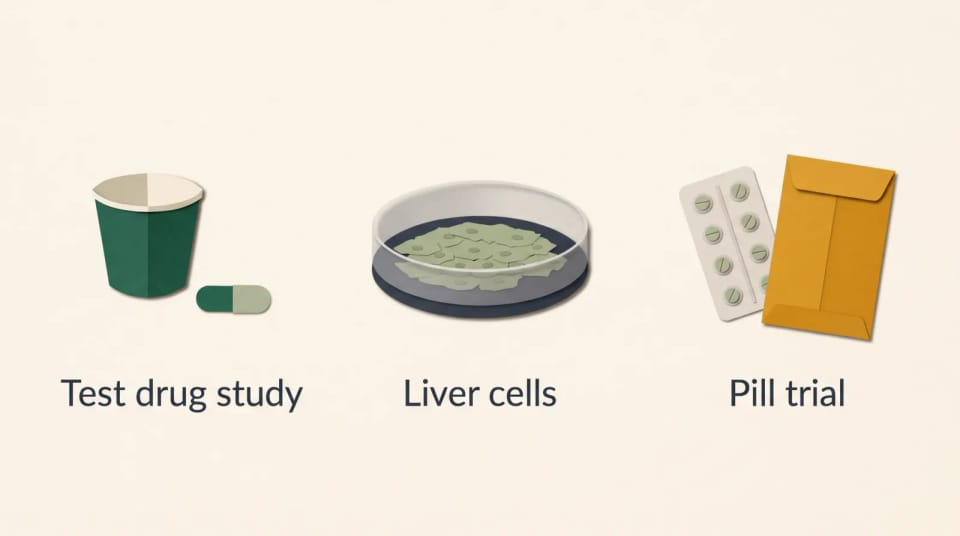
What we have: one-dose test drug studies and liver-cell work. What we need: the pill trial result, which has not been posted.
Does weed affect the IUD, implant, patch or ring?
Nobody has tested cannabis or CBD with any of them. The patch and ring belong to the same combined hormonal group as the pill in CDC guidance (CDC combined hormonal contraceptives), so the enzyme reasoning above applies to them in principle.
Methods also differ in how sensitive they are to known interacting drugs. For strong inducers such as rifampin, the CDC rates the progestin-only pill as category 3 and the implant as category 2, which means the CDC considers the implant less affected by those drugs (CDC classifications). CBD has not been rated for any method.
Can throwing up from weed make the pill fail?
This is the more practical question for heavy users. Cannabinoid hyperemesis syndrome causes cycles of severe vomiting. In a 2025 national survey of 7,034 US adults, 2.7% of all respondents and 17.8% of daily users reported symptoms consistent with it, and women were more likely to report them (Ilgen et al., 2026). Our cannabinoid hyperemesis syndrome guide explains the pattern.
The CDC publishes specific guidance for vomiting or diarrhea while on hormonal pills, for any cause (CDC practice recommendations):
| Situation | What CDC guidance says |
|---|---|
| Vomiting or diarrhea within 24 hours of a pill, or lasting under 48 hours | Another pill is unnecessary; keep taking pills daily; no extra protection needed |
| Vomiting or diarrhea lasting 48 hours or more | Keep taking pills; avoid sex or use condoms until 7 days in a row of hormonal pills after it ends |
The CDC calls this guidance theoretical and says it found no evidence on how vomiting affects pregnancy risk or hormone levels. Your prescriber or pharmacist can tell you how it applies to your pill pack.
Is it safe to smoke weed on the pill?
The CDC warning you may have heard about smoking and the pill is about cigarettes. Its eligibility table rates combined methods as category 2 for smokers under 35, category 3 for smokers 35 or older who smoke fewer than 15 cigarettes a day, and category 4 at 15 or more (CDC classifications). The table text we read has no row for cannabis.
Two points still matter. First, tobacco mixed into a blunt or spliff is tobacco, so ask about it as tobacco. Second, the same CDC table rates combined methods as category 3 for adequately controlled high blood pressure and category 4 at 160/100 or higher. If you want the background on cannabis and blood pressure, our heart-health guide covers it. No source we opened shows that cannabis raises the clot or stroke risk of estrogen pills.
When should you talk to a clinician?
Talk to your prescriber or pharmacist before you add daily CBD, especially at high doses, and whenever you start or stop any other medicine. Get urgent care for chest pain, sudden shortness of breath, or one swollen, painful leg, whatever you think the cause is. Vomiting that will not stop also needs care, both for you and for your pill schedule.
Useful questions to bring:
- Which estrogen and progestin are in my pill, and which enzymes clear them?
- I use a CBD product with about this many milligrams a day. Does that change anything for my method?
- Is anything else I take on the CDC list of interacting drugs?
- What should I do if I vomit for more than a day?
- Would a different method suit me better if I keep using CBD?
If you use CBD daily, logging each product and amount in the High IQ app gives you an exact list to show your pharmacist. For related questions, see cannabis for period pain and PMS, how women respond to THC, and, if you are stopping the pill to conceive, cannabis and pregnancy.
Key takeaways
- No study shows weed or CBD makes birth control fail, and none shows it is safe in that way either.
- Enzyme direction matters: inducers lower pill hormones, blockers raise them. CBD’s measured effect in people is blocking.
- One 640 mg CBD dose slowed CYP3A; 750 mg twice daily of prescription CBD did not change a CYP3A test drug.
- The one CBD and pill trial completed in 2022 and has posted no result.
- Vomiting, including from cannabinoid hyperemesis, is the more practical risk. Follow CDC timing and ask your pharmacist.
FAQ
Can you smoke weed while on the pill?
No study has measured whether smoking weed changes pill protection. A single 20 mg THC edible slowed none of five liver enzymes in a controlled study, but that was oral and one dose. The CDC smoking warnings refer to cigarettes, so tell your prescriber if you mix tobacco into joints.
Does CBD make birth control less effective?
There is no evidence that it does, and the one direct trial has not posted results. CBD’s measured action in people is slowing CYP3A, which would be expected to raise pill hormone levels rather than lower them. That is a mechanism, not a measured outcome, so ask your prescriber about daily high-dose use.
Does THC interact with birth control?
No human study has tested THC with a contraceptive. In one study, 20 mg of oral THC alone did not slow any of the five liver enzymes tested. Liver-cell work suggests THC can switch on CYP3A4 production, but that has not been shown in people taking the pill.
Does weed affect an IUD or the implant?
Neither has been tested with cannabis or CBD. For known strong enzyme inducers, the CDC rates the implant as less affected than the progestin-only pill. Ask your clinician how your specific method handles any medicine or supplement you take.
Sources
- Li L, et al. Combined oral contraceptives as victims of drug interactions. Drug Metab Dispos, 2023.
- Bansal S, et al. Evaluation of cytochrome P450-mediated cannabinoid-drug interactions in healthy adult participants. Clin Pharmacol Ther, 2023.
- Balhara A, et al. Cannabidiol and THC induce drug-metabolizing enzymes in human hepatocytes. Drug Metab Dispos, 2025.
- Rodrigues AD. Drug interactions involving 17α-ethinylestradiol. Clin Pharmacol Ther, 2022.
- US Food and Drug Administration. Epidiolex prescribing information, revised June 2025.
- ClinicalTrials.gov. Cannabidiol and oral contraceptive pills, NCT04396730.
- CDC. US Medical Eligibility Criteria classifications and combined hormonal contraceptive practice recommendations, 2024.
- Ilgen MA, et al. Prevalence of cannabinoid hyperemesis syndrome symptoms in the United States, 2025. Am J Public Health, 2026.
- Friedman JC, et al. Herbal supplement use among adolescent and young adult women in a family planning clinic. J Pediatr Adolesc Gynecol, 2024.



