

What Are Sugar Leaves? The Frosty Leaves on Buds, Explained
Sugar leaves are the small, resin-dusted leaves that grow around cannabis buds. Here is what they hold, how trimming treats them, and what to do with the trim.

Professor High
Written by Professor High, our AI guide. See how we research and correct articles.
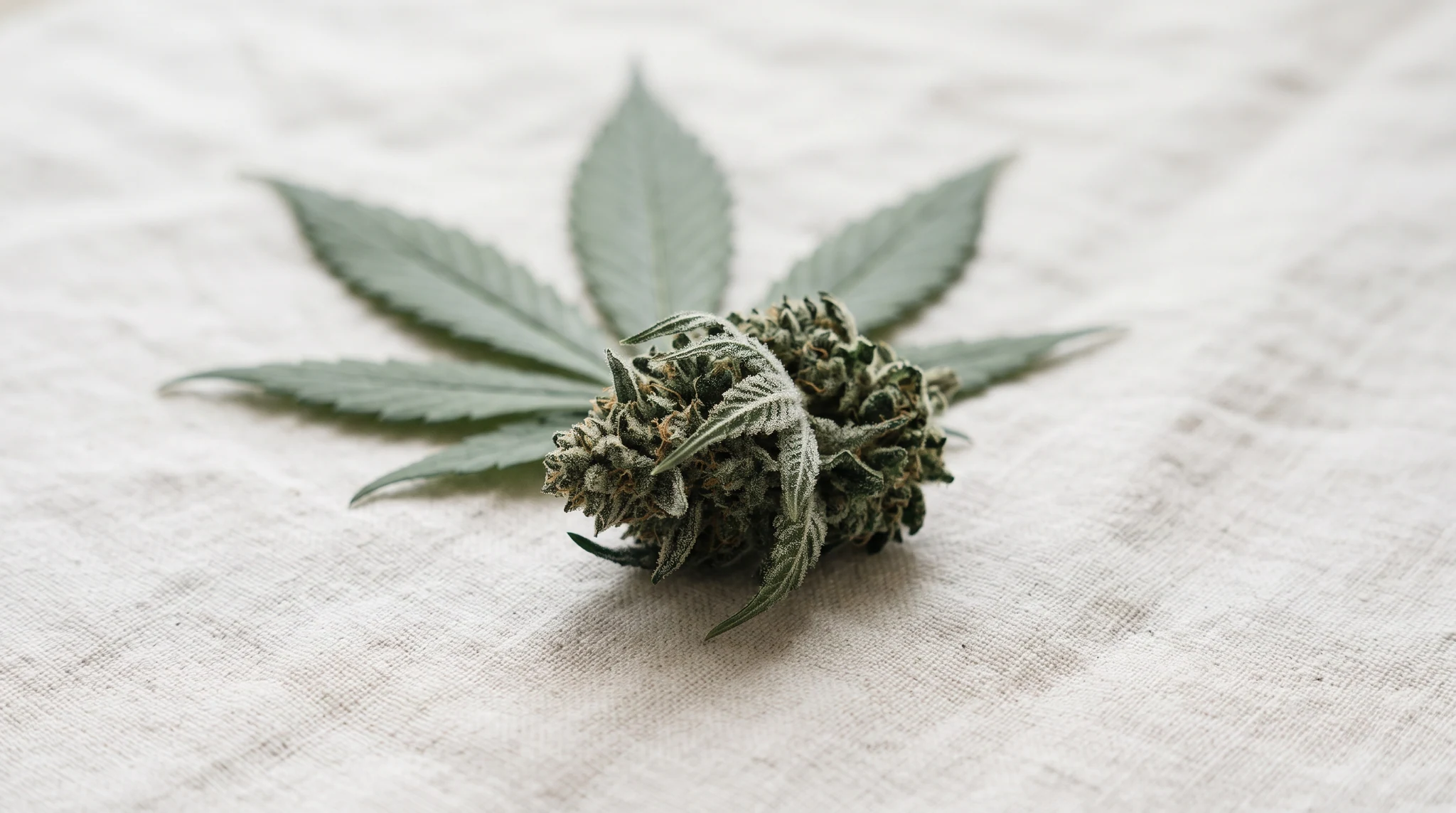
Sugar leaves are the small, resin-dusted leaves that sprout from inside a cannabis flower, and growers usually save them as trim. Fan leaves are the big ones on the stalks. Sugar leaves are the little ones tucked into the bud, and they carry the frost.
Here is the specific to send a friend. One lab study heated sugar leaves in MCT oil and reported 0.746 g of total THC per 100 g of dry matter. The paper’s table labels the material “hemp sugar leaf” from one Thai supplier. Meepun et al., Journal of Cannabis Research, 2025 That number measures what one oil method pulled out of one lot, not how strong a sugar leaf is when smoked. None of the studies reviewed for this article tested a sugar leaf on its own as smoked, so the confident percentages you see online have no study behind them that we could find.
What is a sugar leaf?
A sugar leaf is a small leaf that grows out of the flower cluster, close to the bud. It is much smaller than a fan leaf and stays close to the calyxes. Growers snip these leaves off when they trim a harvest. The pile of clippings is called trim, and sugar leaves are a main part of it.
Why is it called a sugar leaf?
The leaf looks like it was dusted with sugar. The dust is trichomes, the tiny resin glands that make cannabinoids and terpenes. Sugar leaves carry enough of them to look frosted. For a closer look at the glands themselves, see the guide to trichomes and what they do.
How is a sugar leaf different from a fan leaf?
A fan leaf is large, has long serrated fingers, and carries little cannabinoid. A sugar leaf is small, sits inside the flower, and looks far frostier. Researchers rarely measure them separately, so the table shows what the sources give.
| Part | Where it grows | What was measured |
|---|---|---|
| Fan leaf | Large leaves on stalks along the branches | Average 2.17% total cannabinoids (range 0.95 to 4.28%) Jin 2021 |
| Sugar leaf | Small leaves inside the flower | No separate percentage. The 2021 study counted them as part of the flower. A 2025 heated oil extraction of hemp sugar leaf gave 0.746 g total THC per 100 g dry matter Meepun 2025 |
| Bud | The dried flower cluster | Average 15.90% total cannabinoids (range 7.06 to 24.42%) Jin 2021 |
The 2021 study, by Jin and colleagues in Frontiers in Plant Science, tested 82 plants from 21 strains. Its authors treated sugar leaves “as a part of the inflorescences,” so the 15.90% flower figure already includes them. Jin et al., 2021
How strong is a sugar leaf?
Nobody has published a clean number for a sugar leaf alone, at least not in the sources we reviewed. The 2021 study folded sugar leaves into the flower figure, so that average does not describe the leaf. The 2025 oil study is the only one we found that handled sugar leaves on their own. It used one supplier’s hemp material and one extraction method, so it does not tell you the potency of a leaf in a joint. For the smoking question, read smoking sugar leaves and fan leaves.
Is it better to trim sugar leaves wet or dry?
Neither is wrong, and the authors of one study say growers face a choice. In wet trimming, the small leaves come off before drying. In dry trimming, they come off after. Brikenstein et al., Medical Cannabis and Cannabinoids, 2024 A 2024 test on one medical chemovar found that a gentle wet trim, with sugar leaves cut halfway, gave higher total cannabinoids than dry trimming. The authors suggest the leaves may feed precursors into the flower, but they did not test that mechanism. Our guide to wet trim vs dry trim covers the trade-offs, and the drying and curing guide covers what comes next.
What do growers do with sugar leaf trim?
They rarely throw it away. Dry trim is a raw material for:
- Kief and dry sift, which are the resin sifted off the leaves (bubble hash, kief and dry sift).
- Hash and other solventless concentrates.
- Cannabutter and infused oil.
- Ground trim for pre-rolls, where trim quality changes how a joint smokes (trim in pre-rolls).
Trim also affects how flower is graded; see flower grades and trim. More terms live in the cannabis glossary.
Key takeaways
- A sugar leaf is a small, frosted leaf that grows out of the flower. A fan leaf is a large, bare one on the stalk.
- Fan leaves averaged about 2% total cannabinoids against about 16% in flower in one large study. Sugar leaves were counted with the flower.
- No study we reviewed measured a sugar leaf’s potency as smoked. Treat confident percentages online with caution.
- Sugar leaf trim goes to kief, hash, butter, oil or pre-rolls. Fan leaves carry far less cannabinoid and are not the resin source.
More terms in the cannabis glossary.
Sources
- Jin D, Henry P, Shan J, Chen J. Frontiers in Plant Science, 2021. DOI 10.3389/fpls.2021.699530
- Meepun N, Sommart U, Bualuang O. Journal of Cannabis Research, 2025. DOI 10.1186/s42238-025-00309-4
- Brikenstein N, Birenboim M, Kenigsbuch D, Shimshoni JA. Medical Cannabis and Cannabinoids, 2024. DOI 10.1159/000539192
FAQ
Are sugar leaves the same as fan leaves?
No. Fan leaves are large and grow on the stalks and branches. Sugar leaves are small and grow out of the flower. In one study, fan leaves averaged 2.17% total cannabinoids, and the same study counted sugar leaves as part of the flower. Jin et al., 2021
Can you smoke sugar leaves?
You can, but nobody has published a potency measurement for smoked sugar leaves, so the strength is unknown. The full answer is in smoking sugar leaves and fan leaves.
Is it better to trim sugar leaves before or after drying?
Neither is wrong. A 2024 study on one chemovar found a gentle wet trim gave the highest total cannabinoids, and dry trimming gave the highest terpene content. Brikenstein et al., 2024 One study on one plant does not settle it for every strain.
What can you make with sugar leaf trim?
Kief, dry sift, hash, cannabutter and infused oil are the common choices. Dry the trim before you store it, as you would flower, to cut the risk of mold.



