Cannabis Flower Grades Explained: Top Shelf, Mids, Popcorn, and Smalls
Top shelf, mids, popcorn, smalls. No regulator defines any of them. Here is what each tier really means and when the premium is worth paying.

Professor High
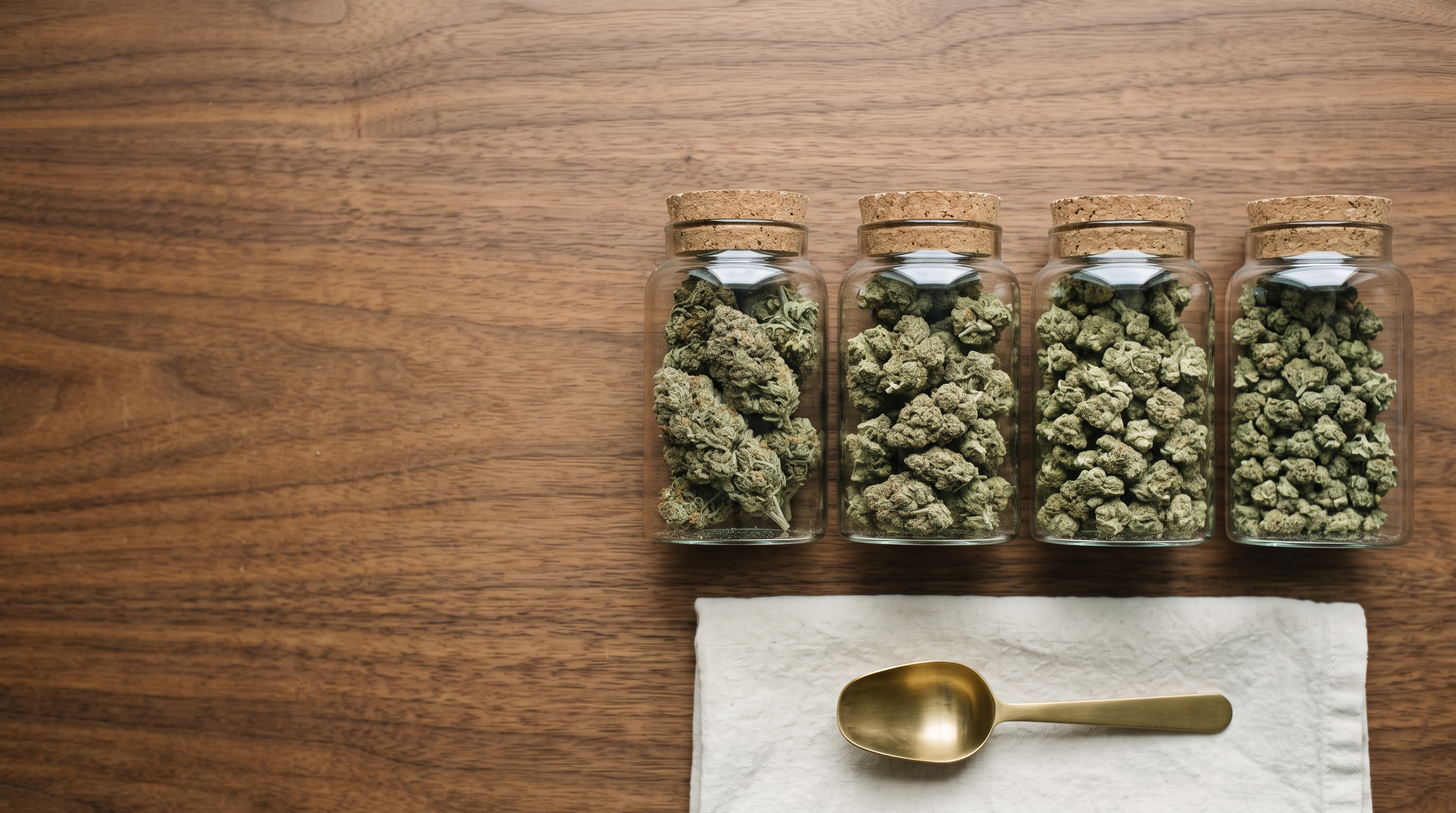
Two jars sit on the counter. The one on the left is labeled “top shelf” at $55 an eighth. The one on the right says “value” at $22. You ask the budtender what the difference is. You get some combination of “it’s just better bud,” “that one’s boutique,” and a number: 31% versus 19%.
Here is the part nobody says out loud. Those two words — top shelf, value — mean whatever that particular store decided they mean this morning. There is no agency that grades cannabis flower. No inspector walked through the cultivation facility and stamped a tier onto anything.
Beef has USDA grades with published marbling criteria. Diamonds have a GIA scale with defined clarity ranges. Eggs, olive oil, maple syrup, lumber — all graded against written standards someone can audit you against. Cannabis flower has none of that. What it has is merchandising: a shelf layout designed to make you reach higher.
That does not mean the tiers are meaningless. It means they are measuring something other than what you probably think.
The tiers, decoded
Different stores use different words for the same things. Here is the working vocabulary you will actually encounter, and what each term describes in practice.
| Term | What it actually refers to |
|---|---|
| Top shelf / premium / exotic | Large, dense, well-manicured buds with heavy visible trichome coverage. Usually the highest lab-reported THC number in the case. |
| Mid-tier / mids | Decent structure, machine-trimmed, mid-range potency number. The bulk of most menus. |
| Value / bottom shelf / house | Older harvests, looser structure, lower potency numbers, or overstock a store needs to move. |
| Popcorn buds | Small, rounded nugs — often from the lower and inner canopy where less light reached. |
| Smalls | A size grade, not a quality grade. Buds that fell through a specific screen size during sorting. |
| Larf | Airy, underdeveloped lower-canopy growth. Fluffy, low density, genuinely less resinous. |
| Shake | The loose fragments that break off buds during handling and settle at the bottom of a container. |
| Trim | The leaf material cut away from the bud during trimming. Sugar leaf carries some resin; fan leaf carries almost none. |
The critical distinction in that table is between popcorn/smalls and larf/trim. Popcorn buds and smalls are sorted by size. Larf and trim are genuinely different plant material. Stores frequently blur the four together under one “value” heading, and that is where consumers lose money — either by avoiding a good deal or by paying bud prices for leaf.
Shake and trim have legitimate uses. Shake is fine for rolling or for cooking. Trim is the standard feedstock for solventless extraction. Neither should be priced like flower.
The A-to-AAAA “quad” system
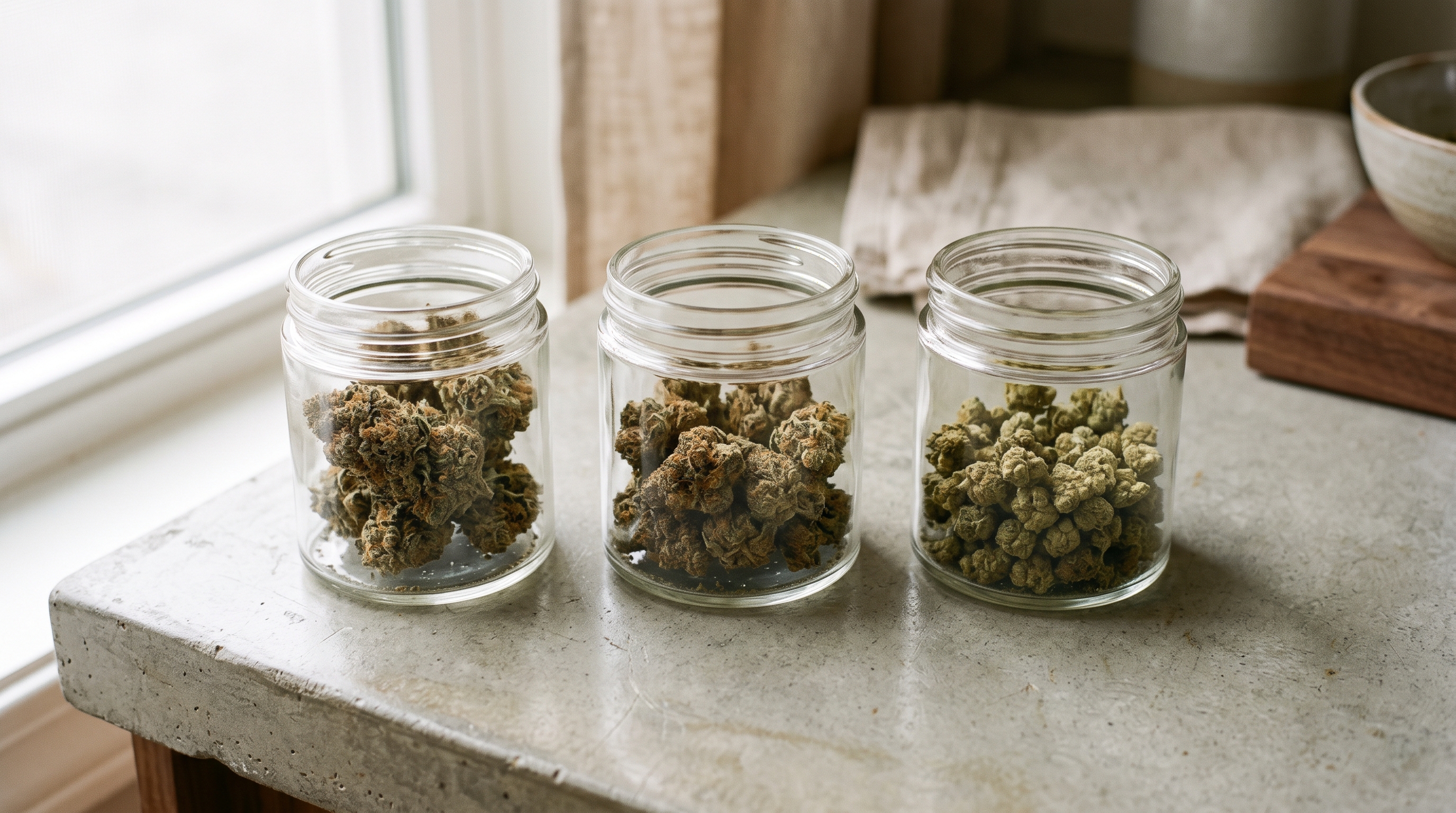
If you have shopped in Canada or read Canadian forums, you have seen flower described as AAAA, AAA, AA, or A — spoken as “quads,” “trips,” and so on. Quads sit at the top.
It looks more rigorous than “top shelf” because it looks like a scale. It is not. No regulator defines those letters. Health Canada sets rules for testing, packaging, labelling and contaminant limits, but it does not define a quality grade and does not certify anyone’s letters. A producer calling their flower AAAA is making a marketing claim, exactly as a dispensary calling a jar “exotic” is making one.
The letters do correlate loosely with real attributes — quads tend to be hand-trimmed, dense and aromatic — but only because sellers who invest in those things also reach for the flattering label. Nothing stops anyone else from reaching for it too.
What actually drives the tier assignment
Six things move flower up or down a shelf. Only some of them relate to how the flower will treat you.
Bud size and density
Large, tight buds photograph well and feel substantial in a jar. Size is mostly a function of where the bud grew: apical sites at the top of the plant get the most light and produce the biggest colas, while lower sites produce smaller, rounder nugs.
This is the one place where “the tiers are pure fiction” would be an overstatement. Namdar and colleagues examined how cannabinoid and terpenoid composition varies with inflorescence position along the stem, and found the composition does differ by position. So top-of-plant and bottom-of-plant material are not chemically identical.
But “not identical” is a long way from “worth double.” Which brings us to the most useful thing in this article, a few sections down.
Trim quality
Hand-trimmed flower keeps its structure and its resin glands. Machine trimming is faster and cheaper, and it knocks trichomes loose in the process.
Timing matters as much as method. Brikenstein and colleagues compared trimming before versus after drying in a medicinal cannabis chemovar and found a genuine trade-off: mild trimming before drying gave the highest cannabinoid concentration, while trimming after drying gave the highest terpene content. Their conclusion was blunt — growers have to pick one, because optimising for both at once appears difficult.
That was a single chemovar, so do not treat the numbers as universal. Treat the shape of the finding as real: trim technique is a lever on chemistry, not just on looks.
Trichome coverage
“Frosty” is the word that sells jars. But trichome density is heavily genetic. Punja and colleagues tracked glandular trichome development across two cultivars and found capitate trichome numbers and stalk length differed significantly between genotypes and across plant age, with maturation happening asynchronously across the same bract surface.
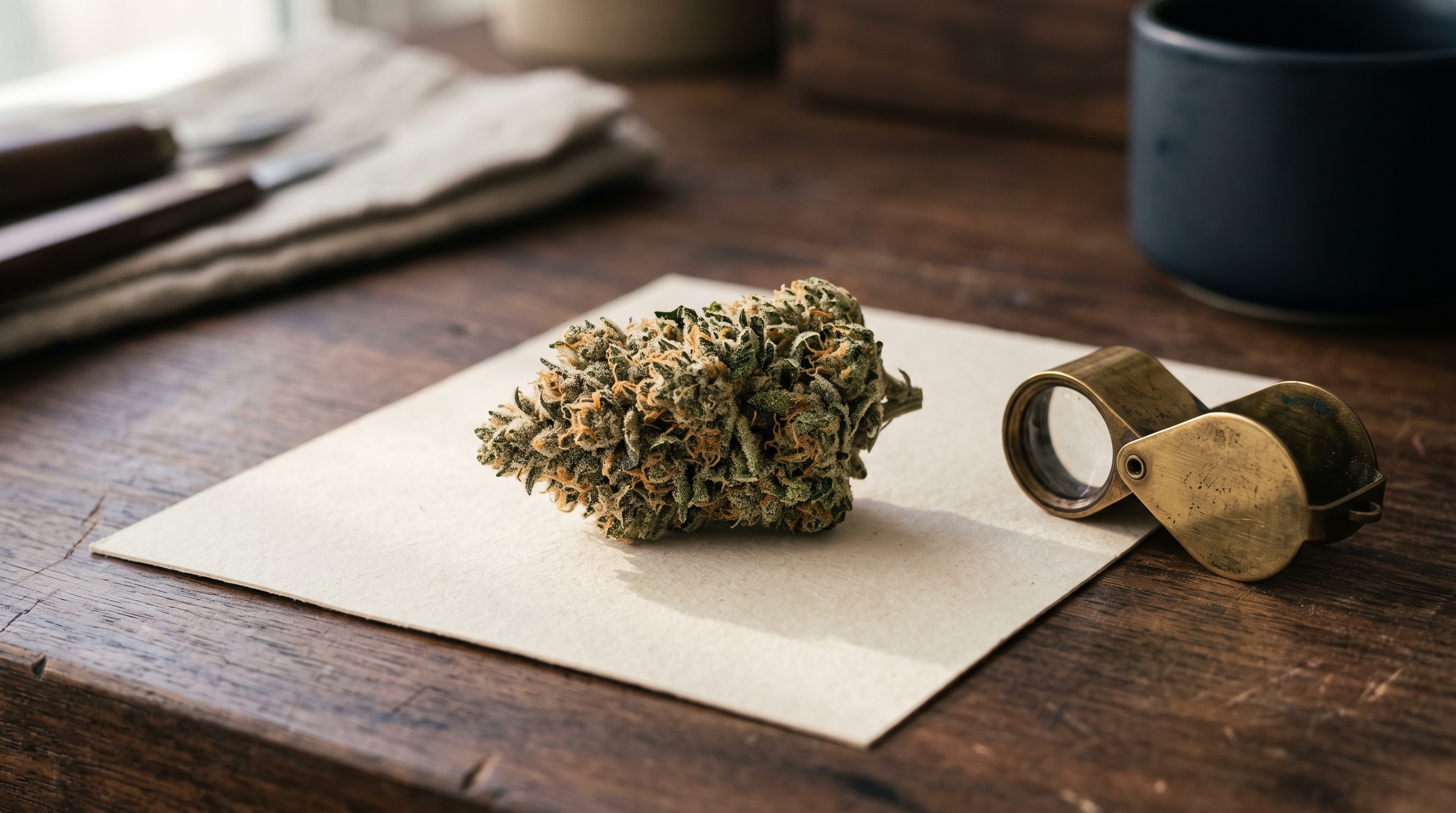
They also noted that post-harvest handling and drying altered trichome morphology. So the frost you see through the jar reflects genetics, harvest timing and handling — not a quality ranking. Some genuinely excellent cultivars are simply less showy. To assess maturity rather than sparkle, reading trichomes under a loupe tells you more than the shelf does, and our full trichome guide covers what the different types do.
The cure
Drying and storage change what is in the jar. Spadafora and colleagues compared freeze drying against tray drying alongside three storage conditions, and found freeze drying preserved cannabinoids and prevented decarboxylation of the acid forms — but cost volatile compounds, the ones responsible for aroma. Glass storage retained the initial aroma profile better than an open tray or a polyethylene box, though it drove conversion of acid cannabinoids into neutral ones.
In plain terms: there is no single setting that maximises everything, and every processing choice trades one thing for another. A slow, careful cure is expensive in time and space, and it is one of the few premium claims that reliably shows up in the smell and the smoke. It is also why how you store flower at home matters — you can undo a good cure in three weeks with a bad jar. Humidity packs help.
Terpene percentage
Total terpene content is the single most informative number on a flower COA, and most menus do not print it. Anything above roughly 2% total terpenes is aromatic; above 3% is genuinely uncommon. When a producer has that number and it is good, they usually want you to see it.
Which terpenes matters as much as how many. Myrcene-dominant flower behaves differently from a limonene-forward jar, and terpinolene profiles read differently again. Caryophyllene and pinene shift the character further. Our terpene guide breaks down the main players.
THC percentage
And here is the one that actually sets the price.
The number that distorts everything
Han and Shi analysed 710,588 cannabis flower products from 3,693 dispensaries across 30 states and Washington D.C. They found a positive association between price and THC level, with a THC elasticity of price of 0.17 — meaning a 10% higher THC figure is associated with roughly a 1.7% higher price per gram. Average standardised price was $9.05 per gram for dried flower and $11.72 for pre-rolls. Notably, they found limited evidence that dispensary-level characteristics — medical versus recreational, license status, nearby competitor density — mattered much at all.
Smart and colleagues found the same pattern earlier, running hedonic price regressions across roughly 31 million cannabis flower purchases in Washington State and finding a statistically significant relationship between price per gram and THC content. They also measured how much bulk buying saves you: a discount elasticity of −0.06, which is small. Han and Shi put the weight effect higher, at −0.18. Either way, buying bigger saves you less than buying a lower tier does.
So the tier tracks the THC number. Now look at what the THC number is worth.
It is frequently wrong. Schwabe and colleagues bought 23 samples from 10 Colorado Front Range dispensaries and tested them by HPLC against the potency printed on the package. Observed average THC potency was 14.98% (±2.23), which was 23.1% below the lowest label value and 35.6% below the highest. Around 70% of samples came in more than 15% under their label, and three samples contained roughly half the maximum potency claimed. Jikomes and Zoorob had already shown that reported cannabinoid content varies systematically depending on which testing facility did the work. We have written more on why lab testing standards are failing consumers and how to read a COA properly.
And even when it is right, it does not predict your experience. Bidwell and colleagues randomly assigned regular flower users to either 16% or 24% THC flower purchased from a dispensary, then measured plasma cannabinoids, subjective intoxication and neurobehavioral performance before use, immediately after, and an hour later. Delayed verbal memory and balance were impaired after use — but differing outcomes for potency within product type were not observed. A 50% jump in labelled THC did not produce a measurably different experience.
Put those three findings together and the shelf logic collapses. Price tracks THC. THC is often overstated by a third. And the number, when accurate, does not tell you how the flower will land. That is the whole argument of why THC percentage is a terrible way to choose cannabis, and the engine behind the potency arms race.
Why smalls are usually the value play
At most producers who grade by size, smalls and popcorn buds come off the same plants, in the same harvest, through the same dry and the same cure as the flower on the top shelf. They were separated afterward by a screen — a step that asks how big the bud is, not what is in it.
Be precise about the claim, though. Position on the stem does affect composition, so smalls are not a chemical photocopy of the colas. The honest summary is that the compositional gap between a top cola and a lower nug off the same plant is modest, and the price gap between “top shelf” and “smalls” often is not.
There is a second, sneakier advantage: small buds have more surface area per gram, so they grind faster and pack more evenly. If you roll, smalls are frequently better material than breaking down a dense cola.
One question does the whole job at the counter: “Are these smalls from the same batch as the flower on the top shelf?” If the answer is yes, and the COA matches, you have found the deal. If the store cannot tell you, that is information too. A good shop knows; the three-week budtender problem is real, and picking a dispensary that keeps proper records solves more than any single purchase does.
When the premium is genuinely worth paying
Not every markup is theatre. Pay up when you can verify at least two of these:
- A total terpene percentage on the COA above 2%. This is the strongest signal on the entire label, and the hardest to fake, because it degrades if the product was handled badly.
- Hand trim, stated explicitly. It preserves resin and structure, and it is expensive enough that nobody claims it casually.
- A recent packaging or harvest date. Terpenes are volatile. Six-month-old premium flower is mid-tier flower at a premium price.
- A cure the seller can describe. “Fourteen days in bins, burped daily” is a real answer. “Slow-cured for quality” is not.
- Small-batch or single-cultivar sourcing rather than a blended lot.
- The jar smells like something specific when you open it. Your nose is a legitimate instrument here — sharper than the THC number, in most cases.
What should not move you: bud size on its own, sparkle, an exotic name, an “exotic” shelf tag, or a THC figure above 30%. And note that growing environment is its own axis entirely, not a tier — the sun-grown terpene argument and the greenhouse versus indoor debate both cut across every shelf in the store.
How to read a menu past the marketing
A working order of operations:
- Ignore the tier word. It is a shelf position, not a measurement.
- Find the terpene total. If it is absent, ask. If the store cannot produce a COA, shop elsewhere.
- Check the harvest or package date. Prefer fresher over frostier.
- Compare price per gram, not per package. Weight terminology trips up more people than it should.
- Ask the smalls question. Same batch or not.
- Treat the THC figure as a wide range, not a number. Given Schwabe’s findings, mentally discount it.
- Buy small first. A gram of an unknown beats an ounce of a mistake.
If you want to sanity-check the whole system, run it yourself: buy an eighth of top shelf and an eighth of the smalls from the same cultivar and batch, and see whether you can tell them apart with the jars unlabelled. Most people cannot. It is the cheapest education in cannabis, and it is a good first dispensary trip to plan around.
What a grade cannot tell you
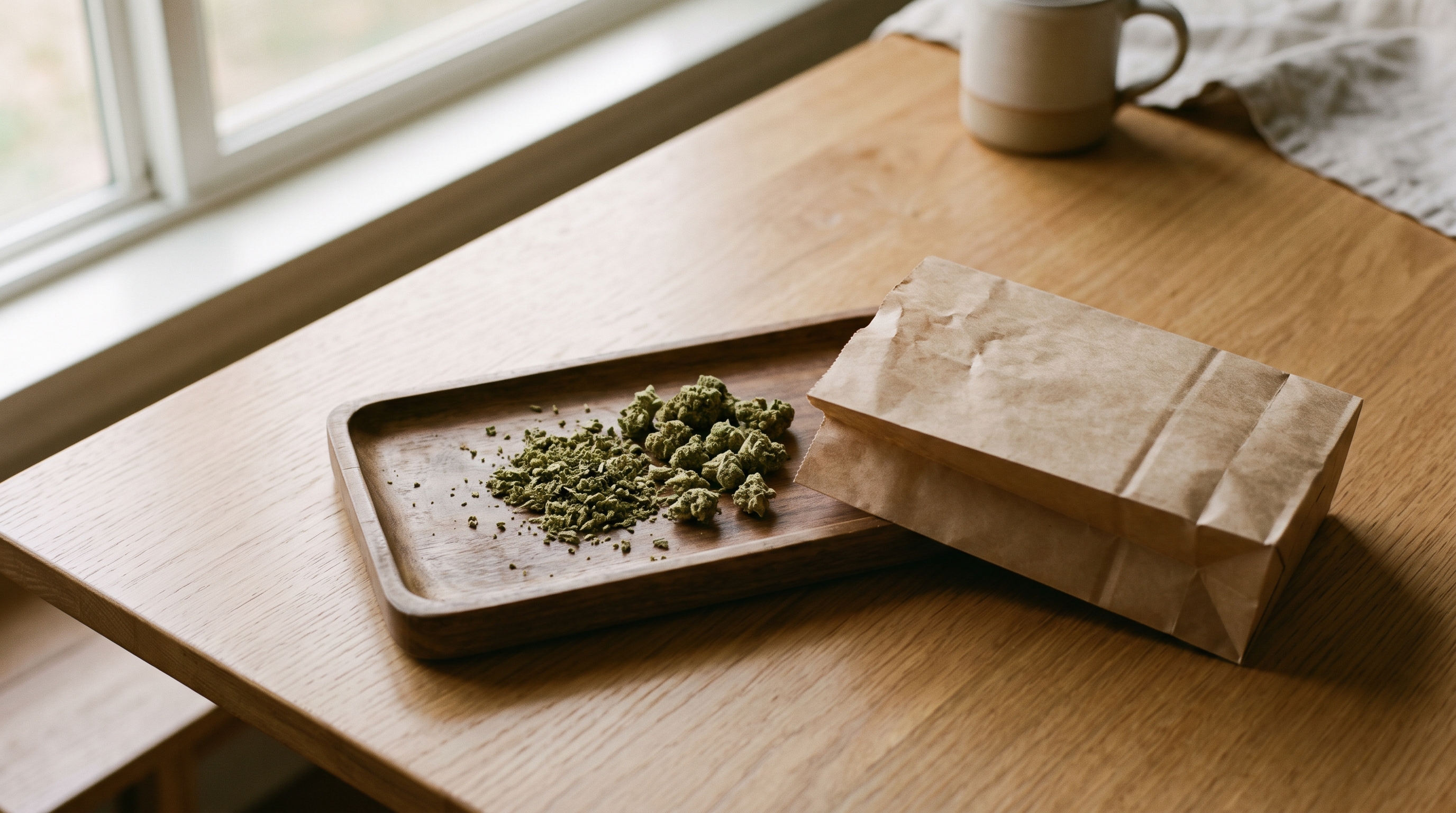
Here is the thing the shelf tag was never designed to answer: how will this make you feel?
Grades measure appearance and a potency number. They do not measure the terpene profile that shapes the character of the experience, and they cannot measure your individual response to it. A myrcene-heavy Granddaddy Purple and a terpinolene-forward Jack Herer at identical THC percentages on identical shelves are not remotely the same experience.
The names are no more reliable than the grades. Blue Dream from two facilities can test as two different chemovars, and the same goes for Gelato, Wedding Cake, GG4, OG Kush, Girl Scout Cookies, Sour Diesel, Green Crack, Northern Lights, Pineapple Express, White Widow, Durban Poison and Bubba Kush.
What holds up better than either is chemistry grouped by effect. That is the reasoning behind High Families — sorting flower by what its profile tends to produce rather than by lineage folklore. A Relax High profile behaves differently from an Energy High one regardless of which shelf it sat on, as do Uplift High and Balance High. If you are chasing calm, sleep, focus or euphoria, the profile predicts more than the price tag does.
Even chemistry only gets you a good starting guess. The last mile is personal — the same jar lands differently on two people, and regular consumers who track their own results end up with far better hit rates than anyone shopping by shelf. The High IQ app logs what you bought, what was in it, and how it actually went, so your next purchase is decided by your own data rather than by a word someone printed on a shelf tag.
FAQ
Are smalls lower quality than top shelf? Usually they are lower cosmetically, not lower in quality. At most producers they are the same plants, same harvest and same cure, separated by a screen. Composition does vary somewhat with bud position on the plant, so they are not identical — but the gap is generally much smaller than the price difference. Ask whether they came from the same batch.
Is there any official cannabis grading standard? No. Regulators set testing, labelling and contaminant rules, but no US or Canadian authority defines “top shelf,” “mids,” or the AAAA quad scale. Every one of those terms is set by the seller.
Why is high-THC flower more expensive if THC doesn’t predict the effect? Because the market prices what it can display. Han and Shi measured a THC elasticity of price of 0.17 across nearly 3,700 dispensaries. Meanwhile Bidwell and colleagues found no differing outcomes between 16% and 24% flower on subjective intoxication or neurobehavioral measures. The price signal and the experience signal have come apart.
How much should I trust the THC number on the label? Less than you do. Schwabe and colleagues tested 23 Colorado samples and found observed potency averaged 23.1% below the lowest label figure, with roughly 70% of samples more than 15% under their label. Read it as a loose range.
Is shake worth buying? For rolling, cooking, or extraction, often yes — provided it is priced as shake and not as flower, and provided it is bud fragments rather than leaf trim. Check what you are actually getting.
What single number should I look at instead? Total terpene percentage, if the COA shows it. Above roughly 2% is aromatic, above 3% is uncommon. It is a better proxy for a satisfying experience than the THC figure, and much harder to inflate.
Sources
- Han B, Shi Y. Multilevel determinants of cannabis prices in legal markets: Evidence from products sold in nearly 4000 cannabis dispensaries in the United States. International Journal of Drug Policy, 2025. doi:10.1016/j.drugpo.2025.104722
- Smart R, Caulkins JP, Kilmer B, Davenport S, Midgette G. Variation in cannabis potency and prices in a newly legal market: evidence from 30 million cannabis sales in Washington state. Addiction, 2017. doi:10.1111/add.13886
- Schwabe AL, Johnson V, Harrelson J, McGlaughlin ME. Uncomfortably high: Testing reveals inflated THC potency on retail Cannabis labels. PLoS One, 2023. doi:10.1371/journal.pone.0282396
- Jikomes N, Zoorob M. The Cannabinoid Content of Legal Cannabis in Washington State Varies Systematically Across Testing Facilities and Popular Consumer Products. Scientific Reports, 2018. doi:10.1038/s41598-018-22755-2
- Bidwell LC, Ellingson JM, Karoly HC, YorkWilliams SL, Hitchcock LN, et al. Association of Naturalistic Administration of Cannabis Flower and Concentrates With Intoxication and Impairment. JAMA Psychiatry, 2020. doi:10.1001/jamapsychiatry.2020.0927
- Namdar D, Mazuz M, Ion A, Koltai H. Variation in the compositions of cannabinoid and terpenoids in Cannabis sativa derived from inflorescence position along the stem and extraction methods. Industrial Crops and Products, 2018. doi:10.1016/j.indcrop.2018.01.060
- Brikenstein N, Birenboim M, Kenigsbuch D, Shimshoni JA. Optimization of Trimming Techniques for Enhancing Cannabinoid and Terpene Content in Medical Cannabis Inflorescences. Medical Cannabis and Cannabinoids, 2024. doi:10.1159/000539192
- Spadafora ND, Felletti S, Chenet T, Sirangelo TM, Cescon M, et al. The influence of drying and storage conditions on the volatilome and cannabinoid content of Cannabis sativa L. inflorescences. Analytical and Bioanalytical Chemistry, 2024. doi:10.1007/s00216-024-05321-w
- Punja ZK, Sutton DB, Kim T. Glandular trichome development, morphology, and maturation are influenced by plant age and genotype in high THC-containing cannabis (Cannabis sativa L.) inflorescences. Journal of Cannabis Research, 2023. doi:10.1186/s42238-023-00178-9
