Wet Trim vs. Dry Trim: What the Research Actually Shows
Wet trim vs dry trim is a trade-off: one study found dry trimming kept more terpenes and a light wet trim kept more cannabinoids. Here is the mold data too.

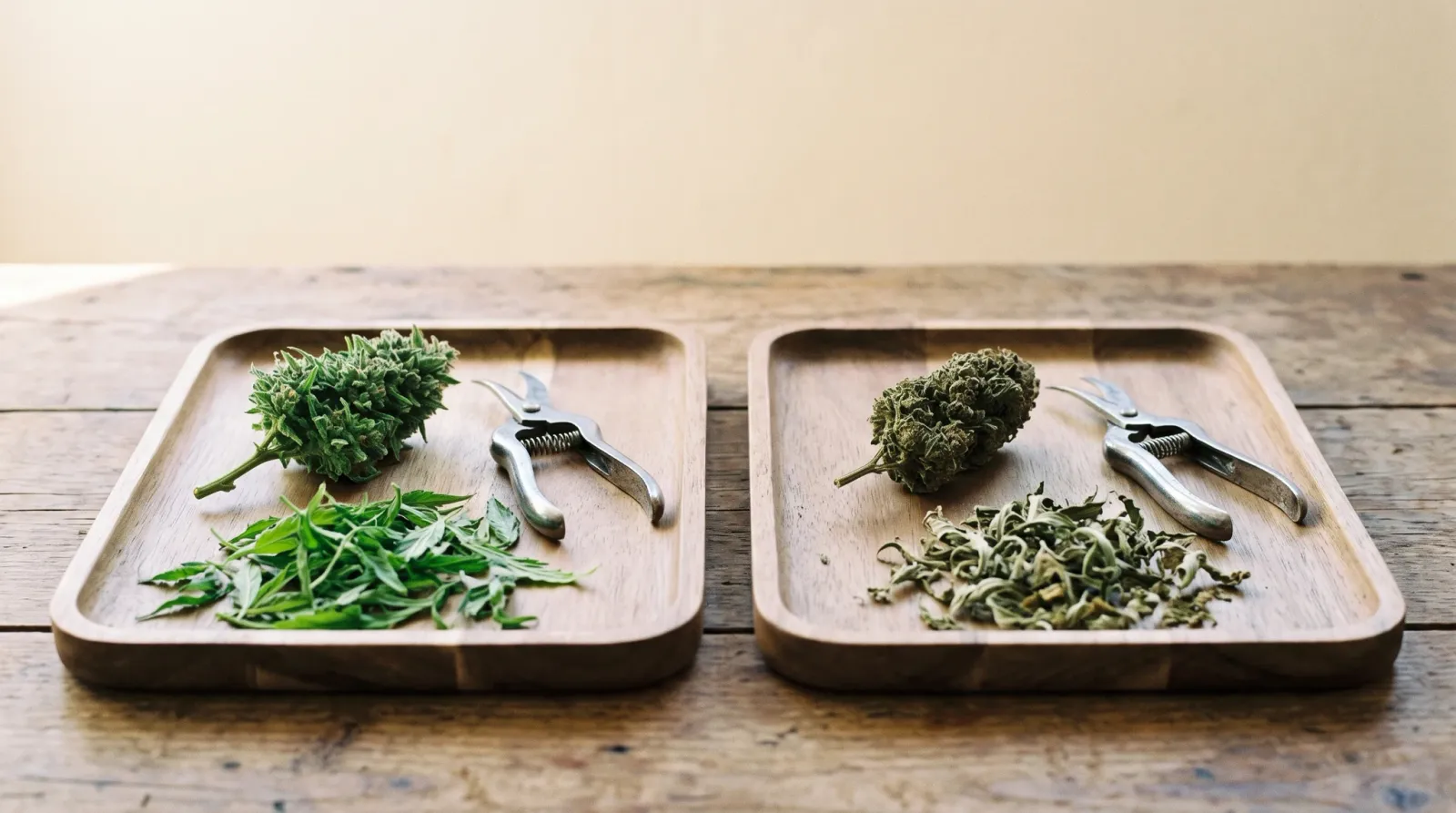
Neither wet trimming nor dry trimming wins on everything: the one controlled study we found measured a trade-off, with dry trimming keeping more terpenes and a light wet trim keeping slightly more cannabinoids. A separate commercial study adds a twist on mold. There, buds that were hang-dried and trimmed after drying carried fewer yeasts and molds than buds trimmed fresh and dried on racks. That is the opposite of the rule most grow guides repeat.
Here is the short version you can send to the friend who swears by one method:
| Question | What the evidence found | How strong it is |
|---|---|---|
| Terpenes and smell | Dry trim gave the highest levels for most terpenes measured | One controlled study, one chemovar, lab drying |
| Cannabinoids | A light wet trim gave the highest total cannabinoids, about 4 percent above dry trim | Same study |
| Mold | Hang-dried, dry-trimmed buds had significantly lower yeast and mold counts than wet-trimmed, rack-dried buds | One commercial survey, mixed with drying method |
| Drying time and bag appeal | No controlled comparison found | Grower opinion only |
This lesson in High School is about the trim choice itself. For the full sequence, see the full drying and curing steps and when to cut and how to hang the branches.
What is the difference between wet trimming and dry trimming?
Wet trimming means cutting away fan leaves and sugar leaves soon after harvest, before the flowers dry. Dry trimming means drying the flowers first, usually on the branch, and trimming them afterward. A postharvest review defines the two the same way and notes that producers often choose based on preference and how work flows through the room, not on a tested result (Das et al., 2022).
The same review gives the one mechanism nobody disputes: taking flowers off the stem exposes more surface to the air, which affects how they dry (Das et al., 2022). It also notes that sugar leaves carry less cannabinoid than the flower itself.
Trimming after harvest is a different job from pulling leaves on a living plant. That earlier step is covered in our guide to leaf removal on the living plant.
Is it better to trim wet or dry?
It depends on what you want to keep. In 2024, Israeli researchers compared three trim methods on one medical hybrid chemovar called Gen12 (Brikenstein et al., 2024). They used only top buds from the main stem and split them into three groups of 30:
- Mild wet trim. Stems removed and sugar leaves cut about halfway, before drying.
- Aggressive wet trim. Stems and sugar leaves fully removed, before drying.
- Dry trim. The same full trim, done after drying.
Every group dried for six days in controlled chambers at 15 °C and under 10 percent relative humidity, down to about 10 percent water. The team then measured cannabinoids by liquid chromatography and terpenes by gas chromatography-mass spectrometry.
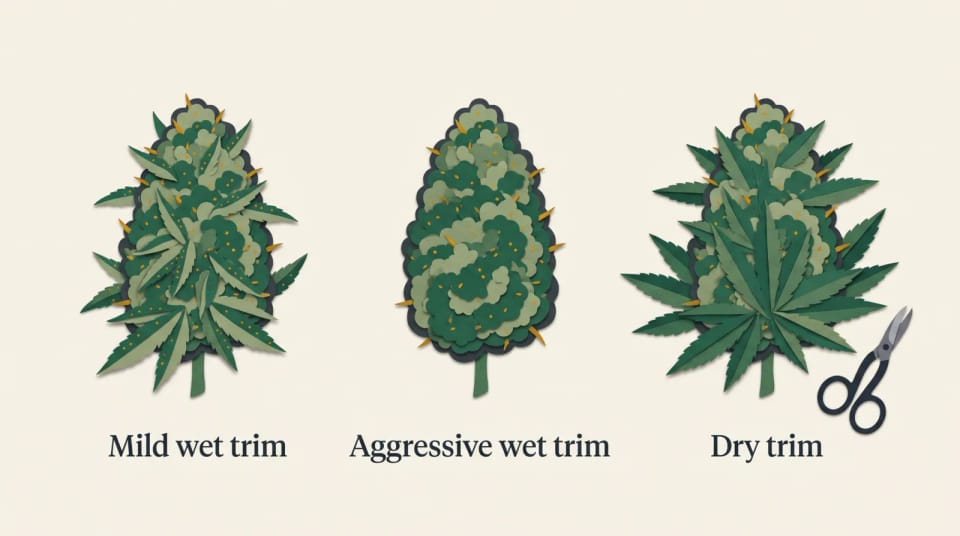
The three groups in the 2024 trim study. All dried the same way for the same six days, so the comparison isolates when and how much was trimmed.
What the study found on cannabinoids
The mild wet trim had the highest total cannabinoids. The authors report it was higher than dry trim by 4 percent and higher than the aggressive wet trim by 3.5 percent (Brikenstein et al., 2024). The paper does not say whether those are relative differences or percentage points. So read it as “a small edge for a light pre-dry trim,” not as a THC number you can expect in your jar.
What the study found on terpenes
Dry trimming kept the most terpenes. For more than 80 percent of the monoterpenes and sesquiterpenes measured, only the dry-trim group sat significantly above both the day-zero baseline and the other two methods (Brikenstein et al., 2024). That list included beta-caryophyllene, alpha-pinene, beta-pinene and alpha-humulene. The two wet-trim groups did not differ from baseline.
There were exceptions. Beta-myrcene was highest in the mild wet trim, with dry trim second. Beta-eudesmol did not differ among the methods. If you want to know what those names mean for aroma, start with how to read a terpene profile.
The authors conclude that a grower has to choose: maximize cannabinoids or maximize terpenes, because one trim method did not do both.
Does wet trimming reduce terpenes or smell?
In that one study, yes, compared with dry trimming. But be careful about how far you stretch it.
The authors suggest two possible reasons. Cutting fresh tissue may stress the flower, and leaving sugar leaves on during the dry may let compounds keep moving into the bud. They label both ideas “possibly”; neither was tested. If you want the background on where these compounds sit, read how trichomes hold terpenes and cannabinoids.
Three limits matter:
- One chemovar, one harvest, one site. Another strain may respond differently.
- Lab drying, not a home room. Fifteen degrees and under 10 percent humidity for six days is far from a hang-dry in a closet. A sister study from the same group found that the drying regime alone changed terpene retention and mold (Birenboim et al., 2024).
- An unexplained oddity. Terpenes in the dry-trim group came out above the fresh baseline. The paper does not explain this. One possibility is how results were adjusted for the weight lost in drying, but that is our inference, not a finding.
So the honest claim is narrow: in one controlled test, trimming after the dry kept more of most terpenes. It is not proof that dry trimming always smells better.
Does wet trimming lower mold risk?
No study we found shows that it does, and one commercial dataset points the other way. Many grow guides, including older lessons in our own archive, repeat a rule of thumb: wet trim when the room is humid. We could not find a primary source for that rule.
What we did find comes from a licensed greenhouse producer in Canada. Researchers tested more than 2,000 fresh and dried samples for total yeast and mold between 2019 and 2022 (Punja et al., 2023). One section compared two handling methods:
- Wet trim: buds removed from the stem, machine-trimmed fresh, then dried on racks.
- Hang dry: whole stems hung with leaves on, then the buds removed and machine-trimmed after drying.
In all four representative samples, yeast and mold counts were significantly higher in the wet-trim buds than in the hang-dried ones. The authors suggest that trimming fresh leaves leaves wound sites where microbes can get in. An earlier survey by the same lead author found that mechanical trimming increased how often Penicillium and Cladosporium were recovered from bud tissue (Punja et al., 2019).
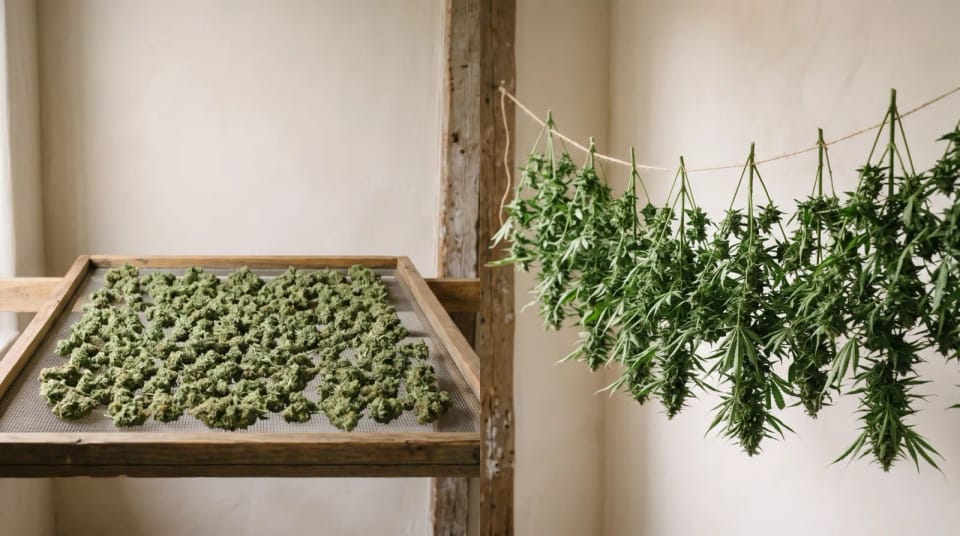
The two methods in the 2023 greenhouse study. The wet-trim buds were also machine-trimmed fresh and rack-dried, so trim timing was not the only difference.
Why that result is not the final word
This comparison is mixed up with other changes. The wet-trim buds differed from the hang-dried ones in drying method, handling and leaf cover, not only in when they were trimmed. Only four samples were shown for the comparison. The trimming was done by machine, in one company’s facility, in a drying room held at 21 to 23 °C and 40 to 55 percent humidity. Nobody tested hand trimming in a humid home room.
So do not read it as “wet trimming causes mold.” Read it this way: the popular rule that wet trimming protects against mold has no data behind it in what we found, and the one dataset we found measured the reverse for this setup.
What actually brought mold counts down
In the same study, the hang-dry method showed a pattern worth knowing. Yeast and mold counts rose for about the first 72 hours, then fell sharply between days four and six as the flowers dried to 12 to 14 percent moisture, a water activity of about 0.62 to 0.7 (Punja et al., 2023). Hang-drying whole stems and drying to that moisture level or lower were among the factors linked to lower counts overall. Counts never reached zero.
If those units are new to you, we explain what a water activity of 0.65 to 0.7 means. A mold count from a lab is also not a safety verdict for one person. If you see fuzz or webbing on your buds, learn how to tell mold from trichomes and what bud rot looks like, and discard flower that is visibly moldy.
When to talk to a clinician: if you get coughing, wheezing, chest tightness or fever after smoking flower you suspect was moldy, or if you have a weakened immune system or lung disease, talk to a doctor. Do not try to treat those symptoms yourself.
Does wet trimming make buds dry faster?
We found no controlled study that measured it. Removing leaves exposes more surface, so faster drying is a reasonable expectation (Das et al., 2022). But the 2024 trim study held drying at six days for every group, so it did not test speed. Claims that wet trim dries in a set number of fewer days rest on grower reports, not measurements.
Does dry trimming lose more trichomes?
We found no controlled study of trichome loss by trim method. Growers disagree about which method knocks off more resin, and neither side has measurements to show. The same goes for bag appeal and smoke smoothness: no peer-reviewed comparison came up in our searches. If you buy rather than grow, see what hand and machine trim look like on a shelf.
So which method should you choose?
This part is practical judgment, not evidence. Match the method to what you care about and to the room you have:
- Aroma first: the only controlled data favors trimming after the dry, at least under fast, cool, dry conditions.
- Slightly more cannabinoids: the same study found a small edge for a light trim before drying.
- A humid room: the evidence does not support wet trimming as mold protection. What lowered counts in the greenhouse study was hang-drying whole stems and getting moisture down within about a week.
- Your hands and your time: a valid reason, and the one the postharvest review says often drives the choice anyway.
Whatever you choose, the drying and the storage after it matter at least as much as the trim. Once the flower is dry, read about storing flower after the dry.
Key takeaways
- The one controlled trim study found a trade-off, not a winner.
- Dry trim kept the most terpenes; a light wet trim kept slightly more cannabinoids.
- “Wet trim in a humid room to prevent mold” has no source we could find, and one commercial dataset measured the opposite for rack-dried, wet-trimmed buds.
- Drying time, trichome loss and bag appeal have no controlled data yet.
- Drying to the right moisture level within about a week mattered more for mold than any trim rule.
FAQ
Is it better to wet trim or dry trim?
Neither is better on every measure. In the one controlled study we found, dry trimming kept more of most terpenes, and a light wet trim kept slightly more total cannabinoids. Pick based on which of those you care about, and on your drying setup.
Can you trim part wet and part dry?
Yes, you can remove the large fan leaves at harvest and finish the sugar leaves after drying. No study we found tested that split as its own method. The closest is the mild wet trim group in the 2024 study, which cut sugar leaves halfway before drying and had the highest total cannabinoids.
Do trimming machines change the answer?
The mold evidence comes from machine-trimmed buds, and an earlier survey linked mechanical trimming to more Penicillium recovered from buds. Hand trimming was not compared in either study. So the machine result does not tell you how hand trimming would compare.
Does dry trimming make weed stronger?
Not in the study we found. Dry trimming had slightly lower total cannabinoids than a light wet trim, while keeping more terpenes. Stronger smell is not the same as more THC.
Sources
- Brikenstein N, Birenboim M, Kenigsbuch D, Shimshoni JA. “Optimization of Trimming Techniques for Enhancing Cannabinoid and Terpene Content in Medical Cannabis Inflorescences.” Medical Cannabis and Cannabinoids, 2024. doi:10.1159/000539192
- Punja ZK, Ni L, Lung S, Buirs L. “Total yeast and mold levels in high THC-containing cannabis (Cannabis sativa L.) inflorescences are influenced by genotype, environment, and pre- and post-harvest handling practices.” Frontiers in Microbiology, 2023. doi:10.3389/fmicb.2023.1192035
- Punja ZK, Collyer D, Scott C, Lung S, Holmes J, Sutton D. “Pathogens and Molds Affecting Production and Quality of Cannabis sativa L.” Frontiers in Plant Science, 2019. doi:10.3389/fpls.2019.01120
- Birenboim M, Brikenstein N, Duanis-Assaf D, et al. “In Pursuit of Optimal Quality: Cultivar-Specific Drying Approaches for Medicinal Cannabis.” Plants, 2024. doi:10.3390/plants13071049
- Das PC, Vista AR, Tabil LG, Baik O-D. “Postharvest Operations of Cannabis and Their Effect on Cannabinoid Content: A Review.” Bioengineering, 2022. doi:10.3390/bioengineering9080364





