Can You Smoke Weed Leaves? What Fan and Sugar Leaves Contain
You can smoke weed leaves, but fan leaves measured about 2% total cannabinoids against about 16% in bud. Here is what sugar leaf holds and better uses for trim.

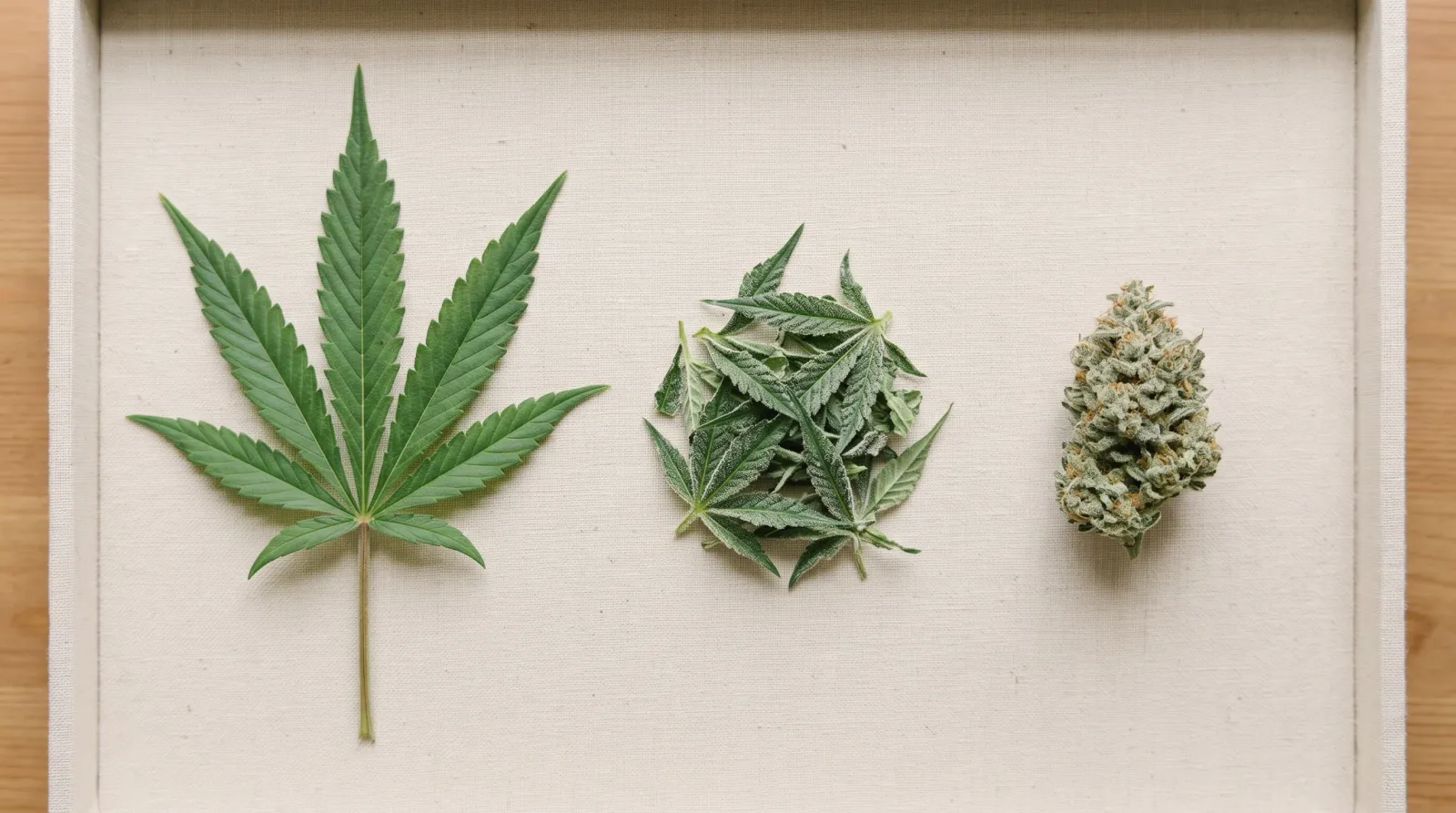
Yes, you can smoke weed leaves, but they are much weaker than bud: in two lab studies, dried fan leaves held about one-seventh of the cannabinoids found in flower. Sugar leaves, the small frosty leaves that grow out of the buds, sit somewhere in between. No study we found measured them on their own.
Here is the specific to send the friend who swears his trim joint is “basically bud.” In a 2021 study of 82 plants from 21 strains, fan leaves averaged 2.17 percent total cannabinoids (range 0.95 to 4.28) against 15.90 percent in flower (range 7.06 to 24.42). The same study counted sugar leaves as part of the flower, so it gives no separate sugar-leaf number. Jin et al., Frontiers in Plant Science, 2021
That one detail undercuts the confident sugar-leaf percentages you see online. We could not find a measurement behind any of them. This High School lesson covers what the leaves contain, what happens when you burn them, and what trim is better used for. It gives no dose and no promise about how leaf feels.
How much THC is in weed leaves compared with buds?
Fan leaves carry roughly 1 to 4 percent total cannabinoids; dried flower in the same studies carried roughly 16 to 20 percent. Two independent sample sets from the same research group agree on that gap.
| Plant part | What it is | Measured total cannabinoids | Source |
|---|---|---|---|
| Flower (bud, sugar leaves included) | The dried inflorescence | 15.90% average (7.06 to 24.42%) across 82 plants | Jin 2021 |
| Flower, three chemovars | Dried inflorescence | 15.77 to 20.37% | Jin 2020 |
| Fan leaf | Large leaves on stalks along the branches | 2.17% average (0.95 to 4.28%) | Jin 2021 |
| Fan leaf, three chemovars | Air-dried leaves | 1.10 to 2.10% | Jin 2020 |
| Sugar leaf | Small resin-dusted leaves inside the bud | Not measured separately in any study we found | — |
The arithmetic: 2.17 divided by 15.90 is about 0.14, or roughly one part in seven. In the 2020 study the leaf-to-flower ratio ran from about 0.05 to 0.13. That is a ratio, not a dose.
Three cautions keep those numbers honest.
- Total cannabinoids are not total THC. Jin measured THC, CBD and the other cannabinoids together. A leaf from a high-CBD plant can carry a similar total with little THC.
- A third dataset gives a higher ratio. A 2023 method study of one drug-type plant found leaf THCA at about 21 to 42 percent of the bud figure. It still ranks leaf well below bud. Tanaka et al., Yakugaku Zasshi, 2023
- Terpenes drop even further. In the 2021 study, total terpenoids were 1.509 percent in flower and 0.103 percent in leaves, about one-fifteenth. Leaf smoke carries far less of the aroma that makes a strain taste like itself. Jin 2021
Raw leaf also holds mostly THCA, not THC, the same as raw flower. Heat converts it, but a joint is an inefficient oven. In a simulated smoking test, only about 30 percent of added THCA came through as THC, against about 70 percent under optimized lab heating. Dussy et al., Forensic Science International, 2005 That loss applies to bud too. The lesson on why raw cannabis holds THCA, not THC walks through the chemistry.
Are sugar leaves worth smoking?
Sugar leaves are the better of the two leaf types, but nobody we found has published how much better. They grow out of the bud itself, so their surface carries trichomes, the resin glands where the cannabinoids sit.
A 2025 review describes sugar leaves as the small “frosty” leaves around the buds. Their trichome density is highest at the tips and margins and “less uniform” than on the bracts, the tiny leaf-like structures that wrap each seed site. The bracts are the most consistent, resin-rich part of the flower. Alberti et al., Plants, 2025 So a sugar leaf is part frosted resin and part green leaf, and the mix changes from leaf to leaf and plant to plant. That is one reason a single “sugar leaf percentage” is not reliable.
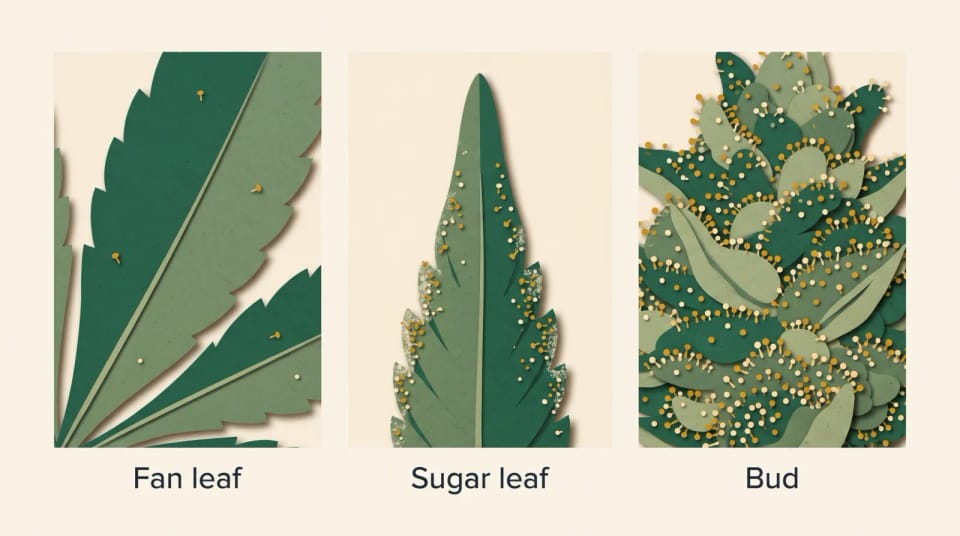
Cannabinoids sit mostly in trichomes. Sugar leaves carry them unevenly, mostly at the tips and edges, which is why no single potency figure fits every sugar leaf.
The closest number we found comes from an extraction study, not a potency test. Heating one lot of sugar leaf in MCT oil recovered about 0.75 grams of total THC per 100 grams of dry material. Meepun et al., Journal of Cannabis Research, 2025 That is what one oil method pulled out of one lot, so treat it as a floor, not the leaf’s content.
Where we looked: Europe PMC and a research-paper index for “sugar leaf” and “sugar leaves” with cannabinoids. A trimming study measured flower after removing every sugar leaf, but it did not test the leaves it removed. Brikenstein et al., 2024 If you want the timing side of that story, see when growers trim, wet or dry.
So, worth smoking? Sugar leaf burns and holds some resin. It is still mostly leaf, and you are paying the cost of smoke for less cannabinoid than the same weight of bud.
Can you smoke fan leaves?
You can, but fan leaves are the least rewarding part of the plant anyone keeps. They are the big, hand-shaped leaves on long stalks that do most of the plant’s photosynthesis. Growers remove some of them for light and airflow, as the guide on why growers remove fan leaves explains, and that is where most fan-leaf piles come from.
The measured range for fan leaf starts at 0.95 percent and tops out at 4.28 percent total cannabinoids. Jin 2021 Claims that fan leaves hold “under 1 percent THC” go below that published minimum, and claims of much higher figures have nothing behind them that we found.
Weaker material also changes the smoke math. A small 1997 study of 10 habitual smokers found the stronger of two research cigarettes delivered more THC and left less tar, though the authors saw a tar saving relative to THC in only a minority of smokers. Matthias et al., 1997 Those cigarettes were not leaf, so read it narrowly: the weaker the material, the more you may burn for the same result.
Are weed leaves harsher to smoke?
Nobody has measured it, as far as we found. The popular line that leaf smoke is harsh “because of chlorophyll,” with specific multiples of throat irritation, has no study behind it that we could locate. We are not going to repeat a number nobody measured.
What is certain is simpler. Burning any plant material, leaf or bud, produces smoke that irritates the airway. Our lesson on why cannabis smoke makes you cough covers the reasons, and smoking versus vaping compares the two routes.
When to talk to a clinician: if you have a cough that lasts for weeks, wheezing, chest tightness, shortness of breath, or you cough up blood, talk to a doctor or nurse. Tell them you smoke cannabis, so they can judge the cause.
What can you do with weed leaves instead?
Sort the pile first, then send each part where it does the most good. Sugar leaf trim is a resin source; fan leaves are mostly compost.
- Separate fan leaves from sugar leaves. Pull out the big stalked leaves. Keep the small frosty ones.
- Dry the sugar leaf trim before you store it, so it does not mold.
- Collect the resin. Shake the dry trim over a fine screen for kief, or make bubble hash or dry sift. Both keep the trichomes and leave most of the green leaf behind, which is the whole point.
- Decarb before infusing. Raw trim holds THCA. The guide to decarboxylation shows how to convert it before you make butter or infuse it into coconut oil. Homemade trim infusions have no lab number, so treat their strength as unknown.
- Compost the fan leaves where local rules allow.
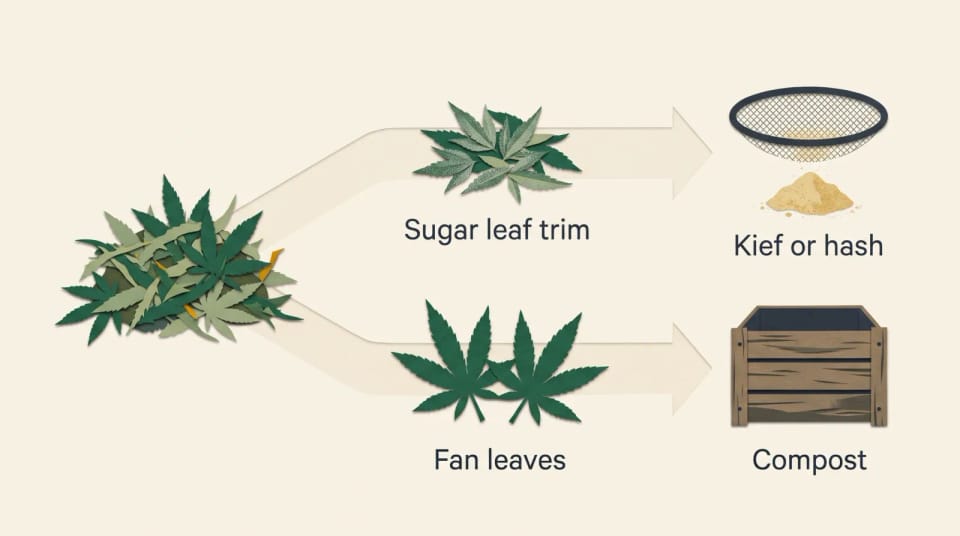
Sorting is the step that matters. Sifting sugar leaf trim keeps the resin and leaves the leaf; fan leaves carry too little resin to be worth sifting.
If you are buying rather than growing, trim and shake are sold as their own grades for a reason. The guide to shake, trim and flower grades explains what you get at each price. For the dose math behind a pre-roll, see how much THC is in a joint.
Is it legal to smoke cannabis leaves?
Under federal law, cannabis leaves count as marijuana unless the plant is legal hemp. The statute defines marijuana as “all parts of the plant Cannabis sativa L., whether growing or not,” and its exclusions name mature stalks, fiber, seed oil or cake, and sterilized seed. Leaves are not on that list. 21 U.S.C. 802(16)
So a leaf from a THC plant is treated like the bud from that plant. State law decides what you may grow, possess and use, and it varies. The federal hemp definition is also changing; the lesson on THCA flower after December 11, 2026 explains the dates. This is a High School lesson, not legal advice.
Key takeaways
- You can smoke weed leaves, but measured fan leaves held about 2 percent total cannabinoids against about 16 percent in flower.
- No study we found reports a separate sugar-leaf number, so treat any confident sugar-leaf percentage with suspicion.
- Total cannabinoids are not THC, and a joint converts only part of the THCA it burns.
- Nobody has measured whether leaf smoke is harsher; any smoke irritates the airway.
- The better use for sugar leaf trim is kief, hash or a decarbed infusion; fan leaves belong in compost.
FAQ
Can you get high from smoking weed leaves?
Leaves contain some cannabinoids, so they are not inert, but measured fan leaves hold a small fraction of what bud holds. Sugar leaves carry more resin than fan leaves, though no study we found measured how much. We do not predict how leaf feels, because no study has tested that.
Do you need to dry weed leaves before smoking them?
Fresh leaves are wet and will not burn well, which is why leaf and flower are dried before use. Drying does not raise potency; no study we found shows that curing or drying makes leaf stronger. Dry trim before storing it to prevent mold.
Can you smoke yellow leaves or leaves from male plants?
We did not find any study that measured cannabinoids in yellowing leaves or in male-plant leaves. Claims about them online come without a source. If a leaf shows mold or rot, discard it.
Are weed stems worth anything?
Stems held even less than leaves in the 2021 study: about 0.58 percent total cannabinoids in stem bark. They are not a cannabinoid source worth smoking or infusing. Compost them with the fan leaves.
Sources
- Jin D, Henry P, Shan J, Chen J. Identification of chemotypic markers in three chemotype categories of cannabis using secondary metabolites profiled in inflorescences, leaves, stem bark, and roots. Frontiers in Plant Science, 2021.
- Jin D, Dai K, Xie Z, Chen J. Secondary metabolites profiled in cannabis inflorescences, leaves, stem barks, and roots for medicinal purposes. Scientific Reports, 2020.
- Tanaka R, et al. Determination of 11 cannabinoids in Cannabis sativa L. by LC-Q-TOF-MS. Yakugaku Zasshi, 2023 (abstract).
- Alberti T, et al. Bracts, buds, and biases: uncovering gaps in trichome density quantification and cannabinoid concentration in Cannabis sativa L. Plants, 2025.
- Brikenstein N, et al. Optimization of trimming techniques for enhancing cannabinoid and terpene content in medical cannabis inflorescences. Medical Cannabis and Cannabinoids, 2024.
- Meepun N, Sommart U, Bualuang O. Green solvent-based extraction of Cannabis sativa L. by-products using MCT oil. Journal of Cannabis Research, 2025.
- Dussy FE, et al. Isolation of Delta9-THCA-A from hemp and analytical aspects concerning the determination of Delta9-THC in cannabis products. Forensic Science International, 2005 (abstract).
- Matthias P, et al. Effects of varying marijuana potency on deposition of tar and delta9-THC in the lung during smoking. Pharmacology, Biochemistry and Behavior, 1997 (abstract).
- 21 U.S.C. 802(16), definition of marijuana. Legal Information Institute, accessed October 29, 2026.





