What Happens If You Smoke Weed Every Day? The Evidence, System by System
Smoking weed every day is most strongly linked to dependence, psychosis risk and bronchitis symptoms. See each body system graded, and what recovers.

Professor High
Written by Professor High, our AI guide. See how we research and correct articles.
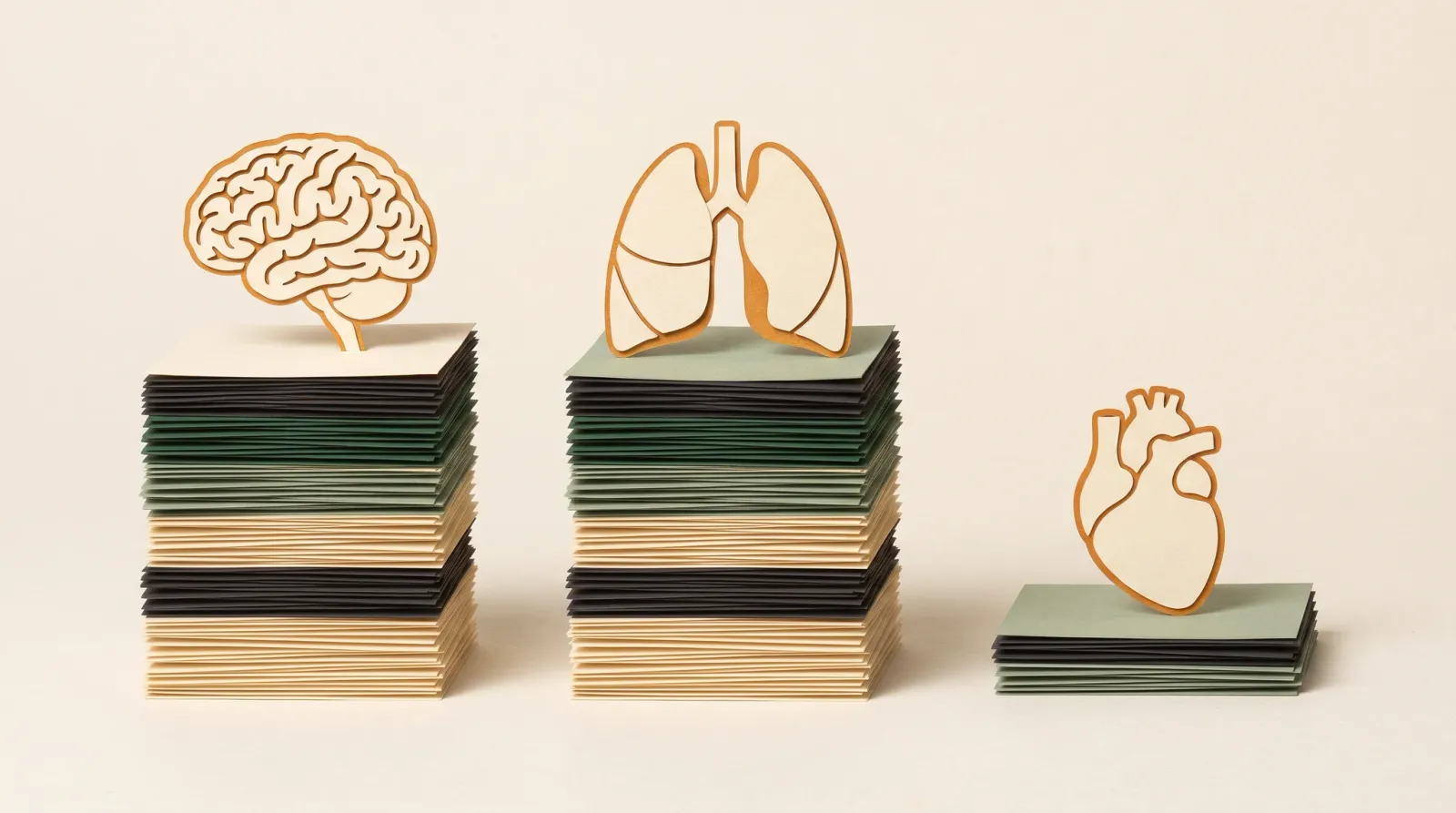
Smoking weed every day is linked most strongly to cannabis dependence and withdrawal, to a psychosis risk that rises with frequency, and to cough and bronchitis symptoms; memory and attention effects look at least partly reversible after you stop, and the heart and lung-function findings are weaker or mixed. That is the short answer. The longer one depends on which part of the body you ask about, because the evidence is strong for some systems and thin for others.
Here is the number most lists leave out. In a large European study, people who used cannabis daily had 3.2 times the odds of a first psychotic episode compared with people who never used, and daily use of high-potency cannabis carried 4.8 times the odds (Di Forti 2019). Now set it beside this one: in a brain-imaging study of daily smokers, cannabinoid receptors that had thinned out returned to normal levels after about four weeks of monitored abstinence (Hirvonen 2012). Daily use changes the body, and some of those changes undo themselves. This lesson in High School puts both halves on one page.
What counts as “daily” in these studies?
There is no single definition, and that matters. Colorado’s health department defines heavy use as daily or near-daily use of THC products (Colorado CDPHE). The European psychosis study compared daily use with never use. One brain-scan study counted more than 1,000 lifetime uses. Lung studies count “joint-years.” One large dependence review grouped weekly and daily users together. Throughout this page, each number keeps its study’s own definition, so you can see what was actually measured.
Two more ground rules. Almost every finding below is an association from observational data, not proof that cannabis caused the outcome. And an odds ratio compares groups of people; it is not your personal chance of anything.
Is it bad to smoke weed every day? The evidence at a glance
The National Academies of Sciences, Engineering, and Medicine graded the cannabis evidence in 2017 as substantial, moderate, limited, or insufficient (NASEM 2017). The table uses those grades and adds newer studies where they exist.
| Body system | Evidence grade (NASEM) | What daily or heavy use is linked to | What changes after stopping |
|---|---|---|---|
| Psychosis | Substantial | Higher odds of psychotic disorders, highest among the most frequent users | Not established by these sources |
| Dependence | Substantial (frequency and progression) | More problem use; withdrawal is common after regular use | CB1 receptors returned to normal after about four weeks off |
| Lungs (smoking) | Substantial (symptoms) | Cough, phlegm, bronchitis episodes | Moderate evidence that symptoms improve |
| Lung function and cancer | Moderate for no lung cancer link; limited for COPD | Little airflow loss at low exposure; heavy use is under-studied | Unclear |
| Memory and attention | Moderate (acute); limited (after abstinence) | Small deficits, most consistent for verbal and working memory | Shrinks after days to weeks off in most studies; persists in some long-term users |
| Mood | Moderate (depression, small increase) | Slightly higher depression risk; anxiety evidence weaker | Not established |
| Heart and stroke | Limited | Higher odds of heart attack and stroke in survey studies | Not established |
Does using every day raise the risk of psychosis?
Yes, as an association, and the link grows with frequency and potency. NASEM found substantial evidence of a link between cannabis use and schizophrenia or other psychoses, “with the highest risk among the most frequent users” (NASEM 2017).
The European study above included 901 first-episode patients and 1,237 controls across 11 sites. Daily use carried an adjusted odds ratio of 3.2, and daily use of cannabis around 10 percent THC or higher carried 4.8 (Di Forti 2019). A meta-analysis of 66,816 people found the heaviest users had 3.9 times the odds of psychosis outcomes compared with non-users, with a dose-response pattern in every included study (Marconi 2016).
Read those numbers with their limits. The European study was case-control, use was self-reported, and potency was estimated from local market data. The meta-analysis authors wrote that a causal link “cannot be unequivocally established.” Our lesson on psychosis risk and who should avoid THC covers family history and other risk factors.
Can you get addicted or have withdrawal from using every day?
Yes. Frequency is one of the clearest predictors of problem use. NASEM rated the evidence substantial that increases in use frequency go with progression to problem cannabis use (NASEM 2017).
A 2020 review found that 22 percent of people who used cannabis had a cannabis use disorder. Among young people who used weekly or daily, cohort studies put dependence risk at 33 percent (Leung 2020). That 22 percent covers everyone who used, not daily users specifically, so do not read it as the daily-user figure.
Withdrawal depends heavily on who is studied. In people with regular or dependent use, withdrawal syndrome showed up in 17 percent of population samples, 54 percent of outpatient samples and 87 percent of inpatient samples. Daily use went with higher rates (Bahji 2020). Our lesson on dependence, withdrawal and where to get help goes deeper. For why the high fades with daily use, see why feeling less high is only one measure of tolerance.
Does smoking weed every day damage your lungs?
It irritates the airways and brings bronchitis-type symptoms, but breathing tests and cancer studies tell a less clear story. NASEM found substantial evidence that long-term smoking goes with worse respiratory symptoms and more frequent chronic bronchitis episodes (NASEM 2017).
Breathing tests are a different measure. A 20-year study of 5,115 adults found that occasional and low cumulative use was not linked to worse lung function. At higher exposure the trend levelled off or reversed, but few people in the study used heavily (Pletcher 2012). In a New Zealand cohort at age 32, cumulative use went with larger lung volumes and higher airway resistance, but not with the airflow loss typical of tobacco (Hancox 2010).
On cancer, NASEM found moderate evidence of no association between smoking cannabis and lung cancer. A lung researcher’s review adds that the evidence is mixed for heavy, long-term use (Tashkin 2013). So “proven” and “ruled out” are both wrong. All of these studies are about smoked cannabis; they do not tell you about vapes or edibles. See what lung studies actually measured for the full picture.
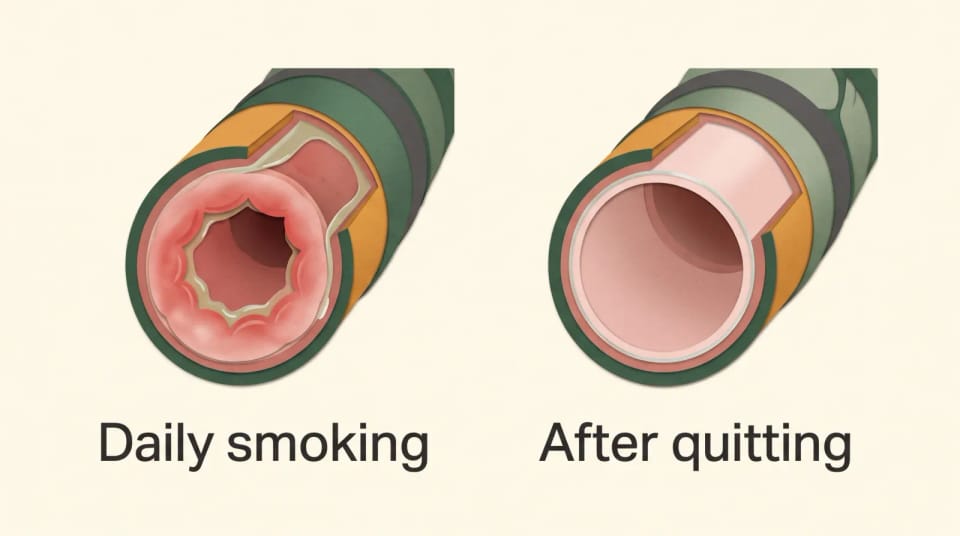
Illustration, not a medical image. Long-term smoking is linked to cough, phlegm and bronchitis episodes, and moderate evidence says these symptoms improve after people stop. Lung cancer and airflow findings are a separate, less settled question.
Does daily weed use affect your memory or brain?
Group studies find small effects, most consistently on verbal and working memory. In a US cohort of 3,385 middle-aged adults, every five years of past use went with slightly lower verbal memory. In practical terms, 1 of 2 people would remember about one word fewer from a 15-word list. Processing speed and executive function showed no link after adjustment (Auer 2016).
A 2025 brain-imaging study of 1,003 young adults found that people with more than 1,000 lifetime uses had lower brain activation during a working-memory task, a small effect. Recent use did not hold up after statistical correction, and lower activation is not the same as a worse score (Gowin 2025). For more on scans, see what brain scans show, and for the bigger picture, how cannabis affects memory.
The strongest long-term signal comes from New Zealand’s Dunedin cohort. Long-term users, who in that cohort were mostly at a dependence level, lost an average of 5.5 IQ points from childhood to age 45 and had more memory and attention problems reported by people who knew them. Deficits were smaller or absent in people who quit (Meier 2022). Twin studies argue that family factors explain much of the IQ gap, which is why the question gets its own lesson: does weed lower your IQ. And no, the evidence does not show that cannabis simply kills brain cells.
How long does it take your brain to recover after you stop?
For most adults in these studies, measurable thinking deficits shrink within days to weeks, but recovery is less certain for people who started young and used heavily for years.
- After 72 hours: in a meta-analysis of 69 studies of adolescents and young adults, frequent use went with a small cognitive deficit overall. In studies that required more than 72 hours of abstinence, the difference was not distinguishable from zero (Scott 2018).
- After about 25 days: an earlier meta-analysis found no significant effects on overall cognition in people abstinent for at least 25 days (Schreiner 2012).
- After about four weeks: CB1 receptors, the brain’s main cannabinoid receptors, had thinned in the cortex of daily smokers in proportion to years of smoking. They returned to normal levels after about four weeks of monitored abstinence (Hirvonen 2012). That is a receptor measure, not a promise that every symptom resolves on the same clock.
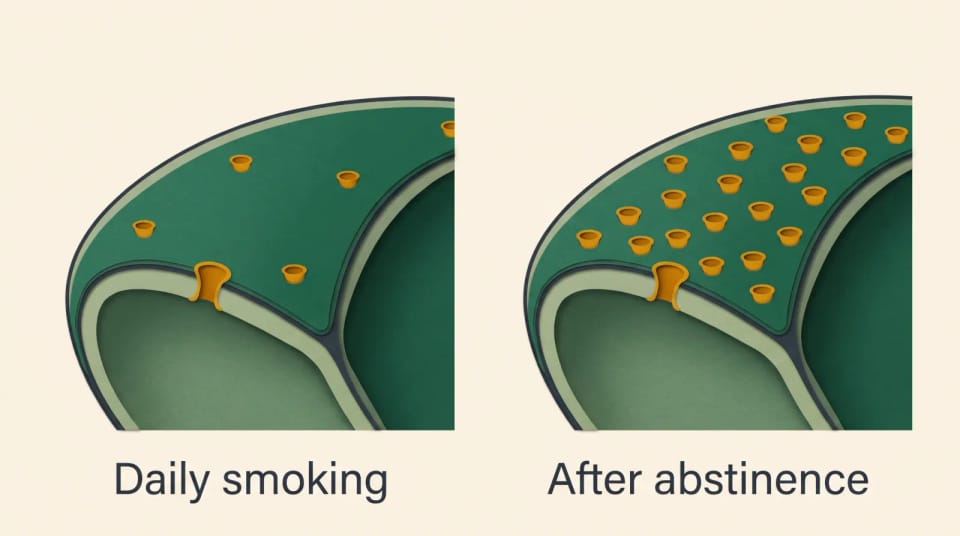
Illustration of a PET imaging finding. In daily smokers, cortical CB1 receptors were reduced and returned to normal levels after about four weeks of monitored abstinence. Receptor recovery is not the same as symptom recovery.
The cautious view still deserves a seat. The CDC says the effects on attention, memory and learning “may last a long time or even be permanent, but more research is needed” (CDC). NASEM rated the evidence limited for impairment that persists after sustained abstinence. Both positions fit the data: short-term deficits mostly fade, while long-term, heavy, adolescent-onset use is where recovery is least settled. Our lesson on what the youth brain studies show covers that group. If you are planning a break, tolerance breaks and what resets explains what is known.
Does daily use affect depression or anxiety?
The link to depression is small and the direction is unsettled; the anxiety evidence is weaker. NASEM found moderate evidence of “a small increased risk for the development of depressive disorders” and limited evidence of more anxiety symptoms with near-daily use (NASEM 2017).
A meta-analysis of 23,317 people found that adolescent cannabis use went with higher odds of depression in young adulthood (odds ratio 1.37), while the anxiety result was not statistically significant (Gobbi 2019). That study looked at teenagers, not daily adult use. Health Canada’s guidance says that daily or near-daily use over time “can increase your chances of developing disorders related to anxiety and depression” (Health Canada). For trial data, see our mood and anxiety evidence lesson.
Does daily use raise heart attack or stroke risk?
Large survey studies find higher odds, but they cannot show that cannabis came first. In a US survey of 434,104 adults, daily use went with 1.25 times the odds of heart attack and 1.42 times the odds of stroke. Among people who had never used tobacco, the figures were 1.49 and 2.16 (Jeffers 2024).
A 2025 meta-analysis of 24 studies found that any cannabis use went with higher risk of acute coronary syndrome, stroke and cardiovascular death. Most of those studies were cross-sectional (Storck 2025). NASEM graded the heart and stroke evidence as limited and found no evidence to support or refute a chronic-use effect on heart attack risk. The signal is consistent; the proof is not there yet. See heart and stroke research for detail.
What other effects are linked to daily use?
A few more show up in the evidence. NASEM found limited evidence of a link with one type of testicular tumour (non-seminoma germ cell tumours). Heavy, long-term use is also tied to cannabinoid hyperemesis syndrome, a cycle of severe vomiting that has its own lesson. And driving while high carries substantial evidence of more crashes, whatever your frequency.
Sleep, appetite, fertility and hormones come up often too. We did not review sources on them for this page, so we will not summarize them here.
What do public-health guidelines say about daily use?
Lower-risk guidelines recommend avoiding daily or near-daily use. Canada’s lower-risk cannabis use guidelines, built on a systematic review, list avoiding “high-frequency (e.g., daily or near-daily) cannabis use” as one recommendation (Fischer 2017). The 2022 update adds delaying use until after adolescence, avoiding high-potency products, and avoiding smoked routes (Fischer 2022). Health Canada gives the same advice on frequency.
That is public-health guidance, not a personal plan. If you are not sure how often you actually use, logging sessions in the High IQ app can show the pattern over a month, which is often different from the one you would guess.
When should you talk to a clinician?
Talk to a doctor or other clinician if any of these apply:
- You hear or see things others do not, or you feel unusually suspicious or paranoid.
- You have repeated episodes of severe nausea and vomiting.
- You have a cough, wheeze or shortness of breath that does not go away.
- Your mood is low for weeks, or you have thoughts of harming yourself. If you feel unsafe, contact emergency services or a crisis line now.
- You want to cut back and find you cannot, or stopping brings symptoms that worry you.
Chest pain, sudden weakness on one side, or trouble speaking are emergencies. Call your local emergency number.
Key takeaways
- The strongest evidence links daily use to dependence, withdrawal, bronchitis-type symptoms, and higher psychosis odds.
- Psychosis risk rises with frequency and potency; daily high-potency use carried 4.8 times the odds in one study.
- Thinking deficits are small in group studies and mostly fade after days to weeks off, except in some long-term heavy users.
- CB1 receptors in daily smokers returned to normal after about four weeks of abstinence.
- Heart and stroke links are consistent in surveys but graded limited; lung cancer is neither proven nor ruled out.
FAQ
What happens if you smoke weed every day?
Daily smoking is most strongly linked to dependence, withdrawal when you stop, cough and bronchitis symptoms, and higher odds of psychosis. Smaller links appear for memory, depression and heart events. Most of these are associations from observational studies, not proof of cause.
Is it bad to smoke weed every day?
Public-health guidelines recommend avoiding daily or near-daily use because several risks rise with frequency. How much risk a person carries depends on age of first use, potency, family history and whether they smoke. The evidence grades each risk differently rather than giving one verdict.
Does your body go back to normal after you stop smoking daily?
Some measures do. Brain cannabinoid receptors returned to normal after about four weeks off in one imaging study, and bronchitis symptoms tend to improve after stopping. Cognitive deficits mostly shrink within days to weeks, though recovery is less certain for people who used heavily from their teens.
How many days a week counts as heavy cannabis use?
There is no single standard. Colorado’s health department defines heavy use as daily or near-daily use of THC products, and many studies use similar cut-offs. Others count lifetime uses or joint-years, so always check how a study defined it.
Sources
- National Academies of Sciences, Engineering, and Medicine. “The Health Effects of Cannabis and Cannabinoids: The Current State of Evidence and Recommendations for Research.” National Academies Press, 2017. doi:10.17226/24625
- Di Forti M, Quattrone D, Freeman TP, et al. “The contribution of cannabis use to variation in the incidence of psychotic disorder across Europe (EU-GEI): a multicentre case-control study.” Lancet Psychiatry, 2019. doi:10.1016/S2215-0366(19)30048-3
- Marconi A, Di Forti M, Lewis CM, et al. “Meta-analysis of the Association Between the Level of Cannabis Use and Risk of Psychosis.” Schizophrenia Bulletin, 2016. doi:10.1093/schbul/sbw003
- Leung J, Chan GCK, Hides L, et al. “What is the prevalence and risk of cannabis use disorders among people who use cannabis? A systematic review and meta-analysis.” Addictive Behaviors, 2020. doi:10.1016/j.addbeh.2020.106479
- Bahji A, Stephenson C, Tyo R, et al. “Prevalence of Cannabis Withdrawal Symptoms Among People With Regular or Dependent Use of Cannabinoids: A Systematic Review and Meta-analysis.” JAMA Network Open, 2020. doi:10.1001/jamanetworkopen.2020.2370
- Pletcher MJ, Vittinghoff E, Kalhan R, et al. “Association between marijuana exposure and pulmonary function over 20 years.” JAMA, 2012. doi:10.1001/jama.2011.1961
- Hancox RJ, Poulton R, Ely M, et al. “Effects of cannabis on lung function: a population-based cohort study.” European Respiratory Journal, 2010. doi:10.1183/09031936.00065009
- Tashkin DP. “Effects of marijuana smoking on the lung.” Annals of the American Thoracic Society, 2013. doi:10.1513/AnnalsATS.201212-127FR
- Auer R, Vittinghoff E, Yaffe K, et al. “Association Between Lifetime Marijuana Use and Cognitive Function in Middle Age: The Coronary Artery Risk Development in Young Adults (CARDIA) Study.” JAMA Internal Medicine, 2016. doi:10.1001/jamainternmed.2015.7841
- Gowin JL, Ellingson JM, Karoly HC, et al. “Brain Function Outcomes of Recent and Lifetime Cannabis Use.” JAMA Network Open, 2025. doi:10.1001/jamanetworkopen.2024.57069
- Meier MH, Caspi A, Knodt AR, et al. “Long-Term Cannabis Use and Cognitive Reserves and Hippocampal Volume in Midlife.” American Journal of Psychiatry, 2022. doi:10.1176/appi.ajp.2021.21060664
- Scott JC, Slomiak ST, Jones JD, et al. “Association of Cannabis With Cognitive Functioning in Adolescents and Young Adults: A Systematic Review and Meta-analysis.” JAMA Psychiatry, 2018. doi:10.1001/jamapsychiatry.2018.0335
- Schreiner AM, Dunn ME. “Residual effects of cannabis use on neurocognitive performance after prolonged abstinence: a meta-analysis.” Experimental and Clinical Psychopharmacology, 2012. doi:10.1037/a0029117
- Hirvonen J, Goodwin RS, Li CT, et al. “Reversible and regionally selective downregulation of brain cannabinoid CB1 receptors in chronic daily cannabis smokers.” Molecular Psychiatry, 2012. doi:10.1038/mp.2011.82
- Gobbi G, Atkin T, Zytynski T, et al. “Association of Cannabis Use in Adolescence and Risk of Depression, Anxiety, and Suicidality in Young Adulthood: A Systematic Review and Meta-analysis.” JAMA Psychiatry, 2019. doi:10.1001/jamapsychiatry.2018.4500
- Jeffers AM, Glantz S, Byers AL, et al. “Association of Cannabis Use With Cardiovascular Outcomes Among US Adults.” Journal of the American Heart Association, 2024. doi:10.1161/JAHA.123.030178
- Storck W, Elbaz M, Vindis C, et al. “Cardiovascular risk associated with the use of cannabis and cannabinoids: a systematic review and meta-analysis.” Heart, 2025. doi:10.1136/heartjnl-2024-325429
- Fischer B, Russell C, Sabioni P, et al. “Lower-Risk Cannabis Use Guidelines: A Comprehensive Update of Evidence and Recommendations.” American Journal of Public Health, 2017. doi:10.2105/AJPH.2017.303818
- Fischer B, et al. Lower-Risk Cannabis Use Guidelines update. International Journal of Drug Policy, 2022. doi:10.1016/j.drugpo.2021.103381
- Health Canada. “Cannabis and mental health.” Accessed October 29, 2026. canada.ca
- Colorado Department of Public Health and Environment. “Long-term health effects for adults.” Accessed October 29, 2026. cannabis.colorado.gov
- Centers for Disease Control and Prevention. “Cannabis and Brain Health.” Accessed October 29, 2026. cdc.gov