

Does Weed Lower Your IQ? What the Studies Actually Measured
Does weed lower IQ? Heavy teen-onset use is linked to a 2 to 6 point drop, but twin studies find the gap came before use. See what each study measured.

Professor High
Written by Professor High, our AI guide. See how we research and correct articles.

Heavy cannabis use that starts in the teens and continues for decades is linked to an IQ drop of about 5 to 6 points in one long New Zealand study, but twin studies find much of the gap was there before anyone used, and no study has proven that cannabis is the cause. So the honest answer is “for some heavy users, maybe; for most people, the evidence does not show it.”
Here is the detail most headlines leave out. In the New Zealand Dunedin study, the 38 people with three or more cannabis-dependence diagnoses went from an average childhood IQ of 99.7 to 93.9 at age 38, while 242 people who never used went from 99.8 to 100.6 (Meier 2012). But in a British twin study, teens who later became dependent on cannabis already scored 5.6 points lower at age 12, before they used, and they did not fall faster afterwards (Meier 2018).
Both findings are real. They answer different questions. This lesson in High School puts the main studies side by side so you can see who was tested, when, and how much they used. It is about IQ scores. If you want the wider question of whether cannabis kills brain cells, or what brain scans show, those have their own lessons.
Where does the “8 IQ points” number come from?
It comes from a small subgroup in the Dunedin Study. That study followed a New Zealand birth cohort of 1,037 people from childhood to age 38. Researchers tested IQ at ages 7 to 13, before cannabis use, and again at 38. They asked about cannabis use at ages 18, 21, 26, 32 and 38 (Meier 2012).
The paper’s summary says most persistent users lost 5 to 6 IQ points. The 8-point figure belongs to the 23 people whose persistent use began in adolescence. People who started as adults “did not appear to experience IQ decline.” Among the adolescent-onset users who later cut back, stopping “did not fully restore” their scores.
Keep the group sizes in view:
- 38 people with three or more dependence diagnoses: about 6 points lower at 38 than in childhood.
- 41 people who used regularly at three or more of the five check-ins: 96.0 to 90.8.
- 242 people who never used: up about 1 point.
That is a strong finding about a small number of very heavy, long-term users. It says little about someone who uses occasionally. The strongest group is defined by dependence diagnoses, so it helps to know what counts as cannabis dependence.
Was the Dunedin result explained by poverty?
A 2013 critique argued that it might be. Ole Rogeberg ran a simulation and showed that differences in family income and schooling could, in theory, produce the same pattern even if cannabis had no effect (Rogeberg 2013). He said the result was not “discredited,” but that the causal claim was premature.
The Dunedin team replied with their own data. Controlling for socioeconomic status left the link unchanged, and it held when they looked only at middle-class participants (Moffitt 2013). The debate was answered with data. It was not closed.
Did the age-45 follow-up change the picture?
It confirmed the drop but added a twist. In 2022, the same cohort was retested at age 45 with 94 percent of members still taking part. The 84 long-term users, who used weekly at 45 and during at least one earlier period, went from a childhood IQ of 99.3 to 93.8, a 5.5-point decline (Meier 2022).
The comparison groups are where it gets interesting:
| Group at age 45 | Average IQ change since childhood |
|---|---|
| Never used cannabis | +0.70 |
| Long-term alcohol users | -0.50 |
| Long-term tobacco users | -1.5 |
| Quit cannabis | -3.3 |
| Recreational cannabis users in midlife | -3.5 |
| Long-term cannabis users | -5.5 |
The long-term users’ decline was not explained by tobacco, alcohol, other drugs, childhood family income or childhood self-control. But it was also not significantly larger than the declines among recreational users or people who quit. People who knew the long-term users well reported more attention and memory problems too. The authors said that whether this means a higher dementia risk “needs research.” Our lesson on cannabis and dementia research covers that separate question.
Were users’ IQ scores lower before they started?
In two twin studies, yes. Twins are useful because they share a home, a family income and, for identical twins, their genes. If one twin uses cannabis and the other does not, any extra drop in the user twin is harder to blame on family background.
In England and Wales, the E-Risk study tested 1,989 twins born in 1994 and 1995 at ages 5, 12 and 18. Teens who became dependent on cannabis scored 5.6 points lower at 12 and 7.3 points lower at 18. The gap did not grow significantly between those ages. Within twin pairs, five of six executive-function tests showed no difference; one working-memory test did. The authors concluded that short-term teen use “does not appear to cause IQ decline” (Meier 2018). The lead author also led the Dunedin papers.
In the United States, two twin samples of 789 and 2,277 people were tested at 9 to 12 and again at 17 to 20. Users scored lower and declined on knowledge-based tests. But heavier use did not mean a larger drop, and the user twin did not decline more than the abstinent co-twin. The authors pointed to “familial factors” rather than cannabis itself (Jackson 2016).
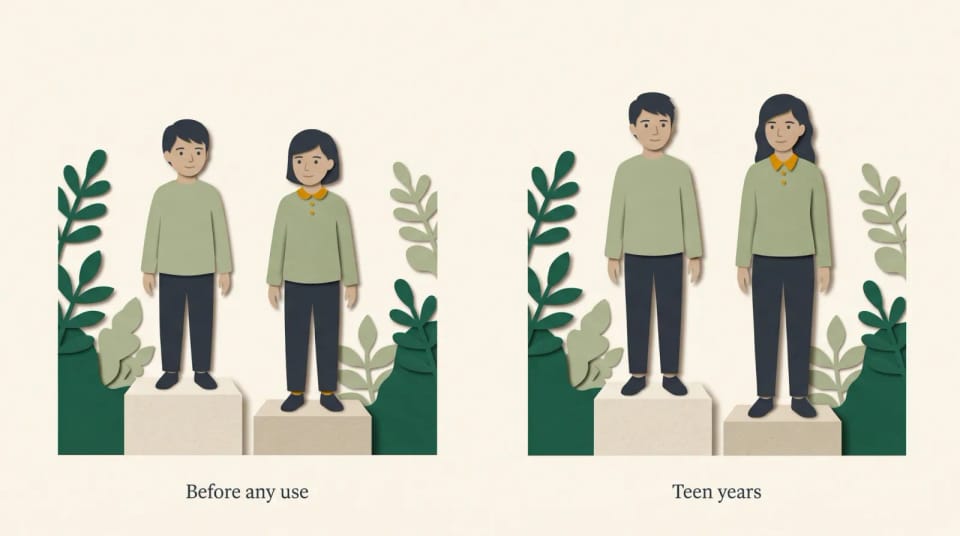
In the British twin study, teens who later became dependent on cannabis already scored lower at 12. The gap at 18 was not significantly wider. This covers use through the teens, not decades of use.
The gap before use is not identical in every group. The large American ABCD study found that young people who started using cannabis had, if anything, slightly better test scores in late childhood, followed by slower improvement (Wade 2026). Those were memory and speed tests, not IQ. Our lesson on the ABCD study of 11,000 youth explains it.
Why did a big UK teen study find no IQ link?
Because cigarettes explained most of it. The ALSPAC study in Avon, England, followed 2,235 teens. By 15, 24 percent had tried cannabis. Researchers measured IQ at 15 and exam results at 16, adjusting for ability before any use (Mokrysz 2016).
Before adjustment, cannabis users had lower IQ. After adjusting for cigarette smoking, alcohol, childhood mental health and behaviour, teens who had used cannabis 50 or more times did not differ from never-users on IQ or exams. Adjusting for cigarettes alone “dramatically attenuated” the link.
This is a useful result with a clear limit. These were teens with a few years of use at most. The study cannot speak to heavy use that continues into adulthood.
What do the studies say when you pool them?
About 2 IQ points, mostly verbal. A 2021 preregistered review pooled seven cohort studies that tested IQ before and after use. It included 808 frequent or dependent young users and 5,308 comparison participants (Power 2021).
The pooled drop was about 2 points, with a range of roughly 1 to 3. Verbal IQ fell by about 3 points; performance IQ, the puzzle-and-pattern side of the test, did not change. The authors said 2 points on its own is not clinically significant. They also noted that six of the seven cohorts followed people only to the mid or late teens, and that they could not separate a cannabis effect from confounding.
Here are the main studies in one place:
| Study | Who | When IQ was tested | Result |
|---|---|---|---|
| Dunedin, New Zealand (2012) | 1,037 people | 7 to 13, then 38 | 3+ dependence diagnoses (38 people): about 6 points lower; never-users: about 1 point higher |
| Dunedin follow-up (2022) | Same cohort | Childhood, then 45 | Long-term users (84): 5.5 lower; not significantly worse than quitters (3.3) or recreational users (3.5) |
| E-Risk twins, UK (2018) | 1,989 twins | 5, 12, 18 | Gap already 5.6 points at 12; no significant extra decline by 18 |
| US twins (2016) | 789 and 2,277 twins | 9 to 12, then 17 to 20 | Users lower; no dose-response; user twin did not decline more than co-twin |
| ALSPAC, UK (2016) | 2,235 teens | 15 | No difference after adjustment, mainly for cigarettes |
| Pooled review (2021) | 7 cohorts | Before and after use | About 2 points lower, mostly verbal |
| Danish men (2024) | 5,162 men | About 20, then about 64 | No harmful link to decline over 44 years |
| Ottawa (2002) | 70 young adults | 9 to 12, then 17 to 20 | Current heavy users: 4.1 lower; former heavy users: no decline |
Read the table by follow-up length. The studies that stop in the teens mostly find a gap that was already there. The study that ran into the 30s and 40s found a decline in its heaviest, longest users. Those are not contradictions. They watched different stretches of life.
Does weed make you dumber while you are high?
Yes, for a while. A 2017 National Academies review found moderate evidence that acute cannabis use impairs learning, memory and attention (National Academies 2017). That short-term effect is not the same as a lower IQ score years later. Our lessons on how cannabis affects memory and forgetting plans while high cover what that feels like day to day.
Timing matters a lot in testing. A 2018 meta-analysis of 69 studies found a small overall thinking-test gap in frequent young users. In studies that required more than 72 hours without cannabis before testing, the gap was not significantly different from zero. The authors said earlier work “may have overstated the magnitude and persistence” of the deficits (Scott 2018).
Some people also confuse low drive with low IQ. Those are different things, and cannabis and motivation has its own evidence.
Does IQ come back after you quit?
For some groups, it seems to. A small Ottawa study of 70 young adults found that current heavy users, at five or more joints a week, scored an average of 4.1 points lower than at ages 9 to 12. Former heavy users who had stopped for at least three months showed no decline (Fried 2002). The authors called the results preliminary.
The longer studies are less reassuring. In Dunedin, adolescent-onset heavy users who stopped did not fully recover. At 45, quitters were 3.3 points lower than in childhood. The National Academies rated the evidence on thinking after sustained abstinence as “limited.” So recovery is possible, but no study guarantees it.
Do adults who start later lose IQ?
The evidence is more reassuring for adults. In Dunedin, people whose heavy use started in adulthood did not show the IQ decline. In Denmark, 5,162 men took a military intelligence test at about 20 and again at about 64. Cannabis history was not linked to greater decline across 44 years (Høeg 2024). That study had few heavy long-term users, and it cannot clear heavy teen use.
The CDC notes that the brain keeps developing until around age 25. It also says long-term effects “may also be caused by something other than cannabis, such as genetics, the home environment, or other unknown factors” (CDC).
Why can’t scientists just settle this?
Because nobody can ethically assign teenagers to years of heavy use. Every study here is observational: researchers watch what people choose, then try to adjust for everything else that differs between them.
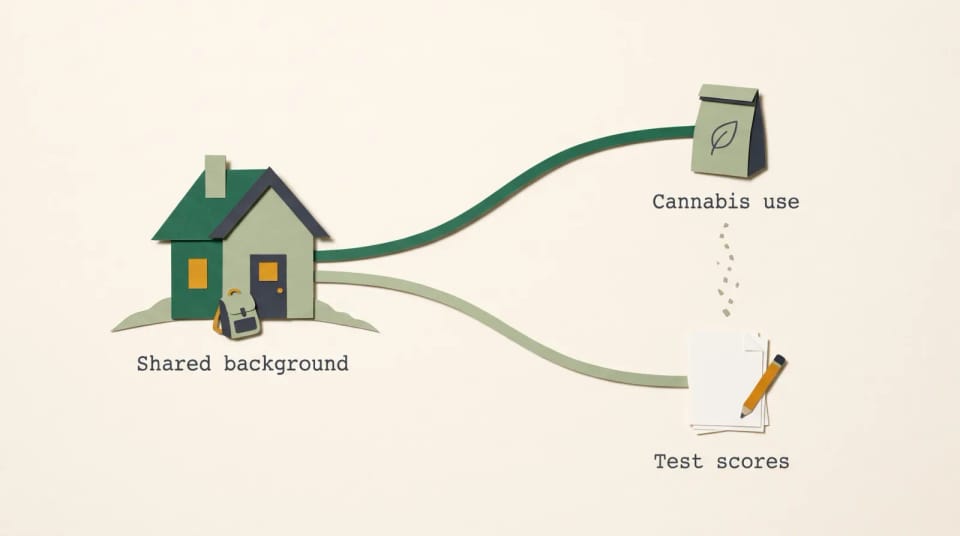
Family background, schooling and cigarette smoking can shape both who uses cannabis and how they score. Twin and adjusted studies try to remove that shared path; none can remove it completely.
Each design solves one problem and leaves another. Twin studies control family background but have mostly followed people only to about 20. Dunedin followed people for decades but cannot rule out every hidden difference. Cigarettes, family income and childhood ability all travel with cannabis use. That is why the dumb-stoner stereotype is too simple, and why “no harm at all” is too simple as well.
What does this mean for you?
For an adult who uses occasionally, these studies do not show an IQ loss. The strongest signal sits with heavy, frequent use that starts in the teens and lasts for decades. If you have a teenager, a parent guide to talking and getting help covers the conversation without scare numbers.
If you want to notice your own patterns, the High IQ app lets you log each session and how it went, so you can see whether focus or memory dips track your use.
Talk to a clinician if memory or concentration problems last after you stop, if they get in the way of work or school, or if your use feels hard to control. A doctor can check other causes, such as sleep, mood or other medicines, and help you plan a change. Stopping after heavy use can bring short-term symptoms; our lesson on cannabis withdrawal explains what to expect.
Key takeaways
- The best-known IQ drop, about 6 points, comes from 38 heavily dependent people in one New Zealand cohort followed to 38.
- The “8 points” figure applies to only 23 adolescent-onset persistent users.
- Twin studies found teens who later used heavily already scored lower before use and did not fall faster by 18 to 20.
- Pooled before-and-after studies put the average gap at about 2 points, mostly verbal.
- No study can prove cause; the honest verdict is “unresolved, with heavy teen-onset use the main concern.”
FAQ
Does weed lower IQ permanently?
No study has shown a permanent drop caused by cannabis. In Dunedin, heavy users whose use began in the teens did not fully regain their scores after quitting. Twin studies and adult-onset users show much less evidence of lasting change.
Is the IQ drop only a problem for teenagers?
The signal is strongest for heavy use that starts in adolescence. In Dunedin, people who began heavy use as adults did not show the decline. A 44-year Danish study of men found no harmful link, though it included few heavy long-term users.
How big is a 6-point IQ drop?
In Dunedin, the heaviest group’s drop of about 6 points equalled 0.38 of a standard deviation, a bit more than a third of the usual spread of scores. That is noticeable across a group. It does not predict any one person’s score.
Does weed make you smarter?
No study here found an IQ gain from cannabis. In the Ottawa study, light users’ scores rose slightly over time, but the study was small and did not show that cannabis caused the rise. The Danish men with a cannabis history declined slightly less with age than men without one, but the authors reported this as no harm, not as a benefit.
Sources
- Meier MH, Caspi A, Ambler A, et al. “Persistent cannabis users show neuropsychological decline from childhood to midlife.” Proceedings of the National Academy of Sciences, 2012. doi:10.1073/pnas.1206820109
- Rogeberg O. “Correlations between cannabis use and IQ change in the Dunedin cohort are consistent with confounding from socioeconomic status.” Proceedings of the National Academy of Sciences, 2013. doi:10.1073/pnas.1215678110
- Moffitt TE, Meier MH, Caspi A, Poulton R. “Reply to Rogeberg and Daly: No evidence that socioeconomic status or personality differences confound the association between cannabis use and IQ decline.” Proceedings of the National Academy of Sciences, 2013. doi:10.1073/pnas.1300618110
- Mokrysz C, Landy R, Gage SH, et al. “Are IQ and educational outcomes in teenagers related to their cannabis use? A prospective cohort study.” Journal of Psychopharmacology, 2016. doi:10.1177/0269881115622241
- Jackson NJ, Isen JD, Khoddam R, et al. “Impact of adolescent marijuana use on intelligence: Results from two longitudinal twin studies.” Proceedings of the National Academy of Sciences, 2016. doi:10.1073/pnas.1516648113
- Meier MH, Caspi A, Danese A, et al. “Associations between adolescent cannabis use and neuropsychological decline: a longitudinal co-twin control study.” Addiction, 2018. doi:10.1111/add.13946
- Scott JC, Slomiak ST, Jones JD, et al. “Association of Cannabis With Cognitive Functioning in Adolescents and Young Adults: A Systematic Review and Meta-analysis.” JAMA Psychiatry, 2018. doi:10.1001/jamapsychiatry.2018.0335
- Power E, Sabherwal S, Healy C, et al. “Intelligence quotient decline following frequent or dependent cannabis use in youth: a systematic review and meta-analysis of longitudinal studies.” Psychological Medicine, 2021. doi:10.1017/S0033291720005036
- Meier MH, Caspi A, Knodt AR, et al. “Long-term cannabis use and cognitive reserves and hippocampal volume in midlife.” American Journal of Psychiatry, 2022. doi:10.1176/appi.ajp.2021.21060664
- Fried P, Watkinson B, James D, Gray R. “Current and former marijuana use: preliminary findings of a longitudinal study of effects on IQ in young adults.” CMAJ, 2002. PMID 11949984
- Høeg KM, Frødegaard RL, Grønkjær M, et al. “Cannabis use and age-related changes in cognitive function from early adulthood to late midlife in 5162 Danish men.” Brain and Behavior, 2024. doi:10.1002/brb3.70136
- Wade NE, Sullivan RM, Wallace AL, et al. “Longitudinal neurocognitive trajectories in a large cohort of youth who use cannabis: combining self-report and toxicology.” Neuropsychopharmacology, 2026. doi:10.1038/s41386-026-02395-1
- National Academies of Sciences, Engineering, and Medicine. “The Health Effects of Cannabis and Cannabinoids: The Current State of Evidence and Recommendations for Research.” National Academies Press, 2017. doi:10.17226/24625
- Centers for Disease Control and Prevention. “Cannabis and Brain Health.” Accessed October 29, 2026. cdc.gov



