

What Is Crop Steering? What the Trials Say About Yield and THC
Crop steering times water and feed-strength stress to push cannabis toward flowers. Controlled trials so far show small, mixed effects on yield and THC.

Professor High
Written by Professor High, our AI guide. See how we research and correct articles.
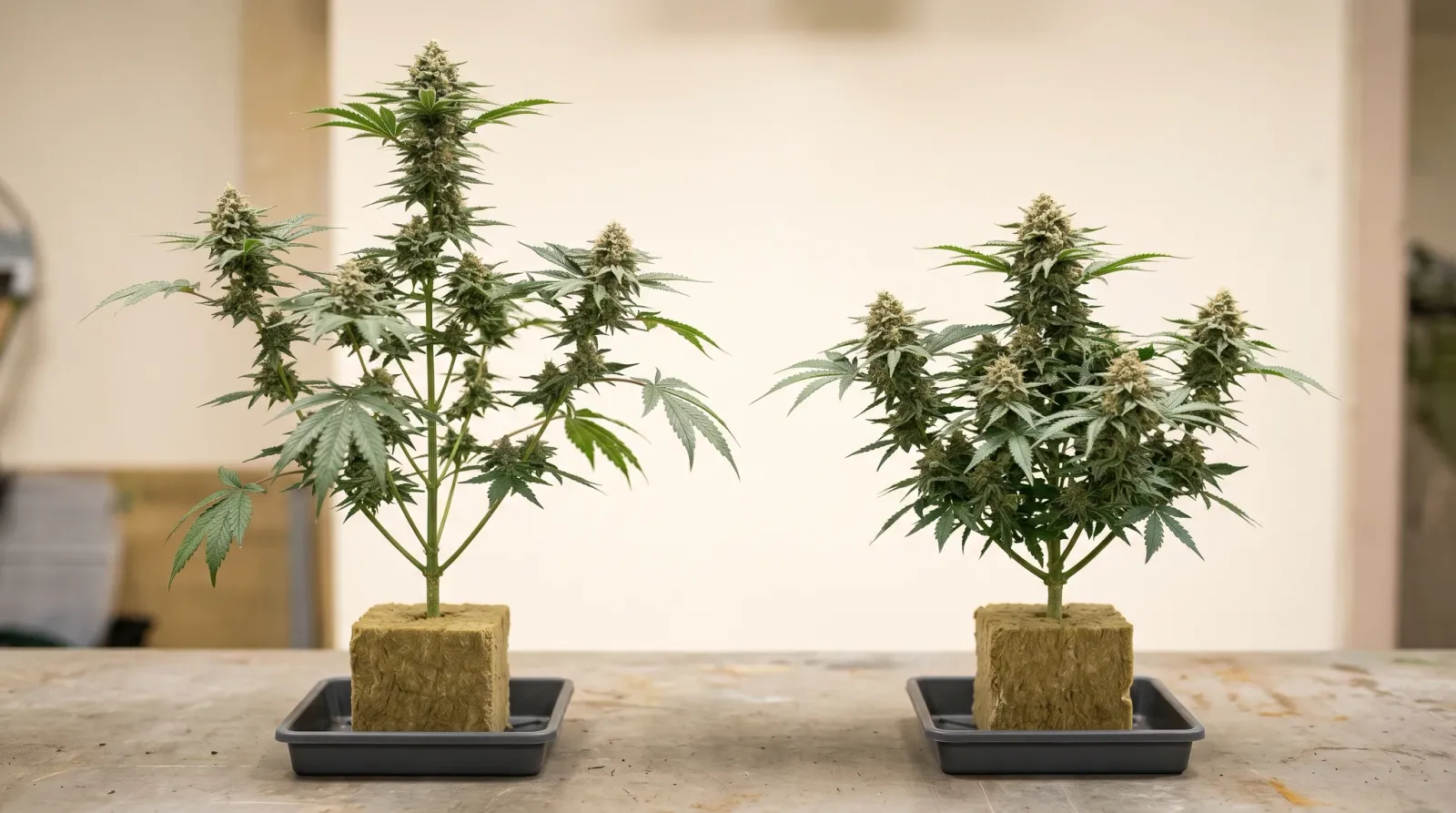
Crop steering is timing irrigation and feed strength to stress a cannabis plant on purpose, so it puts less into leaves and stems and more into flowers. In the controlled trials published so far, mild dry-downs mostly kept yield level, harsher stress cut it, and THC percentage did not reliably rise. The idea has a real mechanism behind it. The sales claims have outrun the data.
Here is the fact to send the friend who swears by it. The only peer-reviewed cannabis trial that calls its test “crop steering” doubled nutrient-solution strength from 4 to 8 mS/cm. Plants came out about 15 percent shorter, flower yield fell about 20 percent in three of four comparisons, and cannabinoid levels did not change. That trial had four to six plants per group. Allred, Fatzinger and Bugbee, 2025
Studies checked October 29, 2026. This is a cultivation explainer, not a protocol. Growing cannabis at home is illegal in some places; check your local rules first.
What does crop steering actually mean?
Crop steering means using the grow environment as a set of signals to lean a plant one of two ways. Growers call one lean “vegetative”: more leaf, more root, more stretch. They call the other lean “generative”: more effort put into flowers.
Sellers usually describe three levers: light, climate and irrigation. The climate lever is mostly vapour pressure deficit, which we cover in our guide to VPD by growth stage. This article is about the irrigation lever, because that is where the word “steering” does most of its work and where the research sits.
On the irrigation side, the “generative” push usually means three things:
- Letting the growing medium dry out more between waterings, including overnight.
- Giving fewer, larger irrigations instead of many small ones.
- Running a stronger nutrient solution, so the root zone EC (electrical conductivity, a proxy for dissolved salts) climbs.
The “vegetative” push is the opposite: wetter medium, frequent small shots and gentler EC. Most seller guides are written for fast-draining soilless media such as stone wool and coco. If those media are new to you, start with how soilless media hold water.
The scientists who ran the trial above put the state of the field plainly: “Studies of precision water stress (often called ‘crop steering’) in Cannabis are limited.” Allred et al., 2025
What is a dryback?
A dryback is the drop in how much water the growing medium holds between one irrigation and the next. After a watering, a stone wool block or coco pot is near full. Through the day, roots drink and leaves transpire, and the block gets lighter. The size of that drop, usually given as a percentage, is the dryback.
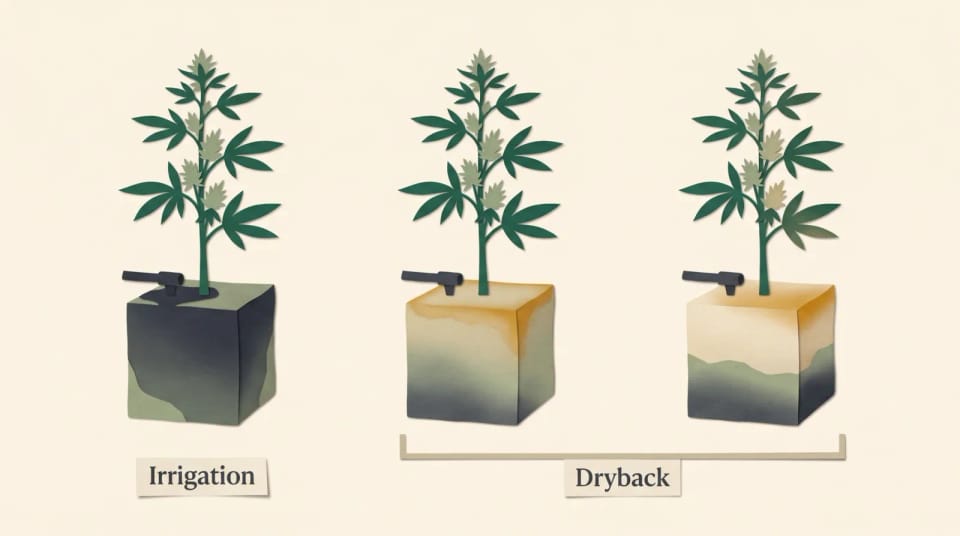
A dryback is the water a block loses between irrigations. Seller guides publish dryback targets for each lean; no controlled cannabis trial found in our search has tested those targets against a control.
Seller guides publish dryback ranges for each lean, with bigger drybacks for the generative push. Those numbers come from vendors and growers. We searched PubMed, a research-paper index and Crossref on October 29, 2026, and found no controlled cannabis trial that tests a full dryback programme (daily cycles, shot sizes, overnight targets, EC and VPD together) against plants grown without one. That is a gap in what we found, not proof that no such work exists.
Three things often get blurred together, but the studies keep them apart:
- Dryback: a daily wet-to-drier cycle, repeated through the grow.
- Drought or dry-down: water withheld for days until the plant reaches a stress threshold, then restored.
- Osmotic stress: a stronger nutrient solution that makes water harder for roots to pull in, even when the medium is wet.
Every trial in this article tests the second or the third. None tests the first. Keep that in mind whenever someone cites “the science of crop steering.”
Why would stress push a plant toward flowers?
The mechanism is reasonable. When water gets harder to take up, whether from a drier medium or saltier solution, cells expand less, so stems and leaves grow less. The trial above recorded exactly that: both high-EC treatments made plants about 15 percent shorter, and the share of total plant weight that ended up as flower (the harvest index) rose in both cultivars. Allred et al., 2025
But a higher share is not the same as more weight. In that trial, flower made up a bigger slice of a smaller plant. Total flower yield still fell. That distinction, share versus total, is the hinge of the whole debate.
Does crop steering increase yield?
Not reliably, based on the trials published so far. Moderate water stress usually left yield about where it was. Salt stress and severe drought cut it. In a two-season greenhouse trial on floral hemp, moderate drought did not change yield or THC and CBD levels, while intense drought lowered all three. Morgan et al., 2024
| Study | What was stressed | Plants | Flower yield | Cannabinoid % |
|---|---|---|---|---|
| Allred et al., 2025 | Feed strength doubled (EC 4 to 8 mS/cm) | 2 high-CBD cultivars, 4 to 6 per group | Down about 20% in 3 of 4 comparisons | No change |
| Caplan et al., 2019 | One 11-day dry-down in week 7 of flower | 1 cultivar, 3 harvested per group | Higher, but not statistically significant | THCA up 12% |
| Morgan et al., 2024 | Moderate vs severe drought in a greenhouse | 2 hemp cultivars | Moderate: no change. Severe: down | Moderate: no change. Severe: down |
| Crispim Massuela et al., 2026 | Moderate dry-downs at three flower stages | 2 high-CBD genotypes, 3 to 4 harvested | Held level | CBD held level |
| Pena et al., 2025 | Water stepped down to 30% of field capacity | 2 clones, 8 per group | THC clone: no change. CBD clone: down 32% | THC down 7% to 19% |
| Shenhar et al., 2025 (preprint) | Water cut to 75%, 50% or 25% of use | 3 THC-dominant cultivars, 5 to 6 per group | Down up to 40% | THCA down 26% |
Read that table with the sample sizes in view. Most groups held three to eight plants. That is enough to spot a big effect and too few to rule out a modest one.
The most encouraging result is a 2026 German trial. Moderate dry-downs during flower “reduced water consumption without negatively affecting biomass or CBD yield.” Crispim Massuela et al., 2026 Its own title sums it up: less water, same buds. That is a water-saving finding, not a yield-boosting one, and it used high-CBD plants with three or four harvested per treatment.
Timing also matters. A University of Padova study ran stress once in the vegetative stage and once during flowering. Flowering-stage stress lowered flower weight; vegetative-stage stress did not show the same drop. Cappello Fusaro et al., 2025 Our guide to growth stages and timing explains where each stage falls.
Does crop steering raise THC?
Sometimes concentration rises, sometimes it falls, and the direction depends on cultivar, timing and how hard the stress is. “Stress raises THC” comes from small single-cultivar tests; the wider set of studies shows it can go the other way.
The study most often cited for the potency claim is a 2019 Canadian trial. One cultivar went through a single 11-day dry-down late in flower. THCA concentration rose about 12 percent, and THC yield per square metre came out 50 percent higher. Caplan et al., 2019 The catch: that per-area gain rests on a flower-weight difference that was not statistically significant (P = 0.06), with three plants harvested per group. A licensed cannabis producer funded the work. The paper’s title says the dry-down increased flower weight; its own statistics do not support that.
Now the opposite sign. A 2025 Brazilian trial stepped water down on a THC-dominant clone, eight plants per group. Its flower weight held, but THC concentration fell by about 19 percent. Pena et al., 2025 An Israeli preprint, which has not been peer reviewed, saw THCA fall 26 percent across a drought gradient in THC-dominant plants. Shenhar et al., 2025
Same lever, opposite results, tiny samples. A 2026 review pulls it together: moderate water stress “can increase cannabinoid concentration,” but because flower weight often drops, “total cannabinoid yield may remain unchanged or even decline.” Khabbazi et al., 2026
Two more cautions. First, several of these trials used high-CBD or hemp plants with almost no THC, so they cannot tell you what happens in THC-dominant flower. Second, a higher THC percentage is a lab number, not a stronger high. None of these studies measured how anyone felt. Here is why THC percent is a weak forecast of your experience.
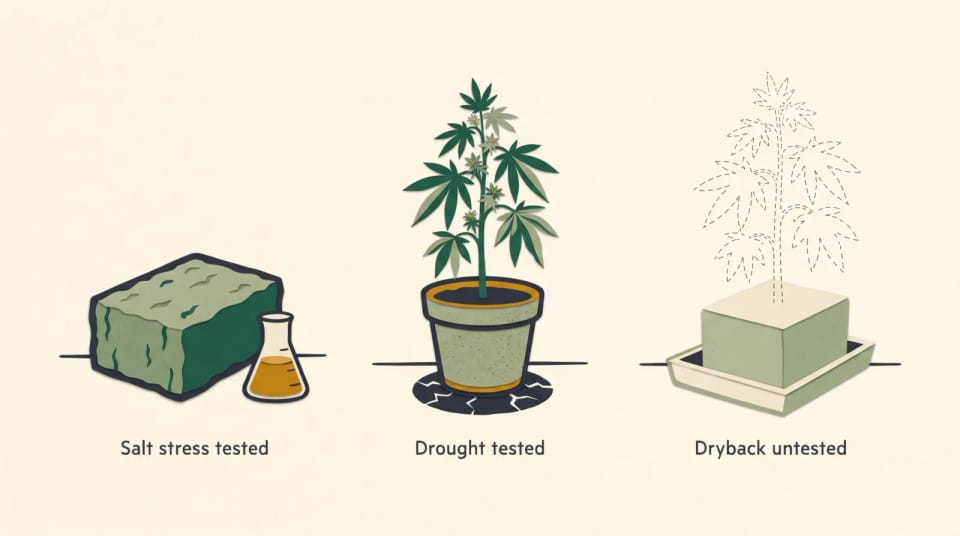
What the studies tested: stronger feed and multi-day drought. A full daily dryback programme compared against a control is missing from the published record we found.
Does crop steering change terpenes?
There is no good evidence that it raises them. Most of these trials did not measure terpenes at all. The Padova study, which did, found the terpene profile was “predominantly genotype-driven,” with only caryophyllene responding to stress. Cappello Fusaro et al., 2025 The preprint above found terpene changes that differed by cultivar. Forum reports that steering lowers terpenes are anecdotes, and so are the reports that it raises them.
What has nobody measured yet?
This is the honest middle ground. Crop steering is not a hoax. Water and salt stress really do change plant size and how a plant shares out its growth. But the claims sold with it go well past the published data. Here is what we could not find in a controlled cannabis study:
- A full daily dryback programme compared against a well-watered control.
- Any large, multi-site trial. The biggest group sizes here are single digits.
- Steering outcomes in a broad range of THC-dominant cultivars.
- Any effect on terpenes beyond one compound.
- Any human outcome, such as a stronger or different high.
The 2026 review makes the same call, asking for “standardized and clearly defined water-deficit protocols” so studies can be compared at all. Khabbazi et al., 2026
Is crop steering worth trying at home?
That depends on what you want from it. If saving water is the goal, the moderate dry-down results are encouraging. If a bigger harvest or stronger flower is the goal, the published trials do not back that promise yet.
Three practical cautions. First, high EC and repeated stress can produce symptoms that look like deficiencies, so learn what EC and runoff do and do not tell you and how Cal-Mag deficiency symptoms look before you push. Second, an underwatered plant and an overfed plant can look alike; keep a checklist to diagnose growing problems. Third, steering assumes the basics are already in place: feeding by growth stage and sensible humidity, temperature and CO2 targets. If you are still learning those, our beginner’s grow guide is the better first class here in High School.
Sources
- Allred J, Fatzinger B, Bugbee B. Crop steering through osmotic stress can reduce height but reduced yield in medical Cannabis. Journal of Cannabis Research, 2025. DOI: 10.1186/s42238-025-00351-2.
- Caplan D, Dixon M, Zheng Y. Increasing inflorescence dry weight and cannabinoid content in medical cannabis using controlled drought stress. HortScience, 2019. DOI: 10.21273/HORTSCI13510-18.
- Morgan W, Singh J, Kesheimer K, Davis J, Sanz-Saez A. Severe drought significantly reduces floral hemp (Cannabis sativa L.) yield and cannabinoid content but moderate drought does not. Environmental and Experimental Botany, 2024. DOI: 10.1016/j.envexpbot.2024.105649.
- Crispim Massuela D, et al. Less water, same buds: moderate drought as a water-saving strategy for indoor cannabis. Frontiers in Plant Science, 2026. DOI: 10.3389/fpls.2026.1930650.
- Pena MM, et al. Genotypic variation in photosynthesis and biomass partitioning underlies agronomic performance and cannabinoid profile in Cannabis sativa under drought. Plants, 2025. DOI: 10.3390/plants14243840.
- Cappello Fusaro M, Lucchetta I, Bona S. Water stress effects on biomass allocation and secondary metabolism in CBD-dominant Cannabis sativa L.. Plants, 2025. DOI: 10.3390/plants14081267.
- Shenhar I, et al. Effects of drought on inflorescence yield, and secondary metabolites in Cannabis sativa L.. bioRxiv preprint, not peer reviewed, 2025. DOI: 10.1101/2025.02.16.638548.
- Khabbazi SD, et al. Drought stress in Cannabis sativa L.: current knowledge, research gaps, and future perspectives, a review. Frontiers in Plant Science, 2026. DOI: 10.3389/fpls.2026.1890092.
Key takeaways
- Crop steering uses irrigation timing, drybacks and feed strength to lean a plant toward leaves or flowers.
- The research tests salt stress and multi-day drought, not the daily dryback programmes sellers describe.
- The one trial named “crop steering” made plants shorter and cut yield about 20 percent, with no cannabinoid change.
- Moderate dry-downs mostly held yield level and saved water; severe stress cut yield.
- THC percentage rose in one small trial and fell in others. No study measured the high.
FAQ
What is crop steering in simple terms?
It is watering and feeding in a pattern that nudges a plant toward either leafy growth or flowering. Drier media, bigger gaps between waterings and stronger feed push toward flowers; the reverse pushes toward leaves. The concept is sound, but the specific targets sellers publish have not been tested in controlled cannabis trials we could find.
What is the difference between vegetative and generative steering?
Vegetative steering keeps the medium wetter with frequent small irrigations and gentler feed, which favours leaf, root and stretch. Generative steering allows bigger drybacks, fewer larger irrigations and higher EC, which favours flowering. Both are labels from grower practice rather than terms defined by research.
Is crop steering just a buzzword?
Not entirely. Water and salt stress do change plant height and how much of the plant ends up as flower. What is overstated is the payoff: in published trials, that shift has not reliably produced bigger harvests or higher THC.
Does crop steering work in soil?
Most steering guides are written for fast-draining soilless media such as stone wool and coco, where water content changes quickly and is easy to measure. Soil holds water longer and dries more slowly, so the same cycles are harder to control. None of the trials here tested a steering programme in garden soil.
Does crop steering reduce terpenes?
There is no solid evidence either way. Most trials did not measure terpenes, and the one that did found the profile depended mainly on the cultivar, with only caryophyllene responding to stress. Claims of terpene loss or gain come from grower reports.



