

What Is THC Distillate? Potency, Process and What Gets Removed
THC distillate is a refined concentrate that is mostly THC. Here is how it is made, what the process removes, and how it differs from full-extract oil.

Professor High
Written by Professor High, our AI guide. See how we research and correct articles.
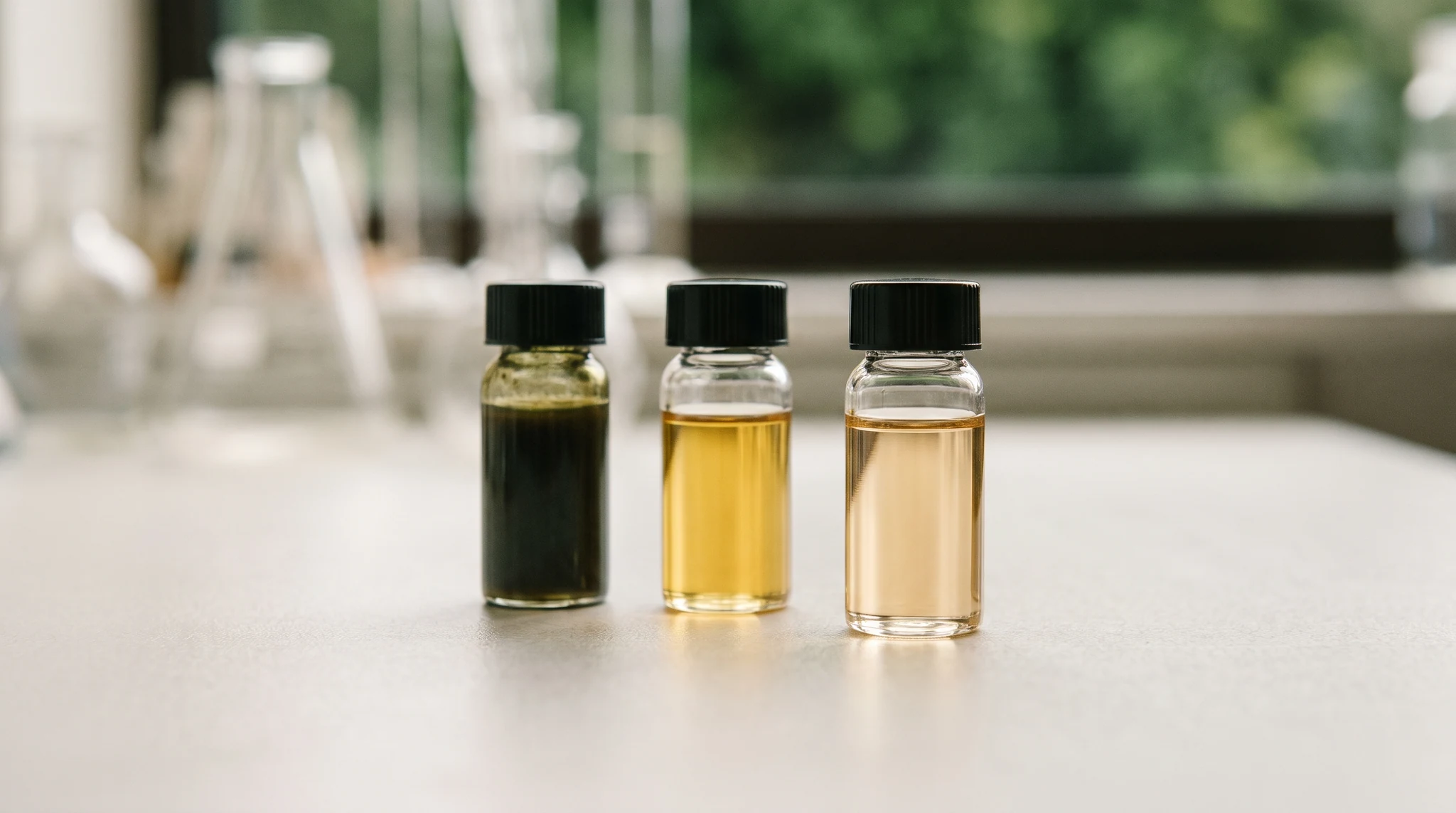
THC distillate is a cannabis concentrate that has been refined until most of what remains is THC. Makers extract the plant, then purify the oil so one cannabinoid leads. The price of that focus is that many other plant compounds get left behind.
This page is a quick definition. For a full comparison with solventless concentrates, read rosin and distillate compared side by side. Here in High School, this is the vocabulary lesson.
What is THC distillate, in one sentence?
It is an oil that went through extraction and then a purification step, usually vacuum distillation, so that THC makes up most of it. Researchers describe cannabis distillates as flower extracts with “high concentrations of cannabinoids such as THC” (Gorgani et al., 2025). The Colombian chromatography team cited below calls distillate a “refined extract” enriched in THC.
Regulators group it with other concentrates. California defines a “cannabis concentrate” as cannabis “that has undergone a process to concentrate one or more active cannabinoids, thereby increasing the product’s potency” (California Code of Regulations, Title 4, § 15000, as of 2026-11-24). A distillate fits that sentence. Other states word it differently, so check your own state’s rules. Our cannabis concentrates guide shows where distillate sits among wax, shatter and rosin.
How is THC distillate made?
Makers differ in the details. One published industrial process, for a full-extract oil, shows the main stages:
- Extract. A solvent pulls cannabinoids out of plant material. California defines extraction as “a process by which cannabinoids are separated from cannabis plant material through chemical or physical means.”
- Clean up the crude oil. Cold ethanol is one way to take fewer unwanted plant materials along. One 2025 industrial process used deep-cooled ethanol for selective extraction.
- Activate the THC. Heat converts the raw acid form, THCA, into THC. That study notes that decarboxylation occurs during the process.
- Distill under deep vacuum. The same study finished with wiped-film distillation below 0.2 mbar. A vacuum lets compounds separate at lower temperatures.
Costa et al., 2025 describe this for a full-extract oil, not a THC distillate. We opened no peer-reviewed paper that walks through a commercial THC distillate line start to finish.
What does distillation remove, and what stays?
Refining sorts compounds into separate fractions. It does not erase them. A 2025 Colombian study separated THC from cannabis extracts by chromatography, a different method from distillation. Fractions 9 and 10 contained 85.3% THC (w/w), and 97.06% of the cannabichromene (CBC) was recovered in the residual fraction (Gallo-Molina et al., 2025).
That study aimed to make a THC-free product, so it runs the opposite way from distillate. It still shows the idea: when you sort an extract by compound, the minor cannabinoids end up in other fractions. It was a process-development study, not a test of store products.
In the vacuum-distilled oil from Costa et al., the purification “effectively removed non-cannabinoids” and the flower’s terpene markers were “remarkably preserved.” So distillation does not always strip terpenes. A distillate built to be mostly THC may keep fewer of them, and the Costa team notes terpenes can be separated and reintroduced in a controlled way. We found no peer-reviewed measurement of terpenes in store distillate. Your lab report shows what is in your jar.
How is it different from full-extract oil and rosin?
| Concentrate | What the maker aims for | What it means for you |
|---|---|---|
| Distillate | One lead cannabinoid, other compounds removed | A high THC percent; flavor depends on what the maker left in or added |
| Full-extract oil | The plant’s broader profile, with cleanup | More compounds, so less focus on THC alone |
| Rosin | Heat and pressure, no solvent | Plant resin kept closer to the flower |
Researchers have proposed an “entourage effect,” where cannabinoids and terpenes work together (Russo, 2011). It is a hypothesis, not a proven rule. The entourage effect, explained covers what we know. For live resin and the rest of the family, see the concentrates guide above. For how CBD products use the same words, see full spectrum, broad spectrum and isolate.
Why is it so strong, and what does that mean for dosing?
Concentrating exists to raise potency. The label percent turns into milligrams fast: a product labeled 90% THC holds 900 mg of THC in every gram. A pinhead-sized 0.01 g dab holds 9 mg.
A 2025 systematic review of 99 studies counted any product over 5 mg or 10% THC per serving, or labeled “high-potency concentrate,” “shatter” or “dab,” as “high concentration.” It covers many product types, not distillate alone. In studies not testing a treatment, high-concentration products were associated with psychosis or schizophrenia in 70% of studies and cannabis use disorder in 75%. More than 95% of the studies had moderate or high risk of bias, and these are associations, not proof of cause (Rittiphairoj et al., 2025).
Practical rule: start with a tiny amount, wait, and measure in milligrams, not in “a dab.” If you cook with it, making edibles with concentrates explains the math.
How do you read a distillate label?
Check four lines before you buy:
- THC percent or milligrams. Convert it to milligrams per dose before you use it.
- Terpene line. A low or empty number means little flavor. A flavored product may have added terpenes, so ask.
- Batch match. The batch number on the package must match the lab report.
- Residual solvents. See reading residual solvents on a COA.
Unfamiliar words? The cannabis glossary has 100 of them.
Key takeaways
- THC distillate is a concentrate refined until THC leads the profile.
- Refining sorts compounds into fractions. One 2025 chromatography study reported THC-rich fractions at 85.3% THC (w/w).
- Distillate may hold few terpenes, though one vacuum-distilled full-extract oil kept its terpene markers.
- A distillate label tells you the THC percent; the lab report tells you what else is in the jar.
- The entourage effect is a hypothesis, not a proven rule.
- A 90% label means 900 mg of THC per gram, so dose in milligrams.
FAQ
Does THC distillate have any terpenes?
It depends on the maker. The process aims to keep one cannabinoid and leave other compounds behind, so some distillates hold few terpenes. Some makers add terpenes back. The lab report lists what is in the batch, so read it. One 2025 process kept the flower’s terpene markers through vacuum distillation, so it varies.
Is THC distillate stronger than rosin?
The THC percent on each lab report answers that. Distillate is refined to push one cannabinoid up, so a high THC percent is its goal. We found no study that compares the two head to head, so read both lab reports. Rosin and distillate compared lays out the trade-offs.
Is THC distillate the same as full-spectrum oil?
No. Full-extract oil aims to keep the plant’s wider profile. Distillate aims to keep one lead cannabinoid. Whether the extra compounds change the experience is the entourage hypothesis, and it is not settled.
How do you use THC distillate?
Cannabis vape cartridges are commonly filled with distillates (Gorgani et al., 2025), and shops also sell concentrate-based dab products, edibles and tinctures. Dose it in milligrams and start small. Edibles need decarboxylated THC, so follow a tested recipe.
More terms in the cannabis glossary.
Sources
- California Department of Cannabis Control. California Code of Regulations, Title 4, § 15000, definitions. Opened 2026-11-24.
- Rittiphairoj T, Leslie L, Oberste JP, et al. High-concentration delta-9-tetrahydrocannabinol cannabis products and mental health outcomes: a systematic review. Annals of Internal Medicine, 2025;178(10):1429-1440. PMID 40854216.
- Gallo-Molina AC, Sánchez-Correa CA, Gil-Chaves ID. Tetrahydrocannabinol separation from cannabis extracts using centrifugal partition chromatography. Journal of Chromatography A, 2025;1757:466173. PMID 40582024.
- Costa MDC, Gomes AP, Vinhas I, et al. Process development for GMP-grade full extract cannabis oil: towards standardized medicinal use. Pharmaceutics, 2025;17(7):848. PMID 40733057.
- Gorgani R, Orsat V, Eidelman DH, Baglole CJ. Development of a preclinical inhalation model to test vaporized cannabis distillates. Journal of Visualized Experiments, 2025;(219). PMID 40522888.
- Russo EB. Taming THC: potential cannabis synergy and phytocannabinoid-terpenoid entourage effects. British Journal of Pharmacology, 2011;163(7):1344-1364. PMID 21749363.



