

How to Make Edibles With Concentrates: Decarb Time, Dose Math and Terpene Loss
Making edibles with concentrates: wax, shatter and rosin need a decarb, distillate usually does not. Get the decarb time, milligram math and terpene loss.

Professor High
Written by Professor High, our AI guide. See how we research and correct articles.
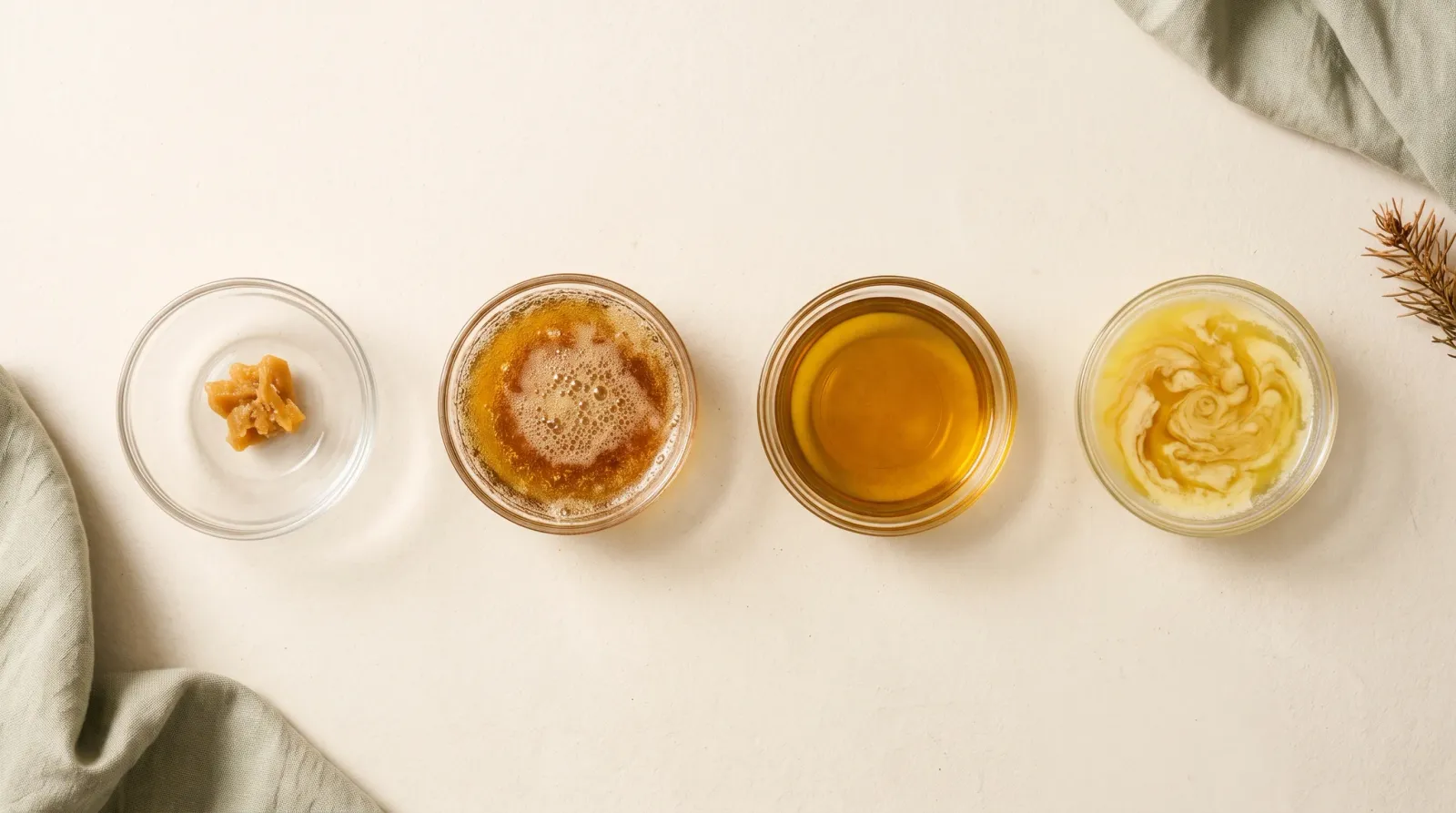
Yes, you can make edibles with wax, shatter, rosin or distillate: check the lab sheet, decarb the concentrate if it is mostly THCA, dissolve it in fat, and count the milligrams with a formula that corrects for THCA. Distillate with THCA near zero usually skips the decarb step. The heat that converts THCA also drives off most of the terpenes, so a costly live resin gives most of its flavor advantage to the dab, not the oven.
Here is the part most recipes miss. Published rate constants predict that a decarb that holds the sample at 200 F (93 C) for 22 minutes converts only about half of the THCA. That figure is our model estimate from a lab study, not a measurement on your wax, and the details are below. At about 240 F (116 C), the same model predicts near-complete conversion in 20 to 30 minutes.
This High School lesson covers cooking with concentrates bought from a licensed seller, for adults where cannabis is legal. It does not teach home extraction with butane or any other solvent. If you are new to infused cooking, start with a labeled oral oil before you work with dabs.
Sources checked October 29, 2026.
Do concentrates need to be decarbed for edibles?
Most dab-type concentrates do; most distillate does not. The lab sheet decides it, not the texture name.
Raw cannabis makes mostly THCA, an acid form of THC. A narrative review puts THCA at up to 90% of total THC in the plant, and notes that baking, smoking and vaporizing convert it quickly (Moreno-Sanz, 2016). A dab rig converts THCA in seconds. An edible has no flame, so you must convert it in the kitchen first.
Extracts made with butane (BHO), such as wax and shatter, contain more than 60% THCA in one forensic study (Hädener et al., 2019). Rosin and live resin are pressed or extracted from the same plant material, so expect a high THCA line there too, and confirm it on the certificate of analysis (COA). Distillate is usually sold already converted, but we found no primary study that proves this for every product. Read the THCA line: a number near zero means the work is done.
| On the lab sheet | What it means | What to do |
|---|---|---|
| THCA high, THC low | Mostly unconverted acid (typical of wax, shatter, rosin, live resin) | Decarb before you infuse |
| THCA near zero, THC high | Already converted (typical of distillate) | Dissolve in fat, no decarb step |
| Only one “THC” number | Unclear whether it is THC or Total THC | Find the full COA before you calculate |
That last row is common. In a Colorado study of 277 products, 43.7% of labels listed only “THC”, 37.5% listed “Total THC”, and 18.8% listed both (Giordano et al., 2025). For a deeper look at the acid form, see THCA versus THC on the lab sheet. For what the products are, see what wax, shatter and rosin are and rosin versus distillate.
How long and how hot do you decarb wax, shatter or rosin?
Aim for about 20 to 30 minutes with the sample near 240 F (116 C), measured with an oven thermometer. Lower heat works, but it needs much longer.
Recipes give everything from 200 F for 20 minutes to 275 F for 5 minutes, and none of them cites a measurement. The best public data come from a lab study that heated a dried cannabis extract and measured THCA conversion over time. It found first-order kinetics, a clean THCA-to-THC conversion with no by-products, and slow reactions below 100 C that did not finish within 60 minutes. At 110 C, THCA was near zero by about 30 minutes (Wang et al., 2016).
We used that study’s rate constants to estimate conversion at common oven settings:
| Sample temperature | Converted at 22 min | Converted at 30 min | Time to about 95% |
|---|---|---|---|
| 200 F (93 C) | about 54-55% | about 64-65% | about 85 min |
| 212 F (100 C) | about 72-74% | about 81-83% | about 50 min |
| 225 F (107 C) | about 87-91% | about 94-96% | about 30 min |
| 240 F (116 C) | about 97-99% | about 99-100% | about 15-19 min |
| 250 F (121 C) | about 99-100% | about 100% | about 10-14 min |
Read this table as a model, not a promise. Five limits apply:
- The study heated a thin dried film of flower extract in a vacuum oven, with no air and no light. A lump of wax on a dish in a home oven lags behind the oven air for the first minutes.
- The temperatures are sample temperatures. A home oven dial can be off, so an oven thermometer matters more than the recipe.
- Rate constants differ between cannabis materials (Benes et al., 2024), so your concentrate can convert faster or slower.
- More heat also costs THC. The same study recorded a total loss of about 8% of the cannabinoid molecules at 110 C (Wang et al., 2016).
- Our estimate extends the study’s 80-110 C constants a few degrees above that range.
The arithmetic of conversion also explains the foam. When THCA becomes THC, it releases carbon dioxide: one gram of pure THCA yields at most 0.877 g of THC, and the rest leaves as gas (PubChem THCA, PubChem THC). So a mostly-THCA wax bubbles as it heats and loses roughly a tenth of its weight. The bubbles slow and stop as the acid runs out, which is a useful sign but not a measurement.
For flower, the logic is the same but the material is different; see how to decarb flower the same way.
How do you turn grams of concentrate into milligrams per serving?
Use this formula: milligrams of THC = grams × 1,000 × (THC% + 0.877 × THCA%) ÷ 100. Then divide by the number of servings.
The 0.877 factor is the weight ratio of THC to THCA, and it is the same “Total THC” equation that labs use (Giordano et al., 2025). Most quick recipes multiply grams by one “THC%” figure. That overcounts a THCA-rich product if the number is really THCA, and it is wrong in the other direction if the label lists only the small THC line.
Two worked examples:
- Raw wax, lab sheet THC 3.1% and THCA 82.0%. Total potential THC is 3.1 + (0.877 × 82.0) = 75.0%. Half a gram (0.50 g) holds about 375 mg. Split into 24 cookies, that is about 15.6 mg each. For about 5 mg each across 24 cookies (120 mg in total), weigh about 0.16 g.
- Distillate, THC 90.0% and THCA 0%. A tenth of a gram (0.10 g) holds about 90 mg. Split into 18 pieces, that is about 5 mg each.
For scale, Colorado defines a standardized serving of a licensed retail edible as no more than 10 mg of active THC, and a package as no more than 100 mg (Colorado Revised Statutes, Title 44; 1 CCR 212-3). That is a rule for licensed products in one state, not a recommended dose for you.
Treat your answer as a ceiling, for three reasons:
- Labels run a little high. Concentrate labels are far more reliable than flower labels: 96.0% fell within ±15% of the labeled THC, against 56.7% of flower. Measured THC still averaged slightly below the label (Giordano et al., 2025). Our Colorado lab study of concentrate labels covers the details.
- No measured kitchen efficiency exists for concentrates. We found no study that measured how much THC from a concentrate survives a home infusion and bake. Batch-to-batch variation in pharmacy-made cannabis oils was large, with a relative standard deviation above 50% (Carcieri et al., 2018).
- Small portions are hard to weigh. On a 0.01 g scale, a 0.10 g portion can be off by up to 10%.
Even professional makers miss. In a 2015 study of 75 edible products, only 17% were labeled accurately; 60% contained less THC than labeled (Vandrey et al., 2015). For why a label can miss, read why a 10 mg label can miss. For flower, use the flower version of this dosing math, which has a different loss step.
How do you mix a concentrate into butter or oil so every bite matches?
Dissolve the decarbed concentrate completely in warm fat first, then mix that fat through the whole recipe before you portion it.
THC dissolves in oil once heat converts it (Barrus et al., 2016). Pour or scrape the warm concentrate into melted butter or oil over low heat, and stir until no beads or streaks remain. A small glass dish that goes straight from the oven to the fat makes this easier, because the concentrate stays soft. For help choosing the base, see which fat to dissolve it in; for a flower-based fat, see cannabutter from flower.
Do not drop a lump of wax straight into brownie batter. A fraction of a gram in a full pan is a very small amount of material spread through a lot of food. If it does not dissolve and spread evenly, a few pieces can carry most of the dose. Stir the infused fat thoroughly into the batter, scrape the bowl, and cut equal portions.
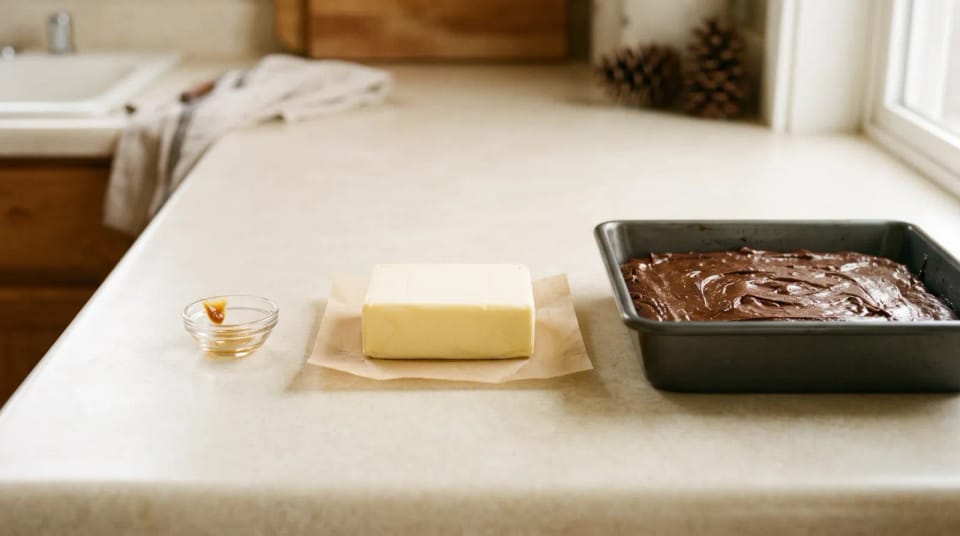
A fraction of a gram has to season a whole pan. Dissolve it in the fat and mix that fat through everything, or a few pieces can carry most of the dose.
Baking itself adds uncertainty. In a study of hemp seed breads, baking time and temperature changed the THC content in both directions, and the crust changed more than the crumb (Lindekamp et al., 2025). Those breads held only trace amounts, so the study shows direction, not a number for your brownies. If you want to check a batch, see ways to check a homemade batch.
Does baking destroy terpenes in live resin and rosin?
Mostly, yes: the small, fragrant terpenes evaporate long before THC does, and a decarb plus a bake leaves little of them.
A terpene’s boiling point is not the temperature where it starts to leave. Evaporation begins far below it, during drying and curing, and becomes extensive during decarboxylation, with monoterpenes lost first (Eyal et al., 2023). The vapor pressures in that paper make the gap clear. At 130 C (266 F), myrcene’s vapor pressure is about 23,000 times that of THC, and beta-caryophyllene’s is about 1,100 times.
| Compound | Type | Boiling point | Vapor pressure at 130 C (torr) |
|---|---|---|---|
| Alpha-pinene | Monoterpene | 155 C (311 F) | 369 |
| Myrcene | Monoterpene | 168 C (334 F) | 243 |
| Limonene | Monoterpene | 176 C (349 F) | 188 |
| Linalool | Monoterpenoid | 198 C (388 F) | 66 |
| Beta-caryophyllene | Sesquiterpene | 263 C (505 F) | 11.7 |
| Alpha-humulene | Sesquiterpene | 276 C (529 F) | 7.2 |
| THC | Cannabinoid | about 425 C (797 F), extrapolated; it breaks down first | 0.0107 |
Values from Eyal et al., 2023, Table 3. The authors work for a medical cannabis manufacturer, and the vapor pressures are modeled, so trust the order more than the exact numbers. PubChem lists similar boiling points, for example 166-167 C for myrcene.
Compare those boiling points with a kitchen. A 240 F (116 C) decarb is below every boiling point in the table, but a 350 F (177 C) oven is above the boiling points of pinene, myrcene and limonene. Both are hot enough for steady evaporation.
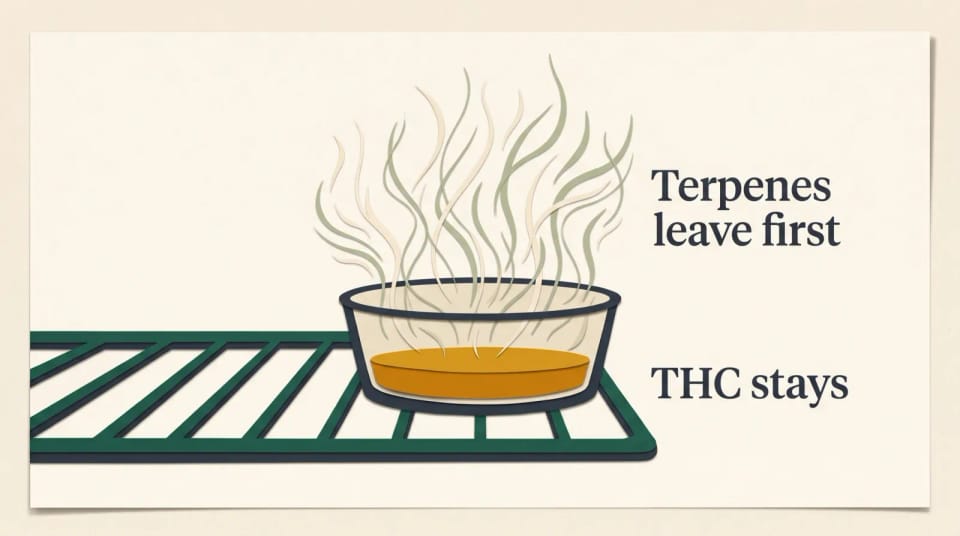
Terpenes evaporate well below their boiling points, and the small monoterpenes go first. THC barely evaporates at oven temperatures.
Measured results agree with the physics. In one experiment on flower, 5 minutes in a boiling water bath halved the monoterpenes, and 30 minutes in a 145 C oven decarboxylated the THCA but left only traces of monoterpenes and removed most sesquiterpenes (Romano and Hazekamp, 2013). A comparison of commercial flower and decarboxylated extracts found cannabinoids preserved but about 90% of the monoterpenes and monoterpenoids lost (Raz et al., 2022). That team shares authors with the vapor-pressure paper, so it is not independent confirmation.
What we do not know: no study we found measured terpene retention in a concentrate during a home decarb, in infused butter, or in a baked edible. None tested whether the terpenes that survive change how an edible feels. So the fair conclusion is about flavor and cost. A live resin or live rosin is a good dab, but an edible will not keep most of what makes it special. For more on boiling points and why they mislead, see why a boiling point is not a temperature prescription, and for the products themselves, live resin versus live rosin.
How long should you wait after eating an edible made with concentrates?
Wait at least 2 hours before you eat more. The CDC says edibles can take 30 minutes to 2 hours to feel intoxicating, and their effects can last longer than people expect (CDC). Delayed onset is the main reason people eat more than they meant to (Barrus et al., 2016). See why two hours is the minimum wait.
If you track your batches, a note of the concentrate, the milligrams per piece and how it felt is the most useful record you can keep. The High IQ app can log how a strain or product worked for you, so the next batch starts from your own notes.
Label the batch clearly and lock it away. The CDC warns that children can become very sick from cannabis edibles (CDC).
When to talk to a clinician: if a child or pet eats an edible, or if an adult has chest pain, trouble breathing, severe vomiting, confusion or panic that does not ease, call Poison Control or emergency services. If you take prescription medicines or have a heart, mental health or pregnancy concern, talk to a clinician before you use edibles.
Sources
-
Wang M, Wang YH, Avula B, et al. “Decarboxylation Study of Acidic Cannabinoids: A Novel Approach Using Ultra-High-Performance Supercritical Fluid Chromatography/Photodiode Array-Mass Spectrometry.” Cannabis and Cannabinoid Research. 2016;1(1):262-271. DOI: 10.1089/can.2016.0020
-
Eyal AM, Berneman Zeitouni D, Tal D, et al. “Vapor Pressure, Vaping, and Corrections to Misconceptions Related to Medical Cannabis’ Active Pharmaceutical Ingredients’ Physical Properties and Compositions.” Cannabis and Cannabinoid Research. 2023;8(3):414-425. DOI: 10.1089/can.2021.0173
-
Raz N, Eyal AM, Davidson EM. “Optimal Treatment with Cannabis Extracts Formulations Is Gained via Knowledge of Their Terpene Content and via Enrichment with Specifically Selected Monoterpenes and Monoterpenoids.” Molecules. 2022;27(20):6920. DOI: 10.3390/molecules27206920
-
Romano LL, Hazekamp A. “Cannabis Oil: chemical evaluation of an upcoming cannabis-based medicine.” Cannabinoids. 2013. PDF
-
Moreno-Sanz G. “Can You Pass the Acid Test? Critical Review and Novel Therapeutic Perspectives of Δ9-Tetrahydrocannabinolic Acid A.” Cannabis and Cannabinoid Research. 2016;1(1):124-130. DOI: 10.1089/can.2016.0008
-
Giordano G, Brook CP, Ortiz Torres M, et al. “Accuracy of labeled THC potency across flower and concentrate cannabis products.” Scientific Reports. 2025;15:20822. DOI: 10.1038/s41598-025-03854-3
-
Hädener M, Vieten S, Weinmann W, Mahler H. “A preliminary investigation of lung availability of cannabinoids by smoking marijuana or dabbing BHO and decarboxylation rate of THC- and CBD-acids.” Forensic Science International. 2019;295:207-212. DOI: 10.1016/j.forsciint.2018.12.021
-
Vandrey R, Raber JC, Raber ME, et al. “Cannabinoid Dose and Label Accuracy in Edible Medical Cannabis Products.” JAMA. 2015;313(24):2491-2493. DOI: 10.1001/jama.2015.6613
-
Barrus DG, Capogrossi KL, Cates SC, et al. “Tasty THC: Promises and Challenges of Cannabis Edibles.” RTI Press. 2016. DOI: 10.3768/rtipress.2016.op.0035.1611
-
Centers for Disease Control and Prevention. “Cannabis and Poisoning.” cdc.gov
-
State of Colorado. C.R.S. 44-10-202 and 1 CCR 212-3 Rule 3-335. Colorado Revised Statutes, Title 44; 1 CCR 212-3
-
Lindekamp N, Triesch N, Weiss M, et al. “Hemp containing breads: Cannabinoid content, profiles, and thermal stability during baking.” Food Chemistry. 2025;487:144714. DOI: 10.1016/j.foodchem.2025.144714
-
Carcieri C, Tomasello C, Simiele M, et al. “Cannabinoids concentration variability in cannabis olive oil galenic preparations.” Journal of Pharmacy and Pharmacology. 2018;70(1):143-149. DOI: 10.1111/jphp.12845
-
Benes F, Binova Z, Zlechovcova M, et al. “Thermally induced changes in the profiles of phytocannabinoids and other bioactive compounds in Cannabis sativa L. inflorescences.” Food Research International. 2024;190:114487. DOI: 10.1016/j.foodres.2024.114487
-
National Center for Biotechnology Information. PubChem compound records for THCA, THC and myrcene.
Key takeaways
- Wax, shatter, rosin and live resin are mostly THCA and need a decarb step; distillate with THCA near zero does not.
- Published kinetics suggest about 20 to 30 minutes with the sample near 240 F (116 C); at 200 F, 22 minutes converts only about half.
- Count milligrams as grams × 1,000 × (THC% + 0.877 × THCA%) ÷ 100, and treat the result as a ceiling.
- Dissolve the concentrate in warm fat and mix it through the whole recipe before you portion.
- Most terpenes leave in the oven, so live resin’s flavor edge mostly stays with the dab.
FAQ
Do I need to decarb THC distillate for edibles?
Usually not, but check the lab sheet. If the THCA line is near zero, the THC is already converted and you can dissolve the distillate in warm fat. If the sheet shows meaningful THCA, decarb it like wax.
Can I put wax straight into brownie batter?
You can, but it is a poor way to get even doses. Decarb the wax, dissolve it fully in the recipe’s butter or oil, and mix that fat through all the batter. An undissolved lump can leave a few pieces much stronger than the rest.
How much concentrate do I use per cup of butter?
Start from the milligrams you want, not from the butter. Decide the milligrams per piece and the number of pieces, then divide the total by the concentrate’s potential THC per gram from the formula above. The butter only carries the THC, so its amount does not set the dose.
Does rosin need to be decarbed for edibles?
Probably, but check. Rosin starts from plant material that is mostly THCA, and we found no study that measured how much THCA remains across rosin products, so confirm it on the certificate of analysis. A high THCA line means it needs heat before it goes into food.



