What to Do With Kief: 10 Uses for the Dust in Your Grinder
Your grinder's kief chamber is full. Here is what kief actually is, how to collect more of it, and ten concrete ways to use it.

Professor High
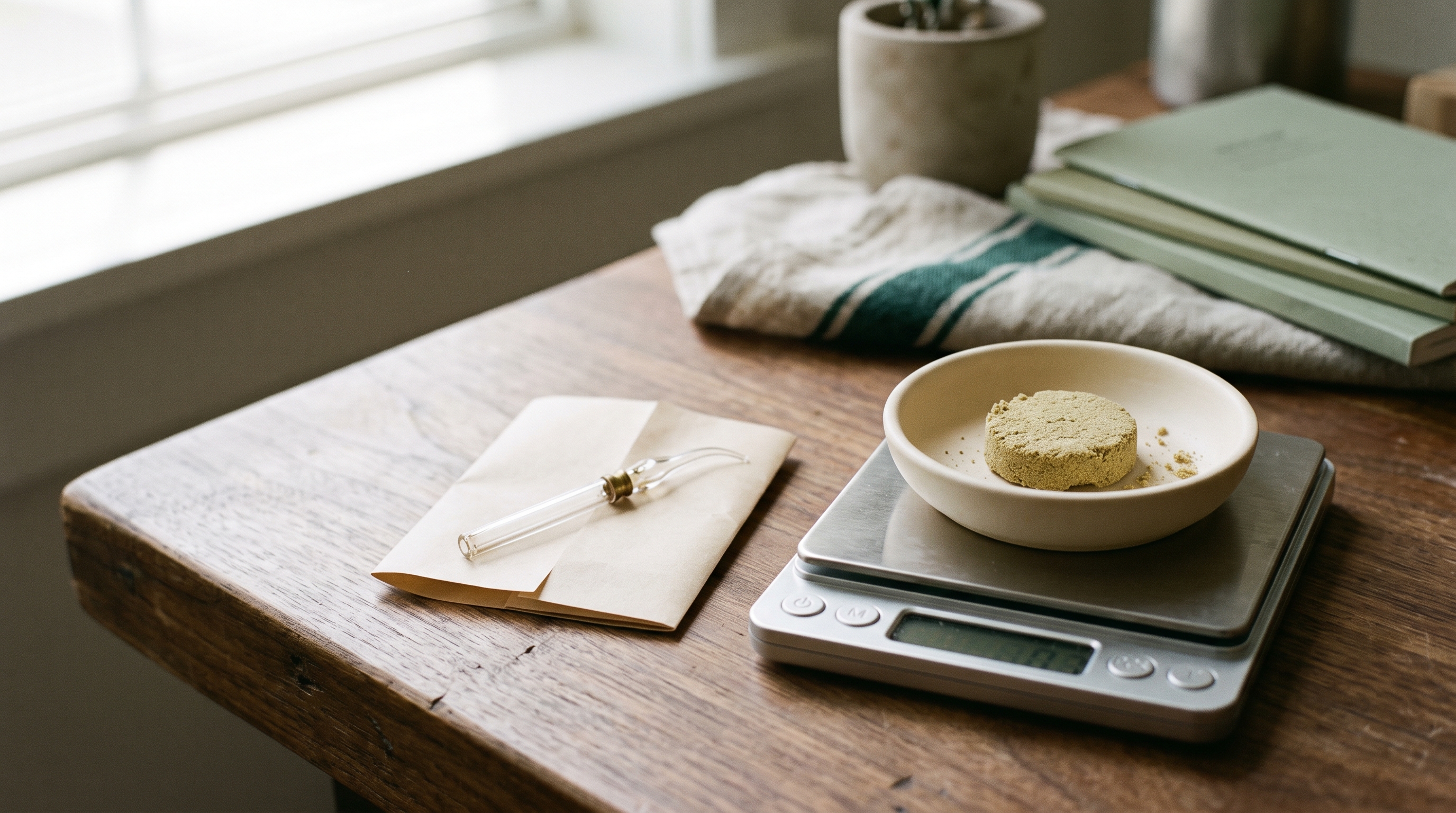
You have been tapping that bottom chamber for eight months. There is now a compacted pale-gold disc in the base of your grinder, and every time you unscrew it you think the same two things: that is probably worth something, and I have no idea what to do with it that will not ruin my afternoon.
Both instincts are correct. Kief is the most concentrated thing most people own without realising it, and the most common way to waste it is to dump the whole chamber onto a bowl and then spend three hours regretting it. So: what the dust actually is, how to judge whether yours is any good, how to collect meaningfully more of it, and ten specific things to do with it — each with an actual method.
If you want to know how kief differs from bubble hash and dry sift as products, we have a full comparison of all three. This piece assumes you already have kief and just want to use it well.
What kief actually is
Cannabinoids and terpenes are not distributed evenly through a cannabis flower. They are manufactured and stored in glandular trichomes — the frosty, mushroom-shaped structures on the surface of the bud. Work by Livingston and colleagues, published in The Plant Journal, mapped these in detail: the large stalked glandular trichomes on female flowers carry high cannabinoid levels and strongly monoterpene-dominant terpene profiles, with 12 to 16 secretory disc cells per gland. The smaller sessile trichomes on mature flowers and vegetative leaves have around eight disc cells and a less monoterpene-dominant profile. A later review by Tanney and co-authors in Frontiers in Plant Science frames the same point bluntly: the trichomes, not the flower mass, are the actual product.
Kief is what happens when you knock those glands off. Every time you twist a grinder, the abrasive action snaps trichome heads from their stalks, and the smallest particles fall through the screen into the collection chamber.
So kief is detached trichome heads — plus whatever else was small enough to fall through the same holes. That second half matters. Grinder screens do not sort by what a particle is, only by how big it is. Fine leaf dust, snapped trichome stalks, and pollen-sized plant debris all make the trip too. That contamination is the entire reason kief quality varies so wildly, and it is why the colour test below works.
If you want the deeper botany on gland types and maturation, our complete trichome guide and the loupe and microscope walkthrough go further than we can here.
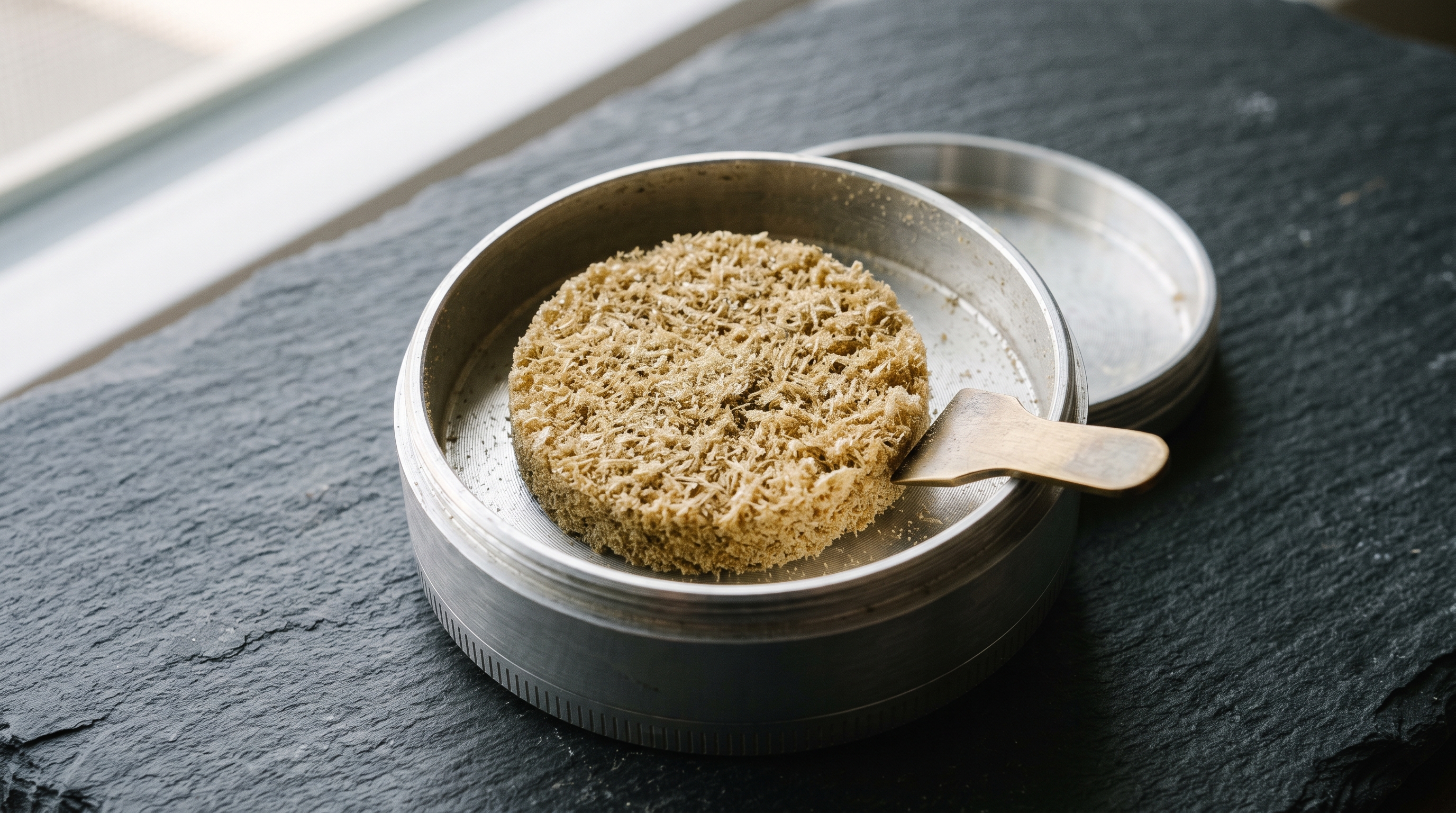
How to judge quality: read the colour
You do not need a lab for the first pass. You need daylight and a white sheet of paper.
| What you see | What it means | Practical read |
|---|---|---|
| Pale blonde to light gold, powdery, faintly sticky | Mostly intact resin heads | Excellent. Press it, dab it, or use it neat |
| Medium tan with visible green flecks | Resin plus meaningful plant matter | Good. Smoke it, infuse it, do not expect it to press cleanly |
| Olive or grass green, fluffy, matte | Mostly pulverised leaf | Poor. Infuse it into fat, do not waste press time on it |
| Dark brown, gummy, smells stale | Oxidised, or heavily contaminated and aged | Cook with it or bin it |
The physical version of the same test: press a pinch between two fingers. High-resin kief smears and sticks, because you are crushing oil-filled glands. Plant-heavy kief stays dusty and powdery no matter how hard you squeeze.
Colour is a ratio signal, not a potency reading. Blonde kief tells you the fraction of resin heads is high; it does not tell you what those heads contain. That depends entirely on the flower it came from, which is exactly the argument we make in why THC percentage is a terrible way to choose cannabis.
How strong is kief, really
Stronger than the flower it came from — reliably, and by a lot. Putting a hard number on it is harder than the internet suggests.
The most defensible published anchor comes from the University of Mississippi’s Potency Monitoring programme. Mehmedic and colleagues analysed 46,211 confiscated cannabis samples from 1993 to 2008 and reported that mean plant-material potency rose from 3.4% to 8.8% over that window, while hashish potencies varied from 2.5–9.2% in 1993–2003 to 12.0–29.3% in 2004–2008. Those hashish figures are seized, often imported, pressed product — not modern craft dry sift — so read them as a floor, not a benchmark. Dispensary-labelled kief and dry sift today commonly claim considerably higher, though that is label data rather than peer-reviewed measurement, and label data has its own well-documented reliability problems.
The honest version for your kitchen: assume your kief is at least two to three times the potency of the flower that produced it, and possibly much more. That single assumption is what keeps the rest of this guide from going badly.
Two consequences follow. Kief burns hotter and slower than flower, so it does not want to be packed like flower. And when you infuse it, the dosing maths shifts by the same multiple — in the format where people already misjudge hardest. If you have not read why edibles hit harder, do that before you infuse anything.
How to collect more of it
Use a three or four-chamber grinder
A two-piece grinder has nowhere for kief to go. Anything sold as three-chamber (grind, collect, kief) or four-chamber has a mesh screen between the flower chamber and a dedicated base. That screen’s mesh is the whole ballgame — finer mesh gives cleaner, blonder kief in smaller quantities; coarser mesh gives you more of it, faster, with more green in it. Our grinder buyer’s guide covers specific models and screen grades.
The coin trick
Drop a clean, smooth coin into the flower chamber before you grind. As you twist, it tumbles around and scrapes trichome heads loose, driving noticeably more through the screen. Use a coin with no raised lettering if you can, wash it first, and understand the trade: a scraper coin also drives more plant dust through, so your kief will run a shade greener. Some grinders now ship with a purpose-made ceramic or acrylic puck for exactly this reason.
Chill it first
Trichome heads are more brittle cold. Twenty minutes in the freezer before grinding — grinder and flower together — makes the glands snap off cleanly rather than smearing. Do not leave cannabis in a freezer long-term; that is a storage decision with different trade-offs, covered in our cannabis storage guide. This is a twenty-minute chill, not a storage strategy.
Graduate to a sifting screen
If you want real volume, stop relying on a grinder. A dedicated sifting box or a stack of mesh screens lets you work whole flower or trim across a defined mesh and collect what falls through.
Micron size is the control you gain. Most cannabis trichome heads fall roughly in the 70 to 120 micron range, so screens in that band capture heads while excluding larger plant fragments. Coarser screens (around 150 microns and up) collect more material, more of it contaminant. Finer screens (below about 70 microns) yield very little, but what they yield is close to pure resin. The workflow is the same idea as ice water extraction, minus the water — which is exactly why the two products end up so comparable, and why full melt grading applies to both.
Work cold, work gently, and stop early. Over-agitating a screen is the single fastest way to turn blonde sift into green dust.
The 10 uses
1. Crown a bowl
The default, and it works — if you do it correctly. Do not dump kief on top of a packed bowl. It sits above the flower, torches at full flame, and burns off before you have pulled anything useful.
Instead: pack your bowl normally, add a small pinch of kief in the centre, then cover it with a thin layer of flower. The kief burns inside the cherry rather than on top of it, at a lower and more even temperature. Light the edge of the bowl, not the middle. Start with a pinch about the size of a grain of rice — remember the two-to-three-times rule.
2. Make a moon rock
The maximalist version of crowning. A moon rock is a nug rolled in something sticky — usually rosin or a warmed concentrate — and then dredged through kief until fully coated. It is genuinely very strong, awkward to smoke, and best broken apart by hand rather than ground (a grinder will just strip the coating). Our moon rocks guide has the full method. Treat it as an occasional thing, not a Tuesday.
3. Dust a joint
Two approaches, very different outcomes.
Mixed in: fold kief through your ground flower before rolling, at roughly one part kief to eight or ten parts flower. Even burn, even effect, no drama. Start here — it works with any technique in our joint rolling guide.
Lined: lay a thin stripe of kief along the length of the flower before rolling. This creates a hotter internal channel that can make the joint canoe — burn unevenly down one side. It looks impressive and smokes worse.
Either way the joint burns slower and harsher, because kief has no cellulose structure holding airflow open and so densifies the pack. Worth comparing against a standard infused pre-roll before you bother.
4. Twax it
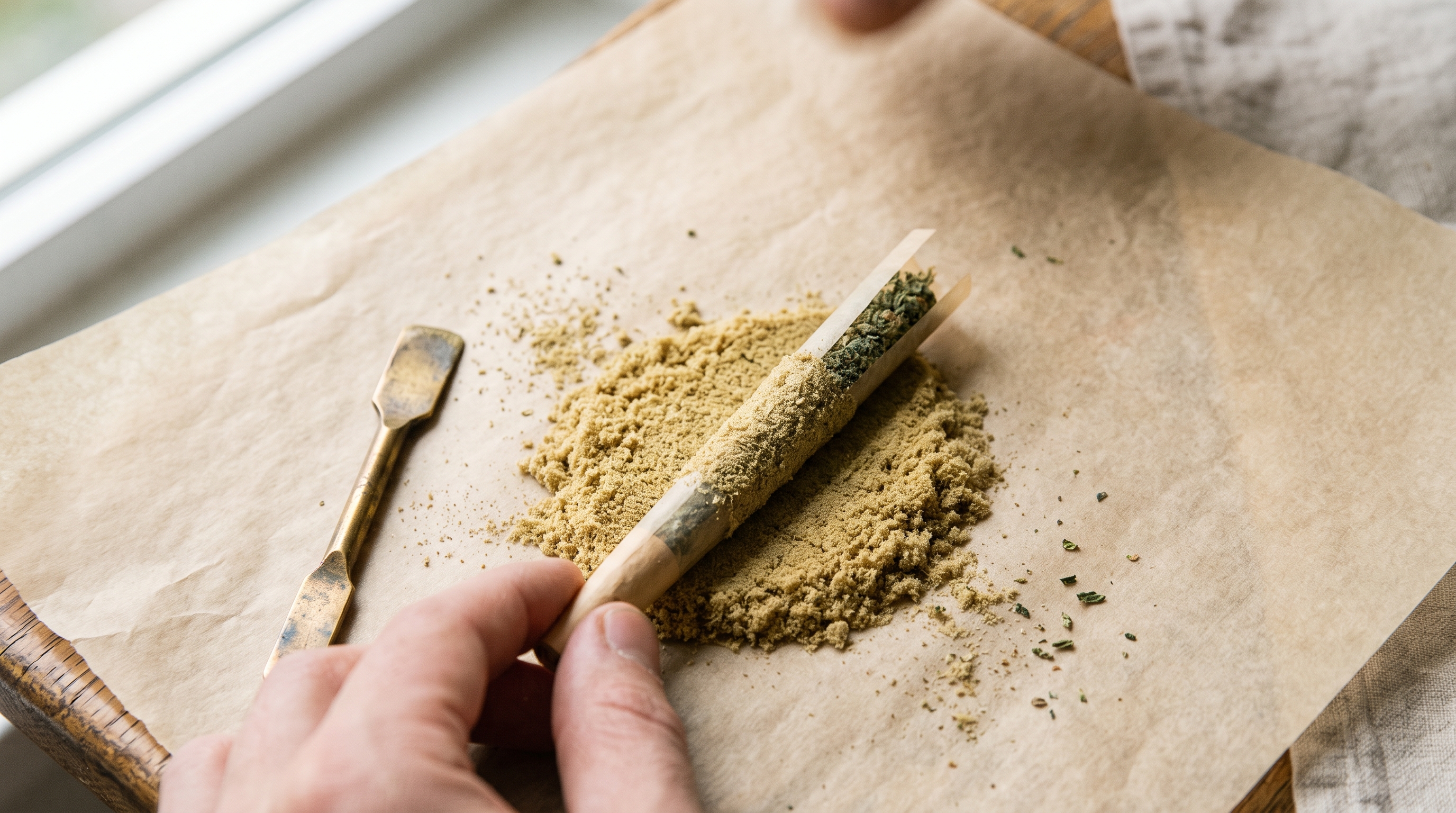
Twaxing is the exterior version: a light coat of concentrate on the outside of a rolled joint, then a roll through kief. The classic form uses rosin as the adhesive — warm a small amount until it is tacky, run a thin line along the paper seam, then roll the finished joint gently through a bed of kief on parchment.
Two warnings that matter. First, coated papers burn unevenly and unpredictably; light gently and expect to re-light. Second, this is a serious dose increase over a normal joint. If a twaxed joint is your first experiment, split it.
5. Press a temple ball
The oldest use on this list and the most satisfying. A temple ball is kief compressed under heat and pressure until the trichome heads rupture and fuse into a single glossy mass — traditional hand-rolled hash.
The low-tech method: seal one to three grams of kief tightly in a small piece of cellophane or parchment, then work it between your palms for ten to twenty minutes. Body heat plus pressure is genuinely enough. The material shifts from powder to a putty, then to a dense ball with a shiny skin. Some people warm it briefly in a sealed bag in warm (not hot) water first to speed the transition.
Blonde kief presses into something dark, glossy and pliable. Green kief presses into a hard crumbly puck that never really sets, because there is not enough resin to fuse. That is the colour test, confirmed.
Temple balls store far better than loose kief — a cured ball has vastly less surface area exposed to oxygen — and they crumble neatly into a bowl or a joint.
6. Press it into rosin
Kief is the ideal rosin feedstock. Flower rosin has to fight through plant material; kief is most of the way to pure resin already, so yields are higher and the result is cleaner.
Key differences from pressing flower:
- Lower temperature. Around 160–190°F (roughly 71–88°C) rather than the higher flower range. Resin flows readily; heat above this cooks off terpenes for no yield gain.
- Finer bag. A 25 to 37 micron press bag, versus the 90 to 160 micron range typical for flower.
- Pre-press first. Compact the kief into a firm puck before it goes in the press, so it does not blow out the bag seams.
- Longer, gentler squeeze. Ramp pressure slowly and hold.
Our DIY rosin press guide covers the mechanics, and the rosin press buyer’s guide covers equipment. If you have never dabbed the result, start with dabbing 101.
7. Cold-cure that rosin
Do not dab your kief rosin the moment it comes off the plates. Scrape it into a small airtight glass jar, put it somewhere cool and dark — roughly 50–70°F, or 15–21°C — and leave it for three days to a week.
Over that window the clear, glassy oil turns opaque and creamy as cannabinoids, lipids and waxes reorganise into a more stable structure. You get a scoopable budder with the terpenes distributed evenly through the mass instead of pooling on top. The cold-cure versus fresh press comparison explains the physics properly. It costs you nothing but patience, and it is the single biggest quality upgrade available to a home presser.
8. Infuse butter or oil
Here is the rule that everything else hangs on: you must decarboxylate first.
Raw cannabis contains almost no THC. It contains THCA — the acid form — which is not meaningfully intoxicating on its own. Heat removes a carboxyl group and converts it. Wang and colleagues, writing in Cannabis and Cannabinoid Research, studied this conversion across 80°C, 95°C, 110°C, 130°C and 145°C and found it follows first-order kinetics, with THCA-A converting at roughly twice the rate of CBDA and CBGA. When you smoke, the lighter does this instantly. When you make butter, nothing does it unless you do.
Kief decarbs faster than flower — it is finer, drier, and has far more surface area per gram — so the standard flower timings are too long. Spread it thin on parchment, watch it, and pull it as soon as the colour deepens and the smell turns nutty rather than grassy. Our perfect decarb guide and the decarboxylation science explainer have the specifics.
After decarbing, stir the kief directly into warm butter or oil. Unlike flower infusions, there is nothing to strain out — kief dissolves into fat. No cheesecloth, no squeezing, no lost yield. That alone makes it the best infusion material in your kitchen. Follow the cannabutter foundation guide, the coconut oil version, or the vegan alternative; choosing the right fat explains why the fat matters.
Do not trust your arithmetic more than it deserves. Bettiol and colleagues, in Frontiers in Pharmacology, measured cannabinoids across 219 samples of standardised pharmacy-made cannabis oil and found statistically significant variability between laboratories working from the same starting material. If licensed pharmacies drift, your saucepan drifts more. Test the result if you can — how to test homemade edible potency covers the home options.
9. Make a tincture
Decarbed kief in high-proof alcohol produces a cleaner tincture than flower does, for the same reason it produces cleaner butter: less plant matter means less chlorophyll, which means less of that bitter green taste.
Method in brief: decarb, combine with high-proof neutral alcohol in a sealed jar, agitate regularly, and give it time. The full walkthrough is in our tincture guide.
Tinctures earn their place because of how they can be taken. Held under the tongue, absorption partly bypasses the digestive route; swallowed, it behaves like an edible. That difference is real and worth understanding — see sublingual versus edible onset speed.
Manage expectations on the oral route generally. Huestis, reviewing human cannabinoid pharmacokinetics in Chemistry & Biodiversity, describes oral absorption of THC as slow and variable, with low and erratic bioavailability compared with inhalation. That is not a flaw in your technique. It is the route.
10. Fill capsules — and, carefully, your coffee
Capsules. Decarbed kief in a gel capsule with a carrier oil is the most repeatable dose on this list, which is exactly why it suits people using cannabis for a specific purpose rather than an experience. No smell, no fuss, no guessing. See our capsules guide and the gummies versus capsules comparison.
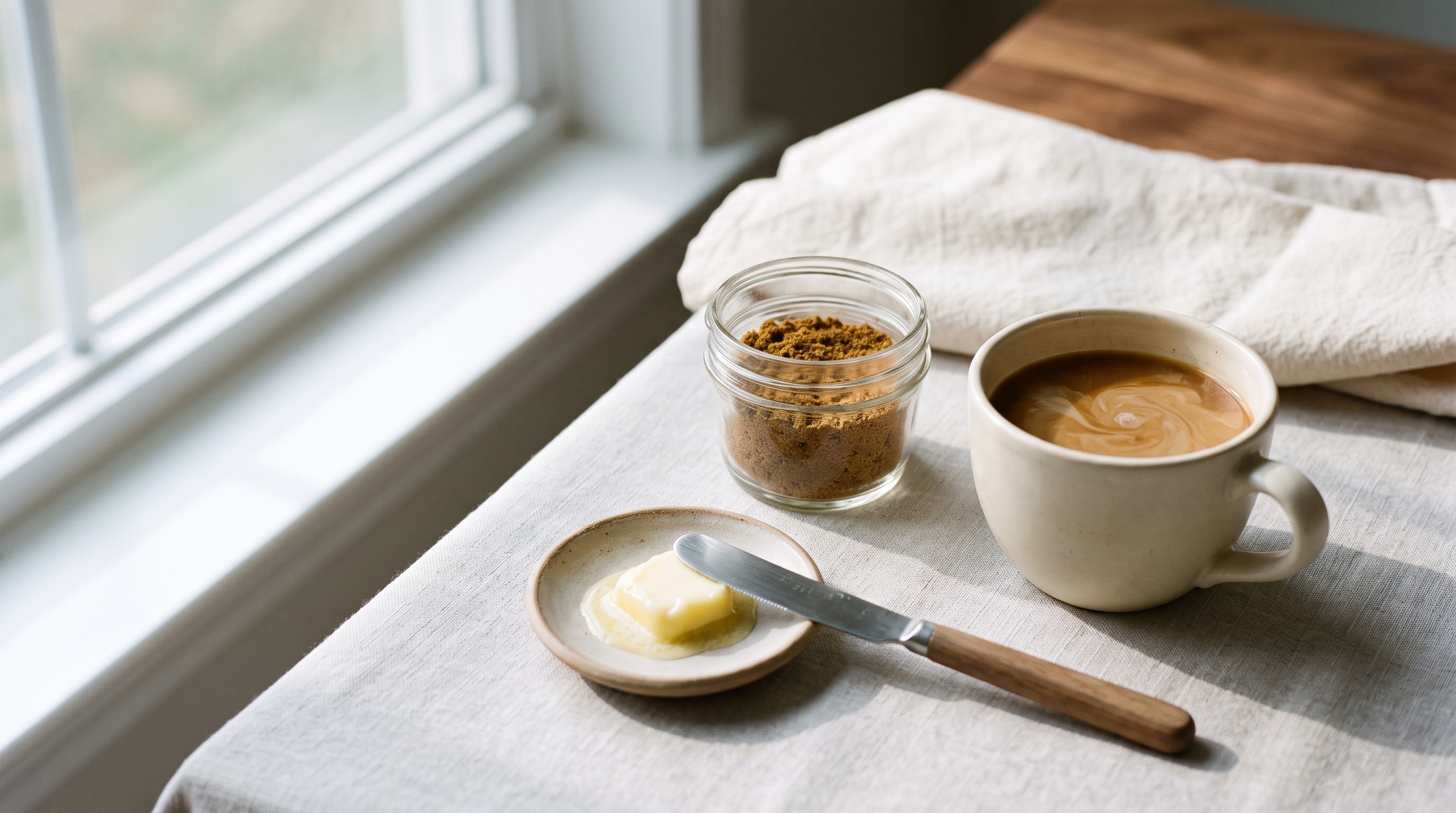
Coffee. This works, with one non-negotiable caveat: sprinkling raw kief into a black coffee does essentially nothing. Cannabinoids are lipophilic — fat-soluble, not water-soluble — and they have not been decarbed. To actually get an effect you need decarbed kief and a fat for it to dissolve into: whole milk, cream, butter, or coconut oil. Our infused coffee and tea recipes handle this properly, and cannabis and coffee covers what the caffeine interaction is actually doing.
Dosing: kief is not flower
Every use above changes your dose, and the smoked and eaten routes fail in different directions.
Smoked kief comes on fast enough that you can stop. The failure mode is over-packing a bowl and taking one enormous hit before your body has told you anything. Fix it at the front: a rice-grain pinch, not a scoop.
Eaten kief is where people get hurt. Slow, unpredictable onset; stronger than the inhaled equivalent; and the classic mistake is redosing at ninety minutes. If you have infused kief into butter, you have concentrated an already concentrated material — halve whatever you think the dose should be, then halve it again for the first attempt. Our beginner’s dosing chart, the two-hour rule, and when to increase your dose — and when absolutely not to are worth ten minutes before you bake anything. If it does go wrong it is unpleasant rather than dangerous; the science of greening out explains what actually helps.
The part strain names will not tell you
Kief inherits its character from the flower it came from — not the name on the jar. A myrcene-heavy cultivar like Granddaddy Purple or Northern Lights yields kief that leans toward Relax High and pushes sedated, body-high effects. A limonene- and terpinolene-forward cultivar like Jack Herer, Super Lemon Haze or Durban Poison sits closer to Energy High and reads uplifted and focused. Balanced cultivars such as Blue Dream or Wedding Cake land in Balance High territory.
There is a complication specific to kief, though: your grinder does not empty between sessions. That disc in the bottom is a blend of every cultivar you have run through it for months. If you care about the profile, dedicate a grinder — or at least empty the chamber when you switch to something meaningfully different.
And the usual caveat applies: cultivar chemistry sets the range, your own physiology picks the point inside it. The only way to learn yours is to write it down — what you used, how much, what happened. That is what the High IQ app is for, and it matters more with kief than almost anything else, because the dose steps are so much larger.
FAQ
Does kief go bad?
It degrades rather than spoils. Loose kief has enormous surface area exposed to oxygen and light, so terpenes evaporate and cannabinoids slowly oxidise. Store it in an airtight container, cool and dark. Pressing it into a temple ball dramatically reduces exposed surface area and is the best long-term storage move available to you. The principles in our storage guide and edible shelf life guide apply.
Can I dab kief directly?
Not well. Kief still contains plant material and unruptured cell debris, so it leaves black residue on a banger and tastes acrid. Press it into rosin first — that is what a press is for. If you want a dabbable product from kief without a press, a hand-pressed temple ball is closer, but still not clean.
How much kief should I expect from a grinder?
Roughly one to two percent of the flower you grind, though it varies enormously with screen mesh, cultivar frostiness, humidity, and how much you chill. A quarter-ounce of frosty flower ground in a good three-chamber grinder might give you a visible dusting. Meaningful quantities take months, which is precisely why a sifting screen is the upgrade if you actually want volume.
Do I really have to decarb kief for edibles?
Yes, if you want the standard THC effect. Undecarbed kief in butter gives you mostly THCA, which does not intoxicate in the same way. Some people deliberately use raw material for THCA specifically, which is a legitimate but different goal. If your intent is a normal edible, decarb.
Is kief the same thing as dry sift?
Not quite. Both are collected trichome heads, but “dry sift” implies deliberate screening through defined micron meshes, usually in multiple passes, to a specified purity. Grinder kief is an accidental by-product with no purity control. Dry sift is kief that someone put effort into. The full comparison covers the distinction, and hash versus wax versus shatter places both against solvent-based products.
Why did my kief press into a crumbly puck instead of a ball?
Not enough resin. A temple ball forms when trichome heads rupture and their contents fuse the mass together. If your kief is mostly plant dust, there is nothing to fuse with. Check the colour — green, matte kief will not press. Infuse that batch into fat instead, where the contamination matters far less.
Sources
Each citation below was verified directly against Crossref or PubMed.
- Livingston, S. J.; Quilichini, T. D.; Booth, J. K.; Wong, D. C. J.; Rensing, K. H.; Laflamme-Yonkman, J.; Castellarin, S. D.; Bohlmann, J.; Page, J. E.; Samuels, A. L. “Cannabis glandular trichomes alter morphology and metabolite content during flower maturation.” The Plant Journal, 2020. DOI: 10.1111/tpj.14516 — PubMed 31469934
- Tanney, C. A. S.; Backer, R.; Geitmann, A.; Smith, D. L. “Cannabis Glandular Trichomes: A Cellular Metabolite Factory.” Frontiers in Plant Science, 2021. DOI: 10.3389/fpls.2021.721986 — PubMed 34616415
- Mehmedic, Z.; Chandra, S.; Slade, D.; Denham, H.; Foster, S.; Patel, A. S.; Ross, S. A.; Khan, I. A.; ElSohly, M. A. “Potency trends of Δ9-THC and other cannabinoids in confiscated cannabis preparations from 1993 to 2008.” Journal of Forensic Sciences, 2010. DOI: 10.1111/j.1556-4029.2010.01441.x — PubMed 20487147
- Wang, M.; Wang, Y. H.; Avula, B.; Radwan, M. M.; Wanas, A. S.; van Antwerp, J.; Parcher, J. F.; ElSohly, M. A.; Khan, I. A. “Decarboxylation Study of Acidic Cannabinoids: A Novel Approach Using Ultra-High-Performance Supercritical Fluid Chromatography/Photodiode Array-Mass Spectrometry.” Cannabis and Cannabinoid Research, 2016. DOI: 10.1089/can.2016.0020 — PubMed 28861498
- Bettiol, A.; Lombardi, N.; Crescioli, G.; Maggini, V.; Gallo, E.; Mugelli, A.; Firenzuoli, F.; Baronti, R.; Vannacci, A. “Galenic Preparations of Therapeutic Cannabis sativa Differ in Cannabinoids Concentration: A Quantitative Analysis of Variability and Possible Clinical Implications.” Frontiers in Pharmacology, 2019. DOI: 10.3389/fphar.2018.01543 — PubMed 30705629
- Huestis, M. A. “Human Cannabinoid Pharmacokinetics.” Chemistry & Biodiversity, 2007. DOI: 10.1002/cbdv.200790152
