How Long to Wait Between Cannabis Hits: A Safer Guide
Wait 5–10 minutes between cannabis hits, or up to 30 if you are new or using a strong product. See why the high keeps building after the first puff.

Wait at least 5–10 minutes between cannabis hits, whether you smoke or vape, and up to 30 minutes if you are new, using a potent product, or trying an unfamiliar device. Health Canada says effects start within seconds to minutes but take 10–30 minutes to feel fully, so a quick second hit can stack.
The 5–10 minute starting point matches guidance from the Washington State Liquor and Cannabis Board and New York’s Office of Cannabis Management for one or two puffs. But it is not a promise that you have felt everything.
That makes the cautious answer simple: wait longer when the product is potent, the device is unfamiliar, or your tolerance is low. Ten to 30 minutes gives a first inhalation more time to declare itself. With a concentrate, a powerful oil vape, or any product whose strength you do not know, one “hit” can be a large and poorly measured dose. The right next move may be no next hit at all.
This is pacing advice, not a technique for getting as high as possible. There is no universal stopwatch because “a hit” is not a standardized unit. Product strength, device temperature, puff length, inhalation depth, tolerance, and even how consistently the device works can all change the amount of THC delivered.
Key Takeaways
- Five to 10 minutes is a common official starting interval, not a universal guarantee. It is intended for pausing after one or two modest inhalations.
- Inhaled effects may begin within seconds or minutes, while the fuller effect of one inhalation may take 10–30 minutes to become clear.
- If you are new, sensitive, using high-THC material, or trying an unfamiliar device, waiting closer to 30 minutes is the more conservative choice.
- A puff is not a dose unit. Flower, dry-herb vaporizers, oil cartridges, and concentrates can deliver very different amounts.
- Do not hold smoke or vapor in your lungs to “make it work.” A normal comfortable inhale and exhale avoids an unnecessary breath-holding ritual.
- Do not combine inhaled cannabis with an edible while you are still evaluating the inhaled effects. Avoid alcohol and other intoxicants.
- Do not drive, bike in traffic, operate machinery, swim alone, or do another safety-sensitive activity after using cannabis.
Why the high can keep building after the first sensation
Inhaled THC moves from the lungs into the bloodstream quickly. In a controlled study of six men, researchers detected substantial plasma THC after the first inhalation, with levels peaking around nine minutes during the smoking session [Huestis et al., 1992]. A later clinical pharmacology review reported that inhaled THC and CBD generally reach peak plasma concentrations within about three to 10 minutes [Lucas et al., 2018].
Your blood level and your moment-to-moment experience are related, but they are not the same clock. An older pharmacokinetic review found that psychoactive effects can start within seconds to a few minutes and may reach their maximum around 15–30 minutes [Grotenhermen, 2003]. That is why “I feel something” and “I have felt the full effect of that inhalation” are different statements.
This distinction matters because rapid back-to-back inhalations can stack before you have made a calm decision about the first one. For more background, our guide to how THC moves through the body may help explain absorption, distribution, and metabolism.
The timing guide: what to do after one inhalation
There is no evidence-based chart that converts every puff into a precise milligram dose. The ranges below are a decision framework, not a dosing prescription.
| Time since one modest inhalation | What may be happening | Safer decision |
|---|---|---|
| 0–2 minutes | Effects may begin, especially with a familiar product | Put the product down; breathe normally; do not judge the full result yet |
| 3–10 minutes | Blood THC commonly rises rapidly; noticeable effects may continue building | Keep waiting, especially if the first change is already clear |
| 10–15 minutes | Many people have a better read on direction and intensity | If you feel where you want to be, stop; there is no prize for adding more |
| 15–30 minutes | A fuller effect from one inhalation may become apparent | New or sensitive consumers should generally use this longer window before reconsidering |
| After 30 minutes | The initial rise is easier to assess, but impairment can last for hours | Only consider more if you remain comfortable, are in a safe setting, and have no safety-sensitive plans |
This table deliberately favors patience. The Washington State Liquor and Cannabis Board advises waiting 5–10 minutes after one or two puffs before consuming more. New York’s safer-consumption guide uses the same 5–10-minute language. Health Canada takes a more conservative position: it says inhaled effects begin within seconds to minutes but may take 10–30 minutes to feel fully, and warns that consuming more during that period can increase adverse effects.
Those recommendations are not actually contradictory. Five to 10 minutes can be a minimum pause; 10–30 minutes can be a more cautious assessment window. If you are uncertain, choose the longer one.
Why one person’s “hit” is another person’s whole session
Product potency changes the starting line
A small inhalation of lower-THC flower is not equivalent to a pull from a high-potency concentrate cartridge. Labels can help, but THC percentage is a poor stand-alone predictor and cannot reveal exactly how much aerosol reached your lungs.
Health Canada advises the greatest caution with products above 20% THC, including waxes and distillates. A conservative pause becomes more important as potency rises because an apparently small inhalation may carry more THC.
Puff size is not standardized
Puff duration, inhalation volume, spacing, and the device all influence exposure [Lucas et al., 2018]. Even when a lab controls a smoking protocol, people can show large differences in blood THC. A 2023 study of 102 regular consumers also found substantial pharmacokinetic variability related to the cannabis material and participants’ baseline THC concentrations [Liyanage et al., 2023].
This is why counting hits is not the same as counting milligrams. Our beginner cannabis dosing chart can help you understand labeled doses, but inhaled cannabis remains much harder to measure than a regulated oral serving.
Tolerance changes perception, not the product
A frequent consumer may notice less from the same exposure than someone who has not used cannabis recently. That does not make fast stacking risk-free. Tolerance can be uneven: someone may feel accustomed to euphoria but still experience changes in reaction time, heart rate, or coordination.
If your usual amount suddenly feels weak, do not automatically compress the time between inhalations. Consider product differences, device problems, recent use, and whether a tolerance break is more appropriate than escalating.
Your setting and body matter too
Sleep, anxiety, medications, and other substances can change the experience. If you use cannabis medically or take prescription medicines, ask a clinician or pharmacist for individualized advice.
Flower, dry-herb vapes, oil pens, and concentrates are not interchangeable
Smoked flower
For a joint, pipe, or bong, a modest inhalation followed by a normal exhale and a 5–10-minute pause is a reasonable minimum. New consumers can wait closer to 30 minutes. Smoking creates combustion products that can harm lung tissue, so taking more hits also means taking more smoke exposure. Our review of cannabis and lung health explains that tradeoff in detail.
Do not try to strengthen a puff by keeping it in your lungs. Controlled research found little evidence that longer breath-holding meaningfully increased the response [Zacny and Chait, 1989]. The complete breakdown is in does holding in weed smoke get you higher?.
Dry-herb vaporizers
A dry-herb vaporizer avoids combustion when used as intended, but it can still deliver an intoxicating dose. Temperature, airflow, chamber packing, and device efficiency affect the aerosol. Start with the same modest-inhalation-and-pause approach; do not assume “vapor” means weak.
Compare temperatures in our dry-herb vaporizer guide, then see how vaping compares with smoking.
Oil cartridges and disposable vapes
Oil devices vary dramatically in concentration, voltage, airflow, and draw activation. Some produce a small amount on a short pull; others deliver a dense aerosol quickly. Regulated packaging may list THC concentration, but it usually cannot tell you the exact dose in your individual puff.
In a crossover trial of 17 adults who had not used cannabis in the previous month, vaporized cannabis produced stronger effects and higher peak blood THC than the same THC dose smoked [Spindle et al., 2018]. That finding does not mean every vape is stronger than every joint. It means route and delivery efficiency can matter, especially for an infrequent consumer.
Use only regulated products where legal, and read our guide to spotting a counterfeit vape cart. If a device is new to you, treat its output as unknown and use the longer pause.
Concentrates and dabs
Concentrates can contain far more THC by weight than flower. A single inhalation may already be a substantial exposure, and “one dab” has no standard size. This article cannot turn concentrate technique into a predictable dose.
People who are new to cannabis should not use a concentrate as their calibration tool. If you choose to use one, avoid rapid repeat inhalations and give the first exposure the full 10–30-minute assessment window. Our beginner guide to concentrates explains why potency and equipment make the category different.
Medical or metered-dose inhalers
For a regulated medical product, follow its label and your clinician’s instructions rather than a general pacing rule.
A simple pacing routine that reduces guesswork
- Check the product first. Confirm the label, THC concentration, and whether it is flower, oil, or concentrate. Do not use an unregulated product of unknown origin.
- Choose a safe setting. Be somewhere familiar, with no driving or safety-sensitive plans. If you are inexperienced, be with a trusted sober adult.
- Take one modest inhalation. Avoid a deep lung-filling pull. Exhale normally instead of holding your breath.
- Put the product down. This physical step matters. Keeping a pen or joint in your hand makes automatic repeat use easier.
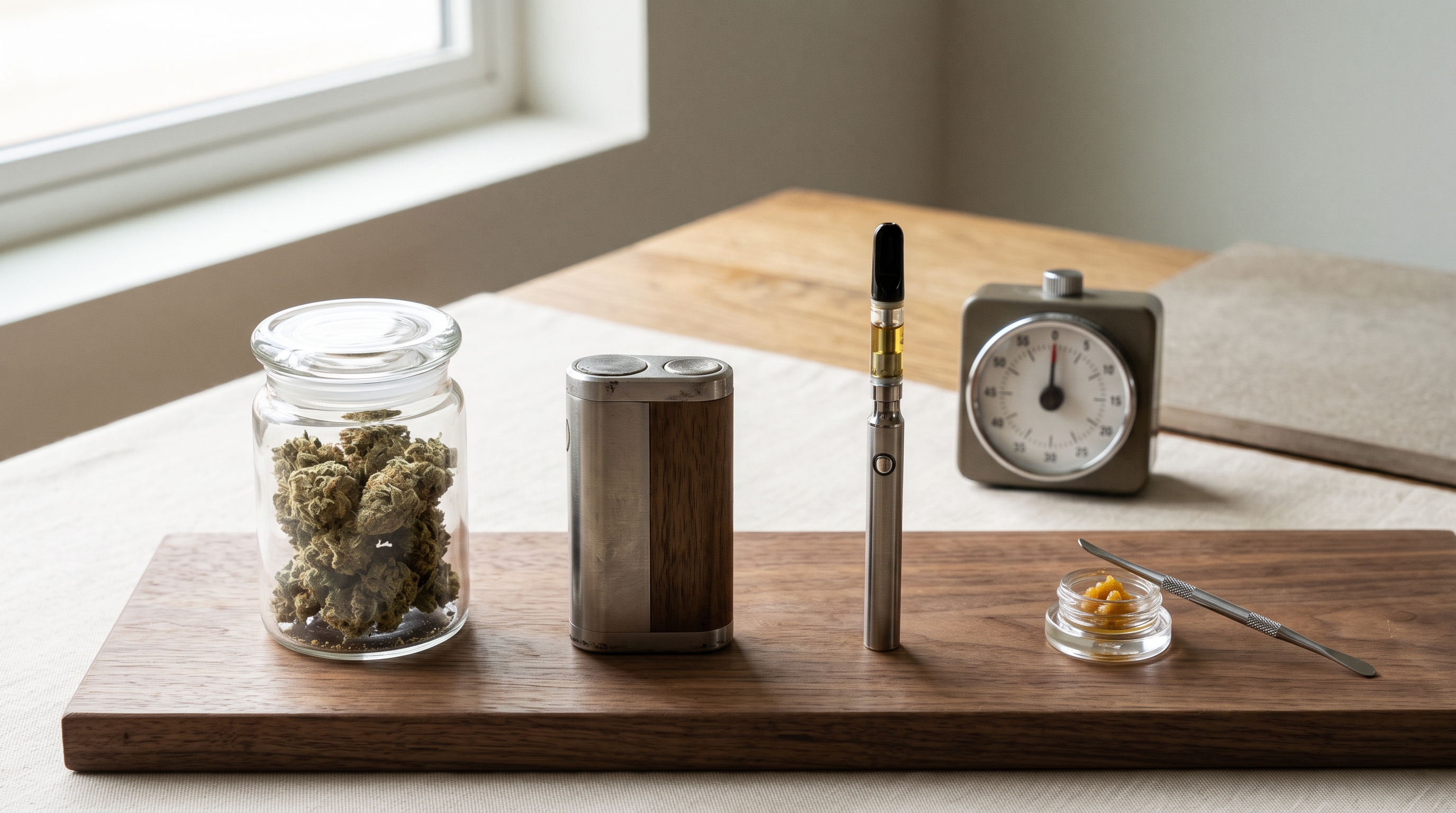
- Start a real timer. Wait at least 5–10 minutes. If you are new, sensitive, or using an unfamiliar or potent product, wait 10–30 minutes.
- Check function, not just vibe. Notice anxiety, dizziness, heart pounding, balance, attention, and whether conversation feels harder—not only whether you feel “high.”
- Stop when the effect is enough. More is optional, not inevitable. If you do choose another inhalation, keep it the same size or smaller and repeat the pause.
- Write down what happened. Product, method, one approximate puff size, wait time, and outcome are more useful than relying on memory next time.
This routine complements our first-time cannabis guide by making one decision—whether to inhale again—less impulsive.
What not to stack while you wait
Do not add an edible because the vape “isn’t working”
Inhaled and edible timelines are fundamentally different. Edibles can take hours to fully develop. If you swallow THC during an inhalation pause, you create two overlapping clocks and make the later peak harder to interpret. Learn the difference in our consumption-method bioavailability guide.
Do not use alcohol as a gap filler
Health Canada advises avoiding cannabis with alcohol, and the CDC notes that multiple substances can increase impairment. Our cannabis and alcohol guide covers the practical risks.
Do not chase a cough or head rush
Coughing, oxygen discomfort, and dizziness are not dose meters. If every inhalation triggers coughing, stop exposing irritated airways and review why cannabis makes you cough. A harsher hit is not proof of a better one.
If you already took too many hits
Stop consuming cannabis. Move to a quiet, familiar place and sit or lie down somewhere safe. Remind yourself that the experience is temporary. Sip water if you can swallow normally, loosen tight clothing, reduce noise and bright light, and ask a trusted sober person to stay nearby. Do not drive yourself anywhere.
Avoid trying to “cancel” THC with alcohol, more cannabis, or an unproven remedy. Our guide on what to do when you are too high separates reasonable comfort measures from internet myths.
Call emergency services for chest pain, trouble breathing, a seizure, loss of consciousness, severe confusion, inability to speak normally, suicidal thoughts, or a serious allergic reaction. For a concerning but non-life-threatening exposure in the United States, contact Poison Control at 1-800-222-1222 or use PoisonHelp.org. Be honest about what was taken; that information helps responders.
Waiting between hits is not the same as waiting to drive
A 5-, 10-, or 30-minute pause only helps you decide whether to consume more. It says nothing about whether you are safe to drive. Inhaled effects can last for hours, and residual effects may last longer. There is no reliable personal trick, THC blood number, or “I feel normal” test that proves driving ability has returned.
The CDC’s safest advice is to avoid driving after using cannabis and arrange a sober driver, taxi, or rideshare. Read how long to wait before driving after cannabis before a session—not while you are looking for your keys.
The Professor High verdict
If you want one memorable rule, use this: one modest inhalation, then hands off for at least 5–10 minutes—and longer, up to 30 minutes, when anything about the product or your response is uncertain.
The timer does not tell you when you are allowed to take more. It creates enough space to notice that you may not need more—the real value of pacing.
FAQs
Is five minutes long enough between cannabis hits?
Five minutes is the low end of some official guidance, but it may not reveal the full effect. Waiting 10 minutes is more informative, and waiting up to 30 minutes is more conservative for new consumers, potent products, concentrates, or unfamiliar devices.
Why do I feel a hit immediately if the peak comes later?
Inhaled THC reaches the bloodstream and brain rapidly, so effects can begin within seconds or minutes. The experience can still build as absorption continues and THC distributes through the body. Onset and full effect are different milestones.
Should I wait longer between vape hits than joint hits?
Not automatically—but you should wait longer when the vape’s output or oil strength is unfamiliar. Controlled research has shown that vaporization can deliver THC efficiently and may produce stronger effects than an equal smoked dose in infrequent consumers. Treat every new device as an unknown.
Does holding the hit reduce the number of puffs I need?
Controlled studies do not show a reliable subjective benefit from prolonged breath-holding. Inhale comfortably and exhale normally. Holding smoke also keeps combustion products in contact with your lungs longer.
Can I alternate a cannabis vape and an edible while pacing?
That makes dosing less predictable because the routes peak on different timelines. Finish evaluating the inhaled effects before considering any other cannabis product, and remember that an edible can take up to four hours to feel fully.
What if I have a high tolerance?
Tolerance can reduce some felt effects, but it does not standardize a puff or eliminate impairment. Keep a deliberate pause, avoid escalating automatically, and consider whether frequent use or tolerance is becoming a problem.
How long should I wait between CBD hits?
CBD is not intoxicating like THC, but inhaled products can contain THC and vaping still carries product and lung risks. Follow the regulated label or clinician’s directions, especially if you take medications, because CBD can interact with some drugs.
Sources
- Huestis, M. A., Sampson, A. H., Holicky, B. J., Henningfield, J. E., & Cone, E. J. (1992). Characterization of the absorption phase of marijuana smoking. Clinical Pharmacology & Therapeutics, 52(1), 31–41. PubMed · DOI
- Lucas, C. J., Galettis, P., & Schneider, J. (2018). The pharmacokinetics and the pharmacodynamics of cannabinoids. British Journal of Clinical Pharmacology, 84(11), 2477–2482. PubMed · DOI
- Grotenhermen, F. (2003). Pharmacokinetics and pharmacodynamics of cannabinoids. Clinical Pharmacokinetics, 42(4), 327–360. PubMed · DOI
- Spindle, T. R., Cone, E. J., Schlienz, N. J., Mitchell, J. M., Bigelow, G. E., Flegel, R., Hayes, E., & Vandrey, R. (2018). Acute Effects of Smoked and Vaporized Cannabis in Healthy Adults Who Infrequently Use Cannabis: A Crossover Trial. JAMA Network Open, 1(7), e184841. PubMed · DOI
- Liyanage, M., Nikanjam, M., Capparelli, E. V., Suhandynata, R. T., Fitzgerald, R. L., Marcotte, T. D., Grant, I., & Momper, J. D. (2023). Variable Delta-9-Tetrahydrocannabinol Pharmacokinetics and Pharmacodynamics After Cannabis Smoking in Regular Users. Therapeutic Drug Monitoring, 45(5), 689–696. PubMed · DOI
- Zacny, J. P., & Chait, L. D. (1989). Breathhold duration and response to marijuana smoke. Pharmacology Biochemistry and Behavior, 33(2), 481–484. PubMed · DOI
- Health Canada. What you need to know if you choose to consume cannabis.
- Health Canada. Cannabis and your health.
- Washington State Liquor and Cannabis Board. What is the “Right” Amount of Cannabis for Me?
- New York State Office of Cannabis Management. The Guide to Safer Cannabis Consumption.
- Centers for Disease Control and Prevention. Cannabis and Driving.
This article is for education and harm reduction, not medical advice. Cannabis laws vary by location. Use only where legal and keep every product away from children and pets.

