

Rosin Micron Labels: Wash Fractions vs Press Bags
Rosin micron labels can describe a wash fraction or a press bag. See why 90u hash can be pressed through 37u mesh without either number being a quality grade.

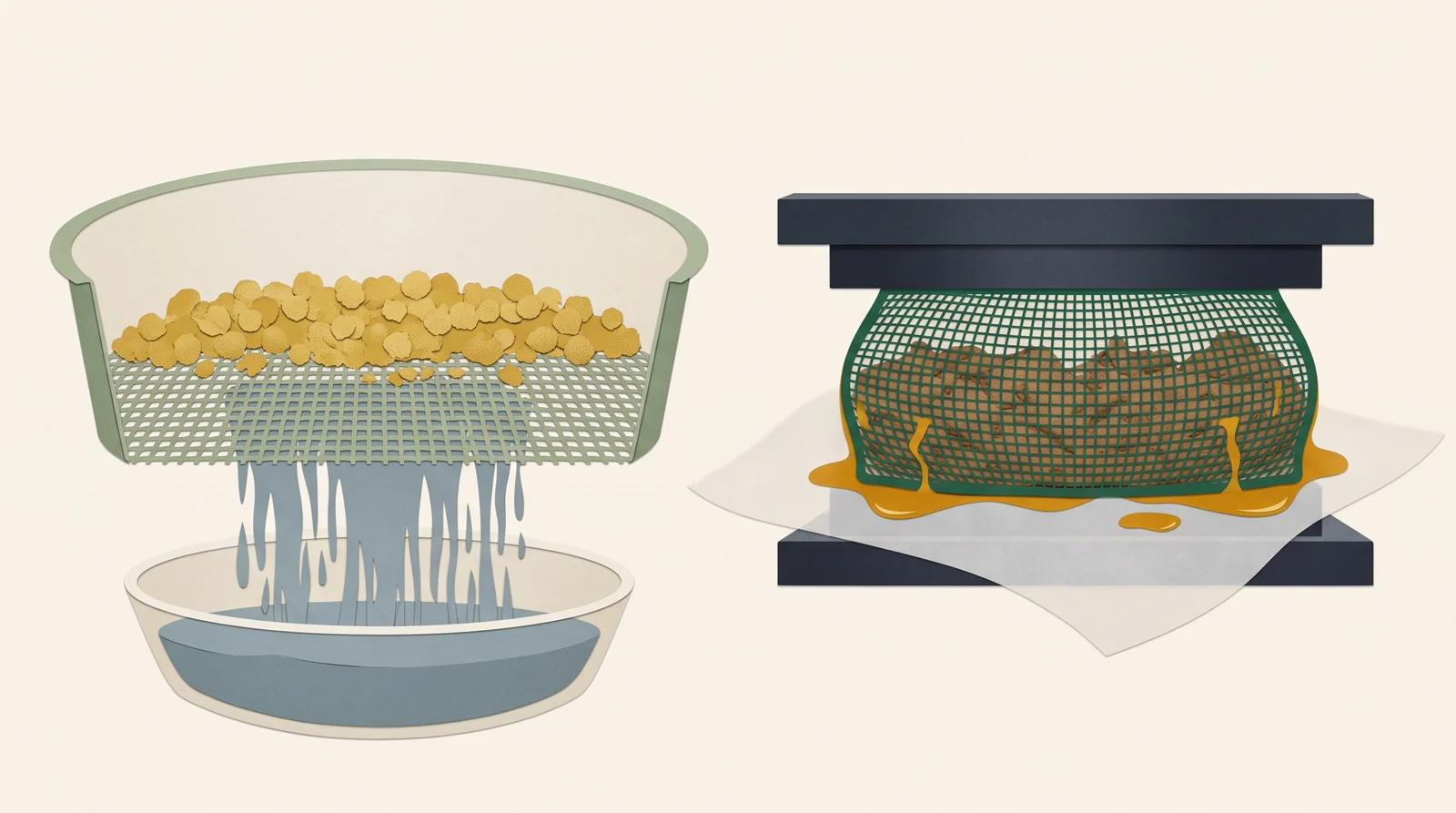
A wash-fraction micron label identifies collected hash; a press-bag micron rating describes the filter used to squeeze out rosin. A hypothetical batch can start with “90u” wash hash and then be pressed in a “37u” bag. The two numbers describe different stages, so they do not contradict each other.
The question to ask first is “Microns at which step?” That is more useful than assuming the larger or smaller number means better rosin.
What does “u” mean on rosin?
In this context, u is shorthand for microns, also written µm. A micron is one-thousandth of a millimeter. On filter equipment, the rating refers to the mesh openings, not the bag’s width or the amount of THC. Lowtemp describes its ratings as the spacing between filter filaments; Cultiva calls the opening sizes approximate. Lowtemp’s equipment guide; Cultiva’s filter guide.
The same unit can appear beside a wash fraction or a pressing filter. Keep the unit attached to the process it names.
| Where the number appears | What it describes | What the maker collects |
|---|---|---|
| Wash fraction, such as “90u hash” | Material collected on that wash screen, after earlier screens | Hash retained on the screen |
| Press bag, such as “37u bag” | The pressing filter’s rated openings | Rosin that flows out through the mesh |
This distinction applies to hash being washed and then pressed. Hash, kief and dry sift are different starting forms. The broader live resin versus live rosin comparison explains why a wash label is not a description of every concentrate.
What does the wash screen keep?
The wash screen holds the collected hash while water drains through. Bubble Bags’ own instructions describe pulling its bags in sequence, draining them, then collecting the material left on each screen. The screens separate fractions; the maker can keep those collections apart. Bubble Bags’ instructions.
Consider a simplified, hypothetical sequence with a 120 µm screen followed by a 90 µm screen:
- Material retained by the 120 µm screen is removed before reaching the next screen.
- Material that passes 120 µm but is retained by 90 µm becomes the collection on the 90 µm screen.
- Material that passes 90 µm continues toward finer screens.
That is why “90u” does not mean every collected head measures exactly 90 microns. In this example, 90 is the retaining screen; 120 is the preceding larger screen. Change that earlier screen and you change what reaches the 90 screen.
This is an idealized sieve explanation, not a guarantee of exact particle diameters in a real batch. The jar label alone does not tell you the full screen sequence or whether separate fractions were later blended.
Our bubble-hash process guide covers the wider workflow. For interpreting a label, keep the screen sequence distinct from any claimed quality tier.
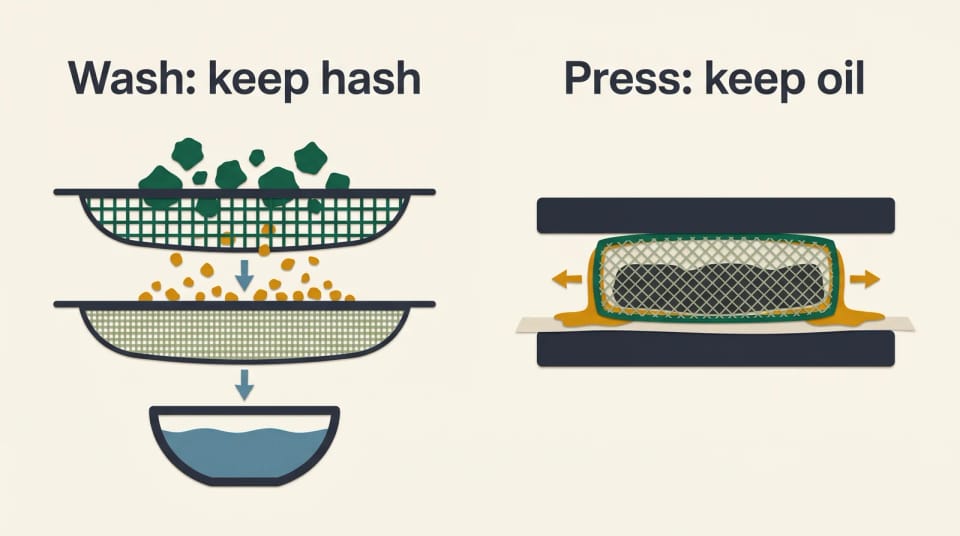
During washing, the selected hash stays on a screen. During pressing, oil leaves the bag. This schematic is not to scale; wash hash is dried before pressing.
What does a 37u press bag keep?
A press bag contains the starting solids while heat and pressure help express oil through the mesh. The collected rosin is outside the bag. Lowtemp discusses small-micron bags for pressing hash and explains that the mesh contains material while resin flows out; Cultiva describes the same containment-and-flow roles. These are commercial equipment explanations, not independent potency studies. Lowtemp; Cultiva.
In our example, dried hash from the 90 µm wash collection goes into a 37 µm press bag. The oil flows through the press mesh; the goal is not to push intact 90 µm heads through 37 µm openings. The wash number describes the selected input. The press number describes a later filter.
It is also possible for the same micron rating to describe equipment at either stage. The number alone cannot tell you whether someone means a wash screen or a press bag.
Does a micron number prove quality or potency?
No. An opening size is a length measurement. A THC result is a chemical measurement. A jar’s “90u” wording does not supply a THC percentage, a contaminant result or a complete description of its contents. Use the batch’s cannabis lab report for reported test results.
Likewise, a seller’s “Tier 1,” “premium” or similar label needs that seller’s definition. It does not follow mathematically from a micron number. A rating tells you about selection or filtration; it does not establish a universal best-to-worst ladder.
If a listing leaves the stage unclear, useful questions are:
- Does this number identify the wash collection or the pressing bag?
- If it is a wash collection, which larger screen came before it?
- Was that fraction kept separate or mixed with other collections?
- What does the producer mean by its tier label?
Ask for a description of the process rather than filling in missing details from the price. Texture words answer another question: cold cure and fresh press concern handling after pressing, not the wash screen’s openings.
FAQ
Can 90u hash be pressed through a 37u bag?
Yes; those numbers can describe the selected wash material and the later pressing filter. The oil leaves the press bag while solids are retained. They are not competing measurements of the same object.
Does a 90u collection contain only 90-micron heads?
No. It names a screen collection, not a measurement of every head. In the hypothetical 120-then-90 sequence, the collection passed the earlier screen and was retained by the later one.
Is 37u rosin automatically better than 90u rosin?
No. First find out which step each label describes. Even when both refer to the same stage, the number alone does not establish potency or a universal quality grade.
Does “first wash” mean the same thing as “90u”?
No. Wash order and screen selection are separate details. A first-wash description tells you which wash collection was used; it does not identify the screen sequence without further information from the producer.
Key takeaways
- Ask “Microns at which step?” before comparing jars.
- A wash fraction is collected on a screen; pressing collects oil outside a bag.
- A hypothetical 90u wash fraction and 37u press bag can describe one batch.
- The previous wash screen matters. Neither number is a universal quality or potency grade.
Sources
- Bubble Bags. How to Make Cold Water Hash with Bubble Bags™. Undated maker instructions; accessed October 10, 2026. Used for its own bag sequence, draining and screen collection. Read the instructions.
- Levi Lanzrath, Lowtemp Industries (2024; updated 2026). Guide to Micron Bag Sizes for Rosin Presses. August 19, 2024; updated May 5, 2026. Firsthand equipment guidance from the company’s founder; used for mesh ratings and pressing filter roles, not universal quality claims. Read the guide.
- Elliot Mercer, Cultiva Supply. Rosin Press Bag Micron Guide: How to Choose the Right Size. Undated retailer equipment guide; accessed October 10, 2026. Corroborates approximate opening size and containment versus flow. No independent clinical or potency evidence is claimed. Read the guide.




