White Ash vs. Black Ash: Does It Reveal Cannabis Quality?
Does white ash mean better weed? Learn what cannabis ash color can reveal, what it cannot prove, and how to check flower quality before buying.

Professor High
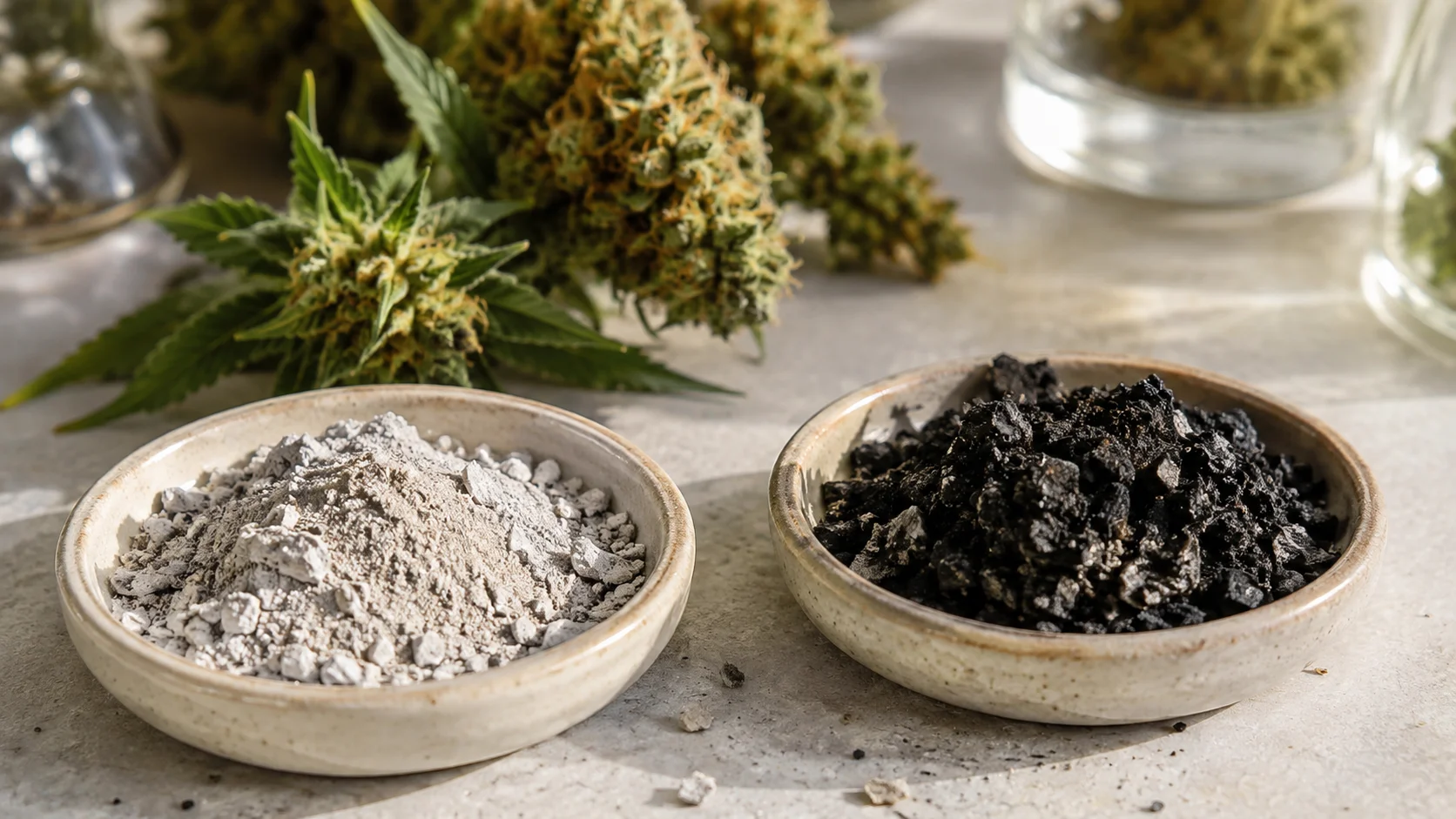
A snowy ash tower makes a great photograph. Somewhere between the photo and the caption, though, it often becomes a laboratory report.
“White ash. Clean flower. Properly grown.”
That is a lot of information to extract from something sitting in an ashtray.
White ash does not establish that cannabis is safer, stronger, pesticide-free, or better grown than flower that leaves dark residue. Ash color can offer clues about combustion and the material left behind. Turning those clues into a verdict on the original flower takes evidence the color alone cannot provide.
Professor High’s assignment today: give the ash its proper job description. We can appreciate a pleasant smoking experience without promoting its leftovers to chief quality officer.
What white ash and black ash actually mean
When plant material burns, some of its organic material becomes gases and particles. The residue can contain both mineral material and carbon-rich char. What people call “ash” in everyday conversation may be a mixture of these things.
A pale residue is generally consistent with less remaining char and a larger visible contribution from mineral ash. Dark residue often contains more charred organic material. That is a useful starting point, but it is not a chemical analysis.
Research on wildfire residues helps explain this distinction. Campbell and colleagues examined ash chemistry after Australian fires and found differences associated with combustion completeness and sampling location. Their study concerns environmental ash and its leachate—the water that has passed through it—not cannabis flower smoked by consumers. It supports the broader chemistry behind the color distinction, not a dispensary grading system. Campbell, 2024.
Here is the detail that tangles up the popular story: light-colored mineral ash still contains minerals. Pale residue is not proof that a plant was emptied of its mineral nutrients.
It also does not follow that every dark particle is a harmful additive. Carbon-rich char can arise from burning ordinary plant material. Neither color identifies the particular compounds in the original flower.
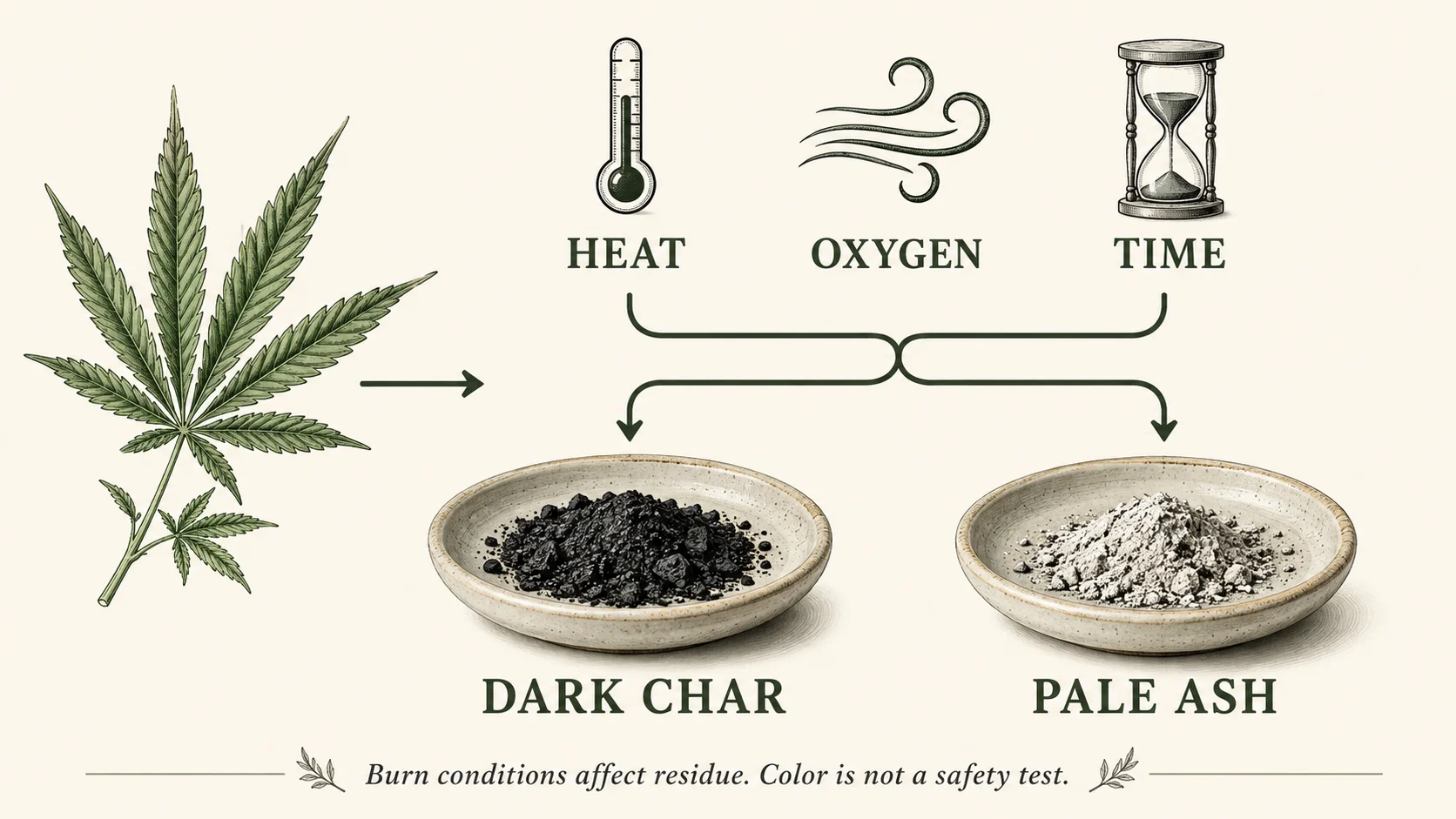
Conceptual illustration, not a laboratory result or a calibrated ash-color scale.
Why the same comparison can tell different stories
An ash photo records the end of a process. To compare two products fairly, you would need to know what happened during that process.
Was the flower burned in the same format? Was it observed at the same stage? Were the amount, preparation, paper, and air supply comparable? Did someone photograph the pale outer layer while leaving darker material underneath?
Those questions are not excuses for disappointing flower. They are reasons an uncontrolled picture cannot isolate what caused the result.
The burn has its own variables
Heat, available oxygen, and exposure time affect plant combustion. The physical setup therefore matters. A partly burned bowl and the exposed end of a joint are not interchangeable test vessels.
Water content is another plausible contributor because heating and evaporating water uses energy. But “black ash means too much moisture” goes beyond what a picture can establish. You have not measured moisture, controlled the burn, or ruled out other influences.
Nor does white ash certify an ideal cure. The same caution applies in reverse: a product can look satisfactory at the end of combustion without that appearance documenting how it was dried or stored.
If you want the post-harvest background, our guide to drying and curing cannabis covers that separate subject. The point here is narrower: a claimed cause needs more evidence than the final color.
“Salt and pepper” is a description, not a grade
Mixed gray and black residue is often called salt-and-pepper ash. The name describes its appearance. It does not come with a validated pass mark, a potency range, or a contamination threshold.
Lighting adds another complication. Exposure, shadows, filters, and the surface beneath the residue can change how pale it looks in a photograph. A video can show a burn in progress, but even that does not reveal the laboratory composition of the flower.
Treat the image as an observation. Trouble begins when a caption turns the observation into a diagnosis.
The three claims ash color cannot carry
1. “White ash proves the flower is clean”
What does “clean” mean here? Free of a particular pesticide? Below an action limit for lead? No microbial contamination? Pleasant flavor? Those are different questions.
California’s Department of Cannabis Control lists laboratory testing for categories including residual pesticides, heavy metals, microbial impurities, mycotoxins, and water activity. Results are recorded in a certificate of analysis, or COA. These tests address defined properties; ash color is not a substitute for them. California DCC testing guidance.
The practical response to a cleanliness claim is to ask for the matching report. Our guide to reading cannabis lab results explains what the sections mean. Then check that the report belongs to the product in your hand using the package batch and lot number.
A COA has limits, too. It reports what was tested in the submitted sample under the applicable method and rules. It does not establish every imaginable property of every flower, and a passing result does not make inhaling smoke harmless.
2. “Black ash proves the grower failed to flush”
This claim jumps backward from residue to cultivation history. It assumes the color identifies residual nutrients, then assumes those nutrients identify a specific growing practice.
Neither inference follows from a photograph. The broader combustion evidence already gives us reasons color can vary, and the mineral component of pale ash undermines the simplistic idea that white means “no minerals.”
We have a separate examination of the science behind flushing before harvest. You do not need to settle every cultivation argument to reject an unsupported consumer test. Even if a growing practice affects some aspect of quality, that does not automatically make ash color a reliable way to detect it.
3. “White ash means stronger or better weed”
Potency is about cannabinoid content. Ash color is an appearance of burned residue. Without evidence tying a standardized color measurement to a specific chemical result, there is no sound conversion between the two.
“Better” is broader still. One person means aroma. Another means value. Another wants a less intense experience. A visual score cannot settle all three.
Start with our guide to comparing cannabis beyond THC percentage. Choosing among products requires several pieces of information, and the highest number is not automatically the right answer either.
But what if white-ash flower usually tastes better to me?
You are allowed to notice a pattern. You are also allowed to prefer a product that burns evenly or tastes more pleasant. Those preferences do not need a scientific stamp to be real preferences.
The leap is from “I often enjoy these products” to “this color proves why they are good.” Several desirable features can arrive together in one product, while the ash receives credit for all of them.
Imagine a hypothetical comparison: one carefully packaged product is fresh and enjoyable, while another is unpleasant and poorly stored. The first leaves pale residue. The second leaves dark residue. You have identified the product you prefer. You have not isolated the cause of that preference.
A convincing ash-quality study would need clear definitions, consistent preparation, independent chemical testing, and blinded assessment where appropriate. It would also need to work on products beyond the original sample. A collection of attractive photographs does not meet those conditions.
The sources reviewed for this article did not establish a validated ash-color test for cannabis potency, contamination, or overall consumer quality. That is a limit of the evidence we found, not proof that every possible relationship has been disproved.
A better way to judge the flower before buying it
The useful checks happen before the ash exists. Keep three questions separate: Can I trace this product? What was measured? Does it suit what I am looking for?
Start with traceability. Prefer a product whose seller, packaging, and batch information can be checked. A confident claim about white ash does not compensate for missing product information.
Read the relevant testing sections. A potency panel alone does not answer a pesticide question. If the report includes contaminant testing, look at those results rather than assuming a large THC number or an attractive label covers everything.
Assess condition without pretending your senses are a lab. Appearance, aroma, and texture can help you decide whether a product seems appealing or questionable. Our flower quality inspection guide provides context. Sensory checks can flag concerns, but they cannot rule out invisible contaminants.
Take suspicious material seriously. Do not burn a questionable sample to see whether it “passes” by turning white. Read mold versus trichomes if you are unsure what you are seeing, and contact the seller about the product.
Define your own quality criteria. Write down what matters: a clear label, an appropriate cannabinoid profile, appealing aroma, acceptable condition, and a price you consider fair. That makes marketing shortcuts easier to spot.
This approach does not require becoming a laboratory scientist. It requires asking a specific question and choosing evidence that can actually answer it.
Pale ash does not make smoke harmless
“Clean burning” is especially slippery because it can sound like a health claim even when the speaker only means an even burn.
The CDC states that cannabis smoke contains many of the toxins, irritants, and carcinogens found in tobacco smoke and that smoking cannabis can damage lung tissue. It also notes uncertainty about specific outcomes such as lung cancer and COPD. Those limits matter; they do not turn pale ash into reassurance about inhaling smoke. CDC cannabis and lung health.
A machine-smoking study by Moir and colleagues detected known carcinogens and other harmful chemicals in cannabis smoke. That experiment measured smoke chemistry under defined conditions; it did not compare health outcomes or validate ash color as a safety marker. Moir, 2008.
Do not take extra hits, hold smoke longer, or repeatedly burn the remnants just to produce a whiter photo. The ashtray is not a destination worth increasing exposure to reach.
FAQs
Does white ash mean good weed?
Not by itself. Pale ash can be consistent with more complete combustion and less remaining char. It does not establish cannabinoid content, freedom from contamination, cultivation quality, or whether you will enjoy the product.
Does black ash mean pesticides or fertilizer are present?
You cannot identify either from the color alone. Dark residue can contain charred plant material. A concern about pesticide residues calls for appropriate laboratory results, not an ash photograph or a seller’s explanation of how the plant was grown.
Is gray or salt-and-pepper ash bad?
The description does not supply a quality grade. Mixed residue may reflect different amounts of char and mineral ash. Consider the product’s traceability, testing, and condition instead of trying to assign a pass or fail from a shade of gray.
Can I test cannabis safety by burning a small piece?
No reliable safety conclusion follows from that home test. Burning it does not give you validated measurements for pesticides, heavy metals, microbes, or other contaminants. Avoid consuming suspicious material and seek product-specific information from the seller.
Should I ignore ash color completely?
You can notice it as part of the burn experience. Just keep the claim proportional: “this left pale ash” is an observation; “this is pesticide-free” requires different evidence. Enjoy the detail without asking it to answer questions it cannot measure.
Key takeaways
A beautiful ash tower can stay a beautiful ash tower. It does not need to carry the whole reputation of the flower on its tiny shoulders.
Use ash color as a limited observation about burned residue. Use product information, relevant testing, and clearly defined preferences to make a buying decision. The next time someone offers white ash as proof of quality, the useful follow-up is simple: quality in which sense, and measured how?
Sources
- Campbell, M., et al. (2024). Combustion Completeness and Sample Location Determine Wildfire Ash Leachate Chemistry. Geochemistry, Geophysics, Geosystems. DOI. Environmental combustion research; not a cannabis quality-validation study.
- California Department of Cannabis Control. Testing laboratories. Official explanation of testing categories and certificates of analysis; requirements are jurisdiction-specific.
- Centers for Disease Control and Prevention. Cannabis and Lung Health. Public-health guidance on smoke exposure and remaining uncertainties.
- Moir, D., et al. (2008). A comparison of mainstream and sidestream marijuana and tobacco cigarette smoke produced under two machine smoking conditions. Chemical Research in Toxicology, 21(2), 494–502. PubMed. Controlled smoke chemistry, not a human health-outcome trial.
