How to Tell If You're Buying Good Weed: A Quality Checklist
A systematic way to judge cannabis at the counter and at home: trichomes, smell, snap, cure and lab results. Why THC percentage tells you the least.

Professor High
You paid fifty-five dollars for an eighth labelled 28% THC. You got home, opened the jar, and it smelled like a hay bale. It crumbled to dust in your fingers. The high was flat, brief and slightly anxious.
That gap between the label and the experience is the most common complaint in legal cannabis, and it is diagnosable. Almost everything that decided how that flower would perform was visible, smellable and touchable before you paid — and the one number you were sold on told you the least.
Here is the inspection protocol. Five checks, most of which take under sixty seconds at the counter.
Why THC percentage is the wrong anchor
Two problems with the potency number.
The first is that it is frequently wrong. When researchers bought 23 flower samples from ten Colorado dispensaries and ran them by HPLC against the label, the average observed potency was 14.98%, and roughly 70% of samples came in more than 15% below their labelled figure. Three held about half the maximum potency claimed on the package (Schwabe et al., 2023). The authors point to inconsistent testing protocols, thin regulatory oversight, and the plain financial incentive to advertise a big number.
The second is that even an accurate figure predicts your experience poorly. In a study of 121 regular users consuming their own legal-market products, concentrate users showed roughly double the plasma THC of flower users at every measurement point — yet self-reported intoxication was similar between groups, and most neurobehavioral measures were not altered by short-term use at all (Bidwell et al., 2020). More THC in the blood did not mean a proportionally bigger high.
We unpack this in why THC percentage is a terrible way to choose cannabis and trace how the market got here in the THC potency arms race. Hold one idea: potency is a dosing variable, not a quality variable.
Check 1: Look at it
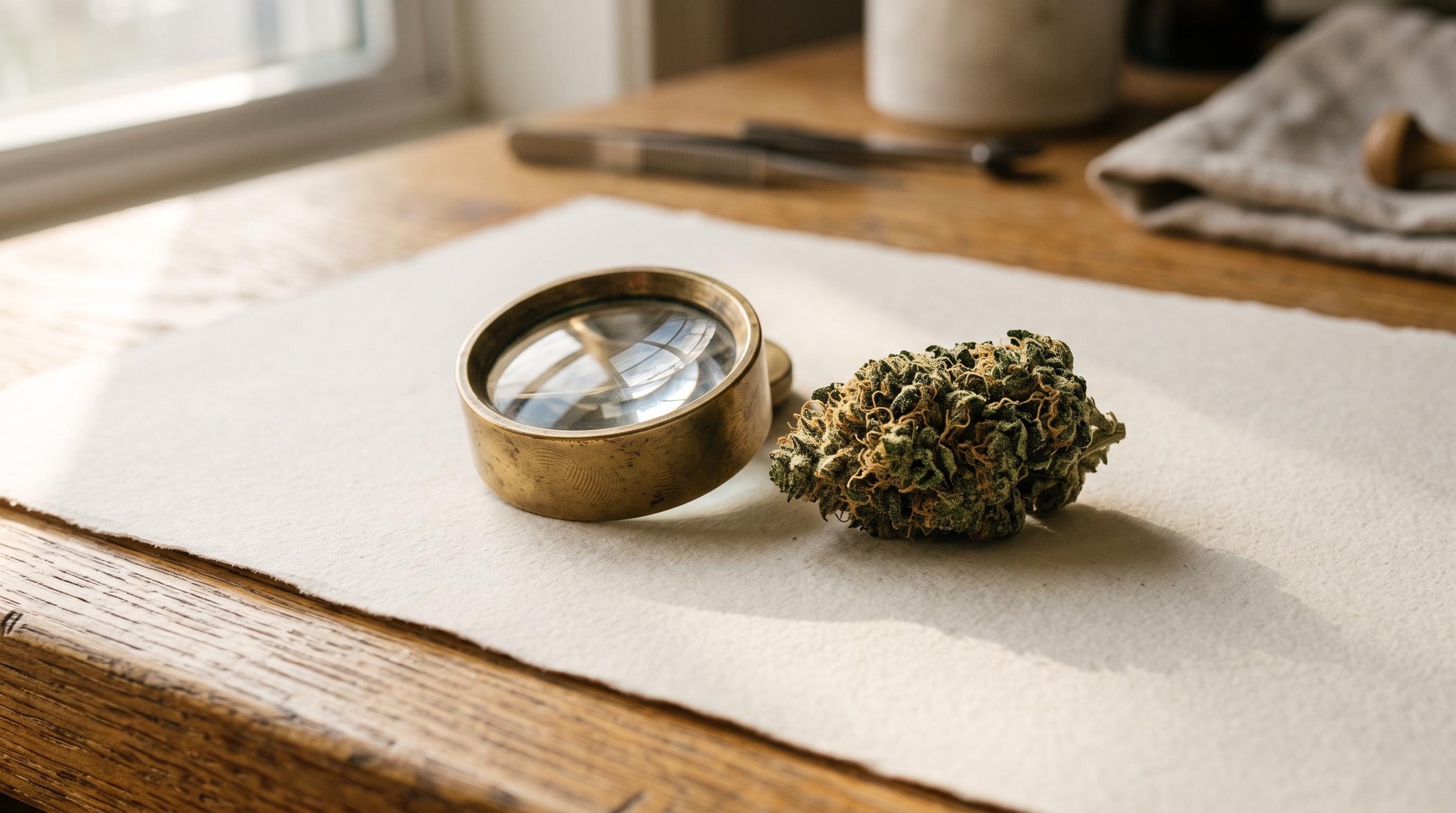
Bring a loupe. A 30x jeweller’s loupe costs under fifteen dollars and is the highest-value item in a consumer cannabis toolkit. Many shops keep one at the counter — ask.
Trichome density and head integrity
The trichomes are the point. Cannabinoids and terpenes are produced in glandular trichomes, and the stalked glandular trichomes on mature flowers carry high cannabinoid levels and strongly monoterpene-dominant terpene profiles, with 12 to 16 secretory disc cells apiece against roughly eight in the smaller sessile trichomes (Livingston et al., 2020). Those mushroom-shaped heads hold your entire chemical experience.
Look for two things.
Density. Well-grown, well-handled flower looks frosted at 30x — heads packed close enough that you struggle to see leaf surface between them. Sparse coverage means an immature harvest or a plant that never had much to give.
Intact heads. This matters more, and almost nobody checks it. You want whole, bulbous, translucent-to-milky heads still sitting on their stalks. You do not want a field of bare stalks with the heads snapped off, or heads gone flat and amber-brown across the whole bud. Broken heads mean rough handling, over-trimming or flower shaken around in transit — and the terpenes leave with them.
There is a good line about this in the old pharmacology literature. Fairbairn and colleagues, storing cannabis for up to two years, concluded that oxidative losses “could be reduced if care was taken to minimize damage to the glands which act as ‘well filled, well closed containers’” (Fairbairn et al., 1976). An intact trichome head is a sealed vial. A broken one is an open one.
For the anatomy, see our complete guide to cannabis trichomes and how to read trichomes with a loupe.
Colour, pistils and trim
Pistils — the hairs — should be mostly darkened to orange or rust on mature flower. Bright white across most of the surface suggests an early cut, though this is a weaker signal than trichome state.
Colour should be a living green, with purple or near-black accents in some cultivars. Granddaddy Purple and Purple Punch come by that honestly through anthocyanin expression. Yellowing, browning or a dull grey cast suggests age, heat damage or light exposure.
Trim tells you about care: hand-trimmed flower keeps its shape and its coverage, while machine-trimmed flower often looks rounded and less frosty because the machine knocked heads off. Seeds and heavy stems are simply weight you cannot smoke.
The disqualifiers
Visible mould looks like grey or white fuzz that follows the contours of the bud rather than sitting on it as discrete points. Under the loupe, trichomes are individual spheres on stalks; mould is a web. If you are unsure, that uncertainty is itself the answer.
Powdery mildew presents as flat white dust, often on the sugar leaves. Easy to mistake for frost at arm’s length, impossible to mistake at 30x.
This is not fussiness. A state-of-the-art review of cannabis smoking and the respiratory system flags the association between cannabis smoke and invasive pulmonary aspergillosis in immunocompromised people as “particularly concerning” (Khoj et al., 2024). If your immune system is compromised, the microbial panel on the lab report is the check that matters most for you.
Check 2: Smell it
If the jar is open, this is the most information-dense two seconds available to you.
Good flower announces itself — fuel, citrus, gas, pine, ripe fruit, something almost savoury. The specific note matters less than the intensity and clarity. A loud, distinct nose means the volatile compounds survived the grow, the dry, the cure, the packaging and the shelf.
| Smell | What it usually means |
|---|---|
| Fresh-cut hay, grass | Dried too fast or too warm; chlorophyll never broke down |
| Ammonia, cat urine | Anaerobic bacterial activity — jarred too wet |
| Musty, damp cardboard | Mould or a mould-adjacent storage history |
| Almost nothing | Old, light-damaged, or a fast commercial dry |
| Sharp green vegetal note | Under-cured; may still improve in a proper jar |
Hay and ammonia are curing failures; musty is a storage failure. Different diagnoses, different implications: a hay-smelling jar will not recover, and a musty one should not be consumed.
One complication about “smelling the terpenes”
You will read everywhere — including in older articles on this site — that a strong nose means high terpene content. That is roughly true and specifically wrong.
When researchers profiled varieties with genuinely divergent aromas, terpene expression across them stayed “remarkably similar.” What actually distinguished a sweet or savoury or citrus-gas variety was minor, non-terpenoid volatiles: a newly described class of volatile sulfur compounds for certain citrus aromas, skatole for others. Their conclusion is blunt — the importance of terpenes in cannabis aroma “has been overemphasized” (Oswald et al., 2023).
So your nose reads something broader than the terpene panel, most of which never appears on a lab report. That is an argument for trusting it more. And it is trustworthy: untrained consumers given a validated aroma lexicon reliably perceived differences between eleven retail strains, which clustered by odour similarity, with aroma profiles linked to perceptions of potency, price and interest in smoking (Gilbert & DiVerdi, 2018).
More in the terpene smell test and the science of cannabis aromas.
Check 3: Touch it
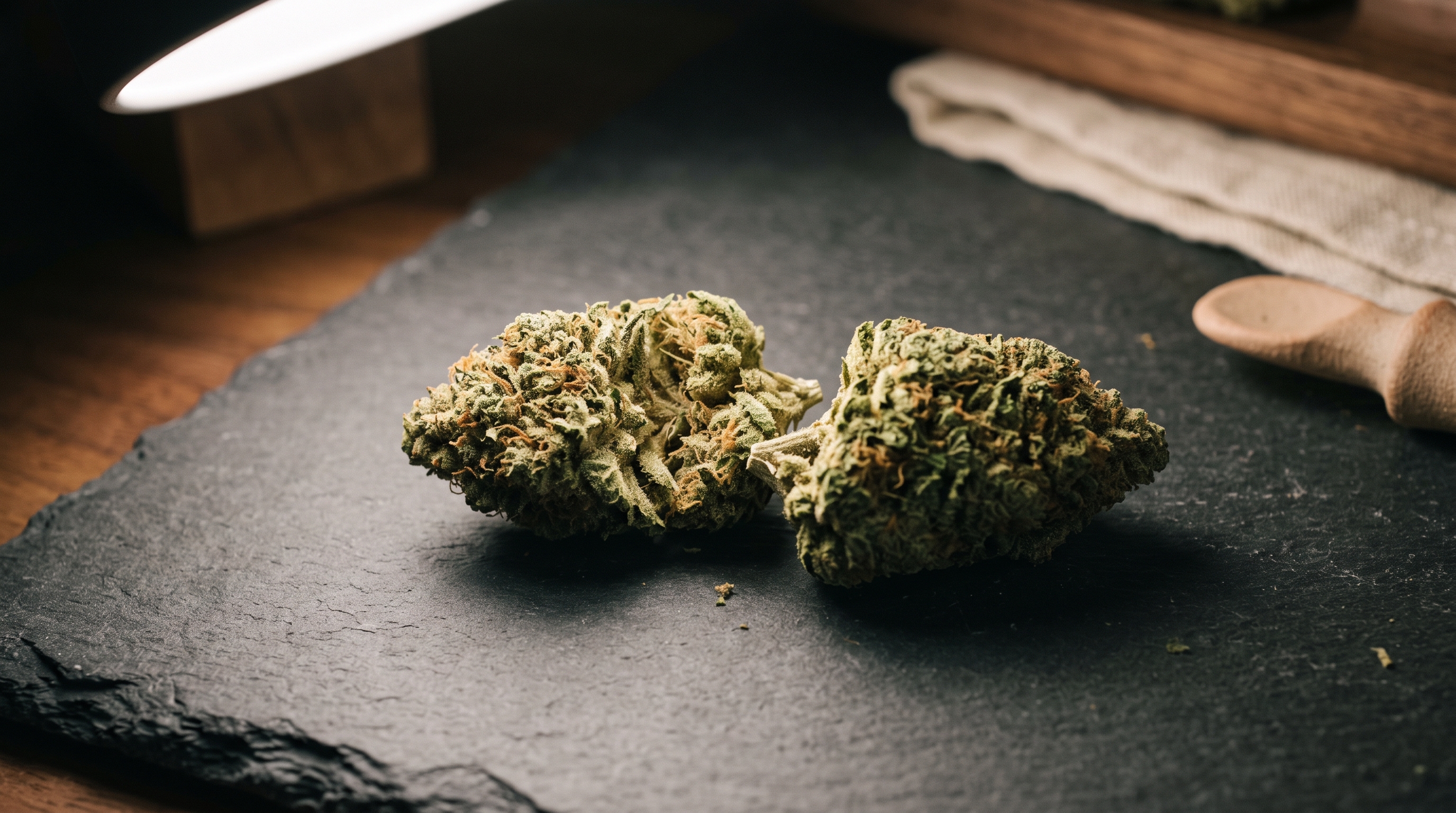
The snap test. A properly cured bud gives a soft, quiet snap when you bend a small stem. A stem that bends without breaking is too wet; a bud that crumbles to powder under light pressure is too dry.
Stickiness. Resin should give slight tack between finger and thumb. Fingers that come away sticky and fragrant are a good sign. Fingers coated in green dust are holding your terpenes.
Structure. Density varies legitimately by cultivar — long, airy structures like Durban Poison and Jack Herer are not failures. What is never cultivar-dependent is sponginess: a bud that compresses damply without springing back holds moisture it should not.
The moisture number that matters
There is a published specification. ASTM D8197 specifies maintaining dry cannabis flower at a water activity of 0.55 to 0.65 (ASTM D8197-18), measured by the practice in ASTM D8196-18. Water activity at equilibrium corresponds to relative humidity, so that band is roughly 55–65% RH — which is why consumer humidity packs come in 58% and 62% versions. Both sit inside the specification.
Below about 55%, terpenes volatilise faster and smoke gets harsh. Above about 65%, microbial growth becomes plausible. That is the whole basis of humidity pack storage; see how to store cannabis for the method.
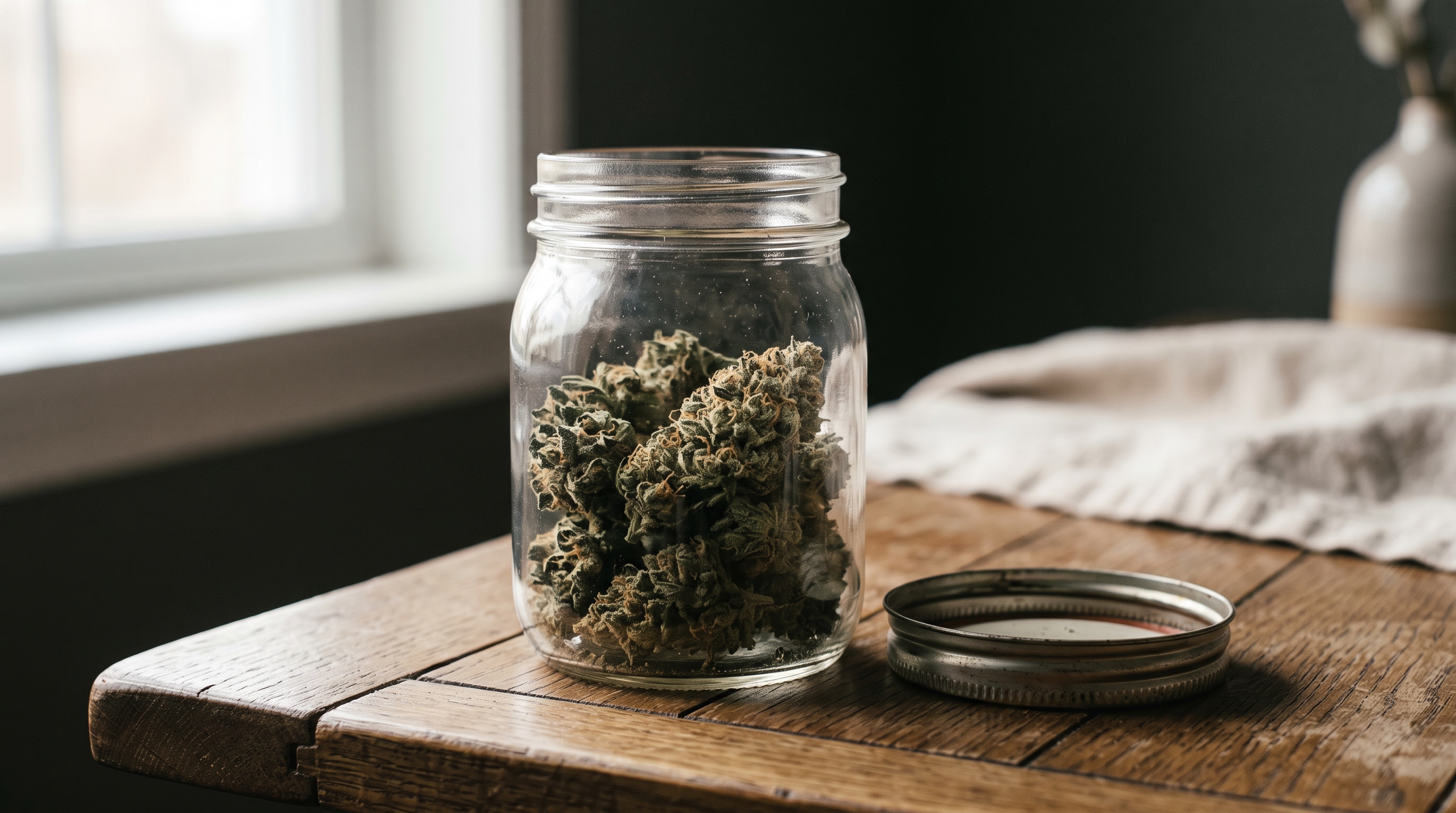
Guard one thing harder than humidity: light. Fairbairn’s team found exposure to light — not even direct sunlight — was “the greatest single factor in loss of cannabinoids,” while temperature effects up to 20°C were insignificant. Carefully prepared cannabis kept dark at room temperature stayed reasonably stable for one to two years (Fairbairn et al., 1976). A clear jar on a sunny shelf does more damage than a warm cupboard.
Check 4: Understand the cure
Everything above is downstream of one process most consumers never think about.
After harvest, flower is dried slowly — ideally around 60°F and 60% humidity over one to two weeks — then sealed and “burped” over further weeks while residual moisture redistributes from the core outward and chlorophyll breaks down. That slow phase turns a harsh, hay-smelling product into something aromatic.
The nuance people get wrong: drying itself does not destroy the aroma. Comparing the steam-distilled volatile oil of fresh versus air-dried indoor-grown cannabis, researchers found drying “had no effect on the qualitative composition of the oil” and did not affect the ability of people familiar with the smell to recognise it (Ross & ElSohly, 1996). The same compounds are still there afterward.
What kills aroma is what comes next: heat, air oxidation, light and mechanical damage to the glands. An operation that force-dries in three days to hit a turnover target is driving off volatiles a gentler process would have kept, and skipping the chemistry that makes smoke pleasant.
This is why the cure matters more to your experience than the potency figure. THCA is largely fixed at harvest; whether the flower is pleasant to consume is decided almost entirely afterward. Our drying and curing guide covers the grower’s side, and greenhouse versus indoor quality and sun-grown terpene content cover how environment feeds in.
Check 5: Read the COA properly
Every legal product should carry a Certificate of Analysis, usually behind a QR code. Most people glance at the THC number and stop. Read it in this order instead.
Contaminant panels first
Pesticides. Combustion does not reliably destroy residues. Researchers smoked cannabis treated with bifenthrin, diazinon, permethrin and the growth regulator paclobutrazol through three device types and trapped the mainstream smoke; recoveries ran as high as 69.5% depending on device and compound (Sullivan et al., 2013). What is on the flower can end up in your lungs.
Heavy metals. Cannabis is a known metal accumulator — it is used in soil remediation precisely because it pulls metals up. Among 7,254 NHANES participants, people reporting exclusive marijuana use had statistically significantly higher blood and urine cadmium and higher blood lead than non-users of marijuana and tobacco; urinary lead was elevated but did not reach significance (McGraw et al., 2023). That is an association in survey data, not a trial, and it cannot separate the plant from its soil — but it is a good reason to want lead, cadmium, arsenic and mercury passing.
Microbials and mycotoxins. Total yeast and mould counts plus specific pathogens. Residual solvents apply only to extracts — but for a cartridge or distillate, that panel is not skippable.
Terpenes second
If the COA carries a terpene panel — many do not, and a shop that provides one is telling you something — this is the most decision-relevant section on the page. Total terpene content under roughly 1% is thin; 2% and up is genuinely aromatic. Then look at what dominates:
- Myrcene-dominant profiles skew toward heavy, physical, relaxed experiences — Relax High territory, though the folk rule about a 0.5% threshold flipping a strain from stimulating to sedating does not survive scrutiny.
- Limonene-forward flower tends toward brighter, more uplifted reports — the Uplift High.
- Terpinolene and pinene cluster with energetic, clear-headed descriptions — the Energy High.
- Caryophyllene, humulene and linalool appear across Balance High profiles.
The entourage effect remains an active hypothesis rather than settled fact, and how much inhaled terpene reaches your bloodstream is its own open question. But as a selection heuristic, terpene dominance beats THC percentage comfortably. See our terpenes guide, the High Families framework, and the German chemovar study for how that clustering holds up in real chemical data.
Cannabinoids last
Check total THC mostly to dose sensibly and to sanity-check the price. Then look for anything else: CBD, CBG, CBC, THCV. Flower at 18% THC with 1% CBG is a materially different product from 18% and nothing else, and only one of them is priced accordingly. How to read cannabis lab results walks the document section by section, and finding your ideal THC to CBD ratio covers dosing.
The counter checklist
- Loupe it. Dense, intact, translucent-to-milky heads. No webbing, no flat white dust.
- Smell it. Loud and specific is good. Hay, ammonia and must are each a different failure.
- Feel it. Soft snap, slight tack, no sponginess, no dust.
- Ask about the cure. “How long was this cured?” is a question good shops enjoy answering — choosing the right dispensary is largely about which answer you get.
- Scan the COA. Contaminants pass, terpenes above 2%, cannabinoids last.
New to all this? Start with what to expect on a first dispensary visit and our beginner strain guide.
The part no checklist can do for you
Commercial labels do not reliably map to chemistry. Analysing cannabinoid and terpene content across commercial samples from six US states, researchers found distinct, reliably present chemotypes — but the commercial labels attached to those products “do not consistently align with the observed chemical diversity” (Smith et al., 2022). Some labels showed biased association with particular chemotypes; none were dependable.
So the Blue Dream in one shop and the Blue Dream in the next may be different plants with different profiles. Same for Gelato, Wedding Cake, Sour Diesel and every other name on the menu. The name is a marketing artifact. The chemistry is the product.
Which means this protocol gets you to good flower — but it cannot get you to your flower. Two people can buy the same jar, run the same checks, and have different nights: one landing calm, the other wired. Tolerance, expectation, context and individual endocannabinoid tone all move the outcome, and none of them are printed anywhere.
The only instrument that resolves that is your own record. Note what you bought, note the terpene profile if you have one, note what actually happened. After a dozen entries you will start seeing your own pattern — most likely a terpene dominance and a rough dose, almost certainly not a strain name. That is what the High IQ app is built to track.
Frequently asked questions
Does a higher THC percentage mean better quality? No. It means more THC by dry weight, which is a dosing variable. Labelled potency is also frequently inflated — around 70% of tested Colorado samples came in more than 15% under their label in one 2023 study. Terpene content, cure quality and freshness affect your experience far more.
Can I tell if cannabis is mouldy just by looking? Sometimes. Under a 30x loupe, trichomes are discrete spheres on stalks and mould is a web or fuzz following the bud’s contours. Powdery mildew looks like flat white dust rather than sparkle. If you cannot tell with certainty, treat that uncertainty as a no — and check the microbial panel.
What humidity should I store cannabis at? ASTM D8197 specifies a water activity of 0.55 to 0.65 for dry flower, roughly 55–65% relative humidity. The 58% and 62% two-way humidity packs both sit inside that range. Keeping it dark matters at least as much.
Why does my flower smell like hay? It was dried too fast or too warm, so chlorophyll never had time to break down during a proper cure. It will not improve in the jar. Not dangerous — just a poorer smoke.
Is a stronger smell always a sign of more terpenes? Not exactly. Recent work found terpene expression stays remarkably similar across varieties with very different aromas, and that minor non-terpenoid compounds drive much of the distinctive character. Your nose reads a wider chemical picture than the terpene panel shows.
Should I worry about pesticides in legal cannabis? Enough to check the panel. Combustion does not reliably destroy residues: one study recovered as much as 69.5% of certain residues in mainstream smoke. Legal-market testing exists precisely for this, so use it.
Sources
- Schwabe AL, Johnson V, Harrelson J, McGlaughlin ME. Uncomfortably high: Testing reveals inflated THC potency on retail Cannabis labels. PLOS ONE, 2023. doi:10.1371/journal.pone.0282396
- Bidwell LC, Ellingson JM, Karoly HC, YorkWilliams SL, Hitchcock LN, et al. Association of Naturalistic Administration of Cannabis Flower and Concentrates With Intoxication and Impairment. JAMA Psychiatry, 2020. doi:10.1001/jamapsychiatry.2020.0927
- Livingston SJ, Quilichini TD, Booth JK, Wong DCJ, Rensing KH, et al. Cannabis glandular trichomes alter morphology and metabolite content during flower maturation. The Plant Journal, 2020. doi:10.1111/tpj.14516
- Fairbairn JW, Liebmann JA, Rowan MG. The stability of cannabis and its preparations on storage. Journal of Pharmacy and Pharmacology, 1976. doi:10.1111/j.2042-7158.1976.tb04014.x
- Oswald IWH, Paryani TR, Sosa ME, Ojeda MA, Altenbernd MR, et al. Minor, Nonterpenoid Volatile Compounds Drive the Aroma Differences of Exotic Cannabis. ACS Omega, 2023. doi:10.1021/acsomega.3c04496
- Gilbert AN, DiVerdi JA. Consumer perceptions of strain differences in Cannabis aroma. PLOS ONE, 2018. doi:10.1371/journal.pone.0192247
- Ross SA, ElSohly MA. The Volatile Oil Composition of Fresh and Air-Dried Buds of Cannabis sativa. Journal of Natural Products, 1996. doi:10.1021/np960004a
- Sullivan N, Elzinga S, Raber JC. Determination of Pesticide Residues in Cannabis Smoke. Journal of Toxicology, 2013. doi:10.1155/2013/378168
- McGraw KE, Nigra AE, Klett J, Sobel M, Oelsner EC, et al. Blood and Urinary Metal Levels among Exclusive Marijuana Users in NHANES (2005–2018). Environmental Health Perspectives, 2023. doi:10.1289/EHP12074
- Smith CJ, Vergara D, Keegan B, Jikomes N. The phytochemical diversity of commercial Cannabis in the United States. PLOS ONE, 2022. doi:10.1371/journal.pone.0267498
- Khoj L, Zagà V, Amram DL, Hosein K, Pistone G, et al. Effects of cannabis smoking on the respiratory system: A state-of-the-art review. Respiratory Medicine, 2024. doi:10.1016/j.rmed.2023.107494
- ASTM International. Standard Specification for Maintaining Acceptable Water Activity (aw) Range (0.55 to 0.65) for Dry Cannabis Flower. ASTM D8197-18. store.astm.org/d8197-18.html
- ASTM International. Standard Practice for Determination of Water Activity (aw) in Cannabis Flower. ASTM D8196-18. store.astm.org/d8196-18.html
