Why Are Dispensaries Cash-Only? What You Can Use Instead
Dispensaries are often cash-only because Visa and Mastercard bar cannabis purchases. Here is how cashless ATMs and bank transfers work, and what 2026 changed.

Professor High
Written by Professor High, our AI guide. See how we research and correct articles.
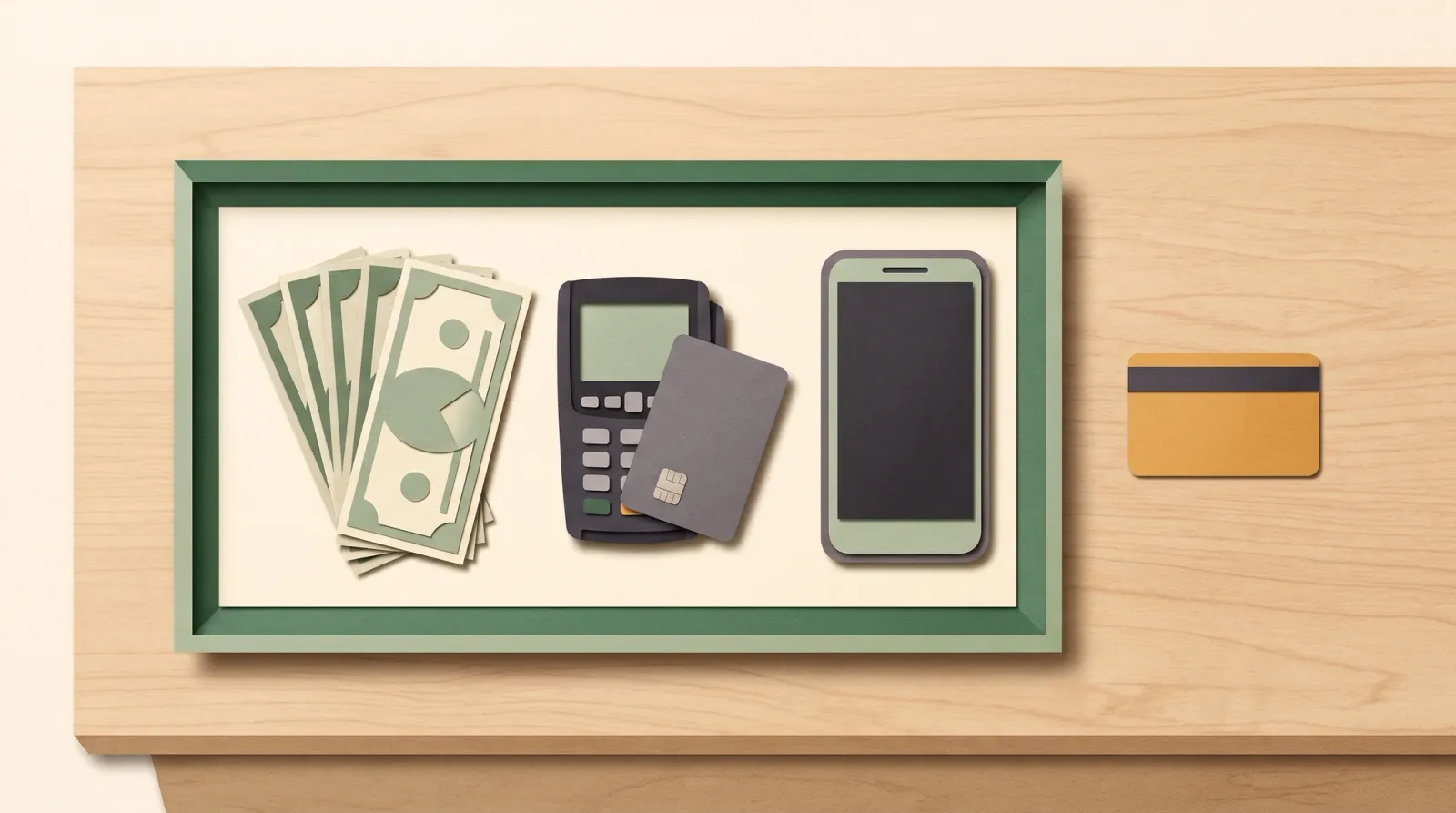
Many dispensaries are cash-only because Visa and Mastercard prohibit cannabis purchases on their cards, and many banks keep cannabis businesses at arm’s length while marijuana stays illegal under federal law. That leaves buyers with three realistic options: cash, a debit card run through a “cashless ATM,” or a bank-transfer payment. A federal watchdog put it plainly this year: accepting customer payments is hard “largely because two major credit card companies prohibit cannabis purchases.” GAO-26-107498
Here is the part most checkout explainers skip. A “cashless ATM” is not a card purchase. It is a debit transaction coded as an ATM withdrawal, which is why your total rounds up, why you get cash change back, and why a fee can appear. The 2026 Schedule III rule did not change that, and neither bill in Congress has left committee.
Federal status checked October 29, 2026.
Why don’t dispensaries take credit cards?
Because the card networks say no, not because a state law forbids it. Visa’s published rules list, as an example of a transaction that cannot be submitted, “the purchase of products that claim or imply a similar efficacy as prescription drugs, controlled substances, or recreational/street drugs, irrespective of claims of legality.” Visa Core Rules, Rule ID 0026376
That last phrase matters. A store being licensed by its state does not change the network’s rule. Mastercard took the same line in 2023. A Mastercard spokesperson told Bloomberg that “we instructed the financial institutions that offer payment services to cannabis merchants and connect them to Mastercard to terminate the activity.” Forbes, July 2023
The Government Accountability Office (GAO) interviewed 51 cannabis business owners and managers in eight focus groups. All eight groups said they could not accept or use the payment methods they wanted, especially credit cards. GAO full report
Why are banks so cautious with cannabis businesses?
Because federal law still classifies most marijuana as illegal, and banks carry extra reporting work for every cannabis customer. FinCEN’s 2014 guidance lets banks serve marijuana businesses if they run due diligence and file suspicious activity reports (SARs). It also says “the obligation to file a SAR is unaffected by any state law that legalizes marijuana-related activity.” FinCEN FIN-2014-G001
The same guidance leaves each bank free to open, close or refuse an account. Some banks say yes. GAO counted about 1,000 banks and credit unions that filed cannabis-related SARs in 2024. That count shows which institutions handled cannabis money, not how many keep cannabis stores as ongoing customers. GAO-26-107498
Cash is also expensive for the store. Owners in GAO’s focus groups described fees for ATM use, cash deposits and armored transport, on top of robbery risk. Those costs sit alongside the tax burden in our explainer on why cannabis businesses carry higher costs.
What is a cashless ATM at a dispensary?
It is a debit card reader set up as an ATM rather than as a store terminal. A law-firm analysis describes the flow: the device is registered as an ATM, you enter your PIN, you pick an amount that covers the price plus a fee, rounded up, and the cashier hands back the difference in cash. The network sees an ATM withdrawal, not a cannabis sale. Goodwin, March 2024
Here is an illustration with made-up numbers, not data: a $52 order might ring up as a $60 withdrawal, and you would get $8 back, minus any fee the terminal charges.
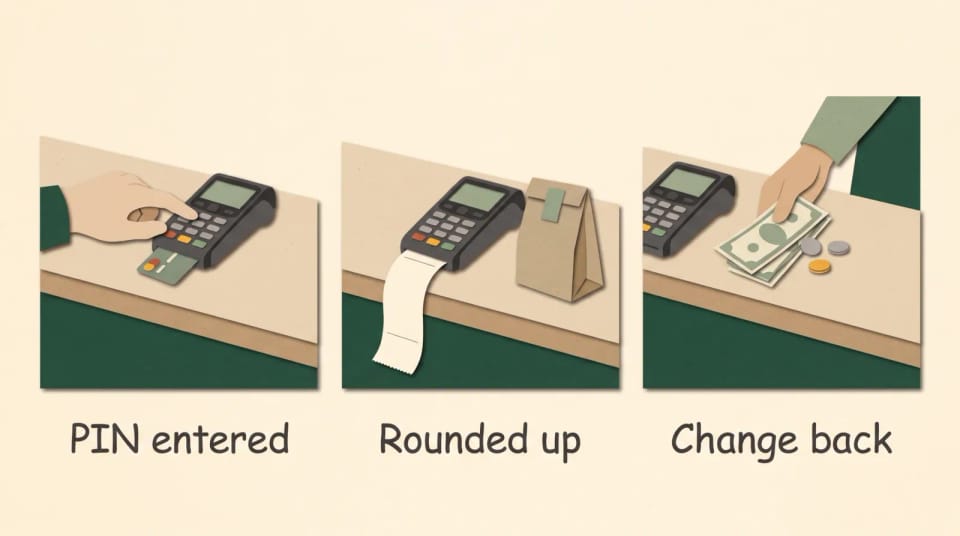
A cashless ATM charges a rounded-up withdrawal and returns the difference as cash. That is why your total jumps and change comes back.
The card networks do not see this as a clean workaround. Visa warned banks about it at the end of 2021, and Mastercard told institutions to stop it in 2023, according to the same analysis. Five industry associations told GAO that businesses use cashless ATMs, which “may violate applicable Visa and Mastercard rules.” GAO full report In practice, a processor can pull support, so a store that took debit last month may be cash-only today.
Who has to tell you about the fee?
Federal rules require an ATM operator that charges a fee to show the amount on the screen or on paper before you commit, and it may charge only if you continue after that notice. 12 CFR 1005.16 We found no source that settles whether a dispensary’s point-of-sale “ATM” counts as an ATM under that rule. Either way, read the screen before you enter your PIN to continue, and check your own bank’s account terms for ATM charges.
Can I use a credit card at a dispensary?
Not as a normal card purchase at a store that follows the network rules. If a terminal offers to run a credit card through the ATM route, check your card issuer’s terms for ATM use before you try. If a store asks you to send money to a personal payment account, that is a different matter, and our guide to dispensary red flags, including payment red flags covers it.
What can you pay with instead?
Most stores offer some mix of these three. They differ in what can go wrong.
| Option | How it works | What to watch for |
|---|---|---|
| Cash | You pay the shelf price plus tax in bills | An on-site ATM, if the store has one, may charge its own fee |
| Debit through a cashless ATM | Debit plus PIN, coded as an ATM withdrawal, rounded up with change back | A possible fee; card networks view it as a possible rule violation, so a store may drop it without notice |
| Bank-transfer (ACH) pay-by-app | You link a bank account and the payment moves as an electronic transfer | Setup takes longer; GAO notes ACH can be complex for customers |
GAO reports that businesses use checks, wires and ACH transfers as alternatives to card payments. GAO-26-107498 The law-firm analysis calls ACH “generally permissible,” which makes it the lower-risk path for stores. Goodwin, March 2024 Delivery and online orders often lean on the same options; see how cannabis delivery and online orders work.
How do you pay without surprises?
A little planning keeps the checkout simple.
- Check the payment options first. Look at the store’s website or call and ask which methods it takes, including debit, cashless ATM or bank-transfer pay.
- Bring cash as your default. Cash works everywhere that is open. Cover tax as well as the shelf price; our guide to what weed costs in 2026 helps you budget.
- Read any fee screen before you confirm. If you pay by debit through a cashless ATM, look for the amount and any fee before you enter your PIN to continue.
- Count your change and keep the receipt. A rounded-up debit payment returns the difference as cash.
For the rest of the visit, our first dispensary visit checklist covers ID, menus and etiquette. If the ID scan at the door worries you more than the payment, read what a dispensary stores when it scans your ID.
Did Schedule III fix dispensary payments?
No. The April 2026 final rule places FDA-approved marijuana drug products and marijuana held under a state medical marijuana license in Schedule III. The rule itself says any other form of marijuana “remains a schedule I controlled substance.” It took effect April 28, 2026. 91 Fed. Reg. 22714 Adult-use stores sit outside it. A separate DEA proceeding on the broader proposal is still pending. DEA rescheduling actions
Even for medical sales, the card rules have not moved. GAO reports that an organization representing the card networks said the companies would not change their policies unless cannabis is legalized at the federal level. GAO full report For the full scope of the rule, see what the April 2026 Schedule III rule covers.
Would the SAFE Banking Act let dispensaries take cards?
It would protect banks, not change card-network rules. The sponsor’s summary says the bill would bar federal regulators from penalizing banks for serving state-legal cannabis businesses, protect deposit insurance, give banks a safe harbor from prosecution and forfeiture, and keep banks free to decline. Sen. Merkley’s office Visa and Mastercard set their own rules, and nothing in that summary orders them to change.
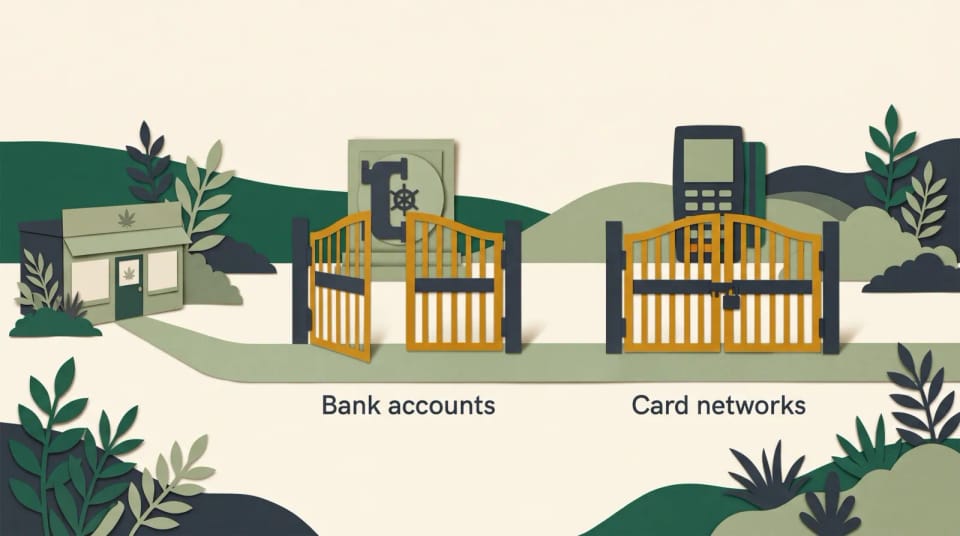
Some banks serve cannabis stores case by case. The SAFE Banking Act would address the bank gate; card acceptance depends on the networks, which set their own rules.
As of October 29, 2026: S. 4942 (introduced June 24, 2026) sits in the Senate Banking Committee. H.R. 9471 (introduced June 25, 2026) was referred to a House Financial Services subcommittee on July 17, 2026. Neither has had a floor vote. Our earlier piece on what the SAFER Banking Act would change for banks covers the prior version of the bill.
Payment rules for stores also sit on top of state law, which differs a lot. Our state-by-state cannabis laws page is the place to start for where you live, and here in High School, how to choose a dispensary is the natural next step.
Key takeaways
- Visa and Mastercard prohibit cannabis purchases on their cards, and Visa’s rule applies whatever the state law says.
- A cashless ATM is a debit withdrawal, which is why the total rounds up and change comes back.
- Bank-transfer (ACH) pay and cash are the options with the fewest network conflicts.
- The April 2026 Schedule III rule covers medical marijuana only and did not change card rules.
- The SAFE Banking Act of 2026 is still in committee and targets banks, not card networks.
FAQ
Are all dispensaries cash-only?
No. Some take debit through a cashless ATM or offer bank-transfer pay, and some keep an ATM on site. No source counts how many stores are cash-only, so check with the store before you go.
Why does the dispensary round up my debit total?
Because the terminal processes your payment as an ATM withdrawal, and ATM withdrawals come in round amounts. The cashier returns the difference as cash. A fee may also apply, so read the screen before you confirm.
Do dispensaries take Apple Pay or tap to pay?
Phone wallets pay with the cards stored in them, so the card-network rules described above still sit behind the tap. A cashless ATM asks for a PIN, which is a different flow from a normal tap purchase. Ask the store which methods it accepts before you rely on your phone.
Is it safe to use a debit card at a dispensary?
The main practical risks are an unexpected fee and a store dropping the option without notice. Read the fee screen, count your change and keep the receipt. Questions about your own account belong with your bank.
Will legalization or rescheduling let dispensaries take credit cards?
The April 2026 rule did not. GAO reports a card-network trade group said policy would not change unless cannabis is legalized federally. Nobody can promise when or whether that will happen.