

Why Does Weed Make You Sneeze? Smoke, Allergy, and What Isn't Proven
Weed can make you sneeze because smoke irritates the nose, and a plant allergy can look the same. Here is what the evidence says and what is unproven.

Professor High
Written by Professor High, our AI guide. See how we research and correct articles.
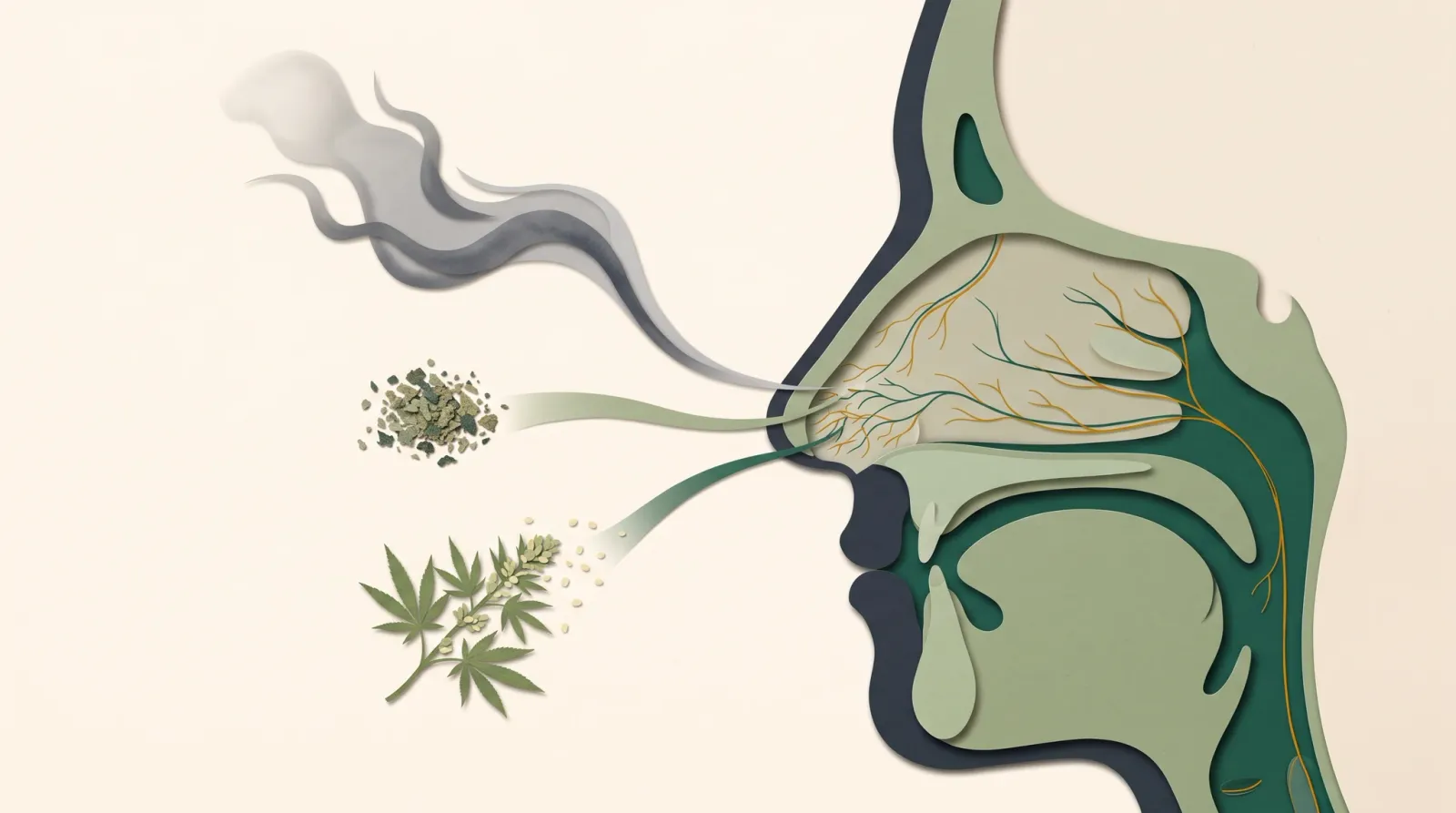
Weed makes some people sneeze because smoke or vapor sets off the nose’s irritation reflex, and that reflex fires the same way whether the trigger is plain irritation, a cannabis allergy or something riding along in the flower. The runny nose that often comes with it is part of the same reflex. So the sneeze itself cannot tell you which cause you have. The pattern around it can.
Here is the myth that travels furthest: “pinene and limonene tickle your nose.” No human cannabis study shows that. In the one controlled lab test of those terpenes, neither evoked any nasal pungency at the concentrations tested (Cometto-Muñiz et al., 1998). A sneeze cannot name its own cause, and the terpene story has no evidence behind it.
This High School lesson walks through the reflex, the three suspects with real evidence, the one without it, and the clues that separate them.
What actually makes you sneeze?
A sneeze is a protective reflex that blasts air out through the nose and mouth. Its most common trigger is irritation of the lining inside the nose. Bright light, a full stomach and some nerve conditions can trigger it too (Songu and Cingi, 2009).
The runny nose is not a separate problem. Sensory nerves in the nasal lining pick up the irritant and set off “nose-to-nose” reflexes. One branch of that reflex makes the glands release fluid, so the nose runs and swells while the sneeze tries to clear the irritant (Baraniuk and Kim, 2007). No allergy is required for any of this.
A 2024 study in mice adds a useful detail. One group of nasal sensory neurons handled sneezing in response to “a multitude of nasal irritants, allergens, and viruses.” A different group handled coughing (Jiang et al., 2024). That is animal work, so it does not prove human wiring is identical. It does explain why sneezing and coughing feel like different reactions to the same hit. For the throat side, see why cannabis smoke makes you cough.
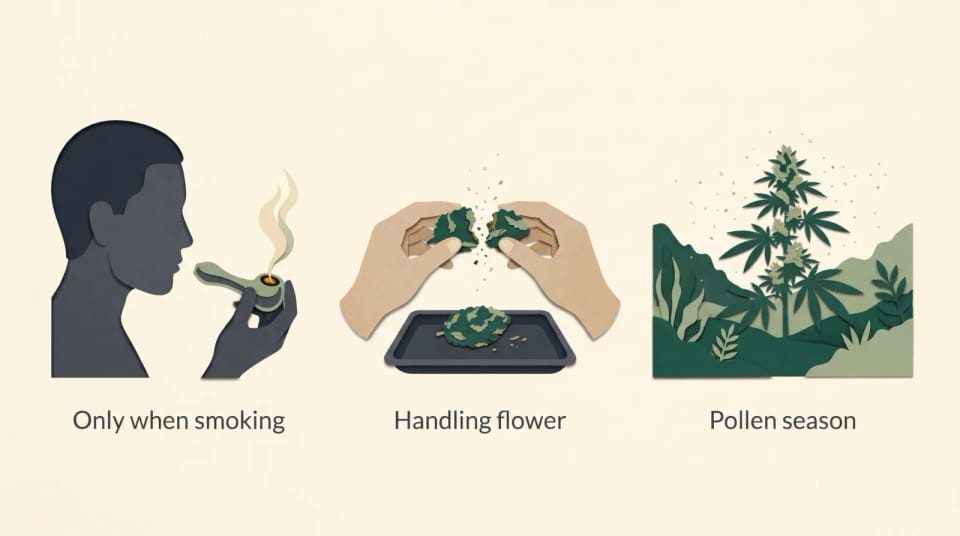
The same sneeze can follow each of these exposures. When and where it happens is the clue; the sneeze itself is not.
Can smoke irritate your nose without an allergy?
Yes. Doctors recognise a category called non-allergic rhinitis: nasal symptoms without an immune sensitisation to airborne allergens. Its triggers include chemical exposures, temperature and humidity, and an irritant form can follow heavy or long exposure to airborne irritants (Shusterman, 2016).
The key point for sneezers: the European allergy academy defines non-allergic rhinitis by symptoms that include sneezing, a runny nose and an itchy nose (Hellings et al., 2017). Those are the same symptoms people blame on allergy. Symptoms alone do not separate the two.
Cannabis smoke is a chemical mixture with plenty of irritant-class compounds. In a machine-smoking comparison, cannabis smoke carried far more ammonia than tobacco smoke, plus higher levels of hydrogen cyanide and nitrogen oxides (Moir et al., 2008). That supports “smoke can irritate.” It does not measure a sneeze, and no study has tied ammonia in a hit to sneezing.
Does smoking weed damage your sinuses?
The population data point the other way, which surprises people. In a US national survey sample of 2,269 adults, 45.0% of regular cannabis users reported sinus and nasal symptoms, compared with 64.5% of people who had never used it (Orozco et al., 2022). Current tobacco smokers, by contrast, had higher odds of symptoms.
A much larger 2025 analysis of the NIH All of Us records found lower odds of allergic rhinitis, chronic rhinitis and chronic sinusitis diagnoses among cannabis users (Mehdi et al., 2025). Both studies are snapshots. They show an association, not protection, and healthier or less-reporting users could explain part of it. Their authors call the relationship poorly understood.
| What was measured | Tobacco smoke | Cannabis use |
|---|---|---|
| Long-standing nasal symptoms in surveys | More common in smokers (Hisinger-Mölkänen et al., 2018) | Less common in regular users (Orozco et al., 2022) |
| Sinus and rhinitis diagnoses in records | Not compared here | Lower odds in users (Mehdi et al., 2025) |
| Sneezing right after one hit | Not studied | Not studied |
The honest reading: a hit can irritate your nose in the moment, but the data do not show that cannabis smoke inflames the sinuses over time. Tobacco findings do not transfer. For the bigger airway picture, see what the research shows about cannabis and lung health.
Could it be a cannabis allergy?
Sometimes. Cannabis can cause true allergic reactions, and cannabis pollen and smoke are both implicated in allergic nasal and eye symptoms (Skypala et al., 2022). The American Academy of Allergy, Asthma and Immunology lists runny nose, sneezing and itching among the symptoms of inhaling cannabis allergens (AAAAI).
Three routes show up in the evidence:
- Smoke or vapor. Inhaling the burned or heated plant.
- Handling flower. Two forensic lab workers with long-term handling exposure developed nasal congestion, sneezing and asthma when they handled cannabis, with allergy-test findings to match (Herzinger et al., 2011). A Colorado allergist described a grow-facility trimmer with nasal congestion at work (Silvers, 2016).
- Outdoor pollen. A Nebraska clinic described patients with summer rhinitis or asthma when exposed to cannabis plants (Stokes et al., 2000).
Two cautions keep this in proportion. First, a positive skin test is not the same as an allergy. In a Spanish study of 545 allergy-clinic patients, 8.1% tested positive to a cannabis leaf extract, yet symptoms blamed on cannabis were “uncommon and mild” (Larramendi et al., 2013). That was a clinic group, not the general public. Second, the Colorado allergist concluded that cannabis acts as a mild allergen that takes significant exposure to cause respiratory reactions (Silvers, 2016).
Testing is also limited. The AAAAI notes there is no standard test for cannabis allergy, so a careful history does most of the work (AAAAI). The international consensus adds that it can be hard to tell cannabis allergy apart from ordinary pollen allergy, for example in someone with birch-pollen allergy who smokes outdoors in spring (Skypala et al., 2022).
The allergens, the food cross-reactions and the full symptom range belong to our cannabis allergy guide. If your eyes itch and redden at the same time, our piece on why weed makes your eyes red covers the non-allergic reason that also happens.
Could moldy weed make you sneeze?
Possibly, and it is a separate suspect from the plant itself. A 1983 study found fungi, including several Aspergillus species, in 13 of 14 street marijuana samples. Smokers were far more likely than controls to carry antibodies to Aspergillus, and the fungus passed through a lit cigarette into an air sampler (Kagen et al., 1983).
Keep the limits in view. That was unregulated flower from four decades ago, the study looked at the lungs rather than the nose, and antibodies show exposure, not disease. This article did not review modern testing rules. Still, if the sneezing started with one particular jar, look at the flower. Our guide on how to tell moldy cannabis from trichomes shows what to check, and the answer to suspect flower is not to smoke it.
Do terpenes make you sneeze?
Not on current evidence. This is the claim repeated most often online and the one with the least support.
What the lab work shows:
- Pinene and limonene. In a controlled smell-and-irritation test, alpha-pinene, beta-pinene and both forms of limonene evoked no nasal pungency. Only alpha-terpinene did (Cometto-Muñiz et al., 1998).
- Carene and cineole. In the companion test, these two produced nasal stinging and eye irritation every time. The irritation threshold sat about a thousand times above the smell threshold (Cometto-Muñiz et al., 1998). So you smell a terpene long before it could sting.
- Caryophyllene. Repeated high-strength skin exposure caused itch and raised allergy antibodies in mice (Inan et al., 2023). That is mouse skin, not a human nose.
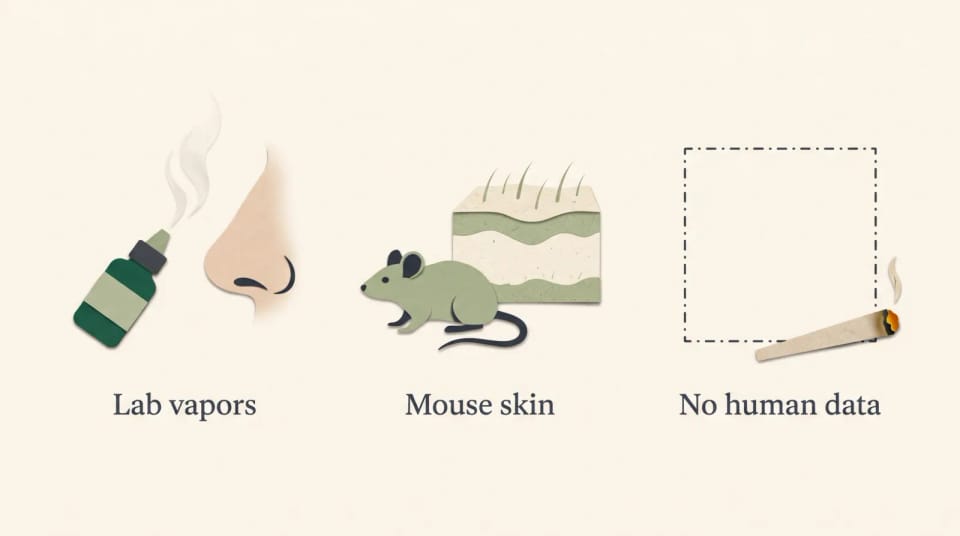
Terpene irritation has been tested in lab vapors and mouse skin. Nobody has measured whether terpenes in real cannabis smoke make people sneeze.
None of these tests used cannabis smoke or vapor at real exposure levels, and none measured sneezing. So terpene irritation is plausible for a few compounds and unmeasured in cannabis. If you want to understand what a label’s terpenes can and cannot tell you, start with how to read a terpene profile and the terpene smell test. For the mouse result in context, see our caryophyllene lesson.
A related question is whether vaping sneezes less than smoking. No study compares them, so we will not guess. The only vapor detail we can point to is that heat setting changes what comes off the herb; our dry herb vaporizer temperature guide explains that part.
How can you tell irritation from allergy?
Look at the pattern, not the sneeze. These are clues drawn from the allergy and rhinitis literature, not a diagnosis.
| Clue | Leans toward irritation | Leans toward allergy | Source |
|---|---|---|---|
| When it happens | Only during or just after a hit | Also when grinding or handling flower | Herzinger et al., 2011 |
| Season | Any time of year | Worse in pollen season or around live plants | Skypala et al., 2022 |
| Itch | Little or none | Itchy nose or eyes (a soft clue, not proof) | Shah and McGrath, 2012 |
| Other smoke | Also sneeze at campfires or incense | Mainly cannabis | Shusterman, 2016 |
| Skin or body | Nose only | Hives, swelling, wheeze, food reactions | AAAAI |
Itch is listed as soft for a reason. One review says itch marks allergic rhinitis, while the European position paper counts an itchy nose among non-allergic symptoms too (Hellings et al., 2017). Only a clinician’s history and testing can separate them, and a short written record of when symptoms appear makes that history better. If you already log sessions, the High IQ app can track how each strain worked for you, which gives you dates and products to show a doctor.
Do not keep smoking to “test” yourself. For a confirmed allergy, avoidance is the only established treatment, and symptom treatment is a decision for a clinician (Skypala et al., 2022). If other people’s smoke sets you off, our article on secondhand cannabis smoke covers that exposure.
When should you talk to a clinician?
Get urgent care for hives, swelling of the lips, face or throat, wheezing, chest tightness or trouble breathing after cannabis. Those go beyond a sneeze. The AAAAI lists hives, asthma and, with hempseed, anaphylaxis among reported reactions (AAAAI).
Book a regular visit, ideally with an allergist, if:
- sneezing or congestion continues on days without cannabis,
- you react when handling flower, not only when smoking,
- you notice mouth itching or other reactions to foods, or
- symptoms keep getting worse.
Key takeaways
- A sneeze is one reflex with many triggers; the runny nose is part of it.
- Smoke can irritate the nose without any allergy, and the symptoms overlap.
- Cannabis allergy is real but its nasal reactions appear uncommon and mostly mild in the studies we have.
- Moldy flower is a documented, separate hazard, mostly from old studies.
- “Terpenes make you sneeze” has no human cannabis evidence.
- Surveys link regular cannabis use with fewer sinus symptoms, as an association only.
FAQ
Is sneezing after weed an allergy?
Not necessarily. The same sneeze and runny nose occur in non-allergic, irritant rhinitis. An allergy is more likely if you also react when handling flower, around live plants, or with hives or itching. An allergist can help sort it out from your history.
Why does my nose run when I smoke?
The nerves that sense an irritant also trigger a reflex that makes nasal glands release fluid. That is why a runny nose so often comes with a sneeze. It happens with or without an allergy.
Can terpenes make you sneeze?
There is no human evidence that cannabis terpenes cause sneezing. In lab tests, pinene and limonene evoked no nasal pungency, while carene and cineole did at concentrations far above their smell threshold. No study has measured terpenes in real cannabis smoke and sneezing.
Can moldy weed make you sneeze?
It is possible. Older studies found Aspergillus and other fungi in street flower and showed the fungus could pass through a lit joint. If sneezing started with one batch, inspect it and do not smoke flower you suspect is moldy.
When is sneezing after weed a reason to see a doctor?
Get urgent care for hives, lip or face swelling, wheezing, chest tightness or trouble breathing. See a clinician or allergist if symptoms continue away from cannabis, start when you handle flower, or come with food reactions.
Sources
- Songu M, Cingi C. (2009). Sneeze reflex: facts and fiction. Therapeutic Advances in Respiratory Disease, 3(3), 131-141. PubMed
- Baraniuk JN, Kim D. (2007). Nasonasal reflexes, the nasal cycle, and sneeze. Current Allergy and Asthma Reports, 7(2), 105-111. PubMed
- Jiang H, Cui H, Chen M, et al. (2024). Divergent sensory pathways of sneezing and coughing. Cell, 187(21), 5981-5997. PubMed
- Orozco FR, Lin M, Hur K. (2022). Cannabis use and sinonasal symptoms in US adults. JAMA Otolaryngology-Head and Neck Surgery, 148(9), 854-861. PubMed
- Mehdi Z, Majeethia H, Dwarampudi JMR, et al. (2025). The associative impact of recreational cannabis use on sinonasal diseases. Laryngoscope Investigative Otolaryngology, 10. PubMed
- Skypala IJ, Jeimy S, Brucker H, et al. (2022). Cannabis-related allergies: an international overview and consensus recommendations. Allergy, 77(7), 2038-2052. PMC
- Larramendi CH, López-Matas MA, Ferrer A, et al. (2013). Prevalence of sensitization to Cannabis sativa. International Archives of Allergy and Immunology, 162(2), 115-122. PubMed
- Stokes JR, Hartel R, Ford LB, Casale TB. (2000). Cannabis (hemp) positive skin tests and respiratory symptoms. Annals of Allergy, Asthma and Immunology, 85(3), 238-240. PubMed
- Cometto-Muniz JE, Cain WS, Abraham MH, Kumarsingh R. (1998). Trigeminal and olfactory chemosensory impact of selected terpenes. Pharmacology Biochemistry and Behavior, 60(3), 765-770. doi:10.1016/s0091-3057(98)00054-9
- Cometto-Muniz JE, Cain WS, Abraham MH, Kumarsingh R. (1998). Sensory properties of selected terpenes. Annals of the New York Academy of Sciences, 855, 648-651. doi:10.1111/j.1749-6632.1998.tb10640.x
- Shusterman D. (2016). Nonallergic rhinitis: environmental determinants. Immunology and Allergy Clinics of North America, 36(2), 379-399. doi:10.1016/j.iac.2015.12.013
- Hellings PW, Klimek L, Cingi C, et al. (2017). Non-allergic rhinitis: position paper of the European Academy of Allergy and Clinical Immunology. Allergy, 72(11), 1657-1665. doi:10.1111/all.13200
- Shah A, McGrath KG. (2012). Chapter 6: Nonallergic rhinitis. Allergy and Asthma Proceedings, 33(3), 19-21. doi:10.2500/aap.2012.33.3536
- Hisinger-Molkanen H, Piirila P, Haahtela T, et al. (2018). Smoking, environmental tobacco smoke and occupational irritants increase the risk of chronic rhinitis. World Allergy Organization Journal, 11, 6. doi:10.1186/s40413-018-0184-5
- Moir D, Rickert WS, Levasseur G, et al. (2008). A comparison of mainstream and sidestream marijuana and tobacco cigarette smoke produced under two machine smoking conditions. Chemical Research in Toxicology, 21(2), 494-502. PubMed
- Kagen SL, Kurup VP, Sohnle PG, Fink JN. (1983). Marijuana smoking and fungal sensitization. Journal of Allergy and Clinical Immunology, 71(4), 389-393. PubMed
- Silvers WS. (2016). A Colorado allergist’s experience with marijuana legalization. Annals of Allergy, Asthma and Immunology, 116(2), 175-177. Journal
- Herzinger T, Schöpf P, Przybilla B, Ruëff F. (2011). IgE-mediated hypersensitivity reactions to cannabis in laboratory personnel. International Archives of Allergy and Immunology, 156(4), 423-426. PubMed
- Inan S, Ward SJ, Baltazar CT, et al. (2023). Epicutaneous sensitization to the phytocannabinoid beta-caryophyllene induces pruritic inflammation. International Journal of Molecular Sciences, 24(18), 14328. PubMed
- American Academy of Allergy, Asthma and Immunology. Marijuana (cannabis) allergy. AAAAI



