

Strain Names With Numbers: What 33, 710, 22, 95 and 92 Mean
Strain names with numbers use six codes: a plant tag, a parent, a brand, a year, a road, or nothing anyone wrote down. Here is a twelve-strain decoder.

Professor High
Written by Professor High, our AI guide. See how we research and correct articles.
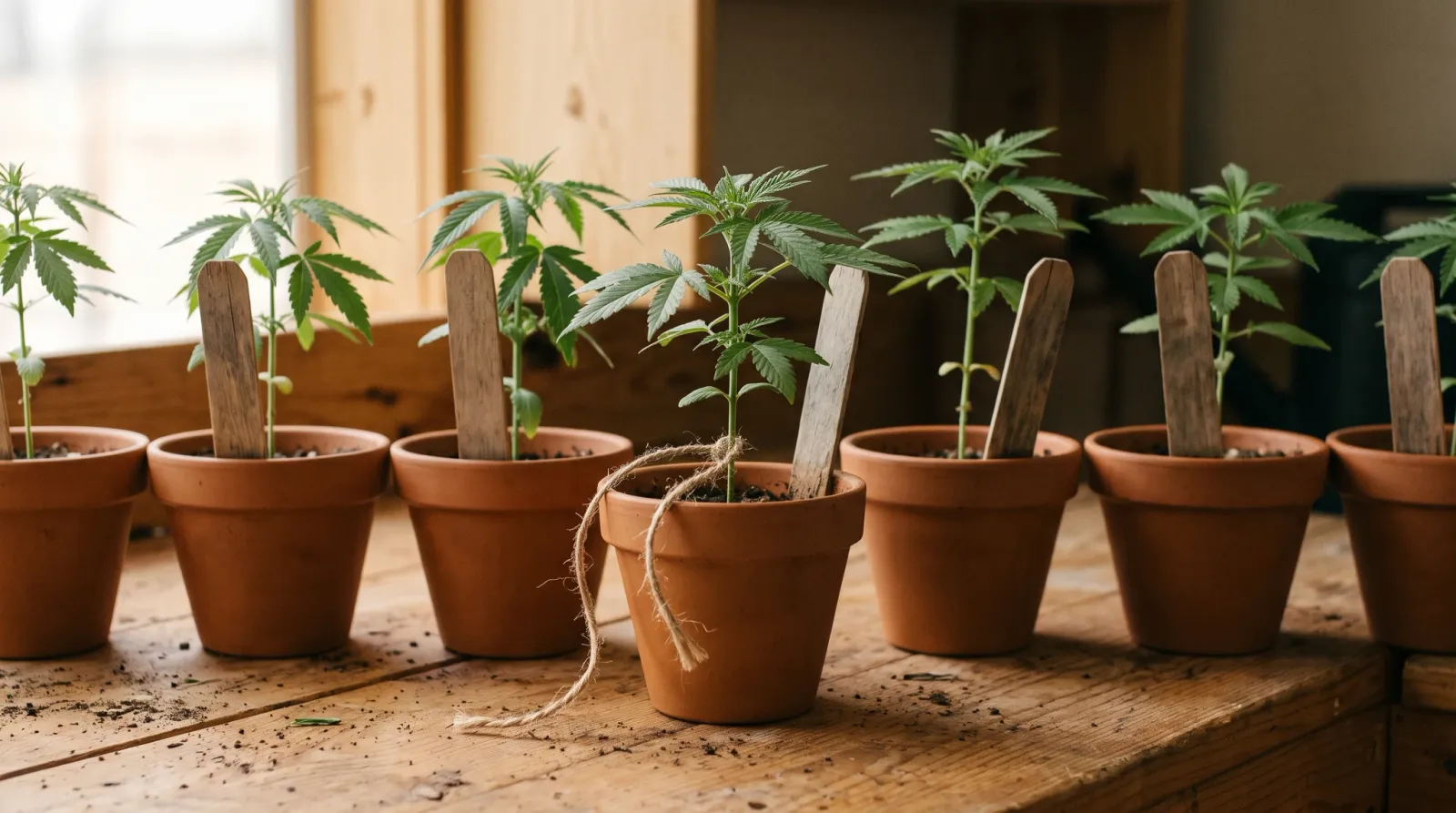
A number in a strain name is not one code but six: it can be a plant tag from a seed run, a parent strain carried into a cross, a company name, a year, a road, or something no breeder ever explained. Gelato #33 is plant 33 from one seed batch. 33 Weddings borrows that 33 from a parent. 710 Labs and 22Red are company names. Chem 91 points to 1991, and 95 Ckies points to Interstate 95. The 92 in 92 Demon has no documented meaning at all.
Here is the part worth sending to a friend. The 33 in Gelato #33 was the number on a plant’s jar. The breeder’s friends later nicknamed it “Larry Bird” after Bird’s Celtics jersey. And Gelato 42, the number many pages pair with Larry Bird, “has never been a thing,” according to the breeder himself (GreenState, 2024).
None of these numbers is a THC percentage, a generation count or a quality score. Below is a decoder for twelve names, then one section per type.
What do the numbers in strain names mean?
Most of the time, the number tells you where a plant came from, not what it does. The table sorts twelve real names by number type. The last column says whether a breeder, producer or first-hand account actually documents the meaning.
| Name | What the number means | Type | Evidence |
|---|---|---|---|
| Gelato #33 | Jar number from the original Gelato seed run; “Larry Bird” nickname came later | Plant tag | Documented by the breeder |
| Gelato #41 | Same seed run; the breeder lists it as Bacio Gelato | Plant tag | Documented by the breeder |
| Gorilla Glue #4 | The fourth numbered female, the one that was kept | Plant tag | Documented in trade press |
| Wedding Cake | Reported as Triangle Mints #23, a numbered selection | Plant tag | Secondary sources only |
| 33 Weddings | Gelato #33 crossed with Wedding Cake | Parent | Listed parents; name read from them |
| 95 Ckies | I-95 crossed with Girl Scout Cookies | Parent | Producer copy, quoted by retailers |
| 710 Chem | Sits on the 710 Labs genetics page as a clone-only Chem | Brand | Brand documented; strain link inferred |
| 22Red | The founder’s personal number; a brand, not a strain | Brand | Documented by the brand |
| Chem 91 | The 1991 Chemdog seed run | Year | Oral history, details disputed |
| I-95 | Interstate 95, the East Coast highway | Place | Documented in press |
| 3 Chems | Unknown; lineage listings conflict | Unknown | Not documented |
| 92 Demon | Unknown | Unknown | Not documented |
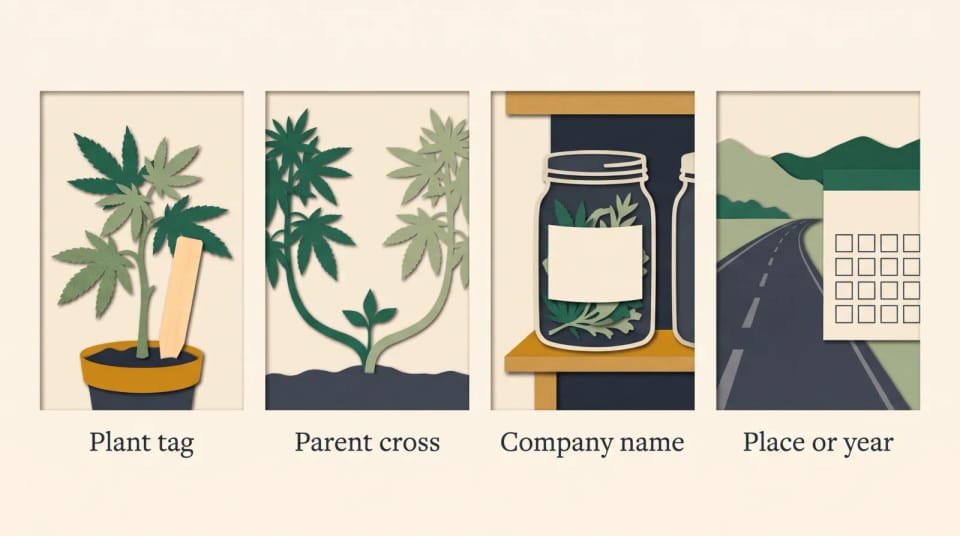
Four common sources for the number in a strain name. The illustration contains no real strain, brand or number on purpose: the point is that the same digits can come from very different places.
Why do famous strains have a number like #33 or #4?
The classic case is a plant tag. A breeder germinates a batch of seeds, numbers each plant, grows them out and keeps the standout. The number on that plant’s pot or jar sticks to its clones. If you want the full process, our guide to how a pheno hunt works walks through it.
Gelato is the best-documented example. Its breeder, Mario “Mr. Sherbinski” Guzman, said the Gelato numbers “are actually the numbers on their jars; I had about a hundred of them” (Newsweed interview). In a 2018 interview he named “#25, #33, #41, #45, #47, #49” as numbers from the same run (High Times).
The nicknames came second. Guzman told GreenState that at first he “only knew them by the numbers,” and that friends “added names based on legendary sports players that have the same number jersey as the plant” (GreenState). Larry Bird wore 33 for the Boston Celtics, and the team retired that number in 1993 (NBA.com; UPI).
Guzman now approves six numbered cuts: #25, #33, #41, #43, #47 and #49 (GreenState). Keep two caveats in mind. He sells the genetics, so his approval list carries a commercial interest. And his own accounts differ in places: in one interview he calls #25 “actually Guava Gelato,” while the approved list calls it Barry Bonds. For the wider family, see the Gelato family.
Gorilla Glue #4 follows the same logic. A later germination “produced several numbered females. Number four was the keeper” (High Times). Another history relays the founders’ account of four phenotypes, with #4 the winner (potguide). Because the keeper lives on as cuttings, many of these numbered plants are clone-only. Our beginner’s guide to cloning explains what a cut is.
Wedding Cake is a quieter example. Secondary sources describe it as a selection from Seed Junky’s Triangle Mints line, with “the official cut” being Triangle Mints #23 (Leaf Nation). I could not open the breeder’s own post, so treat that number as reported, not confirmed.
Is a #4 or a #1 the same plant everywhere?
No. A bare number identifies nothing. Plant numbers are local to one breeder and one seed batch, so many breeders have a #1 and a #4. One archival reference puts it plainly: “Selection numbers are not globally unique” (Origenetica). To mean anything, a number needs the breeder, the source strain and the context.
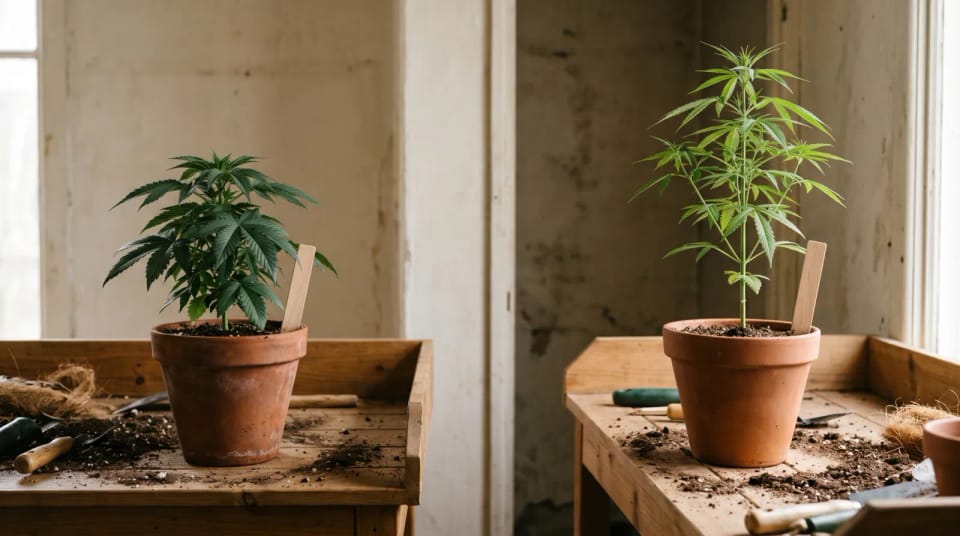
Same kind of tag, different plants. A number like #4 only means something next to the breeder and the seed batch it came from.
Even a full name is a weak guarantee. A genetic study of 81 marijuana and 43 hemp samples found that strain names “often do not reflect a meaningful genetic identity” (Sawler et al., 2015). A smaller study of 30 dispensary strains found inconsistencies within named strains, though many were stable once outliers were removed (Schwabe and McGlaughlin, 2019). Neither study tested numbered names specifically. Our article on whether strain names match the genetics covers this in depth.
Why is it called 33 Weddings?
Because the 33 belongs to a parent. A seed company lists 33 Weddings as “Gelato #33 x Wedding Cake” (Crop King Seeds). The listing does not explain the name in words, but the parents make the reading straightforward: the 33 comes from Gelato #33, and “Weddings” from Wedding Cake.
95 Ckies works the same way. Producer copy quoted on retail pages describes it as “I-95 Cookies” and as “crossing I-95 with Girl Scout Cookies” (retail listing). So the 95 is the I-95 parent. And I-95 itself takes its number from a road, which brings us to place names.
What do numbers like 95 and 91 refer to?
Some numbers point to a place or a year.
I-95 is named “in reference to the United States’ longest north-south highway,” according to a 2017 profile of the strain from Top Dawg Seeds and Money Mike (High Times; Leaf Nation). That is Interstate 95, the East Coast interstate.
Chem 91 carries a year. Oral histories trace Chemdog to a June 1991 show, where the first seeds produced three females “dubbed ‘Chem Dog’ (now known as the Chem 91), ‘Chem Dog A’ (now Chem’s Sister) and ‘Chem Dog B’” (High Times). Note the phrase “now known as.” The 91 label came later, and the same source says the details “continue to be matters of much dispute.” Another account says Chem 91 “dropped in 1991” (Honeysuckle).
What does 710 mean in a strain name?
In 710 Chem, the 710 most likely names a company. Flip 710 upside down and it spells OIL, which is where 710 Labs “got its name” (Detroit Metro Times); the same joke appeared in print as early as 2013 (Boulder Weekly). The company’s genetics page lists 710 Chem as “Chemdog x Skunk” and “Clone Only” (710 Labs).
One honest caveat: no source I found says in words how the strain got its name. Reading the 710 as the company’s prefix is an inference from where the strain is listed. The company also uses plant numbers inside its own names, and says those are phenotype numbers (710 Labs). For the oil joke and the July 10 holiday, read about 710 and the oil-upside-down joke. It is a close cousin of 420, the other famous cannabis number.
Is 22 Red a strain?
No. 22Red is a cannabis brand, not a strain. The brand says it pays “homage to the number 22,” which comes from its founder’s “affinity for numerology and synesthesia” (22Red). The founder, Shavo Odadjian, has said that twos have always looked red to him; he founded the brand in 2018 (Herb).
That is one person’s perception and belief, not a property of the plant. The number tells you whose brand it is, nothing more.
Which strain numbers has nobody explained?
Some numbers have no documented meaning. I searched breeder pages, interviews and press and found no breeder statement for these:
- 92 Demon. No source explains the 92. Pages that claim it honors a 1992 birth year give no breeder source.
- 100 Rackz. No breeder explanation, and listings disagree on who bred it.
- 3 Chems. Lineage databases list it as Stardawg crossed with another Chem line, and a forum user noted that those parents contain three Chem cuts (SeedFinder). That is a tidy guess, not a breeder’s word.
- 7 Steps to Heaven. Its listed lineage has seven named parts, but no source says the name counts them.
Not finding an explanation is not proof that none exists. Breeders sometimes explain names on social media I did not open. Until one says it, the honest answer is “unknown.”
Old seed lines carry numbers too. Afghani #1 was released in 1985 and Skunk #1 in 1987, and Skunk #1 was one of 30 hybrids its breeder tested (Sensi Seeds; Sensi Seeds history). Neither page says why the names end in #1, so I will not guess.
Does the number tell you anything about how a strain will feel?
No. A plant tag, a parent, a brand, a year or a road says nothing about potency or effect. Two jars with the same number from different growers can test differently, as our piece on same name, different lab results shows.
What helps more is the label and your own record. Check the cannabinoid and terpene results, and see our guide to picking by chemistry, not by name. The High IQ app lets you log how a strain actually worked for you, so the next jar is a choice and not a guess. If a product leaves you with symptoms that worry you, talk to a clinician and bring the package label; the strain name will not help them much.
For the bigger picture of how names work, from lineage to flavor to pop culture, read what strain names tell you here in High School.
Key takeaways
- A number in a strain name can be a plant tag, a parent, a brand, a year, a place or unknown.
- Plant numbers like Gelato #33 and Gorilla Glue #4 came from numbered pots in one seed run.
- The same number means nothing without the breeder and the source strain.
- No number is a potency, generation or quality score.
- For 92 Demon, 100 Rackz, 3 Chems and 7 Steps to Heaven, no breeder explanation was found.
FAQ
Does a higher number mean stronger weed?
No. Plant numbers record the order plants were tagged in a seed run, not their strength. Gelato #49 is not stronger than Gelato #25 because of its number. Check the lab results on the label instead.
Is Gelato 42 real?
The Gelato breeder says “Gelato 42 has never been a thing” and lists Larry Bird as #33 (GreenState). He approves six numbers: #25, #33, #41, #43, #47 and #49. Keep in mind that he sells the genetics, so that list reflects one breeder’s view.
What do F1, F2 and BX mean at the end of a strain name?
Those are breeding codes, not plant tags. F1 is a first-generation cross, F2 is a cross of two F1 plants, and BX means a backcross to a parent. Our guide to F1, F2 and backcrosses explains each step.
Why is it Gorilla Glue #4 if there is a #1?
Because #4 was the plant that was kept. The numbers came from several numbered females in one germination, and number four was the keeper (High Times). Other numbers from that run were not the ones that spread.
Does a numbered clone-only strain mean seeds sold under that name are fake?
Not exactly. A clone-only cut like Gorilla Glue #4 spreads as cuttings, so seeds can never be that exact plant. Seeds sold under the name are a cross or a relative, which can still be a fair product but is not the original cut.
Sources
- Bernard A. Interview with Mr. Sherbinski. Newsweed, 2020.
- Caeczar TH. 4 Minutes and 20 Seconds with Sherbinski. High Times, 2018.
- Wietstock C. Famed Gelato strain breeder clears the air on imposters. GreenState, 2024.
- Danko D. 25 Years of Chem Dog. High Times, 2016.
- 710 Labs. 710 Chem genetics page and What is pheno hunting?
- 22Red. About.
- Sawler J, et al. The genetic structure of marijuana and hemp. PLoS One, 2015.
- Schwabe AL, McGlaughlin ME. Genetic tools weed out misconceptions of strain reliability in Cannabis sativa. Journal of Cannabis Research, 2019.



