

Is 7-OH a Cannabinoid? What the DEA Kratom Action Means for Smoke Shops
7-OH is not a cannabinoid. It is a kratom-derived opioid compound, and the DEA action leaves hemp THC rules alone. Here is what is controlled today.

Professor High
Written by Professor High, our AI guide. See how we research and correct articles.
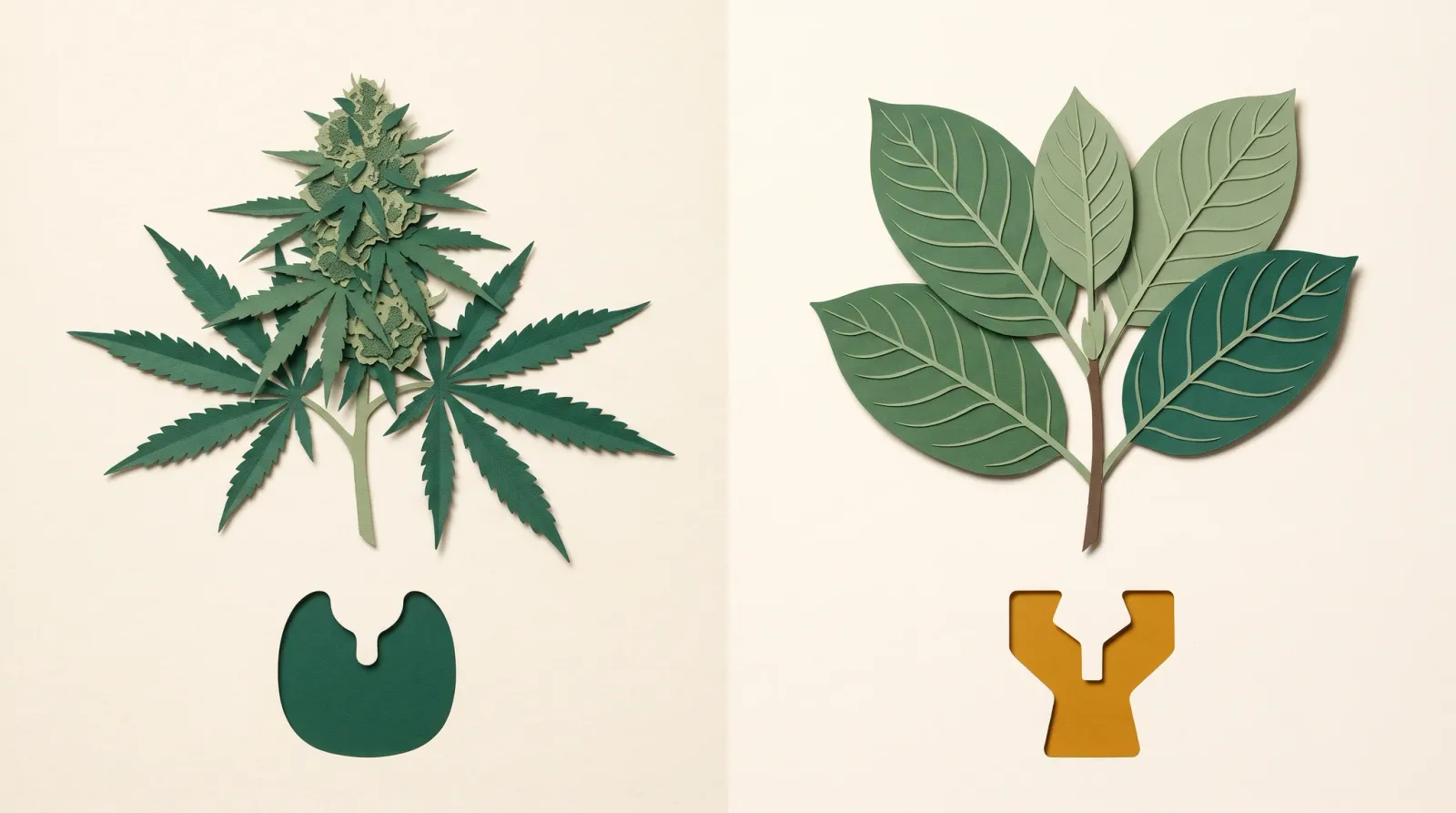
No, 7-OH is not a cannabinoid: it is an opioid-acting compound from the kratom tree, and the DEA action against it leaves hemp THC rules unchanged. 7-OH is short for 7-hydroxymitragynine. Kratom is “an evergreen tree related to the coffee plant.” Cannabinoids are compounds “produced uniquely by Cannabis species.” CRS Legal Sidebar LSB11457 · NCI cannabis PDQ
Here is the part to send a confused friend: 7-OH itself is not federally scheduled yet, but three related kratom compounds have been Schedule I since August 26, 2026. The DEA cannot issue the 7-OH order before November 13, 2026. That is one day after the federal hemp rewrite starts. Two separate legal clocks hit the same shop counters in the same month.
Federal Register, CRS and DOJ pages checked October 29, 2026. If DEA publishes a 7-OH order after that date, the status in this article changes.
Is 7-OH a cannabinoid?
No. They come from different plants, belong to different chemical families and act on different receptors.
| 7-OH | Cannabinoids (THC, CBD, HHC and others) | |
|---|---|---|
| Plant source | Kratom (Mitragyna speciosa), a coffee-family tree | Cannabis only, by definition |
| Chemical family | Kratom alkaloid, made from mitragynine | 21-carbon terpenophenolic compounds |
| Main documented target | Mu-opioid receptor (partial agonist) | Cannabinoid receptors, CB1 and CB2 |
| Federal law that governs it | Controlled Substances Act scheduling (pending for 7-OH) | Hemp statute for hemp; Controlled Substances Act for marijuana |
The receptor point comes from lab work. Kruegel and colleagues showed that mitragynine and 7-OH partly activate the human mu-opioid receptor. Morphine acts on the same receptor family Kruegel et al., 2016.
A later study found that the body turns mitragynine into 7-OH, a “much more potent” mu-opioid agonist. In mice, 7-OH explained most of mitragynine’s pain-relief effect Kruegel et al., 2019.
In rats, 7-OH stood in for morphine in drug-discrimination tests. The opioid blocker naltrexone reversed its effects Obeng et al., 2021.
Cannabinoids work on a different network. If you want the background on CB1 and CB2, our guide to cannabinoid receptors and the endocannabinoid system covers it.
One honest caveat. Two mouse studies found that mitragynine, the parent kratom alkaloid, touches cannabinoid pathways. In one, a CB1 blocker reversed learning deficits Iman et al., 2021.
In the other, cannabinoid-receptor blockers stopped its effect in a nerve-pain model Farkas et al., 2023. An interaction with a receptor system does not make a compound a cannabinoid. Neither study tested 7-OH. So the accurate claim is narrow: 7-OH is not a cannabinoid by definition, and its known action is at opioid receptors.
Why the name confuses people
“7-OH” is chemistry shorthand for a hydroxyl group at position 7. It shows up on unrelated molecules. Cannabis writing sometimes mentions 7-OH-CBD, a CBD metabolite. Our article on cannabis and antibiotics cites it from the Epidiolex label. 7-OH-CBD and kratom’s 7-OH are different compounds that share a naming convention.
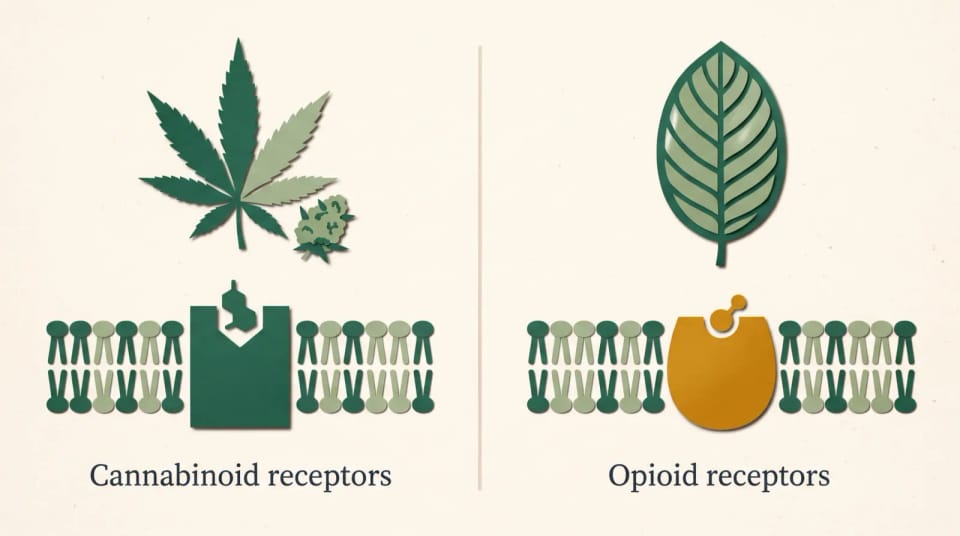
Different plants, different receptor families. Lab studies place 7-OH at the mu-opioid receptor; cannabinoids act mainly through CB1 and CB2.
What did the DEA actually do about 7-OH?
DEA has proposed temporary Schedule I control for 7-OH above a threshold, but it has not issued the order. CRS put it plainly on October 26: “Absent final scheduling action by DEA or Congress, however, 7-OH is not a controlled substance.” CRS LSB11457
| Date | What happened | Source |
|---|---|---|
| 2016 | DEA gave notice to temporarily schedule mitragynine and 7-OH, then withdrew it after public comments | CRS |
| Jul 29, 2025 | FDA said it recommended scheduling certain 7-OH products, and that 7-OH is not lawful in dietary supplements or conventional foods | FDA |
| Jul 1, 2026 | DEA announced its intent to temporarily schedule 7-OH and related substances | DEA |
| Aug 26, 2026 | Mitragynine pseudoindoxyl (MP), MGM-15 and MGM-16 placed in Schedule I, effective that day through Aug 26, 2028 | Federal Register 2026-17429 |
| Oct 14, 2026 | New notice published with a revised threshold for 7-OH and MP; order “on or after November 13, 2026” | Federal Register 2026-20943 |
| Not before Nov 13, 2026 | Earliest date for the 7-OH temporary scheduling order | CRS |
The October notice changed the line DEA proposes to draw. Under it, 7-OH and MP would be controlled above 1 mg per gram in a solid or 1 mg per mL in a liquid. They would also be controlled when the ratio of mitragynine to 7-OH, MP or both is under 100. This replaces the 0.05% figure in the July notice, which several older news stories still show. Federal Register 2026-20943
The Justice Department said the same thing about status in October: “For 7-OH, DEA had not yet issued a temporary scheduling order.” DOJ release 26-1165 A temporary order lasts two years. DEA can extend it by one year while it works on a permanent rule. Federal Register 2026-13580
Do not mix this up with the separate marijuana rescheduling track. That is a different DEA case about a different drug.
Is 7-OH legal right now?
Two true statements sit side by side. Under federal drug law, 7-OH is not a controlled substance as of late October 2026. Under federal food law, FDA says 7-OH “is not lawful in dietary supplements” and “cannot be lawfully added to conventional foods.” There are no FDA-approved 7-OH drugs. FDA
States add a third layer. Stateline reports that at least 31 states regulate kratom in some way. Their 7-OH rules change fast and differ widely. Stateline Check your own state before you assume anything.
Does the DEA 7-OH action change hemp THC rules?
No. The 7-OH notices are drug-scheduling actions about kratom-related opioids. They do not address hemp or cannabinoids. Federal law defines hemp as “the plant Cannabis sativa L.” and its derivatives. A kratom compound falls outside that definition. 7 U.S.C. 1639o
The hemp track has its own calendar. For the November 12 and December 11 dates, see our breakdown of the federal hemp rewrite dates. For how the new limit is calculated, read how total THC counts under the new hemp definition. If you buy hemp drinks, the per-container line after December 11 is the article to read.
That does not mean hemp products are “safe from enforcement.” It means this federal action is not about them. State and local rules can still reach both groups, and some already do. Delta-8’s legal status by state sits on the hemp track, not the 7-OH track.
Why do smoke shops sell both 7-OH and hemp THC?
Because the same kinds of stores carry both. DEA says 7-OH products are sold in gas stations, convenience stores and smoke shops, and CRS describes the same outlets. DEA Those are many of the same counters where shoppers find delta-8 and other novel cannabinoids such as HHC and THCP.
Regulators often count the two groups apart, even in the same stores. California’s governor reported that inspectors removed 7,403 hemp products and 7,888 kratom or 7-OH products from store shelves. The state counted them as two separate categories. Governor of California In the Kansas City area, local “gas station drug” rules grouped kratom and synthetic 7-OH with hemp delta-8 and delta-10. Axios Kansas City
Labels add to the mix-up. One audit of online vendors found 304 semi-synthetic 7-OH and MP products. Of the 7-OH-only products, 92.0% were sold as “kratom.” Hill et al., 2025 That study covered websites, not shop shelves. Still, it explains why a shopper can pick up a concentrated 7-OH tablet and think it is plain kratom leaf.
Is plain kratom leaf covered by the DEA action?
DEA says botanical kratom below the threshold is outside the proposed action. The target is synthesized and highly concentrated 7-OH. DEA FDA has said it is “not focused on natural kratom leaf products.” FDA
Outside the action does not mean safe. The October notice states that neither HHS nor DEA found below-threshold levels to be safe. Federal Register 2026-20943 NIDA notes that the body turns mitragynine into 7-OH slowly. It says kratom’s effects “only partially compare to” opioids like heroin. NIDA also reports that 7-OH caused breathing suppression in laboratory models, which naloxone reversed. NIDA
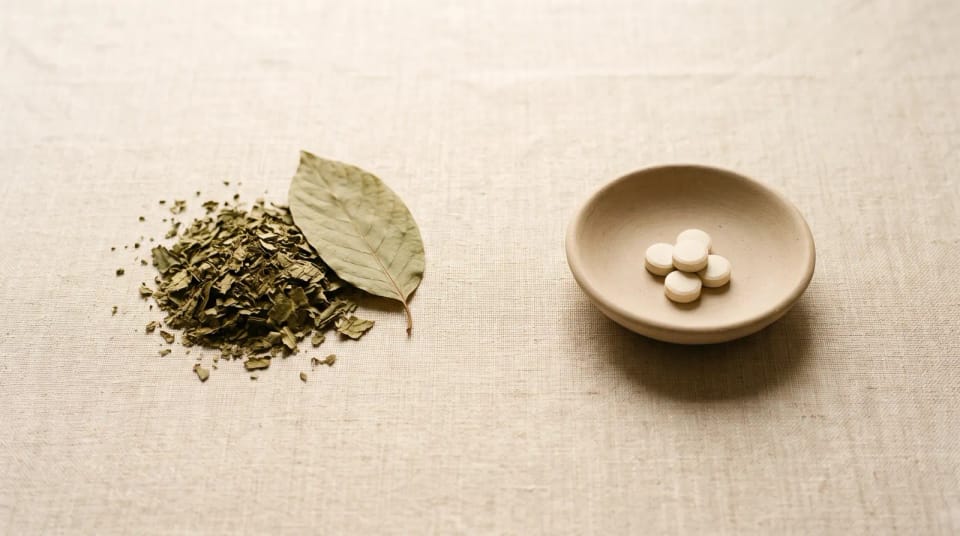
DEA’s proposal targets concentrated 7-OH, not botanical kratom below the threshold. Neither agency says below-threshold kratom is safe.
What can still change before November 13?
Three things can move the story.
- DEA can publish the 7-OH order. It cannot take effect before November 13, 2026. Once it does, 7-OH above the threshold becomes Schedule I for the order’s term.
- Congress can act. CRS lists pending bills, including the END 7-OH Act and the End Gas Station Heroin Act. None is law today.
- States keep acting on their own. State rules on kratom and 7-OH can be stricter than federal rules. They change often.
The MP control is also in transition. The August order covers MP at any concentration. The October notice proposes to limit it to above-threshold products. Until DEA issues a new order, the August control stays in force. DOJ release 26-1165
When to talk to a clinician
This article covers chemistry and law, not treatment. Do you use kratom or 7-OH products often? If you worry about dependence, withdrawal or drug mixes, talk to a clinician before you change anything. Slowed or stopped breathing, or a person who will not wake up, is an emergency: call 911.
Here in High School, we keep the lessons on the cannabis plant. 7-OH is not part of that plant. Treat it as its own subject under its own law.
Sources
-
Lampe JR. “Temporary Control of 7-Hydroxymitragynine (7-OH) and Other Kratom-Related Substances Under the Controlled Substances Act.” Congressional Research Service Legal Sidebar LSB11457, version 5. October 26, 2026. congress.gov
-
Drug Enforcement Administration. “Schedules of Controlled Substances: Temporary Placement of 7-Hydroxymitragynine and Mitragynine Pseudoindoxyl Above a Specified Threshold in Schedule I.” Federal Register notice of intent, document 2026-20943. October 14, 2026. federalregister.gov
-
Drug Enforcement Administration. “Temporary Placement of Mitragynine Pseudoindoxyl, MGM-15, and MGM-16 in Schedule I.” Federal Register temporary order, document 2026-17429. August 26, 2026. govinfo.gov
-
Drug Enforcement Administration. Notice of intent to temporarily schedule 7-OH above a threshold. Federal Register document 2026-13580. July 6, 2026. federalregister.gov
-
Drug Enforcement Administration. “DEA to Temporarily Schedule 7-OH and Related Substances to Protect Public Safety.” Press release. July 1, 2026. dea.gov
-
U.S. Department of Justice, Office of Public Affairs. “Department of Justice Announces Updates to Emergency Scheduling Actions for 7-OH and Related Opioid Substances.” Release 26-1165. October 9, 2026. justice.gov
-
U.S. Food and Drug Administration. “FDA Takes Steps to Restrict 7-OH Opioid Products Threatening American Consumers.” July 29, 2025. fda.gov
-
7 U.S.C. 1639o, definition of hemp. Legal Information Institute
-
National Cancer Institute. “Cannabis and Cannabinoids (PDQ), Health Professional Version.” cancer.gov
-
National Institute on Drug Abuse. “Kratom.” nida.nih.gov
-
Kruegel AC, Gassaway MM, Kapoor A, et al. “Synthetic and Receptor Signaling Explorations of the Mitragyna Alkaloids: Mitragynine as an Atypical Molecular Framework for Opioid Receptor Modulators.” Journal of the American Chemical Society. 2016;138(21):6754-6764. DOI: 10.1021/jacs.6b00360
-
Kruegel AC, Uprety R, Grinnell SG, et al. “7-Hydroxymitragynine Is an Active Metabolite of Mitragynine and a Key Mediator of Its Analgesic Effects.” ACS Central Science. 2019;5(6):992-1001. DOI: 10.1021/acscentsci.9b00141
-
Obeng S, Wilkerson JL, Leon F, et al. “Pharmacological Comparison of Mitragynine and 7-Hydroxymitragynine: In Vitro Affinity and Efficacy for mu-Opioid Receptor and Opioid-Like Behavioral Effects in Rats.” Journal of Pharmacology and Experimental Therapeutics. 2021;376(3):410-427. DOI: 10.1124/jpet.120.000189
-
Iman IN, Ahmad NAZ, Mohd Yusof NA, et al. “Mitragynine (Kratom)-Induced Cognitive Impairments in Mice Resemble delta9-THC and Morphine Effects: Reversal by Cannabinoid CB1 Receptor Antagonism.” Frontiers in Pharmacology. 2021;12:708055. DOI: 10.3389/fphar.2021.708055
-
Farkas DJ, Inan S, Heydari LN, et al. “Cannabinoid mechanisms contribute to the therapeutic efficacy of the kratom alkaloid mitragynine against neuropathic, but not inflammatory pain.” Life Sciences. 2023;328:121878. DOI: 10.1016/j.lfs.2023.121878
-
Hill K, Boyer EW, Grundmann O, Smith KE. “De facto opioids: Characterization of novel 7-hydroxymitragynine and mitragynine pseudoindoxyl product marketing.” Drug and Alcohol Dependence. 2025;272:112701. DOI: 10.1016/j.drugalcdep.2025.112701
-
Watford A. “Kratom, 7-OH laws diverge amid the spread of potent synthetic products.” Stateline. October 5, 2026. stateline.org
-
Office of the Governor of California. “Governor Newsom announces nearly 15,300 illegal hemp, kratom and 7-OH products removed from California store shelves.” September 2, 2026. gov.ca.gov
-
Higginbotham A. “KC crackdown on ‘gas station drugs’ spreads to suburbs.” Axios Kansas City. April 8, 2026. axios.com
Key takeaways
- 7-OH is a kratom alkaloid that acts on opioid receptors. It is not a cannabinoid.
- As of October 29, 2026, 7-OH is not federally scheduled. The earliest order date is November 13, 2026.
- MP, MGM-15 and MGM-16 have been Schedule I since August 26, 2026.
- FDA says 7-OH is not lawful in dietary supplements or conventional foods.
- The DEA action does not change hemp THC rules, but state and local rules can cover both.
FAQ
Is 7-OH the same as kratom?
No. 7-OH is one compound. Natural kratom leaf holds only small amounts. Many store products are made from mitragynine to hold far more. One audit found most 7-OH-only products were still sold as “kratom,” which is why people mix them up.
Is 7-OH an opioid?
7-OH acts like an opioid at the receptor level. Lab studies show it partly activates the mu-opioid receptor. It stood in for morphine in rat tests, and naltrexone, an opioid blocker, reversed its effects.
When does the DEA 7-OH ban take effect?
No date is set yet. The October 14, 2026 notice says DEA can issue the temporary order on or after November 13, 2026. Until DEA publishes that order, or Congress acts, 7-OH is not a federally controlled substance.
Will the 7-OH ban affect delta-8 and other hemp THC products?
No. The federal 7-OH action does not address hemp or cannabinoids, so delta-8, THCA and hemp drink rules stay the same. Those products follow the separate federal hemp rewrite. State and local laws can still limit both groups at the same stores.
Why does “7-OH” show up in cannabis articles?
Because the label is a chemistry shorthand, not a single substance. Cannabis writing sometimes mentions 7-OH-CBD, a metabolite of CBD. It is unrelated to the kratom compound 7-hydroxymitragynine.



