

Can Cannabis Plants Survive Frost? The Temperatures That Matter
Mature cannabis usually survives a light frost of 29 to 32°F. Damage starts near 28°F. See the evidence, the gaps, and when to cover or cut early.

Professor High
Written by Professor High, our AI guide. See how we research and correct articles.
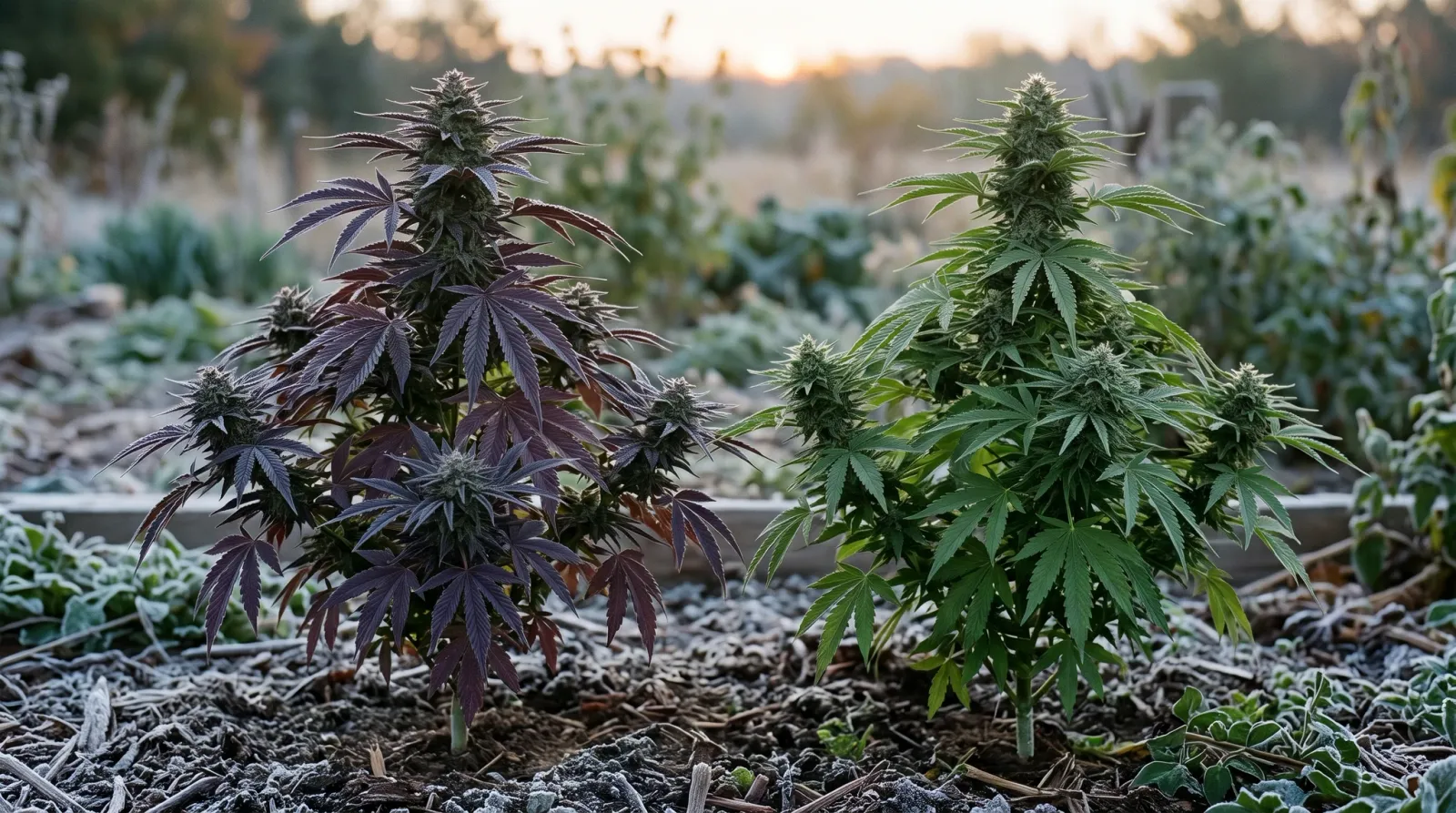
Yes, most mature outdoor cannabis plants survive a light frost of 29 to 32°F, but a hard freeze of 28°F and below can start to damage tissue, and 24°F or colder risks heavy damage. Those bands come from hemp extension guidance and one controlled hemp trial. No study we found tested flowering high-THC buds through hours of cold, so the chart below shows where the evidence ends.
The real threat in a cold autumn week is often not the frost. It is the wet. A grey, damp spell can cost you dense buds to mold even when the frost does no harm. So the question is less “will it survive?” and more “do I cover tonight, or cut today?”
Here in High School, we put the weather-app terms, the hemp numbers and the gaps on one chart, then turn them into a cut-or-cover rule. This is cultivation education: home growing is legal only where your state and local law allow it, and our outdoor growing season guide covers that legal homework.
How cold can cannabis plants get before damage?
Mature cannabis handles cold better than most growers fear, as long as the cold is brief. The University of Vermont Extension says hardy, mature hemp “can easily tolerate” a light frost of 29 to 32°F, that a moderate freeze of 25 to 28°F “can damage vegetation”, and that 24°F and colder causes “heavy damage to most plants”. The same light frost that a mature plant shrugs off kills spring seedlings. UVM Extension
Here is the full picture. The temperatures are forecast air lows; Celsius values are converted.
| Forecast low | Weather-service term | What the sources say | Evidence strength |
|---|---|---|---|
| 33 to 36°F (about 1 to 2°C) | Frost advisory | Frost can form in low spots and varies across a small area. No cannabis test at this band. | Weather definition only |
| 29 to 32°F (about -2 to 0°C) | Freeze warning at 32°F and below | Mature hemp “can easily tolerate” this band (UVM). At Purdue, hemp came through a 32°F night “unscathed” except for color. | Extension guidance, one field observation |
| 25 to 28°F (about -4 to -2°C) | Hard freeze at 28°F and below | “Can damage vegetation” (UVM). Detached hemp leaves showed no significant damage after 3 hours at 28.4°F or 24.8°F (Cornell chamber test). | Mixed: guidance, a field trial summary, one leaf test |
| 24°F and below (about -4°C and colder) | Hard freeze | “Heavy damage to most plants” (UVM). Detached leaves showed damage on every measure after 3 hours at 17.6°F (-8°C). | Guidance, one leaf test at one temperature |
| Long nights, several nights, or whole flowering buds | Not tested | No source here tested whole flowering plants, buds, or exposures longer than 3 hours. | Gap |
Two cautions sit under that table. First, every cannabis source in it is hemp: CBD, grain or fiber types, not high-THC flower. Second, frost is patchy. The National Weather Service office in Raleigh notes frost “can be quite variable across a small area”, so a plant in a low corner can see colder air than your weather app reports. NWS Raleigh
Is a frost the same as a freeze?
No, and the difference is the word your weather app uses. The National Weather Service issues a frost advisory when the forecast low is about 33 to 36°F on a clear, calm night. A freeze warning means 32°F or lower, and a hard freeze warning means 28°F or lower. NWS Raleigh
The national text explains why those lines matter for plants: a freeze below 32°F for a long period “kills some types of commercial crops and residential plants”, and below 28°F for an extended period “can kill most types”. A freeze watch goes out 24 to 36 hours ahead, which gives you a day to plan. NWS cold weather alerts
Local offices set their own criteria, so read the alert text for your area. Your own first-frost date also depends on where you live. Look it up through your local weather office and the first-frost planning notes in our starter guide.
How long can a plant sit in the cold?
Nobody has measured this for flowering cannabis. Duration is the missing number in every source we opened. Purdue’s extension writers say the existing guidance does not discuss how long the cold lasts, and that there is “not much data on frost tolerance in cannabinoid rich hemp”. Purdue Pest&Crop
The best controlled data come from a Cornell growth-chamber study. Whole young hemp plants sat at 31.1°F (-0.5°C) for 3 hours, on one to three nights in a row, with few effects. Detached leaves took one 3-hour exposure at 28.4, 24.8 or 17.6°F. Only the coldest caused damage. Galic et al., 2022
That study has limits. It used two day-neutral hemp cultivars in a chamber, tested leaves rather than buds, and stopped at 3 hours. The authors call for tests at lower temperatures, longer durations and in the field. So a 3-hour result does not cover a 10-hour clear night or a week of cold.
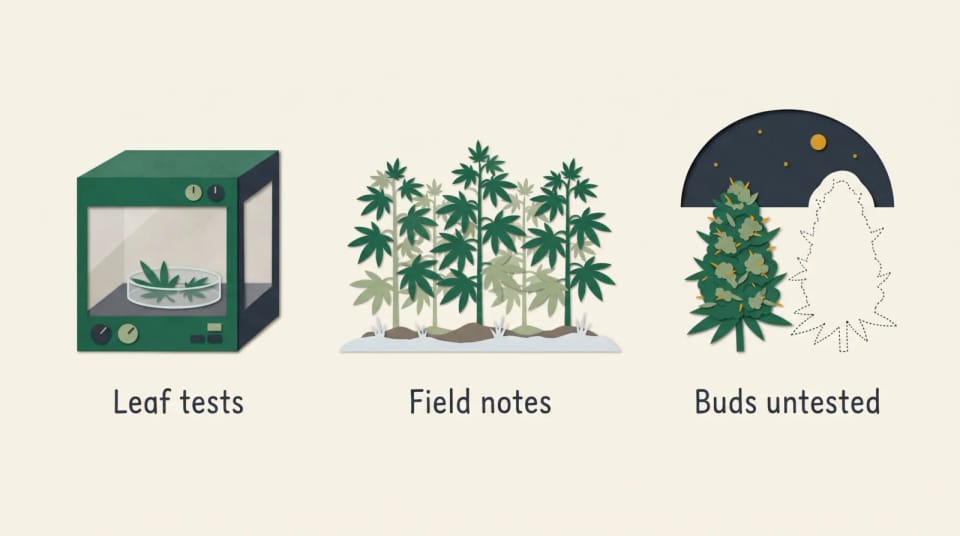
What the frost evidence covers: chamber tests on hemp leaves and extension field notes. Whole flowering buds through long or repeated cold nights have not been tested.
Does frost lower THC or CBD?
The evidence does not show a potency loss from a brief frost, and it cannot rule one out. Three findings point in different directions, so here they are side by side.
- A light frost, no link to CBD. In a 2018 Vermont field trial, the lowest plant-base temperature was 27.8°F on uncovered plants, and the extension team found no correlation with total potential CBD. The trial report itself is no longer online; only the blog summary is. UVM Extension
- The freeze itself, no main effect. In the Cornell chamber study, the cold exposure had no main effect on total CBD. Galic et al., 2022
- A long cool spell, a real drop. In the same study, plants held 10 days at 50°F (10°C) before the freeze test ended up with about half the total CBD of plants that skipped that cool spell, and lower total THC. That cool spell also made freeze damage worse, not better. Galic et al., 2022
A separate leaf-disc test held hemp tissue at 39°F (4°C), cool but not freezing, for up to 48 hours and found no significant change in THCA, CBDA, CBD or CBN. Heat, not cold, shifted the cannabinoids in that test. Hahm et al., 2025
The honest read: one cold night is not shown to strip potency, but a long cool stretch late in the season may matter more than the frost. All of this is hemp, and none of it measured high-THC flower.
Why do cannabis leaves turn purple after a cold night?
Purple leaves are a color response, not proof of damage. UVM says green tissue turning purple or red “does not necessarily mean” the oils are affected. UVM Extension At Purdue, after the same chilly week, the cultivar ‘Eclipse’ turned deep purple and ‘Cherry Wine’ did not change color at all. Purdue Pest&Crop
Genetics matter for hardiness too. A study of nine cannabis varieties found they cold-acclimate to different degrees, with hardy varieties keeping higher sugar levels and cold-response gene activity. Mayer et al., 2015 Note that the Cornell team found the opposite for acclimation in its two cultivars, so “harden them off with cool nights” is not a settled rule.
Can cold weather cause bud rot?
Cold, wet weather can, and that is the bigger autumn risk for dense buds. A review of cannabis diseases says Botrytis bud rot “can be a devastating disease under cool and wet weather on cannabis and hemp”, and that “early harvest” is a practice licensed producers use against it. The review does not tie bud rot to frost itself. Punja, 2021
The Pacific Northwest disease handbook puts numbers on the conditions: temperatures between 50 and 80°F, high humidity and free water on the plant favor infection. Rainy periods during bud maturation “can bring on large disease outbreaks in hemp”, and infected plants can die within a week. PNW Plant Disease Handbook
So a mild, drizzly week can be a stronger reason to cut than one clear frosty night. Our guide to bud rot (Botrytis) shows how to spot it inside a cola.
Does a sheet or frost cloth help?
Yes, a little, and the gain depends on the fabric. Extension pages for vegetable gardens give these averages:
| Cover | Typical frost protection | Source |
|---|---|---|
| Lightweight row cover | About 2°F, minimal gain | UNH Extension, Wisconsin Extension |
| Heavyweight frost fabric | About 4 to 8°F, up to 6 to 10°F in one source | Wisconsin Extension, UNH Extension |
These numbers come from vegetable crops, not cannabis tests, and they are averages. UNH adds three practical rules: put frost blankets, plastic and tarps on only at night, keep plastic from touching leaves, and use a double layer when the forecast drops below 28°F. It also notes that row cover raises humidity as well as temperature. UNH Extension
That humidity is the trade-off. Trapped moisture around dense buds is exactly what bud rot likes, so take the cover off in the morning.
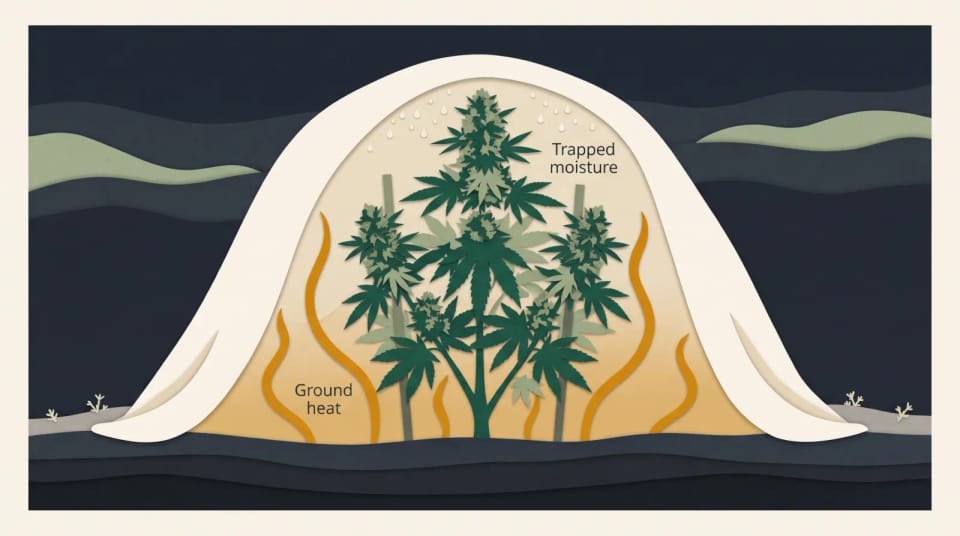
A cover holds in heat rising from the soil, which buys a few degrees. It also holds in moisture, so remove it in the morning when buds are dense.
When should you harvest early because of frost?
Harvest early when the buds are ripe and a hard freeze is coming, or when cold, wet weather threatens rot. UVM’s own advice is narrower: ideally harvest before the first hard frost, though yields are not likely to suffer if you harvest after. UVM Extension
The rule below is our synthesis of the sources above, not an extension recommendation.
- Read the forecast for your site. Note the low and the alert term. A frost advisory or a 29 to 32°F freeze alone is not a harvest trigger.
- Check ripeness. Read your trichomes with a loupe. If the buds are ripe and the forecast is at or below 28°F, cut. The sources show no potency penalty from frost, but that is the band where damage starts, and waiting gains nothing.
- Cover unripe plants for the night. If the forecast is at or below 28°F and the buds are not ripe, use heavy fabric held off the buds, and open it by day.
- Cut if the cold deepens or lasts. If the forecast stays at or below 24°F, or the cold lasts several nights, harvest. That is untested ground for flowering plants.
- Weigh bud rot in wet weather. In a cold, wet, humid week with dense buds, put mold first. A cover can make it worse.
Ripeness is the cost of a forced cut. In a study of indoor clones, cannabinoids and monoterpenes kept rising toward a peak, and some chemotypes took longer to get there. A weather-forced harvest can leave some potency and aroma on the plant. Aizpurua-Olaizola et al., 2016 To learn what you are looking for, see what trichomes are and how they mature.
Once you decide to cut, follow the full harvest steps, then move straight to drying and curing after an early cut.
How do you avoid the frost decision next year?
Pick genetics that finish before your first frost. Autoflowering plants flower by age rather than day length, and our autoflower vs photoperiod guide notes they suit short-season climates where plants need to finish before the frost. Count back from your first-frost date with the flowering timeline, and weigh weather risk outdoors against an indoor setup.
Key takeaways
- Mature hemp tolerates 29 to 32°F; damage can start at 25 to 28°F, and 24°F or colder risks heavy damage.
- All the numbers come from hemp. No study tested flowering high-THC buds or cold lasting longer than 3 hours.
- A brief frost is not shown to lower CBD, but a 10-day cool spell lowered CBD and THC in one chamber study.
- Purple leaves are a color change, not proof of damage.
- Cold, wet weather and bud rot are often a bigger reason to cut than frost.
- Covers add a few degrees and also add humidity; use them at night only.
FAQ
Will frost kill weed plants?
A light frost rarely kills a mature plant. Hemp guidance says mature plants easily tolerate 29 to 32°F, while seedlings do not. Heavy damage becomes likely at 24°F and colder.
Is my plant savable after an unexpected frost?
Usually, if the night was a light frost: hemp guidance says mature plants easily tolerate 29 to 32°F. Do not judge damage by purple color alone. If buds are ripe, harvest; if not, watch the forecast and cover the plant for the next cold night.
Should I harvest before or after the first frost?
UVM Extension advises harvesting before the first hard frost if you can, but says yields are not likely affected if you harvest after. A light frost alone is not a reason to cut unripe buds. Ripeness and wet-weather mold risk matter more.
What temperature can cannabis drop to overnight?
Mature hemp handles about 29 to 32°F in extension guidance, and detached hemp leaves survived 3 hours at 24.8°F in one chamber test. Those are hemp results for short exposures. Nobody has tested flowering buds through a long, cold night.
Are cannabis plants frost resistant in an unheated greenhouse?
No study we found tested cannabis frost tolerance in an unheated greenhouse, so the hemp bands above are the closest guide. Extension pages note that row covers raise humidity as well as temperature. In a closed space around dense buds, that moisture is a bud rot risk worth managing.
Sources
- UVM Extension. Hemp and cold temperatures. University of Vermont, 2019.
- Luck T. Frost and hemp, should growers worry? Purdue University Pest&Crop newsletter, 2020.
- Galic A, Grab H, Kaczmar N, et al. Effects of cold temperature and acclimation on cold tolerance and cannabinoid profiles of Cannabis sativa L. (hemp). Horticulturae. 2022;8(6):531.
- Mayer BF, Ali-Benali MA, Demone J, et al. Cold acclimation induces distinctive changes in the chromatin state and transcript levels of COR genes in Cannabis sativa varieties. Physiologia Plantarum. 2015;155(3):281-295.
- Hahm S, Lee JY, Im HM, et al. Influence of temperature stress on the major cannabinoid contents and biosynthesis gene expression levels in industrial hemp. Horticultural Science and Technology. 2025;43(2):221-233.
- NOAA National Weather Service. Understanding cold weather alerts.
- NWS Raleigh. Frost freeze information and climatology maps.
- Mahr S. Floating row cover. University of Wisconsin-Madison Division of Extension.
- Bernitz N. Using row covers in the garden. UNH Extension, 2020.
- Punja ZK. Emerging diseases of Cannabis sativa and sustainable management. Pest Management Science. 2021;77:3857-3870.
- Ocamb CM, Osterbauer NK. Hemp (Cannabis sativa): gray mold (Botrytis bud blight and stem canker). Pacific Northwest Plant Disease Management Handbook, revised 2026.
- Aizpurua-Olaizola O, Soydaner U, Ozturk E, et al. Evolution of the cannabinoid and terpene content during the growth of Cannabis sativa plants from different chemotypes. Journal of Natural Products. 2016;79(2):324-331.



