

Can You Grow Weed With Regular LED Bulbs? What the Light Math Says
Yes, you can grow weed with regular LED bulbs, but one bulb lights about one small plant. See the photon math, the bulb count and the yield you give up.

Professor High
Written by Professor High, our AI guide. See how we research and correct articles.
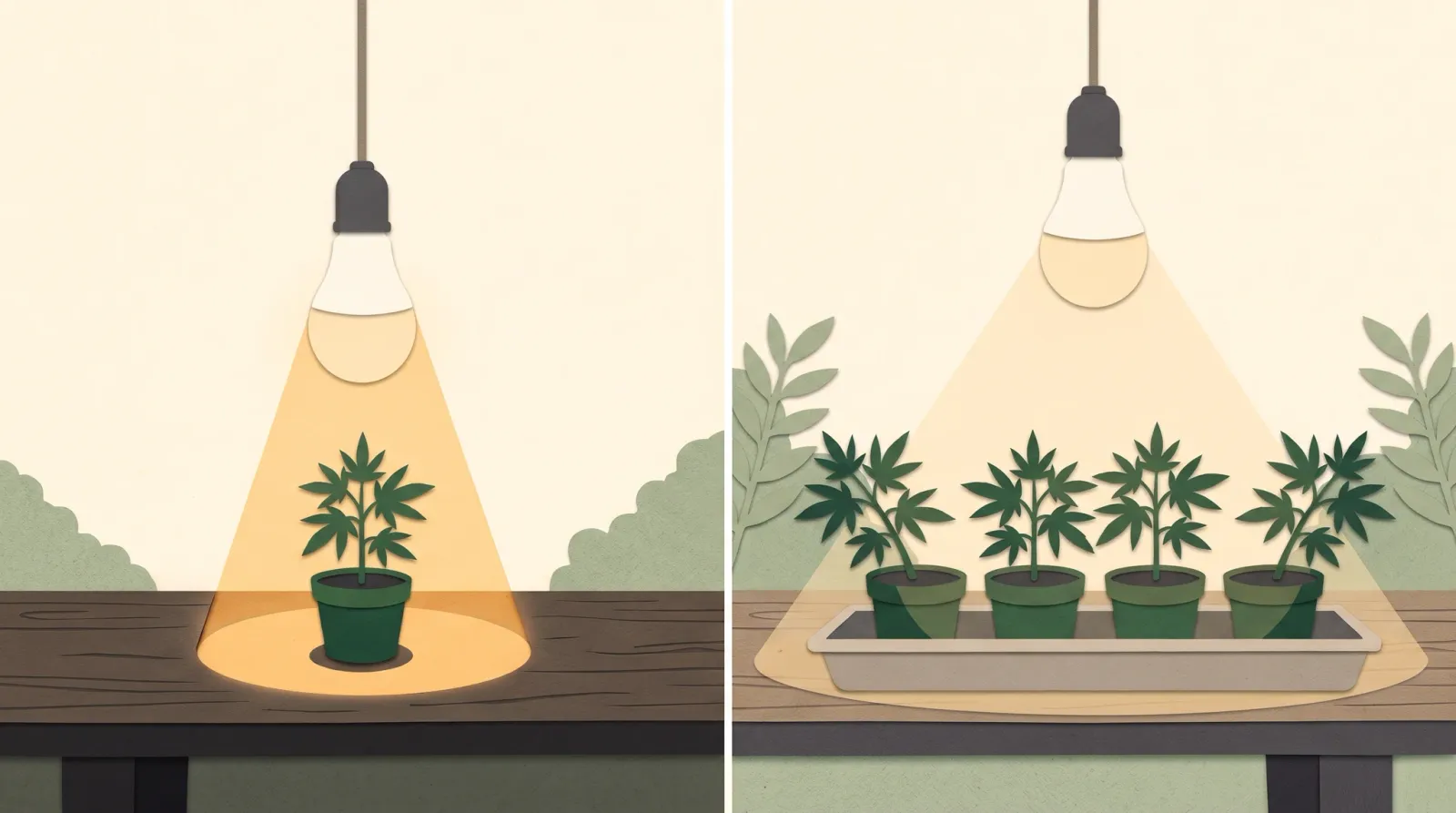
Yes, regular LED bulbs can grow weed, but a household bulb makes so few plant-usable photons that one bulb lights about one small plant, and only dimly. The light is not the wrong kind. There is simply not much of it, and it spreads thin fast.
Here is the number to send a friend. One 800-lumen “60-watt equivalent” LED bulb makes roughly 12 micromoles of plant-usable photons per second, by our calculation from published conversion factors. The lowest light level a controlled cannabis yield trial tested was 120 micromoles per square meter per second. Reaching that across one square meter would take about 10 of those bulbs, with every photon landing on a leaf. The low end of a second trial, 600, would take about 50. Rodriguez-Morrison et al., 2021; Llewellyn et al., 2022
So the honest answer has three parts. Will the plant live? Yes. Will it flower? Trials say yes, even at low light. Will it make a harvest worth the electricity? Only a small one, over a small area. Before you start, check your state’s home-grow rules.
What does a cannabis plant actually need from a light?
A plant needs photons landing on its leaves, counted per square meter per second. Growers call that PPFD (photosynthetic photon flux density). Lumens, the number on a bulb box, do not measure that.
Lumens weight light by how bright it looks to human eyes. A lighting review from Utah State University researchers says lumens per watt “is not applicable for horticultural lighting because it is a measure of photons weighted for human vision.” Kusuma, Pattison and Bugbee, 2020 That is why a bulb that lights a room well can still starve a plant.
Hours matter too. PPFD times hours gives the daily total, called the daily light integral. Our cannabis daily light integral lesson walks through that math, and cannabis light schedules covers how many hours each stage gets.
How much light does one regular LED bulb give?
About 12 micromoles of photons per second, with a physical ceiling near 26. No one in our research measured a specific household bulb, so we calculated it two ways and show the working.
- The bulb. A traditional 60-watt incandescent makes about 800 lumens, and an LED bulb can match it at about 9 watts. FTC, Shopping for Light Bulbs
- Best estimate. A preprint estimates that 1,000 lux of white LED light equals about 15 micromoles per square meter per second. That means 1 lumen is about 0.015 micromoles per second, so 800 lumens is about 12. The preprint is not peer reviewed. Sharakshane, 2018 (bioRxiv)
- Ceiling. The best cool-white LED chips reached about 2.9 micromoles per joule in the 2020 review. Nine watts times 2.9 is about 26. A real bulb loses some light to its driver and cover, so it sits below that. Kusuma, Pattison and Bugbee, 2020
Now spread those photons over an area. This table assumes one bulb and gives the best estimate, then the ceiling, in micromoles per square meter per second.
| Area under one bulb | All light lands on plants | Half the light lands on plants |
|---|---|---|
| 30 x 30 cm (one plant) | about 133 / 290 | about 67 / 145 |
| 50 x 50 cm | about 48 / 104 | about 24 / 52 |
| 1 square meter | about 12 / 26 | about 6 / 13 |
A single bulb aimed tightly at one plant lands near 120, the lowest level tested for flower in the trial above. Over 12 hours that is a daily light integral of about 5.7; the trial’s lowest flowering treatment was about 5.2. Spread the same bulb over a square meter and the light drops to a tenth.
These are calculations, not readings. A PAR meter at the canopy beats any estimate, including ours.
What do you lose growing weed under low light?
You lose yield per square meter, steeply, but the trials did not find a loss in potency. The clearest data come from a University of Guelph trial on one cultivar under LED light. Rodriguez-Morrison et al., 2021
- Dry flower yield rose from 116 to 519 grams per square meter as canopy light rose from 120 to 1,800. That is about 4.5 times more flower.
- Yield kept climbing in a straight line. The researchers found no plateau, even at the top level.
- Cannabinoid concentration did not change with light. Total terpene content rose from 8.85 to 12.7 milligrams per gram.
- Flowers at the top of the plant got denser as light rose.
A second Guelph trial on a high-THC cultivar held flowering light between 600 and 1,000. Dry flower weight was 1.6 times higher at the top level, and cannabinoid concentration again did not change. Llewellyn et al., 2022
To put the low end in plant terms: the 120 treatment gave 116 grams per square meter, and each plant had 0.09 square meters. That works out to about 10 grams per plant footprint. Treat that as an illustration of the trial’s dimmest treatment, not a prediction for a bulb grow. No trial we found tested household bulbs on cannabis.
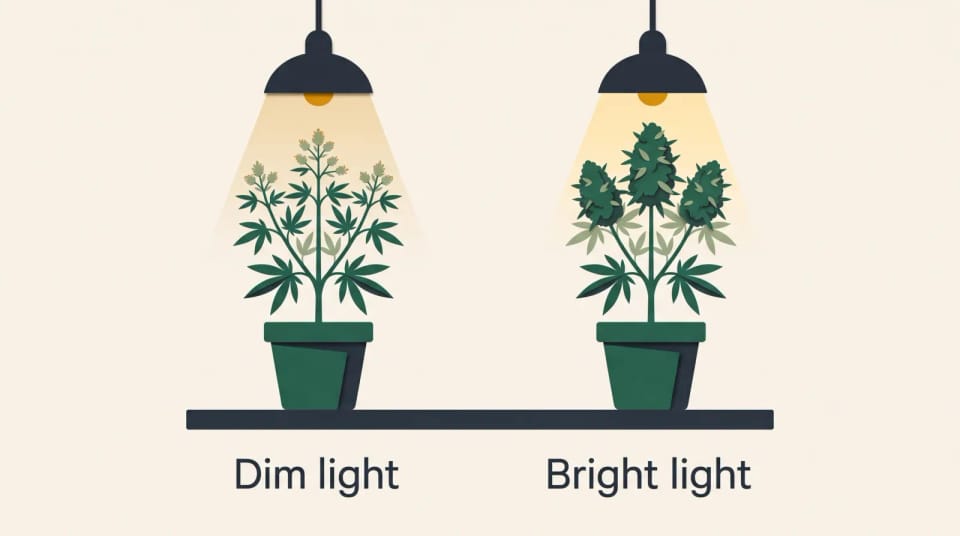
In a controlled trial, flower yield per square meter rose about 4.5 times from the dimmest to the brightest light, while cannabinoid concentration stayed the same. One cultivar, LED fixtures, not household bulbs.
Low light is not wasteful per watt, though. An older trial under high-pressure sodium lamps found the most grams per watt at the lowest power level. Potter and Duncombe, 2012 The real trade-off is grams per square meter against grams per watt.
Do LED grow lights really work better than regular LEDs?
Mostly because they put out more photons per watt and per square meter, not because household light is the wrong color. Spectrum matters a little. Quantity matters a lot.
| Question | Regular LED bulb | LED grow light |
|---|---|---|
| Photons per watt | about 1.3 micromoles per joule, our estimate | 2.5 to 2.8 in the 2020 review |
| Photons on one square meter | about 12 to 26 per bulb, calculated | sized to cover the area |
| Spectrum | white light | white, or white plus red |
| Built to aim light down at a canopy | no | yes |
The per-watt figures come from the same review, which reported grow fixtures at 2.5 to 2.8 micromoles per joule. A bulb at 12 micromoles per second on 9 watts gives about 1.3, so roughly half. Newer fixtures may do better. Kusuma, Pattison and Bugbee, 2020
On color, a Utah State hemp trial changed the blue share of light from 4% to 20% at the same intensity. Yield moved about 12%, and cannabinoid concentration did not change. Westmoreland, Kusuma and Bugbee, 2021 Compare that with the 4.5-times swing from intensity alone.
You may read that household bulbs “waste” green and yellow light. Leaf research does not support that. In sunflower leaves under strong white light, green light drove photosynthesis more effectively than red, because it reaches deeper into the leaf. Terashima et al., 2009 A warm or daylight bulb is fine in kind. It is just not enough.
If you decide to upgrade, our LED grow light buyer’s guide explains how to read PPFD and efficacy on a fixture.
How many household LED bulbs does it take to grow cannabis?
About 10 bulbs per square meter to match the dimmest flowering level tested, and about 50 to match the low end of a second trial. This table uses the best estimate first and the ceiling second, and assumes every photon lands on the canopy. No real setup manages that, so real counts run higher.
| Target light at the canopy | Where it comes from | 9 W bulbs per square meter | Bulb watts | Grow light watts at 2.5 per joule |
|---|---|---|---|---|
| 120 | Lowest flowering level in the 2021 trial | about 10 / 5 | about 90 | about 48 |
| 400 | Close to that trial’s vegetative level | about 33 / 15 | about 300 | about 160 |
| 600 | Lowest flowering level in the 2022 trial | about 50 / 23 | about 450 | about 240 |
| 1,000 | Highest flowering level in the 2022 trial | about 83 / 38 | about 750 | about 400 |
Bulb watts use the best-estimate count. For a wall-power sense check, our grow tent setup guide works from 30 to 40 watts of actual draw per square foot of canopy, which lands in the same range as the grow-light column.
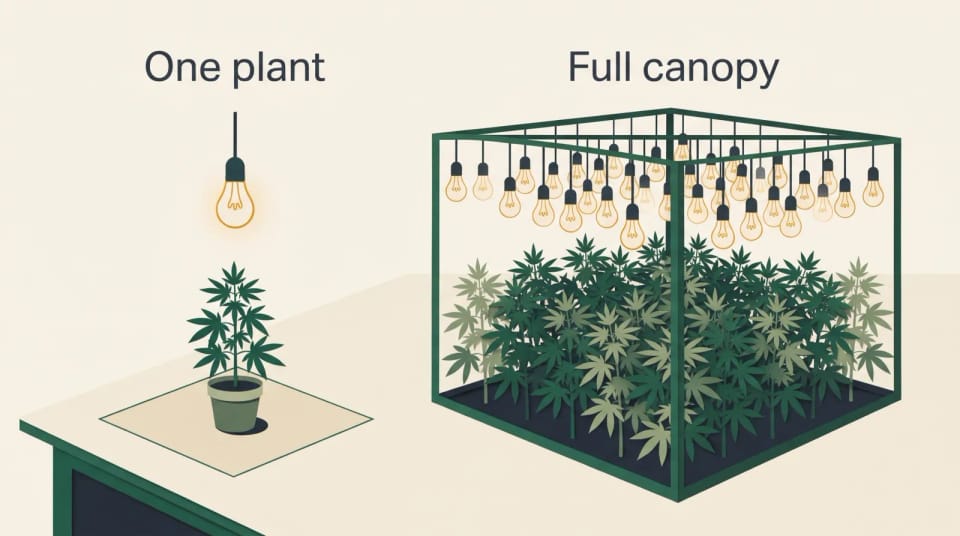
Calculated, not measured: matching the dimmest flowering level in one cannabis trial would take about 10 household LED bulbs per square meter, with every photon landing on the plants.
At that point you have spent more on bulbs, sockets and power than a small panel costs. If you only want one or two plants, the micro-growing guide shows the small-box fixture route, and what a first indoor grow costs helps you price it.
When is a regular LED bulb enough?
For rooting cuttings, keeping a small plant alive, or a single plant you accept will yield little. The evidence here is narrow, so here is exactly what it says.
- Rooting cuttings. In the 2021 trial, cuttings rooted for 14 days under about 100 micromoles per square meter per second of fluorescent light. Rodriguez-Morrison et al., 2021 One bulb close over a small tray can reach that range by our math.
- One small plant. A bulb aimed at a 30 cm square lands near the trial’s dimmest flowering level. Expect the low end of the yield range.
- Seedlings. We found no trial of cannabis seedling light needs, so we will not give you a number. Thin, stretched stems are the usual sign of too little light; our guide to common growing problems covers that.
We also found no cannabis trial of compact fluorescent or incandescent bulbs, so this article does not rate them. Whatever you use, light falls off quickly as the bulb moves away, as the area table above shows. Check how warm the bulb runs before you set it close to leaves.
If you do not control the light cycle, autoflowering versus photoperiod plants matters more than the bulb. For the whole picture, from seedling to harvest stages to the full beginner grow walkthrough, High School has you covered.
How do you check if your bulbs give enough light?
Use the box, then a meter if you can.
- Read the bulb box. Find the lumens and the actual watts. Ignore the “equivalent” wattage.
- Convert lumens to photons. Multiply lumens by about 0.015. An 800-lumen bulb gives about 12 micromoles per second.
- Divide by the area. Divide by the canopy area in square meters. Assume only part of the light lands on leaves.
- Compare with trial light levels. The 2021 trial tested 120 to 1,800. Near the bottom means a small harvest.
- Measure if you can. A PAR or quantum meter at the top of the canopy beats any estimate.
Key takeaways
- Regular LED bulbs can grow weed. The limit is how many photons land per square meter, not the color.
- One 800-lumen bulb makes about 12 micromoles of plant photons per second, by calculation; the ceiling is near 26.
- Matching the dimmest flowering level in one trial takes about 10 bulbs per square meter.
- In trials, more light meant much more flower per square meter, but not stronger flower.
- A bulb suits rooting cuttings or one small plant. Measure with a PAR meter before you trust any estimate.
FAQ
Can you grow weed with a regular light bulb?
A regular LED bulb can keep a cannabis plant alive and grow one small plant. It makes about half the photons per watt of a grow light, and its light spreads thin over any real area. We found no cannabis trial of compact fluorescent or incandescent bulbs.
Why does a 60-watt equivalent bulb not equal a grow light?
“60-watt equivalent” means the bulb looks as bright to your eyes as an old 60-watt incandescent. It actually draws about 9 watts. Plants respond to photons, not to brightness as people see it, so the label tells you little about plant growth.
Can household LEDs flower cannabis?
Yes. A controlled trial flowered plants at 120 micromoles per square meter per second, near what one bulb gives a single small plant. Yield at that level was the lowest in the trial, under a quarter of what the brightest level produced.
Does a white or daylight bulb matter for plants?
Not much. In a hemp trial, changing the blue share of light from 4% to 20% moved yield about 12%, while intensity changes in another trial moved yield about 4.5 times. Pick bulbs for photon output first, and treat color as a minor detail.
Is a regular LED cheaper to run than a grow light?
Not per photon. By our estimate, a household bulb makes about half the photons per watt of the grow fixtures in a 2020 review. To light the same area to the same level, bulbs draw roughly twice the power.
Sources
- Rodriguez-Morrison V, Llewellyn D, Zheng Y. “Cannabis Yield, Potency, and Leaf Photosynthesis Respond Differently to Increasing Light Levels in an Indoor Environment.” Frontiers in Plant Science. 2021;12:646020. DOI: 10.3389/fpls.2021.646020
- Llewellyn D, Golem S, Foley E, et al. “Indoor grown cannabis yield increased proportionally with light intensity, but ultraviolet radiation did not affect yield or cannabinoid content.” Frontiers in Plant Science. 2022;13:974018. DOI: 10.3389/fpls.2022.974018
- Kusuma P, Pattison PM, Bugbee B. “From physics to fixtures to food: current and potential LED efficacy.” Horticulture Research. 2020;7:56. DOI: 10.1038/s41438-020-0283-7
- Sharakshane A. “An easy estimate of the PFDD for a plant illuminated with white LEDs: 1000 lx = 15 μmol/s/m2.” bioRxiv preprint, not peer reviewed. 2018. DOI: 10.1101/289280
- Westmoreland FM, Kusuma P, Bugbee B. “Cannabis lighting: Decreasing blue photon fraction increases yield but efficacy is more important for cost effective production of cannabinoids.” PLOS ONE. 2021;16(3):e0248988. DOI: 10.1371/journal.pone.0248988
- Federal Trade Commission. “Shopping for Light Bulbs.” Consumer Advice, August 2023. consumer.ftc.gov
- Terashima I, Fujita T, Inoue T, Chow WS, Oguchi R. “Green light drives leaf photosynthesis more efficiently than red light in strong white light: revisiting the enigmatic question of why leaves are green.” Plant and Cell Physiology. 2009;50(4):684-697. PMID: 19246458
- Potter DJ, Duncombe P. “The effect of electrical lighting power and irradiance on indoor-grown cannabis potency and yield.” Journal of Forensic Sciences. 2012;57(3):618-622. PMID: 22211717



