Cannabis Chocolate Bark: A Recipe Built for Precise Dosing
Make cannabis chocolate bark with infused coconut oil, then score it into uniform pieces for a precise, repeatable per-piece dose every time.

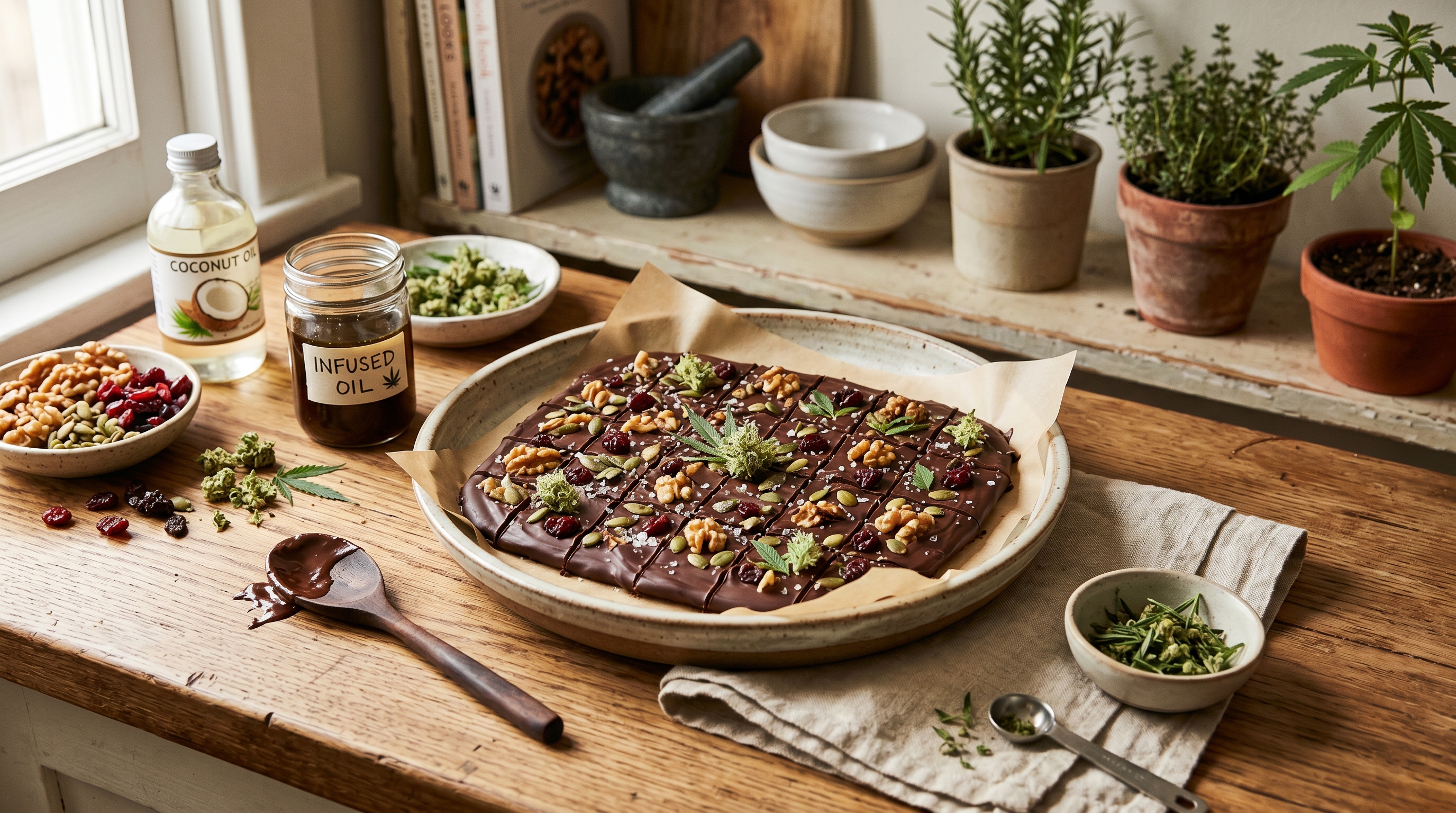
There is a special kind of regret that lives in homemade edibles. You eyeball the dose, swirl some infused oil into a batch, cut it into “roughly even” squares, and ninety minutes later you discover that “roughly even” was doing a lot of heavy lifting. One piece is a polite buzz. The next is a one-way ticket to the couch.
Here is the good news: chocolate bark is one of the most forgiving formats for fixing that problem. It is essentially a flat slab of chocolate that you score and snap into pieces. Unlike gummies poured into molds of slightly different volumes, or a brownie that bakes unevenly, bark gives you something rare in home edibles — a thin, uniform sheet where the infused fat is distributed evenly and every piece is the same thickness. Score it into a clean grid, divide your total milligrams by the number of pieces, and you get a per-piece dose you can actually trust.
This is Professor High’s guide to making cannabis chocolate bark with a dosing system baked in. We will cover the infused oil, the melt-and-set method (plus a proper temper if you want the glossy snap), the toppings, the storage, and — most importantly — the per-piece math that keeps “roughly even” from ruining your evening.
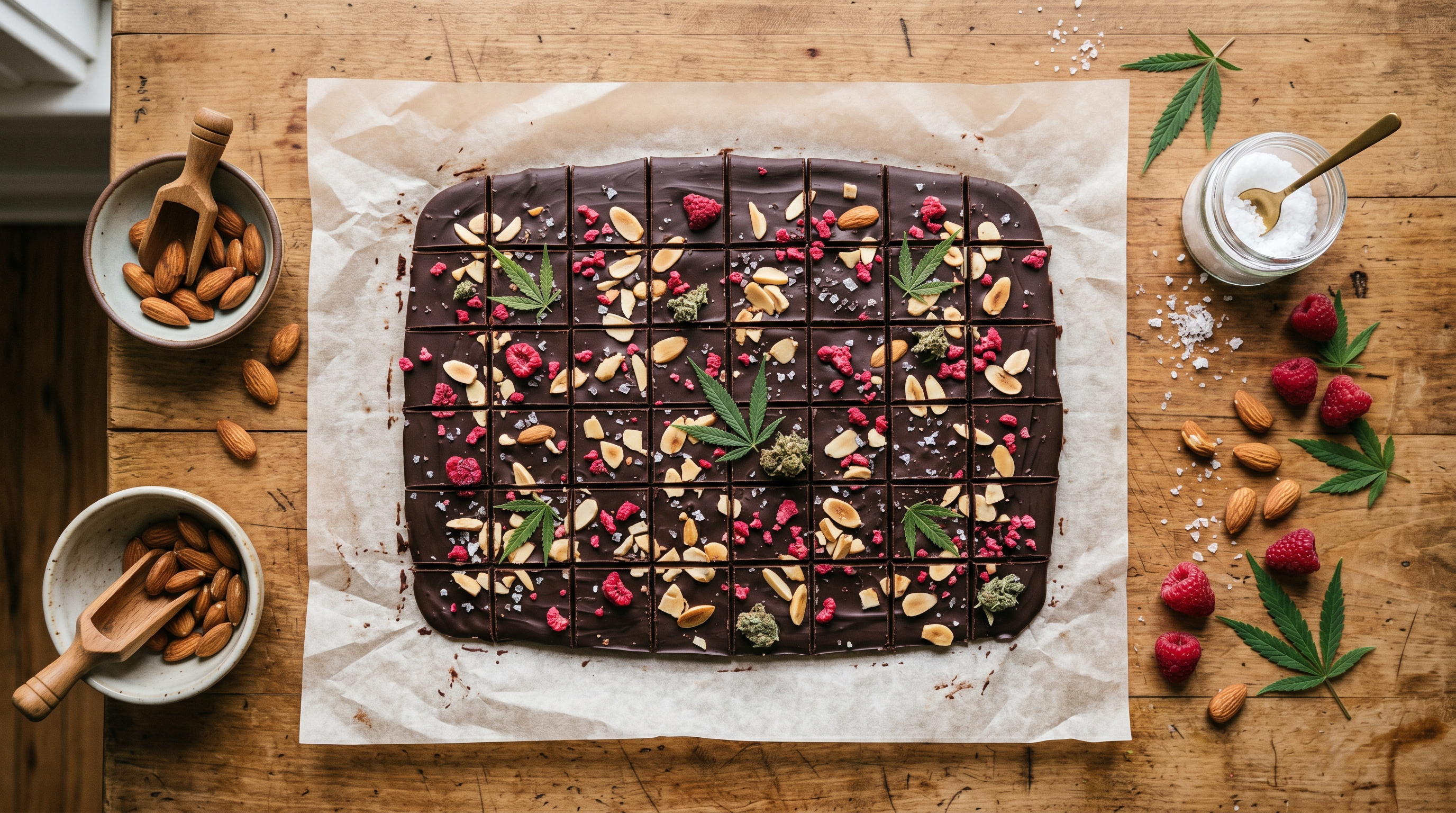
Why bark beats most homemade edibles for dosing
Most edible-dosing disasters come down to one of two problems: the infused fat isn’t evenly distributed, or the finished pieces aren’t actually the same size. Bark sidesteps both.
Because you stir your infused coconut oil into fully melted chocolate and then spread it into one thin, even layer, the cannabinoids are suspended uniformly across the whole sheet. There are no dense pockets and no weak corners — provided you stir thoroughly. And because bark is a flat slab you score before it fully hardens, you control exactly how many pieces you get. Twelve squares, twenty squares, thirty — your call. That number is the denominator in your dosing math, and you set it.
If you want the full theory behind why this matters, our deep dive on edible dosing math for home cooks walks through the same logic for any recipe. Bark just happens to make the math unusually honest.
One important caveat up front: every dosing number in this article is an estimate. Home infusions vary wildly in efficiency, lab-tested flower percentages are not always accurate, and your own tolerance is its own variable. Treat the math as a careful starting point, not a guarantee.
Ingredients and equipment
This recipe makes one standard sheet-pan slab of bark — enough to score into 20 to 24 pieces.
For the bark:
- 12 oz (about 340 g) good chocolate — dark (60-70% cacao) sets hardest and masks cannabis flavor best
- 1 to 2 tablespoons cannabis-infused coconut oil (coconut oil is ideal here because it stays semi-solid at room temperature and blends smoothly into chocolate)
- Optional: ¼ teaspoon flavorless oil or cocoa butter if your bark looks too stiff to spread
For the toppings (pick a few):
- Toasted chopped nuts — almonds, pecans, pistachios, hazelnuts
- Freeze-dried fruit — raspberries, strawberries, cherries (freeze-dried, not fresh; moisture ruins the set)
- Flaky sea salt
- Crushed pretzels, toasted coconut, cacao nibs, or a drizzle of contrasting chocolate
Equipment:
- A half sheet pan or large rimmed baking sheet
- Parchment paper
- A heatproof bowl and a saucepan (for a double boiler) — or a microwave
- An instant-read or candy thermometer (essential if you want a true temper)
- A flexible spatula and a sharp knife or bench scraper
You will also need infused coconut oil that you have already made and, ideally, have a rough potency estimate for. If you haven’t made it yet, start with our infused coconut oil recipe and the decarboxylation guide — proper decarb is what activates the THC in the first place, and skipping it is the single most common reason homemade edibles do nothing.
The golden rule: keep infused fat to a small fraction
This is the most important technical point in the whole recipe, so it gets its own section.
Chocolate sets because cocoa butter crystallizes into a stable structure. When you add extra fat — and infused coconut oil is extra fat — you interfere with that structure. Add too much and your bark will be soft, greasy, or refuse to harden at room temperature. The fix is simple: keep the infused oil to a small fraction of the total, generally no more than about 1 to 2 tablespoons per 12 ounces of chocolate. At that ratio the chocolate still sets cleanly, and you can always concentrate the dose by using more potent oil rather than more volume of oil.
If you need a higher total dose, do not pour in more oil. Make a stronger infusion instead, or simply cut the slab into fewer, larger pieces.
Step-by-step method
1. Prep your pan and toppings
Line a sheet pan with parchment. Chop nuts, measure out your freeze-dried fruit, and have your sea salt within reach. Bark sets fast once it hits cool surfaces, so toppings go on immediately — you don’t want to be chopping pecans while your chocolate seizes.
2. Melt the chocolate gently
You have two paths here.
The simple melt-and-set shortcut: Chop the chocolate, place about three-quarters of it in a microwave-safe bowl, and heat in 20- to 30-second bursts, stirring between each, until almost fully melted. Add the remaining quarter and stir off the heat until smooth. This residual-heat method gets you most of the way to a decent set without a thermometer. It’s the right choice for a casual batch.
The proper temper (for glossy snap): If you want bark that shines and breaks with a crisp snap, temper it. Melt about three-quarters of your chopped chocolate over a double boiler, stirring, until dark chocolate reaches roughly 115°F (around 45°C). Pull it off the heat and stir in the reserved quarter of solid chocolate — this is called seeding, and the unmelted cocoa-butter crystals guide the whole bowl into proper temper. Stir until it cools to about 84°F (around 29°C). Tempering is genuinely fussy, and a casual melt-and-set works fine for most people, so don’t let it scare you off making bark at all.
3. Stir in the infused oil thoroughly
Once your chocolate is melted and smooth, add the infused coconut oil and stir for a full minute. This is your one job that protects every later dose: even distribution. A lazy swirl leaves cannabinoid-rich streaks, which means some pieces hit harder than others. Stir like the evenness of your evening depends on it, because it does.
4. Spread into a thin, even layer
Pour the chocolate onto the parchment and spread it with a spatula into an even rectangle, ideally about ¼-inch (6 mm) thick. Even thickness is the second half of even dosing — a slab that’s thick in the middle and thin at the edges produces uneven pieces no matter how carefully you cut.
5. Add toppings and set
Scatter your nuts, fruit, and a pinch of flaky salt over the surface, pressing gently so they stick. Let the bark set at cool room temperature, or chill it in the fridge for 20 to 30 minutes until fully firm. (If you tempered properly, room-temperature setting preserves the gloss better than the fridge.)
6. Score and snap into uniform pieces
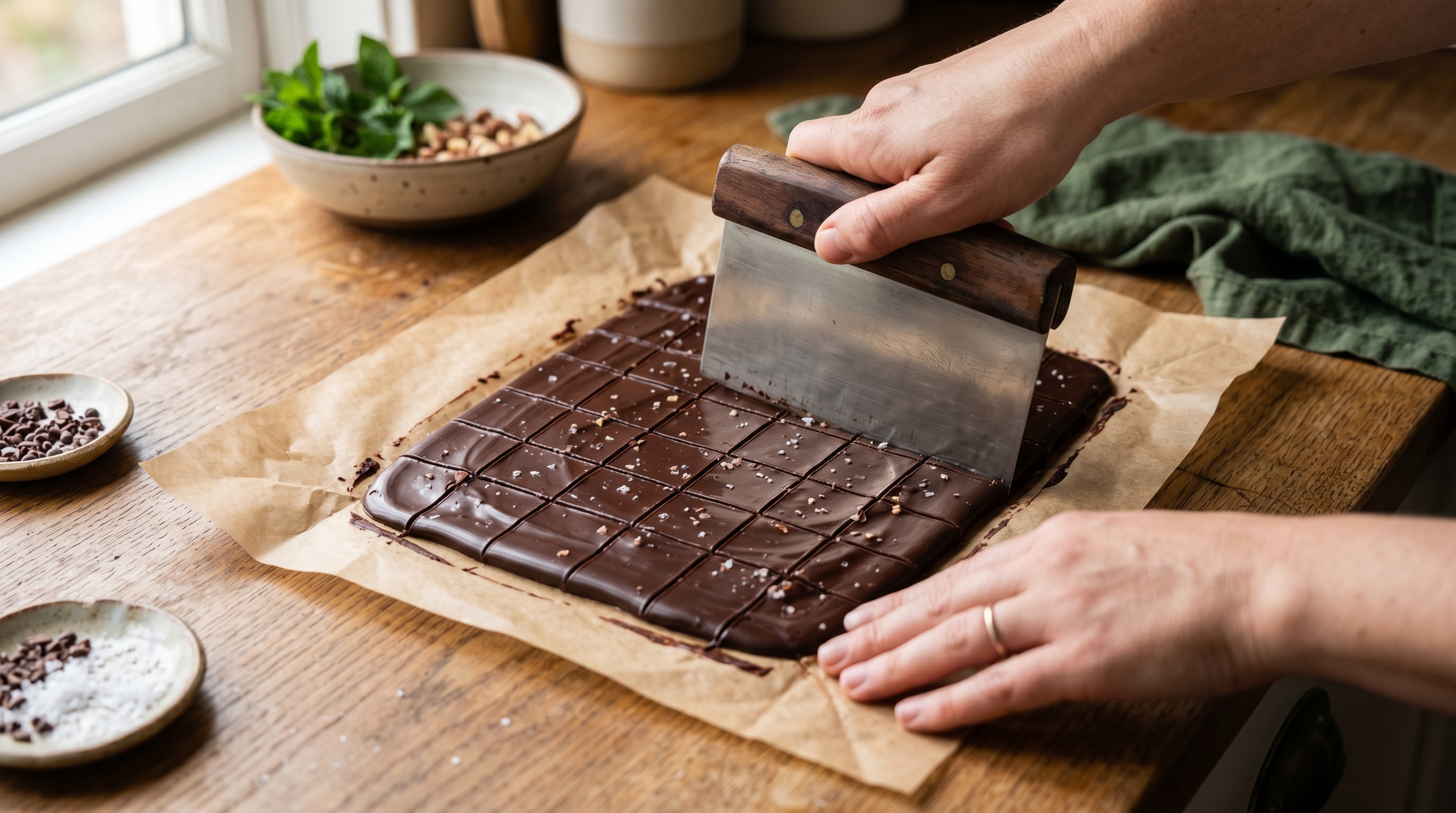
Here is where the dosing happens. Before the bark is rock-hard — or with a sharp knife once it’s set — score it into a clean, regular grid. Decide your piece count now, because that number drives the math in the next section. A 20-piece grid (4 by 5) is a clean, easy target. Snap along the score lines.
The per-piece dosing calculation
This is the part that turns a recipe into a dosing system. The math has three steps.
Step 1 — Estimate the total THC in your infused oil.
Start from the flower you decarbed and infused. The rough formula:
grams of flower × (THC% as a decimal) × 1000 = total mg of THC, before losses
Say you infused 7 grams of flower that tested at 20% THC:
7 × 0.20 × 1000 = 1,400 mg of THC potential.
Now apply a realistic efficiency haircut. Decarboxylation, infusion, and straining are all lossy, and home extraction commonly captures only somewhere around half to two-thirds of the theoretical maximum. If we assume a conservative ~50% real-world efficiency:
1,400 mg × 0.50 ≈ 700 mg of THC actually in your finished oil.
Step 2 — Figure out how much THC went into the bark.
If that 700 mg is spread across, say, 14 tablespoons of finished oil (a typical yield), that’s roughly 700 ÷ 14 = 50 mg per tablespoon. If you stir 2 tablespoons of that oil into your bark, the whole slab holds about 2 × 50 = 100 mg of THC.
Step 3 — Divide by your piece count.
Score the slab into 20 pieces:
100 mg ÷ 20 pieces = 5 mg of THC per piece (estimated).
Want a lower dose? Cut the same slab into 40 smaller pieces for roughly 2.5 mg each. Want a stronger piece? Use only 10 larger pieces for roughly 10 mg each. The total dose in the slab never changed — you just changed the denominator.
If all of this feels like a lot, our dosing math for home cooks breaks it down further, and the beginner’s dosing chart gives you sensible per-serving targets. For most newcomers, a 2.5 to 5 mg piece is a sane place to begin.
Safety, labeling, and start low, go slow
Edibles are not like smoking. The effects arrive slowly — often 45 minutes to 2 hours — and they tend to feel stronger and last longer, in part because your liver converts THC into a more potent metabolite. Our explainer on why edibles hit harder covers the 11-hydroxy-THC science, and the 2-hour rule is the single best habit for avoiding the classic “I didn’t feel it so I ate three more” mistake.
A few non-negotiables:
- Start low, go slow. Eat one piece. Wait two full hours before deciding whether to eat more. Every time.
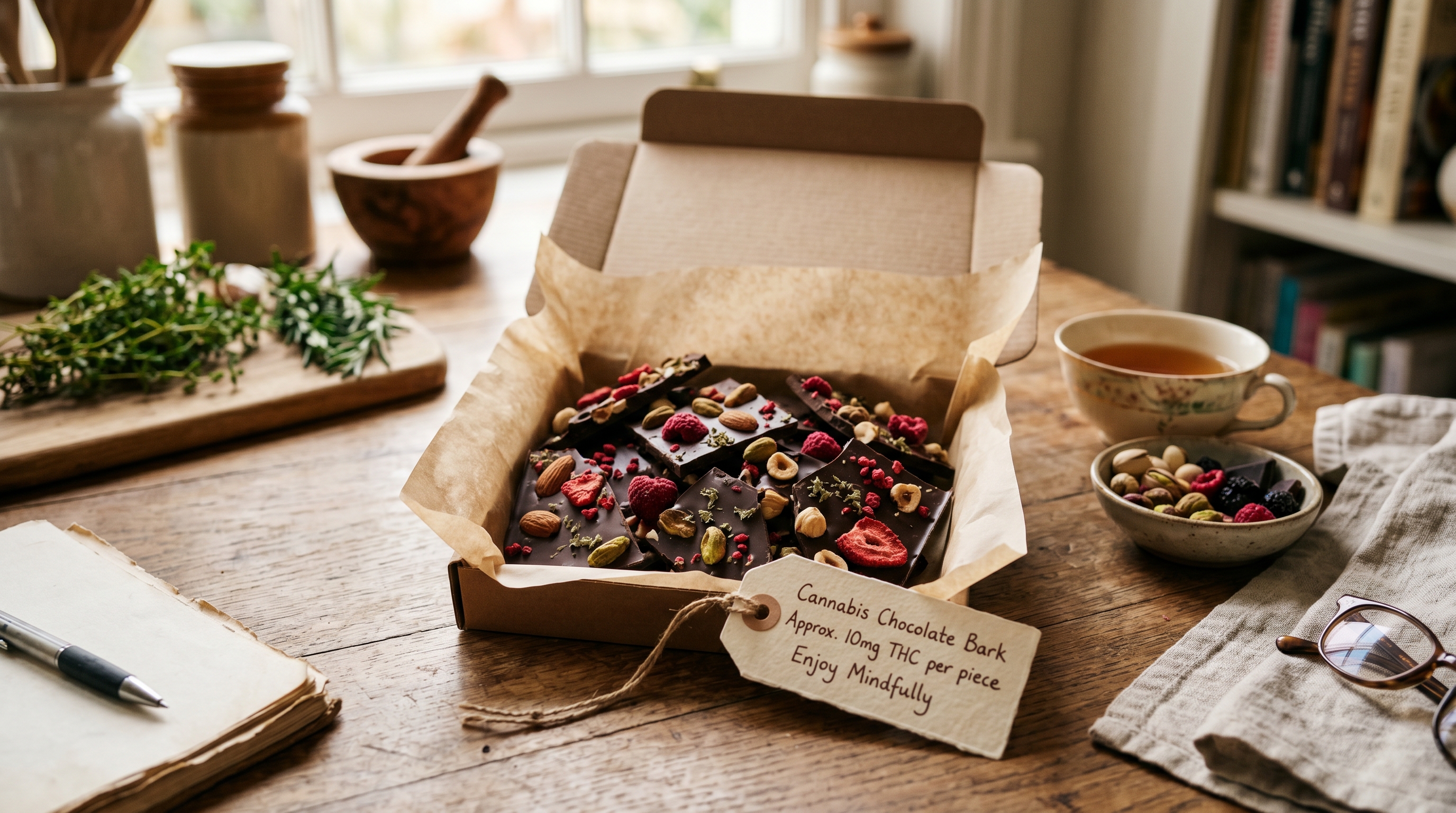
- Label everything. Homemade bark looks exactly like the dessert it is. Write the estimated per-piece dose and total piece count on the container, and never leave it where children or pets can reach it. Cannabis chocolate is a real poisoning risk for both — keep it locked away.
- Treat your numbers as estimates. Until you’ve tested a batch on yourself at a low dose, you don’t truly know its strength. If you want more certainty, our guide on testing homemade edible potency at home covers the options.
- Don’t mix with alcohol when you’re still learning your dose.
Nothing here is medical advice. If you use cannabis for a health condition, talk to a clinician, and check your local laws — legality varies enormously by location.
Choosing flower for your infusion
The strain you decarb and infuse shapes both flavor and the kind of experience your bark delivers, because terpenes survive infusion and ride along with the cannabinoids.
For a relaxed, dessert-after-dinner bark, myrcene-forward flower from the Relax High family pairs naturally with dark chocolate. Classic choices include Granddaddy Purple, Northern Lights, and Bubba Kush — their myrcene content leans toward relaxed and sleepy effects, which is exactly what you want in an evening treat.
If you’d rather your bark not flatten you, reach for something brighter. Strains in the Uplift High family — like Super Lemon Haze, Tangie, or the citrusy Blue Dream — bring limonene, which tends toward euphoric and happy notes and even complements orange-zest bark beautifully. For something steadier and pepper-forward, caryophyllene-rich strains from the Relief High family such as GSC or Wedding Cake round out a richer dark-chocolate slab. Beginners who want gentle, predictable effects might lean toward the low-diversity Balance High family, or balanced-cannabinoid options like Harlequin for a milder, more creative feel.
Flavor and topping ideas
Bark is a blank canvas. A few combinations that work especially well:
- Dark chocolate + flaky sea salt + toasted almond — the classic, and the salt mutes any lingering cannabis grassiness.
- Dark chocolate + freeze-dried raspberry + pistachio — tart, jewel-toned, very giftable.
- White or milk chocolate + crushed peppermint — holiday peppermint bark, dosed.
- Dark chocolate + orange zest + cacao nibs — pairs with citrusy limonene strains.
White and milk chocolate contain more milk solids and sugar and set a little softer, so be even more conservative with your infused-oil ratio if you go that route.
Storage
Wrap finished pieces in parchment and store them in an airtight container. Properly stored bark keeps for roughly up to 2 weeks at cool room temperature, about 4 weeks refrigerated, or several months frozen — keep it away from heat and light, which degrade both the chocolate and the cannabinoids over time. Our edibles shelf-life and storage guide has the full breakdown, including how potency fades with age. Always store dosed bark separately from regular chocolate so nobody grabs the wrong square.
Want bark that actually fits you?
Here’s the part the recipe can’t do for you: the strain that makes one person melt into the couch makes another feel bright and chatty. The bark format gives you a consistent dose, but the right dose and the right strain are personal. That’s the whole reason we built the High IQ app — to help you track which infusions, doses, and strains actually work for your body, so your next batch isn’t a guess. Log a batch, note how 5 mg felt, and let your own patterns guide your next slab.
If you want to keep cooking, our cannabutter foundation guide and the DIY gummies dosing guide round out a complete home-edibles toolkit, and the high-dose vs. microdose explainer helps you decide where your bark should land.
Key Takeaways
Professor High’s takeaway: Bark is the rare edible where the format does the dosing work for you. Make a known-strength infusion, keep the infused fat to a small fraction so the chocolate still sets, stir it in evenly, spread it thin, and score a clean grid. Total milligrams divided by piece count equals your per-piece dose. Then — always — start low and go slow, because your math is an estimate and your body has the final say.


