Reagan's War on Drugs: How 'Just Say No' Shaped Cannabis Culture
How Reagan's 1980s drug war, 'Just Say No,' DARE, and the 100:1 crack disparity built mass incarceration and the cannabis stigma we're still undoing.


If you grew up after 1985, you learned a version of cannabis history before you ever met the plant. A first lady’s three-word slogan. A frying egg on TV. A police officer in your fifth-grade class warning that one joint led to a needle in an alley. None of that was an accident. It was a planned campaign, and its fingerprints are still all over how America talks about weed today.
The 1980s War on Drugs did not invent cannabis prohibition. Across the long history of cannabis, the plant moved from ancient medicine to outlaw. The 1937 Marihuana Tax Act and the 1970 Controlled Substances Act had already done the legal heavy lifting. The Reagan era did something quieter and more lasting. It scaled prohibition up to a massive size. Then it wrapped it in a moral story so total that doubting the policy felt like cheering for drugs. To understand the legalization debates of 2026, you have to understand that machine — who built it, what it cost, and who paid.
So let’s open the textbook. Professor High has tenure, and this is the lecture nobody assigned you in school.

Reagan’s Escalation: From Strategy to Machine
President Nixon declared drugs “public enemy number one” in 1971. His aide John Ehrlichman later admitted the campaign was built partly to disrupt Black communities and the antiwar left [Baum, 2016]. But Nixon’s drug war was small next to what came next.
Reagan took office in 1981. He reframed drug use. It was no longer a health problem. Now it was a moral and criminal one. Spending on drug law enforcement nearly tripled in his first term — a number Reagan touted in a 1986 message to Congress [Sacco, 2014]. The logic was simple. Be “intolerant” of drugs. Lean hard on the police. Treat every user as a soldier in a war.
The words mattered because they set the terms. When he signed the 1986 drug bill, Reagan called drug use “evil.” The goal, he said, was “nothing less than a drug-free generation.” That left no room for nuance. There was no line drawn between cannabis and heroin. There was no nod to the fact that some drugs carry very different risks. It all got swept into one war. As we explain in why the medical-versus-recreational divide is artificial, flattening distinctions like this does lasting harm.
“Just Say No” and DARE: The Cultural Front
The smart move in the Reagan-era drug war was that it didn’t just pass laws — it sold a brand. First Lady Nancy Reagan led the campaign.
The story goes that a schoolchild asked Mrs. Reagan what to do if offered drugs. She answered, “Just say no.” Whether the story is exactly true matters less than what it became. By the 1986 bill signing, Reagan reported more than 10,000 “Just Say No” clubs across the country. The slogan turned a hard medical question into a simple act of willpower. If you used drugs, you just hadn’t said no hard enough.
Then came DARE — Drug Abuse Resistance Education. It launched in Los Angeles in 1983 and spread fast. At its peak DARE reached about 75% of American school districts and ran in 43 countries. Police officers in uniform taught kids to resist drugs. Parents, schools, and police loved it.
It also didn’t work. This is one of the best-documented findings in public-health research:
- Ennett et al. (1994), a meta-analysis in the American Journal of Public Health, found DARE’s effect on drug use was tiny [Ennett, 1994].
- Lynam et al. (1999) followed students for ten years. DARE graduates were no less likely to use drugs than other kids [Lynam, 1999].
- The U.S. Government Accountability Office reviewed the research in 2003 and found “no significant differences in illicit drug use” between DARE students and controls [GAO, 2003].
Some studies even hinted DARE graduates were more likely to try drugs later. The likely reason? The program’s wild warnings broke down once kids met the real world. When a kid is told cannabis is as deadly as heroin, then watches a friend smoke and stay fine, the whole lesson falls apart. That broken trust is why the gateway-drug myth has been so hard to kill. It is also why honest, evidence-based cannabis education matters so much now.

The 1986 and 1988 Acts: Mandatory Minimums Become Law
The big laws arrived in the fall of 1986. They were forged in panic.
On June 19, 1986, University of Maryland basketball star Len Bias died of a cocaine overdose. The Boston Celtics had drafted him two days earlier. House Speaker Tip O’Neill hailed from Massachusetts, the Celtics’ home, and the death set off a firestorm. Congress drafted the Anti-Drug Abuse Act of 1986 (Public Law 99-570) at top speed — mostly without committee hearings. Reagan signed it on October 27, 1986, just before the midterm elections [Wikipedia, 2010]. Some still call it the “Len Bias Law.”
The 1986 Act’s key feature was a two-tier system of mandatory minimum sentences for drug trafficking. They were among the harshest in U.S. history [Sklansky, 1995]. Five years without parole for some amounts. Ten years for larger ones. The catch is that mandatory minimums tie a judge’s hands. The amount of drug, not the facts of the person, sets the sentence.
Two years later, the Anti-Drug Abuse Act of 1988 (Public Law 100-690) went further. It created the Office of National Drug Control Policy and the “drug czar.” It pushed mandatory minimums onto conspiracy and attempt charges. It made simple possession of crack — and only crack — carry a mandatory minimum for a first offense: five years for more than five grams. It also locked in “zero tolerance.” A casual user could now lose federal benefits, student aid, or public housing.
This was the machinery of mass incarceration. Cannabis was written right into it. The 1986 Act set a 100-kilogram threshold for marijuana trafficking minimums, lumping the plant in with heroin and PCP.
Crack vs. Powder: The 100:1 Disparity and Racial Injustice
Here is where the policy stopped being just harsh. In its effects, it became a racial sentencing multiplier.
Crack and powder cocaine are nearly the same drug in chemistry. The 1986 Act punished them in wildly different ways. Five grams of crack — about the weight of two sugar packets — drew the same five-year minimum as 500 grams of powder. That is a 100-to-1 ratio. The Stanford Law Review found no clear reason for the ratio in the record. Congress just divided the powder amounts by 100 [Sklansky, 1995].
The fallout fell along stark racial lines. Crack was cheaper and more common in Black communities. Powder cost more and was tied to white users. The U.S. Sentencing Commission’s data is clear. In the early 1990s, more than 90% of federal crack defendants were Black, yet most crack users nationwide were white or Hispanic. The ACLU put it plainly. Black Americans were about 15% of drug users but 74% of those sent to prison for a drug offense [ACLU, 2020].
The Commission saw the problem early. It urged Congress to cut the gap in 1995, 1997, and 2002 [USSC, 2002]. Congress said no each time. It was the first time in the Commission’s history that Congress flatly rejected its advice. The Fair Sentencing Act of 2010 finally cut the ratio from 100:1 to 18:1. The First Step Act of 2018 made that cut retroactive. A true 1:1 ratio still is not federal law as of 2026.
Intent and impact are not the same thing. The Commission found no proof that Congress meant to target Black Americans. But as the Commission itself said, if the impact is discriminatory, the harm is no less real. A 2018 study in BMC International Health and Human Rights found the gap didn’t even meet its own goal. The mandatory minimums showed no measurable effect on actual cocaine use [Pearl, 2018]. The policy didn’t cut drug use. It cut freedom — and it did so unequally.
Mass Incarceration: Counting the Cost
Numbers tell this part better than adjectives. The federal prison population roughly doubled in the 1980s. States copied the federal template and drove their own counts to record highs [Brennan, 2021]. The 1984 Comprehensive Crime Control Act had already ended federal parole, so the long sentences stuck. By the time the dust settled, the United States held the largest prison population on Earth. Much of it was built on low-level, nonviolent drug cases.
The damage spread far past prison walls. A drug conviction could cost a person the right to vote. It could end student aid, block public housing, and — for noncitizens — trigger deportation. Whole neighborhoods lost a generation of working-age people. That deepened the racial wealth gaps that leaders later struggled to explain. As Maryland Governor Wes Moore put it in 2024, these were “tools that have led to the mass incarceration of Black men and boys” [NPR, 2024].
The Lasting Stigma on Cannabis
You might ask a fair question. Most of this was about crack and cocaine. Why does it matter so much for cannabis?
Because the War on Drugs blurred the lines between drugs. It then locked cannabis into the “drug menace” box in the public mind. The plant caught the moral panic but never earned the science. Decades of reefer-madness-style messaging in film and television — plus DARE’s all-drugs-are-deadly lessons — taught two full generations that cannabis was a hard drug and a path to ruin.
That stigma had real, countable costs. Long after views began to shift, cannabis stayed the single largest driver of drug arrests. The ACLU’s 2020 report, A Tale of Two Countries, found that cannabis possession arrests still topped drug enforcement. A Black person was 3.64 times more likely to be arrested for cannabis than a white person — even though both groups use it at about the same rate [ACLU, 2020]. The stigma shaped daily life too: workplace drug testing, zero-tolerance job rules, and the sense that weed was something to hide. Even the way cannabis culture grew differently around the world — and how countries like Germany approached legalization — traces in part to how hard the U.S. pushed its drug-war model abroad. The stigma also shaped community rituals, from coded language to the rise of 420 as a cultural touchstone.
The science the drug war ignored is now catching up. The plant’s effects come from terpenes and cannabinoids working with your body’s own endocannabinoid system — not from any moral failing. CBD has driven a medical breakthrough in epilepsy care. And seniors are now among the fastest-growing groups of cannabis users. The “Just Say No” generation, it turns out, said yes — once the facts arrived.
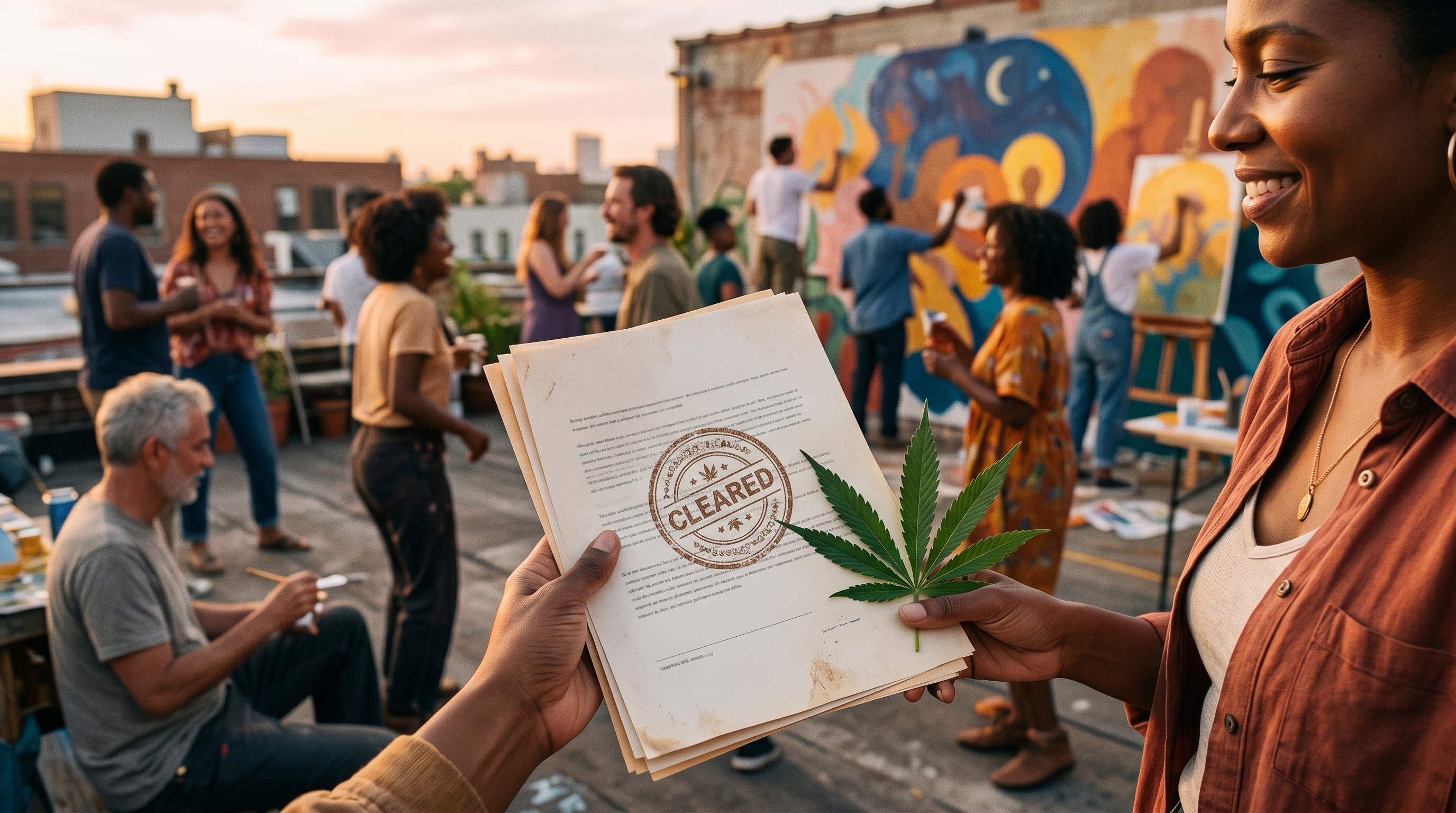
The Legacy: Reform, Expungement, and What Comes Next
The shift since the 1980s is striking. Two out of three Americans now back legalization. Recreational cannabis is legal in 24 states and Washington, D.C., as of 2026 — you can see the full state-by-state map of where weed is legal. The patchwork even shapes how you have to travel with cannabis across state lines. And in 2024 the federal government moved to reschedule cannabis to Schedule III. It was the biggest federal step in half a century toward admitting the old rules were wrong [ACLU, 2024].
But legal sales alone do not undo the drug war’s harm. More and more, reformers frame the work ahead as a racial-justice project, not just a business one. Three themes stand out:
- Expungement and pardons. California and Illinois built automatic record-clearing into legal cannabis. In 2024, Maryland Governor Wes Moore pardoned about 175,000 cannabis convictions in one stroke. He followed Massachusetts Governor Maura Healey’s sweeping pardons months before. NORML says hundreds of thousands of convictions have now been cleared or sealed nationwide [NPR, 2024].
- Gaps that won’t close. A May 2026 Weill Cornell study in the American Economic Journal: Economic Policy found legal cannabis cut arrests sharply. But racial gaps in arrests held steady, and prison admissions for drug crimes fell only for white people [Meinhofer, 2026]. Legalization shrank the gap. It did not close it.
- Federal reform still waiting. Advocates point to the MORE Act and the Cannabis Administration and Opportunity Act. Both bills would drop federal penalties. Both would pair legal cannabis with record-clearing and money for the communities prohibition hit hardest.
Here is the throughline. The Reagan era taught America to fear cannabis. Undoing that takes more than a new law. It takes a new story — swapping slogans for science, and panic for honest, personal understanding. The goal is to let each person learn how cannabis actually affects them. That is the whole idea behind tracking your own patterns in the High IQ app instead of trusting a stranger’s moral certainty. The drug war’s worst lie was that one rule fits everyone. The truth is the opposite.
Key Takeaways
- The Reagan era did not start cannabis prohibition. It scaled it up and wrapped it in fear.
- “Just Say No” and DARE were huge cultural campaigns. DARE reached 75% of school districts, yet research found it did not reduce drug use.
- The 1986 and 1988 Anti-Drug Abuse Acts built mandatory minimums and the 100-to-1 crack-powder gap.
- That gap fell mostly on Black Americans and helped fuel mass incarceration, even though use rates were similar across races.
- Cannabis inherited the stigma. Today’s reform — legalization, expungement, and rescheduling — is the slow work of undoing it.
Frequently Asked Questions
Did Reagan start the War on Drugs? No — Nixon coined the phrase and launched the federal campaign in 1971, and prohibition dates back to the 1937 Marihuana Tax Act. Reagan escalated it dramatically, nearly tripling enforcement spending and signing the mandatory-minimum laws that built the modern incarceration system.
What was the 100:1 crack-powder disparity? The 1986 Anti-Drug Abuse Act set crack cocaine sentencing thresholds at one-hundredth the weight of powder cocaine — five grams of crack carried the same five-year mandatory minimum as 500 grams of powder. Because crack arrests fell disproportionately on Black Americans, the ratio functioned as a racial sentencing multiplier. It was reduced to 18:1 by the Fair Sentencing Act of 2010.
Did DARE actually work? Multiple meta-analyses and a ten-year follow-up study found DARE had no statistically significant effect on drug use, and the GAO confirmed this in 2003. Some research suggested it may have slightly increased later use by undermining the credibility of drug-safety messaging.
Is the War on Drugs over? Not entirely. While 24 states have legalized recreational cannabis and the federal government moved to reschedule it in 2024, cannabis remains federally controlled, hundreds of thousands of people carry convictions, and racial disparities in arrests persist even in legal states, according to 2026 research.
Why does the 1980s drug war still affect cannabis today? It cemented a cultural stigma that lumped cannabis in with hard drugs, drove decades of disproportionate arrests, and shaped workplace, legal, and social attitudes that reform is only now beginning to unwind.
Sources
- [Sacco, 2014] Congressional Research Service, Drug Enforcement in the United States: History, Policy, and Trends (Lisa N. Sacco), congress.gov.
- [Wikipedia, 2010] Anti-Drug Abuse Act of 1986 (Pub. L. 99-570), congress.gov / GovTrack; Wikipedia summary. Anti-Drug Abuse Act of 1988 (Pub. L. 100-690), Reagan Library.
- [Baum, 2016] Dan Baum, “Legalize It All,” Harper’s Magazine (2016) — reporting the John Ehrlichman interview.
- Reagan, “Remarks on Signing the Anti-Drug Abuse Act of 1986,” The American Presidency Project; “Remarks on Signing the Anti-Drug Abuse Act of 1988,” Reagan Library.
- [Sklansky, 1995] Sklansky, D., “Cocaine, Race, and Equal Protection,” 47 Stanford Law Review 1283 (1995).
- [USSC, 2002] U.S. Sentencing Commission, Cocaine and Federal Sentencing Policy (1995, 1997, 2002 reports); “The Crack Sentencing Disparity and the Road to 1:1.”
- [Brennan, 2021] Brennan Center for Justice, “Race, Mass Incarceration, and the Disastrous War on Drugs” (2021).
- [Pearl, 2018] BMC International Health and Human Rights, “Mandatory minimum sentencing policies and cocaine use in the U.S., 1985–2013” (2018).
- [Ennett, 1994] Ennett et al., “How effective is drug abuse resistance education?” American Journal of Public Health 84(9) (1994). [Lynam, 1999] Lynam et al., “Project DARE: No effects at 10-year follow-up” (1999). [GAO, 2003] U.S. Government Accountability Office, GAO-03-172R (2003).
- [ACLU, 2020] ACLU, A Tale of Two Countries: Racially Targeted Arrests in the Era of Marijuana Reform (2020); “Marijuana Legalization Is a Racial Justice Issue” (2019). [ACLU, 2024] ACLU rescheduling statement (2024).
- [Meinhofer, 2026] Meinhofer et al., “State Recreational Cannabis Laws and Racial Disparities in the Criminal Legal System,” American Economic Journal: Economic Policy (2026); Cornell Chronicle summary.
- [NPR, 2024] NPR, “Maryland is pardoning 175,000 marijuana convictions” (2024).
Professor High teaches the history nobody assigned you. The plant didn’t change between 1986 and 2026 — the story we tell about it did. Learn the facts, track your own experience, and never let a slogan think for you.


