The 1970 Controlled Substances Act: How Cannabis Became Schedule I
How a 1969 Supreme Court ruling, Nixon's politics, and an ignored 1972 commission landed cannabis in Schedule I — and the long road back.


Here is a fact that should stop you cold. Under federal law, cannabis sits in the same legal box as heroin. Fentanyl — the opioid that kills tens of thousands of Americans each year — sits one rung below it, in Schedule II. That is not a quirk of chemistry. It is a political choice made in 1970. A commission the president himself appointed argued against it. And the label has stayed frozen for more than half a century.
I am Professor High, and I read terpene chemistry for a living. But to grasp why cannabis is classified this way, you have to put down the lab notebook and pick up the legislative record. The story of how cannabis became a Schedule I drug is not really about science. It is about a Supreme Court ruling, a new president, a buried report, and one quote from a Watergate conspirator that lays the whole thing bare.
Let me walk you through it.

From Leary to the CSA: why the old law collapsed
Before 1970, federal cannabis prohibition rested on a strange piece of law: the 1937 Marihuana Tax Act. Congress did not ban cannabis outright. Instead it used its taxing power to make the plant nearly impossible to hold or sell legally. You needed a tax stamp to obey the law. But to get that stamp, you had to admit you held a drug that was illegal under state law everywhere. In other words, the law forced you to confess to a crime.
That trap finally caught up with the government in Leary v. United States, decided May 19, 1969 [Leary, 1969]. Timothy Leary, the Harvard psychologist turned counterculture icon, had been convicted under the Tax Act. Officers found cannabis in his car at the Texas-Mexico border. He challenged the law on Fifth Amendment grounds. A unanimous Supreme Court agreed with him. The Marihuana Tax Act was unconstitutional.
That ruling left the federal government with no working tool to ban cannabis. Congress needed a new legal footing. It could no longer lean on taxes, so it turned to its power to regulate interstate commerce. The answer arrived the next year.
Nixon and the five schedules
On October 27, 1970, President Richard Nixon signed the Comprehensive Drug Abuse Prevention and Control Act of 1970 (Public Law 91-513, 84 Stat. 1236). Buried inside it, as Title II, was the Controlled Substances Act — the CSA. It swept away the patchwork of older drug laws and put a single federal system in its place. That system still runs drug policy today.
The CSA’s central innovation was a system of five “schedules,” ranking substances by abuse potential and accepted medical use:
- Schedule I — high abuse potential, no accepted medical use, no accepted safety even under medical supervision. The most restrictive category. (Heroin, LSD.)
- Schedule II — high abuse potential, but with accepted medical use under strict controls. (Morphine, cocaine, fentanyl, oxycodone.)
- Schedule III — moderate-to-low physical dependence, accepted medical use. (Ketamine, anabolic steroids, Tylenol with codeine.)
- Schedule IV — lower abuse potential. (Xanax, Valium, Ambien.)
- Schedule V — lowest abuse potential. (Cough syrups with small amounts of codeine.)
The schedule a drug lands in is not a footnote. It determines criminal penalties, who can prescribe it, and — critically — how hard it is to research. And cannabis was placed at the very top: Schedule I.

Cannabis as Schedule I — “temporarily”
Here is the detail most people never learn: cannabis’s Schedule I placement was supposed to be temporary.
While the CSA was being drafted, Assistant Secretary of Health Roger O. Egeberg wrote to Congress in August 1970. He recommended that cannabis go into Schedule I “at least until the completion of certain studies now underway.” Those studies pointed to a commission the law itself created — the National Commission on Marihuana and Drug Abuse. Schedule I was meant to be a placeholder. It was a parking spot for the plant while a serious federal study figured out where it really belonged.
That is worth sitting with. The harshest drug class in American law was handed to cannabis as a holding pattern, pending evidence. The evidence came. The label never moved.
To meet the Schedule I test, the government had to claim cannabis has “no currently accepted medical use.” This set up a vicious circle that still runs today. You need a Schedule I license to study a Schedule I drug. That makes the research very hard to do. And with little research, the “no accepted medical use” finding stays in place. The label justified itself. The lack of research was the evidence.
The Shafer Commission (1972) — and the report Nixon ignored
The commission was led by Raymond P. Shafer, the former Republican governor of Pennsylvania and a Nixon ally. The president had every reason to expect a loyal, law-and-order verdict. On the White House tapes, he made his wishes plain. In a recorded September 1971 talk, he told Shafer to “keep your commission in line.”
The Shafer Commission did not stay in line. It spent two years on what is still the most thorough federal study of cannabis ever done. Then, on March 22, 1972, it delivered its first report: Marihuana: A Signal of Misunderstanding [Shafer, 1972]. The findings were blunt:
- “Neither the marihuana user nor the drug itself can be said to constitute a danger to public safety.”
- On the gateway theory: “No verification of a causal relationship between marihuana use and the subsequent use of other drugs has been produced.”
- The commission concluded that “total prohibition is functionally inappropriate” and called criminal penalties for personal possession “constitutionally suspect.”
Its recommendation: decriminalize possession of small amounts of cannabis for personal use. Not full legalization — just the removal of criminal penalties for the individual user.
Nixon rejected the report before it was even released. In a televised May 1, 1971 news conference — nearly a year early — he had already declared: “Even if the Commission does recommend that it be legalized, I will not follow that recommendation.” When the report landed, he would not engage with it. He did not dispute its evidence or offer a counter-argument. He simply ignored his own commission. The “temporary” Schedule I label became, by the stroke of a pen, permanent.
This was the last time the federal government ran an honest, fully funded study of cannabis and followed the evidence where it led. Every commission since has worked inside the political limits Nixon set that day.
Ehrlichman and the war on drugs as politics
If the Shafer episode tells you that the science was ignored, a single interview tells you why.
In 1994, journalist Dan Baum interviewed John Ehrlichman, Nixon’s former domestic-policy chief and a Watergate convict. Baum published the exchange in Harper’s Magazine in April 2016 [Baum, 2016]. Ehrlichman, asked what the drug war was really about, answered with a candor that still lands like a slap:
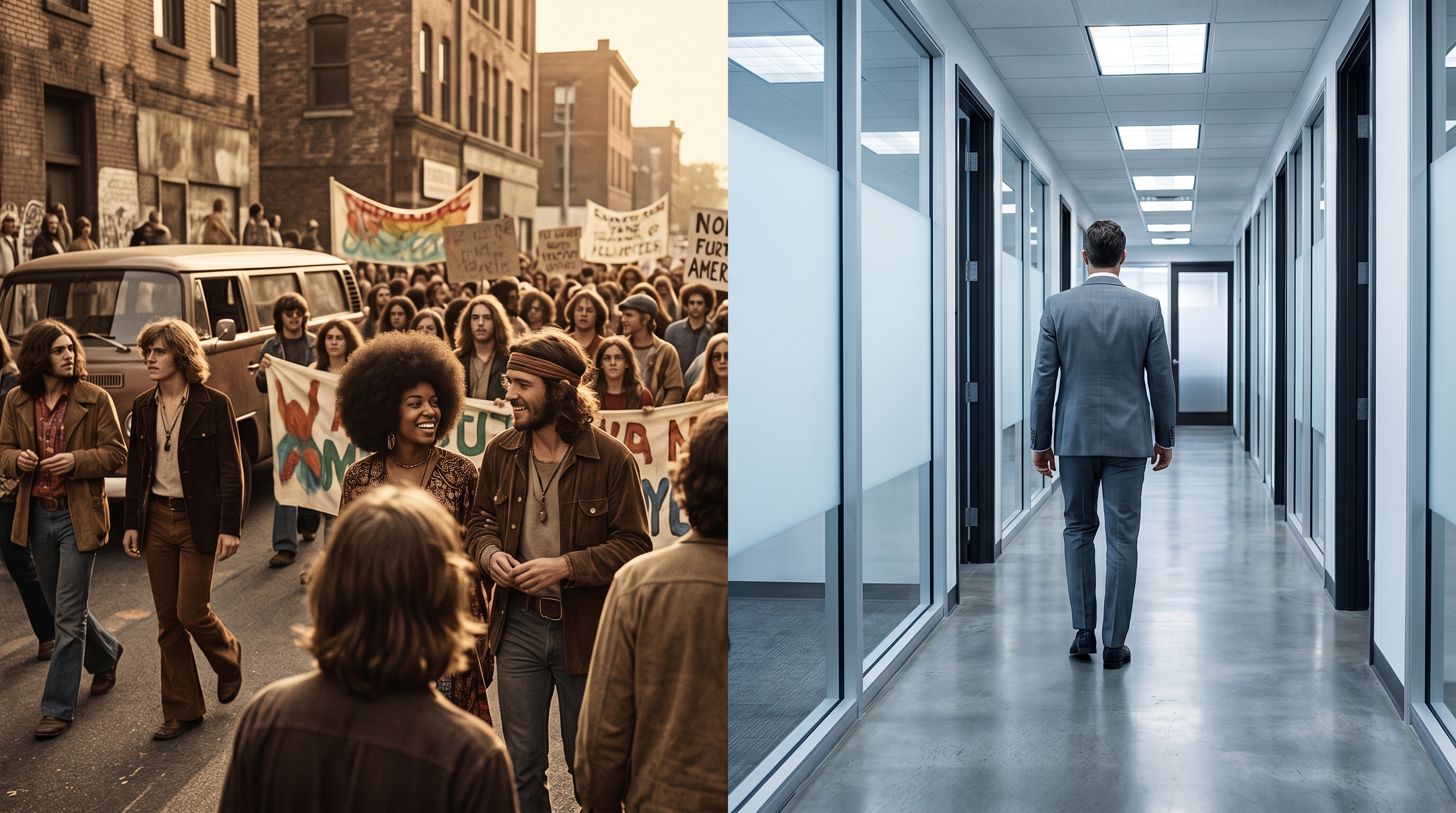
“The Nixon campaign in 1968, and the Nixon White House after that, had two enemies: the antiwar left and black people. You understand what I’m saying? We knew we couldn’t make it illegal to be either against the war or black, but by getting the public to associate the hippies with marijuana and blacks with heroin, and then criminalizing both heavily, we could disrupt those communities. We could arrest their leaders, raid their homes, break up their meetings, and vilify them night after night on the evening news. Did we know we were lying about the drugs? Of course we did.”
Ehrlichman’s family later disputed the quote. Baum stood by it — he had taped the interview. And whatever you make of one man’s words decades later, the White House tapes, in Nixon’s own voice, back up the same picture: a drug policy built to crush political enemies, not to protect public health. The scheduling decision was a tool. The plant was a target.
In 1973, Nixon folded federal drug enforcement into one new agency. Reorganization Plan No. 2 of 1973 shut down the Bureau of Narcotics and Dangerous Drugs. In its place, effective July 1, 1973, it created the Drug Enforcement Administration (DEA) — the body that has run cannabis scheduling ever since.
Decades of denied petitions
The legal fight to undo the 1970 decision began almost at once — and ran straight into the same self-locking wall.
In 1972, the same year as the Shafer report, the National Organization for the Reform of Marijuana Laws (NORML) filed the first petition to reschedule cannabis. The agency refused even to accept it for filing. NORML sued. What followed was one of the longest-running legal sagas in American history:
- The petition bounced through the D.C. Circuit Court of Appeals repeatedly across the 1970s and 1980s.
- In September 1988, after lengthy hearings, the DEA’s own administrative law judge, Francis L. Young, ruled that cannabis “does not meet the criteria of a Schedule I controlled substance” and famously called it “one of the safest therapeutically active substances known to man.” He recommended rescheduling.
- In 1990, DEA Administrator John Lawn set Young’s ruling aside.
- In 1994, the D.C. Circuit let Lawn’s reversal stand. Twenty-two years for the first petition to reach a dead end.
More petitions followed — Jon Gettman’s in 1995 (denied 2001), a coalition petition in 2002 (denied 2011 after years of agency silence). Every single one failed. The pattern was always the same: the agency tasked with enforcing prohibition was also the gatekeeper deciding whether prohibition was justified.
The Schedule III rescheduling (2024–2026)
For the first time, that pattern is breaking — slowly, and through a process unlike any before.
In August 2023, the Department of Health and Human Services formally recommended to the DEA that cannabis be moved to Schedule III, citing a “currently accepted medical use,” a lower abuse potential than Schedule I and II drugs, and only moderate-to-low physical dependence. This is the same “accepted medical use” finding the government had spent fifty years denying.
On May 21, 2024, the Department of Justice published a Notice of Proposed Rulemaking to transfer cannabis from Schedule I to Schedule III. A hearing was scheduled, then mired in procedural fights. An administrative law judge questioned the standing of various participants. A January 2025 order then stayed the proceedings pending an appeal. The case sat frozen while the presiding judge retired.
Then, on December 18, 2025, an executive order (“Increasing Medical Marijuana and Cannabidiol Research,” E.O. 14370) directed the Attorney General to complete the rescheduling “in the most expeditious manner.” In April 2026, the DEA withdrew the stalled 2024 hearing, terminated those proceedings, and announced a new expedited hearing to begin June 29, 2026. Separately — and significantly — the Justice Department issued an order placing FDA-approved cannabis products and state-licensed medical cannabis into Schedule III immediately, while the broader rescheduling of the plant itself heads to that new hearing.
If you want the practical consequences of all this — what Schedule III actually changes for patients, businesses, and ordinary consumers — I broke it down in Cannabis Rescheduled to Schedule III: What It Means for You and the deeper policy mechanics in Schedule III Marijuana Rescheduling. The short version: Schedule III is reform, not legalization. Cannabis would still be federally controlled. But it would, at last, no longer be classified as a drug with no medical value.
The legacy
The most striking thing about cannabis’s Schedule I status is its sheer durability. It has outlasted Nixon, who resigned in 1974 and died in 1994. It has outlasted the political era that produced it. It survived state-by-state legalization that now covers most of the country, decades of scientific advances in cannabis research, and a growing patchwork of state and national reform.
That durability has a cost. The Schedule I label distorted research for two generations, hamstrung medical inquiry, and propped up cultural myths — the gateway theory, the stoner stereotypes — long after the evidence contradicted them. It is why so much of what passes for cannabis “knowledge” is shaky: why cannabis education is broken, why dispensary labels are mostly wrong, and why the indica-vs-sativa framework and THC-percentage shopping persist despite being scientifically hollow. Prohibition did not just lock up the plant. It locked up the understanding of it.
The same political machinery shaped the industry’s economics, too — from the punishing 280E tax burden that flows directly from Schedule I status to the banking reform fights and interstate commerce limits that still box in legal operators. And it left the medical-versus-recreational divide looking far more artificial than the law pretends.
If you want the longer arc — how a plant used as medicine for thousands of years became a federal taboo, how Reefer Madness propaganda became cultural shorthand, how 420 became a number with meaning, and how cannabis wove itself through music, fashion, and the mainstream — the through-line is the same. The science kept saying one thing. The politics kept saying another. For fifty-five years, the politics won.
That may finally be changing. But it is worth remembering how we got here, because the lesson generalizes far beyond one plant: when a classification is built to win an election rather than describe reality, no amount of evidence dislodges it easily.
The good news for you, the modern consumer, is that you no longer have to wait for Washington to understand your own experience. The plant’s effects come from its chemistry — its cannabinoids and terpenes — not from a schedule number assigned in 1970. Learn the chemistry, track your own responses, and you will know more about how cannabis affects you than any federal commission ever bothered to find out.
Key Takeaways
- The 1937 Marihuana Tax Act collapsed in 1969 when the Supreme Court struck it down in Leary v. United States. Congress needed a new law.
- The Controlled Substances Act, signed October 27, 1970, created five drug schedules and placed cannabis in the harshest one, Schedule I.
- That placement was meant to be temporary, pending a federal study. The 1972 Shafer Commission then recommended decriminalization — and Nixon ignored it.
- A 1994 interview with Nixon aide John Ehrlichman, plus the White House tapes, suggest the policy was built to target political enemies, not to protect public health.
- Every rescheduling petition failed for fifty years. The 2024–2026 move toward Schedule III is the first real crack in that wall — but it is reform, not legalization.
Frequently Asked Questions
Why is cannabis classified the same as heroin but stricter than fentanyl? Because Schedule I is defined by “no accepted medical use” and Schedule II allows medical use under strict controls. Heroin shares Schedule I; fentanyl and morphine are Schedule II because they have recognized medical applications. The placement reflects a 1970 legal-political decision, not a comparative ranking of how dangerous each substance is.
Was cannabis’s Schedule I status meant to be permanent? No. Assistant Secretary of Health Roger Egeberg recommended Schedule I placement in 1970 “at least until” a federal commission completed its study. The Shafer Commission reported in 1972 and recommended decriminalization. The Nixon administration rejected it, and the temporary placement became permanent in practice.
Did the Shafer Commission recommend legalizing cannabis? Not legalization — decriminalization of possession for personal use. The 1972 report concluded cannabis did not endanger public safety and that total prohibition was “functionally inappropriate,” but it stopped short of recommending a legal commercial market.
Is the Ehrlichman quote real? Journalist Dan Baum reported it from a 1994 interview and published it in Harper’s in 2016, stating he had recorded it. Ehrlichman’s family disputed it after his death. The White House tapes independently corroborate the political framing Ehrlichman described.
What does Schedule III actually change? Schedule III recognizes accepted medical use and eases research and certain tax burdens. It is reform, not legalization — cannabis would remain federally controlled. See our full Schedule III explainer for details.
Sources
- Leary v. United States, 395 U.S. 6 (1969) — Supreme Court of the United States, decided May 19, 1969. supreme.justia.com/cases/federal/us/395/6
- Comprehensive Drug Abuse Prevention and Control Act of 1970, Pub. L. 91-513, 84 Stat. 1236 (Oct. 27, 1970).
- Controlled Substances Act — overview and schedule definitions, Wikipedia. en.wikipedia.org/wiki/Controlled_Substances_Act
- National Commission on Marihuana and Drug Abuse, Marihuana: A Signal of Misunderstanding (March 22, 1972) — the Shafer Commission report. en.wikipedia.org/wiki/Shafer_commission
- Americans for Safe Access, “History of Cannabis Scheduling in the United States.” safeaccessnow.org/history_of_cannabis_scheduling_2024
- Dan Baum, “Legalize It All,” Harper’s Magazine, April 2016 (the Ehrlichman interview). harpers.org/archive/2016/04/legalize-it-all
- Reorganization Plan No. 2 of 1973 (creating the DEA, effective July 1, 1973), 87 Stat. 1091. govinfo.gov
- In the Matter of Marijuana Rescheduling Petition, Docket No. 86-22, Opinion of ALJ Francis L. Young (Sept. 6, 1988). druglibrary.org/schaffer/Library/studies/YOUNG/index.html
- Alliance for Cannabis Therapeutics v. DEA, 15 F.3d 1131 (D.C. Cir. 1994). law.justia.com/cases/federal/appellate-courts/F3/15/1131
- NORML, “A Brief History of Cannabis Rescheduling Petitions in the United States.” norml.org
- DOJ Notice of Proposed Rulemaking, “Schedules of Controlled Substances: Rescheduling of Marijuana,” 89 FR (May 21, 2024). govinfo.gov
- DEA, “Rescheduling of Marijuana; Notice of hearing on proposed rulemaking,” 91 FR 22777 (April 28, 2026). thefederalregister.org/documents/2026-08177
- U.S. DOJ Office of Public Affairs, “Justice Department Places FDA-Approved Marijuana Products… in Schedule III” (April 2026). justice.gov/opa/pr
This article is educational and historical in nature. It is not legal advice. Cannabis laws vary by jurisdiction and change frequently; consult current federal and state law for your situation.


