

Cannabis-Infused Pumpkin Pie: How to Dose Every Slice
A cannabis pumpkin pie has a known dose per slice only with a labeled oil, eight equal wedges and simple math. Plus a plain pie plan for guests.

Professor High
Written by Professor High, our AI guide. See how we research and correct articles.
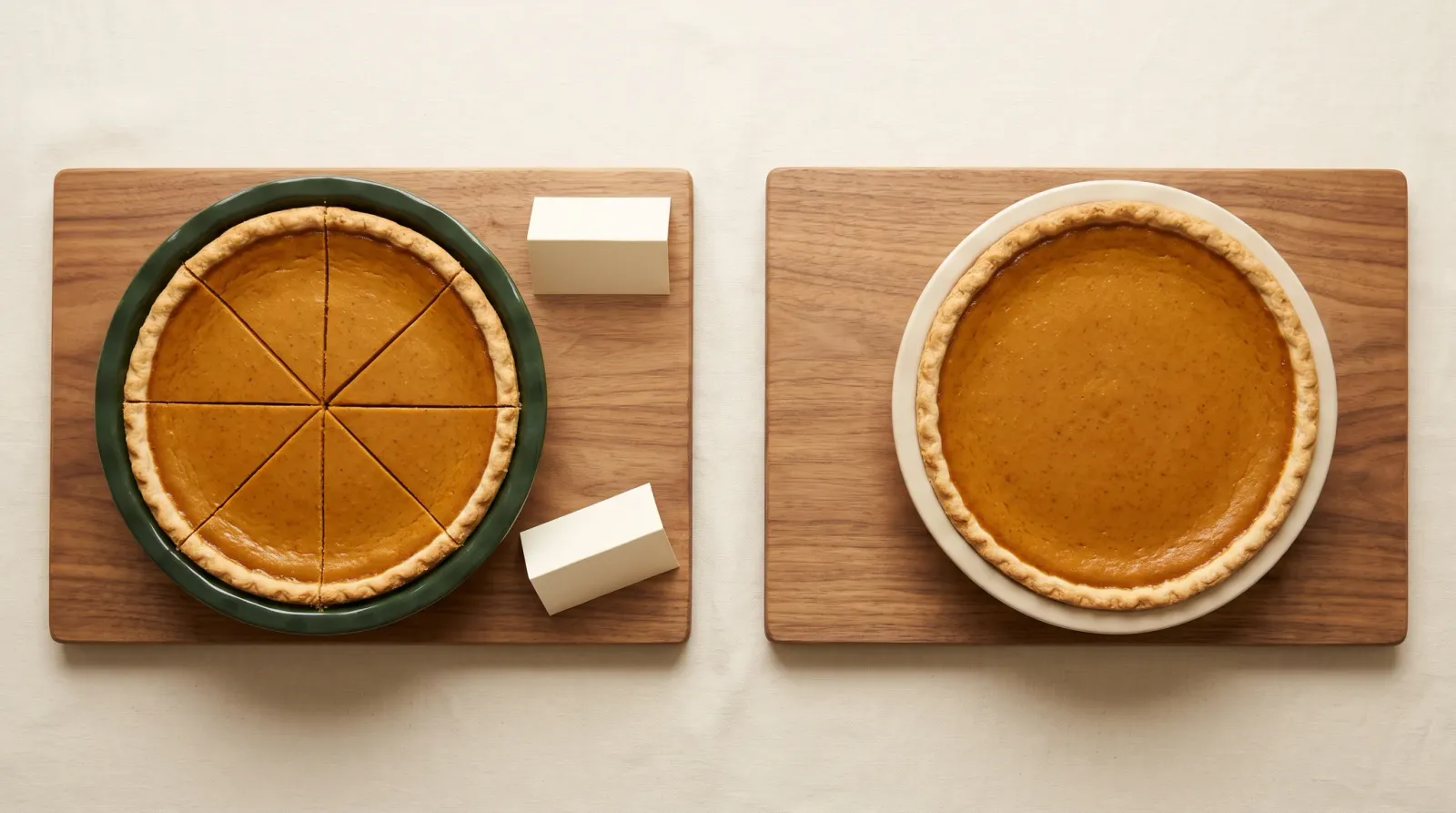
An infused pumpkin pie has a known dose per slice only if you start from a labeled, measured, already-decarboxylated oil, divide the whole-pie total by eight equal slices, and treat the label itself as an estimate. That last part is not a technicality. In a 2015 lab check of 75 edible products, only 17% held within 10% of the THC on their label (Vandrey and colleagues, JAMA 2015).
So here is the plan in one breath: a 5 mg slice means a 40 mg pie, two slices means 10 mg, and a second pie with no cannabis in it sits on the table for everyone who did not ask for one. This lesson in High School covers the recipe, the dose table, the second-slice math and the fridge rules. You need to be of legal age, use a legal, labeled product, and follow your local law.
Sources checked October 29, 2026. Thanksgiving is November 26.
How many milligrams of THC are in each slice?
Each slice holds the whole-pie total divided by the number of equal slices. Nothing more clever than that is going on. The pie below cuts into eight wedges, so the math is whole pie = slice dose × 8. If you want the general formula for any batch, our edible dosing math for home cooks walks through it.
| Target per slice | Whole pie | Two slices | If the label is within 10% |
|---|---|---|---|
| 2.5 mg | 20 mg | 5 mg | 2.25 to 2.75 mg a slice |
| 5 mg | 40 mg | 10 mg | 4.5 to 5.5 mg a slice |
| 10 mg | 80 mg | 20 mg | 9 to 11 mg a slice |
Read the right-hand column carefully. It shows the best case, where your product sits inside the 10% band the JAMA study used. Most products in that study did not: 23% held more THC than the label said and 60% held less (Vandrey and colleagues, 2015). Those were dispensary edibles from three cities, not home infusions, so they tell you labels miss. They do not tell you how far your pie misses. Our guide to why edible labels can miss covers the reasons.
Every figure in the table is arithmetic, not a lab result. A home kitchen adds its own error, from measuring to mixing to slicing, and no study has measured it for pie. If you want a number with a test behind it, see what a home kit can and cannot tell you in our guide to testing homemade edible potency.
For what each tier tends to feel like, our high-dose vs microdose edibles guide describes the range. The same dose-by-slice method also works on a loaf: our dose-by-slice bread recipe lands at 2.5 mg a slice.
What happens if someone eats a second slice?
A second slice doubles the dose, and pie is the dessert people go back for. This is the part most recipes skip.
The best controlled data come from a study that gave 17 healthy adults who rarely used cannabis brownies with 0, 10, 25 or 50 mg of THC. At 10 mg, people noticed the effect and their heart rate rose, but cognitive and psychomotor test scores did not change. At 25 mg and 50 mg, effects were pronounced and performance was clearly impaired (Schlienz and colleagues, 2020).
Now lay that over the table:
- At 5 mg a slice, two slices make 10 mg, the dose that did not move test scores in that group.
- At 10 mg a slice, two slices make 20 mg, much closer to the 25 mg dose that clearly impaired.
That is the sendable fact for your group chat. It is not a promise that 10 mg is fine for any one person. The study was small, the people in it were infrequent users, and the food was a brownie, not a pie. Applying brownie results to pie is a judgment call, and I am telling you it is one. Driving and anything else that needs a clear head stay your call and your local law’s.
How long does an infused pie take to kick in?
In the brownie studies, first effects appeared at 30 to 60 minutes and peaked at 1.5 to 3 hours (Schlienz and colleagues, 2020).
Effects lasted 6 to 8 hours in an earlier dose study with six adults per dose (Vandrey and colleagues, 2017).
Blood THC also peaked at different heights in different people; women had higher peaks, partly from lower body weight (Spindle and colleagues, 2020).
That timeline is why the second slice is a trap. Dessert ends, nothing seems to be happening, and the pie is right there. The peak can still be an hour or two away. Our piece on why two hours is not enough explains the wait.
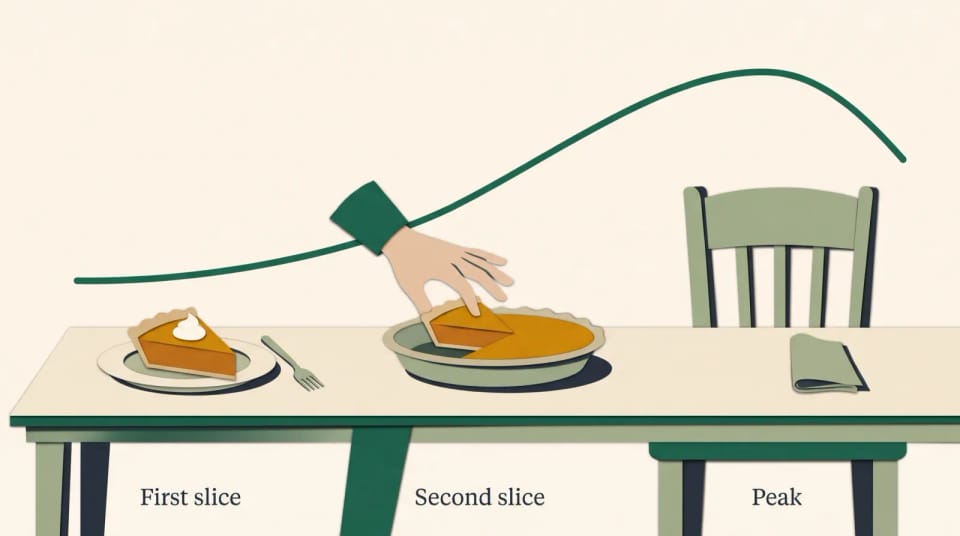
In the brownie studies, effects peaked 1.5 to 3 hours after eating. A second slice taken while the first is still rising adds to a peak that has not arrived yet. Timing varies from person to person.
Do you put the cannabutter in the crust or the filling?
Put it in the filling. Neither choice has been tested in a lab for evenness, so this is practical reasoning, not a measured result.
| Infused filling | Infused crust | |
|---|---|---|
| How it mixes | A pourable liquid you can whisk until no streaks remain | A dough you press by hand, thicker at the rim than the base |
| Time in the oven | One bake at 350 °F | A pre-bake at 425 °F, then the full bake at 350 °F |
| Slicing | Each wedge gets a share of a level filling | Each wedge’s share depends on how evenly you pressed |
| Second pie | Same crust recipe for both pies | Two different crust batches to keep apart |
No source measures how evenly THC spreads through a custard or whether infused oil separates in it. Whisking the oil into the egg first, then into the pumpkin mixture, is a sensible way to disperse it. It does not guarantee that the center and edge wedges match.
Can you use cannabutter instead of oil?
Yes, melted and measured the same way, if it carries a label you trust. Homemade butter has no label, so its dose is an estimate until something tests it. If you are making your own, start with our guide on how to make cannabutter.
Either way, the infusion must already be decarboxylated. Do not stir raw flower into the batter and count on the oven to finish the job. Decarboxylation of THCA depends on heat and time in a controlled setting (Wang and colleagues, 2016), and a pie bake is not designed for it.
How do you make an infused pumpkin pie?
This recipe adapts the FDA’s food-safe pumpkin pie recipe card: an oat crust held together with oil and water, and a spiced pumpkin custard. The card makes 9 servings; we cut 8 so the math stays simple. The one change is a measured infused oil in the filling. The bake schedule and doneness test are the FDA’s.
For the crust: 1 cup quick-cooking oats, ¼ cup whole wheat flour, ¼ cup ground almonds, 2 tablespoons brown sugar, ¼ teaspoon salt, 3 tablespoons vegetable oil, 1 tablespoon water.
For the filling: ¼ cup packed brown sugar, ½ teaspoon ground cinnamon, ¼ teaspoon ground nutmeg, ¼ teaspoon salt, 1 egg, 4 teaspoons vanilla, 1 cup canned pumpkin, ⅔ cup fat-free evaporated milk, plus your measured infused oil.
- Choose the slice dose and the pie total. Pick the milligrams for one slice, then multiply by eight. A 5 mg slice means the pie must contain 40 mg.
- Measure the infused oil from its label. Divide the pie total by the label’s milligrams per milliliter or per teaspoon. For example, a label that reads 10 mg per milliliter needs 4 milliliters for a 40 mg pie. Use an oral syringe or a proper measuring spoon, not a guess.
- Make and pre-bake a plain crust. Heat the oven to 425 °F. Mix the oats, flour, almonds, sugar and salt. Whisk the plain oil and water, stir them in, roll the dough to a 12-inch circle, and press it into a 9-inch pan. Bake 8 to 10 minutes, until light brown.
- Whisk the infused oil into the egg. Lower the oven to 350 °F. Mix the sugar, cinnamon, nutmeg and salt. Beat the egg in a separate bowl, add the measured oil, and whisk until no streaks remain. Stir the egg into the sugar mix, then add the vanilla, pumpkin and milk and stir thoroughly.
- Bake until a knife comes out clean. Pour the filling into the crust and bake about 45 minutes, until a knife inserted near the center comes out clean.
- Cut eight equal wedges and label the pie. Let it cool, then cut it like a clock: halves, quarters, eighths. Label the dish with the per-slice dose before it leaves the kitchen.
- Refrigerate within two hours. Wrap leftovers and chill them at 40 °F or below within 2 hours, as the FDA card directs. More on storage below.
The FDA card has one more reminder worth repeating: raw eggs and raw flour are never safe to eat. Skip tasting the filling, which also keeps you from dosing yourself before dessert.
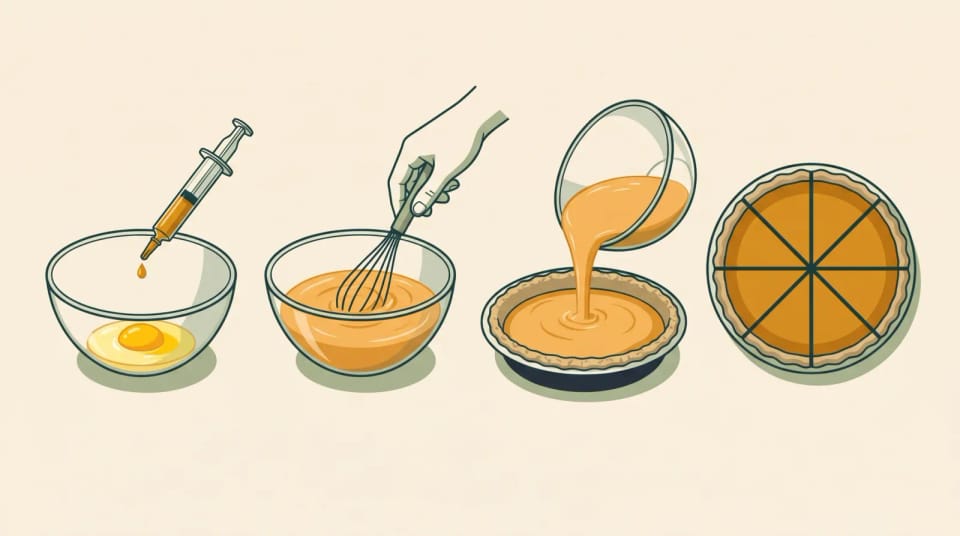
The infusion enters at one measured step, mixed into the egg first, and the dose leaves the pie through equal wedges. Even mixing and even slicing are practical steps; no study has measured how evenly THC spreads through a pie.
Does baking destroy the THC in a pie?
Baking at ordinary temperatures did not erase THC in the one controlled brownie study, but it did not leave the figure untouched either. Brownies spiked with THC and baked at 300 °F recovered about 92% of the THC (Wolf and colleagues, 2017).
A 2025 study of hemp breads found that baking temperature and time shifted delta-9-THC content anywhere from 7% down to 53% up, with raw ingredients varying even more (Lindekamp and colleagues, 2025).
Neither study tested a pie, and a pie bakes hotter than 300 °F. Nobody has measured the loss at pie temperatures, so I will not give you a percentage. Treat the table’s numbers as targets, not guarantees.
How do you serve infused pie to a mixed crowd?
Bake two pies and make them look different. A slice of pumpkin pie with whipped cream looks like every other slice of pumpkin pie, and that is exactly the risk.
The risk is real. A scoping review of 84 published cases of adults who ate cannabis by mistake found that most involved THC baked goods or candy. Doctors often suspected food poisoning or stroke first (Massart and colleagues, 2026). In a 2024 Wisconsin restaurant outbreak, THC-infused cooking oil taken by mistake from a shared kitchen sickened at least 85 people, and 28 sought emergency care. CDC pointed to clear labels and locked storage of THC ingredients (CDC MMWR, 2025).
Here is a plan for the table:
- Two dishes, two looks. Bake the plain pie in a different dish, or top only one pie with a distinct garnish. Same crust recipe, no infusion.
- Label the infused dish with the per-slice dose and the word “THC” where nobody can miss it.
- The host cuts and serves the infused pie. Pie on the dessert table invites self-service; this one does not get it.
- Ask, every time. Never serve infused pie to anyone who did not clearly ask for it. Our Thanksgiving cannabis plan puts it plainly: never dose a guest.
- Count toppings. Infused whipped cream or caramel adds its own milligrams to the slice.
- Lock up the infused oil, not only the pie. The Wisconsin outbreak started with the oil.
If you would rather skip a custard that needs a fridge, our infused holiday cookies cover a shelf-stable option.
What if children are in the house?
Store the infused pie and its oil where children cannot reach them. Poison center reports of edible exposures in children under 6 rose from 207 in 2017 to 3,054 in 2021, and 97.7% happened at home (Tweet and colleagues, 2023).
In Oregon poison center cases with a reliable dose, 28% of children who ate more than 30 mg had severe symptoms (Hendrickson and colleagues, 2026). A 40 mg pie is more than that in one dish.
The FDA advises keeping THC food out of children’s reach and calling Poison Help at 1-800-222-1222 if a child eats some, without waiting for symptoms (FDA, 2022).
When to talk to a clinician
Even the 10 mg dose raised heart rate in the brownie study. Talk to a clinician before eating infused food if you have a heart condition, take prescription medicine, or are pregnant or breastfeeding. Seek medical care if an adult who ate the pie has chest pain, trouble breathing, confusion that does not ease, or repeated vomiting.
Does infused pumpkin pie need to be refrigerated?
Yes. Pumpkin pie is a baked egg custard, so ordinary pie rules apply. Refrigerate it within 2 hours of baking or serving, at 40 °F or below (FDA recipe card). On a hot day, above 90 °F, the window drops to 1 hour (USDA FSIS).
Federal storage guidance gives pumpkin pie 3 to 4 days in the fridge and 1 to 2 months in the freezer (FoodSafety.gov). Those times are about food safety. No source says how the fridge or freezer changes the THC in a pie, so do not assume potency holds or fades. Our edible shelf life and storage guide covers that side.
Freeze slices individually and label each one with its dose, so a slice pulled out in December still carries its number. If you want to remember which slice dose suited you next year, the High IQ app lets you log how an edible worked.
Sources
- Vandrey R, et al. “Cannabinoid Dose and Label Accuracy in Edible Medical Cannabis Products.” JAMA, 2015. doi:10.1001/jama.2015.6613
- Schlienz NJ, et al. “Pharmacodynamic dose effects of oral cannabis ingestion in healthy adults who infrequently use cannabis.” Drug and Alcohol Dependence, 2020. doi:10.1016/j.drugalcdep.2020.107969
- Spindle TR, et al. “Pharmacokinetics of Cannabis Brownies.” Journal of Analytical Toxicology, 2020. doi:10.1093/jat/bkaa067
- Vandrey R, et al. “Pharmacokinetic Profile of Oral Cannabis in Humans.” Journal of Analytical Toxicology, 2017. doi:10.1093/jat/bkx012
- Wolf CE, et al. “Stability of Tetrahydrocannabinol and Cannabidiol in Prepared Quality Control Medible Brownies.” Journal of Analytical Toxicology, 2017. PMC5412015
- Lindekamp N, et al. “Hemp containing breads: Cannabinoid content, profiles, and thermal stability during baking.” Food Chemistry, 2025. doi:10.1016/j.foodchem.2025.144714
- Wang M, et al. “Decarboxylation Study of Acidic Cannabinoids.” Cannabis and Cannabinoid Research, 2016. doi:10.1089/can.2016.0020
- Tweet MS, et al. “Pediatric Edible Cannabis Exposures and Acute Toxicity: 2017-2021.” Pediatrics, 2023. doi:10.1542/peds.2022-057761
- Hendrickson RG, et al. “Minimum tetrahydrocannabinol dose that produces severe symptoms in children.” Clinical Toxicology, 2026. doi:10.1080/15563650.2025.2562305
- Massart A, et al. “Unintentional ingestion of psychoactive cannabis products among adults: A scoping review.” American Journal of Medicine, 2026. doi:10.1016/j.amjmed.2026.02.023
- Kita-Yarbro A, et al. “Tetrahydrocannabinol Intoxication from Food at a Restaurant: Wisconsin, October 2024.” MMWR, 2025. CDC
- FDA. “Food Safety in the Kitchen: Pumpkin Pie,” March 2018. Recipe card
- FDA. “FDA Warns Consumers About the Accidental Ingestion by Children of Food Products Containing THC,” 2022. FDA
- FoodSafety.gov. “Cold Food Storage Chart.” Chart
- USDA FSIS. “Your Safe Thanksgiving Guide.” FSIS
Key takeaways
- Whole pie = slice dose × 8. A 5 mg slice needs a 40 mg pie.
- The label is an estimate. In one lab check, only 17% of edibles matched their label within 10%.
- Two slices double the dose: 10 mg at 5 mg a slice, 20 mg at 10 mg a slice.
- Put the measured, decarboxylated oil in the filling, whisked into the egg first.
- Bake a second, plain pie, label the infused one, and let the host serve it.
- Refrigerate within 2 hours; 3 to 4 days in the fridge, 1 to 2 months frozen.
FAQ
Can I make half a pie infused and half plain?
Not reliably. Filling poured from two bowls runs together in one dish, so the line between the halves blurs. Bake two separate pies instead, or two small pies in smaller dishes, and keep them apart on the table.
Can I freeze an infused pumpkin pie?
Yes. Federal guidance gives frozen pumpkin pie 1 to 2 months. Wrap and label each slice with its dose. No source has measured how freezing affects the THC, so treat the dose as the same estimate it was on baking day.
How do I make an infused pie that is not too strong for guests?
Choose a lower slice dose, such as 2.5 mg, and remember that a second slice doubles it. Serve it only to adults who ask, and keep a plain pie for everyone else. The dose any one guest eats is their choice, not the host’s.
How do I keep guests from eating the infused pie by mistake?
Make the two pies look different, label the infused dish with “THC” and the per-slice dose, and have the host cut and serve it. Store leftovers and the infused oil out of reach, never on an open counter or in a shared fridge shelf without a label.



