Cannabis Laws in Alaska 2026: Frontier Cannabis Rules
Alaska cannabis laws in 2026: 1 oz possession, 6-plant home grow, the Ravin privacy legacy, the first legal cannabis cafes, taxes, and bush access.

Alaska did something no other state has ever done. Before legalization was a ballot question anywhere in the country, before Colorado, before Washington, Alaska’s own Supreme Court decided that what an adult does with a little cannabis inside their own home is simply none of the government’s business. That was 1975. The rest of the country took another forty years to catch up.
So Alaska’s cannabis story isn’t a copy of anyone else’s. It’s a frontier story, built on a fierce streak of privacy and self-reliance that runs through the whole state. This is your plain-language guide to what’s actually legal in Alaska in 2026. How much you can carry. How much you can grow. Where you can buy it, what you’ll pay, and why this is the state that invented the legal cannabis cafe.
One quick note before we start. I’m Professor High, not a lawyer, and this is education, not legal advice. Laws shift, local rules vary wildly across Alaska, and your situation is your own. For anything with real stakes, talk to a licensed Alaska attorney.
The quick answer
If you’re 21 or older in Alaska in 2026, here’s the short version:
- Possess up to 1 ounce of cannabis in public.
- Buy up to 1 ounce at a time from a licensed retail store.
- Grow up to 6 plants per adult (no more than 3 flowering at once), capped at 12 plants per household when two or more adults live there.
- Gift an ounce or less to another adult 21+ — selling without a license is not allowed.
- Consume at home, on private property with permission, or at a licensed on-site consumption cafe — never in public.
Now the details, because Alaska’s are genuinely unique.
The Ravin legacy: privacy first
Most states legalized cannabis at the ballot box. Alaska started in a courtroom.
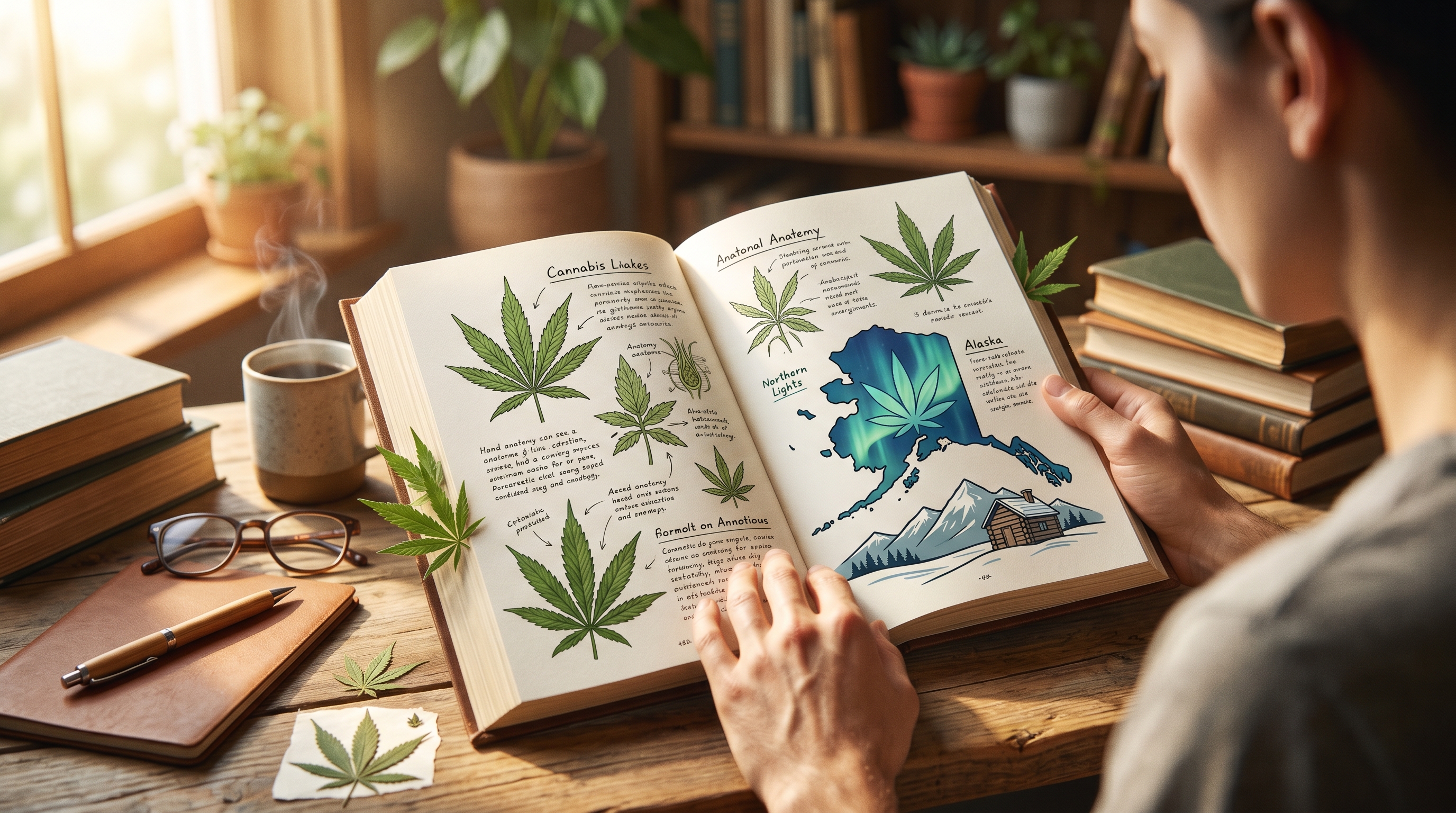
In 1975, the Alaska Supreme Court decided Ravin v. State. The court ruled that the right to privacy written into the Alaska Constitution protects an adult’s choice to possess and use a small amount of cannabis in their own home for personal use. It remains the only state or federal court decision in the country to find a constitutional privacy right covering some level of cannabis use [Ravin, 1975].
Read that again. While the federal government was ramping up the drug war, an Alaska court was saying the home is off-limits. That decision didn’t make commercial sales legal. It didn’t stop decades of political back-and-forth over the rules either. But it planted a flag. In Alaska, what happens inside your four walls is treated differently than what happens on a public street. That principle still shapes how the state reads its cannabis laws today.
If you want the bigger picture of how different states arrived at legalization from completely different directions, our state-by-state cannabis laws guide maps the whole country, and the national legalization overview tracks the federal story that’s still unfinished.
Ballot Measure 2: legalizing the market
The privacy right covered your home. It didn’t cover a store. For that, Alaska needed a vote.
In November 2014, voters passed Ballot Measure 2 with about 53% support. It took effect on February 24, 2015, making Alaska the third state to legalize adult-use cannabis, after Colorado and Washington [Alaska, 2014]. The measure legalized possession and home cultivation for adults 21 and older, and it authorized a licensed, regulated commercial market. The first licensed retail stores opened on October 29, 2016.
Regulation lives with the Alcohol and Marijuana Control Office (AMCO) and the Marijuana Control Board, which writes the rules, issues licenses, and enforces them. If you ever need the official word, those are the bodies to check — not a budtender, not a blog (not even this one).
Possession: the 1-ounce rule
For adults 21 and older, the public possession limit is 1 ounce of cannabis. That’s also the most you can buy in a single retail transaction.
Cross the line and the penalties scale up:
- 1 to 4 ounces in public: a misdemeanor for a first offense.
- More than 4 ounces, or any amount with intent to sell without a license: felony territory.
Sharing is allowed within reason. You can gift an ounce or less to another adult 21+ without payment. What you can’t do is sell cannabis without a state license — that’s the line between a friendly hand-off and a crime. Alaska takes the licensed-market boundary seriously.
A useful habit: know what an ounce actually looks like so you don’t accidentally drift over the limit. Our visual guide to cannabis quantities breaks down grams, eighths, and ounces so the numbers mean something in your hand.
Home grow: the frontier’s favorite right
This is where Alaska’s self-reliant streak shows up most clearly. Home cultivation isn’t a grudging allowance here — it’s baked into the culture.
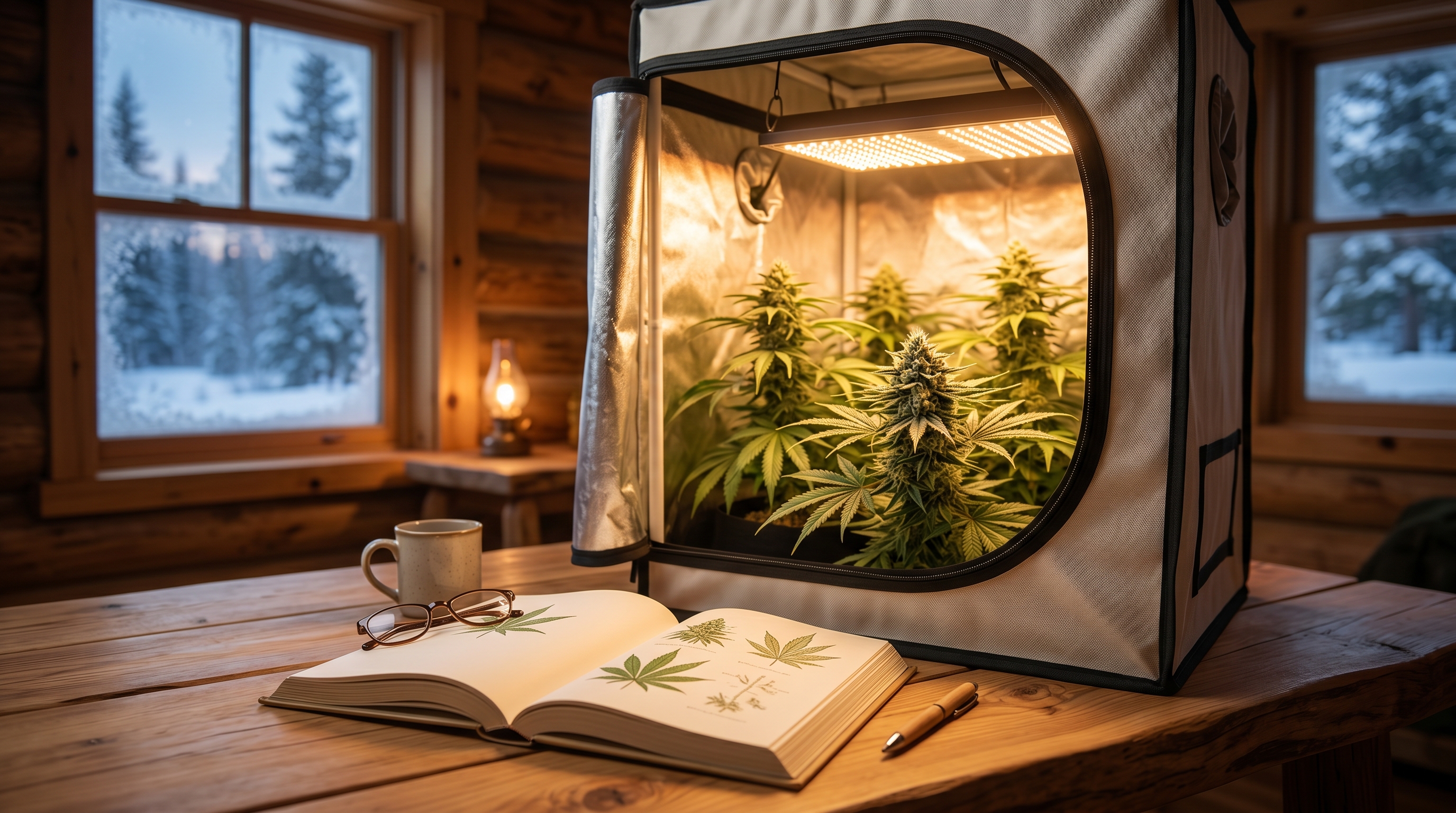
Each adult 21 or older may grow up to 6 plants, with no more than 3 mature (flowering) at any one time. When two or more adults share a home, the household cap is 12 plants total, with no more than 6 flowering. Plants must be kept out of public view and secured so minors can’t get to them.
And remember the Ravin backdrop. Personal cultivation and possession in the home sit on top of that constitutional privacy foundation, which is part of why Alaska’s home-grow rules feel more settled and less contested than in many states. For a lot of Alaskans — especially those living far from any store — growing your own isn’t a hobby, it’s the supply chain.
If you’re thinking about putting a few plants in, start with our beginner’s complete guide to growing cannabis at home. Alaska’s short, intense summers and long dark winters make this a real decision: the indoor vs. outdoor growing comparison matters more here than almost anywhere, and most serious Alaska growers run lights indoors. If you do go outside, the outdoor growing season starter guide and a tight harvest plan help you beat the frost.
On-site consumption: the cafe pioneer
Here’s Alaska’s claim to fame that even some cannabis fans miss.
For years, the awkward truth of legalization was this: you could legally buy cannabis, but you had almost nowhere legal to use it. Renters, tourists, and anyone without a private space were stuck. Public use was banned. Hotels said no. The legal product had no legal place to be enjoyed.
In 2019, Alaska’s Marijuana Control Board became the first regulator in the United States to formally approve on-site consumption at licensed retail stores [Alaska, 2019]. A store can apply for an on-site consumption endorsement, set up a designated area, and let customers consume what they buy right there. The first of these cafe-style spaces opened to the public in 2021. Alaska, the most remote state in the union, built the model that places like Colorado, California, and even much of Europe are still working out.
The rules are careful. On-site purchases for consumption are limited to small single-serving amounts per visit, so it’s a sit-and-enjoy experience, not a stock-up. Smoking areas need proper ventilation and separation so the air handling protects staff and other patrons. And as always, it’s adults 21+ only.
This puts Alaska at the front of a global shift toward social consumption spaces. If that interests you, see how the European cannabis social club model is heading toward America, and where cannabis fits into the rise of cannabis tourism. A consumption cafe is also a great place to be deliberate about your experience — our guide on how to find your ideal high explains why the name on the menu matters less than the profile.
Where to buy, and what you’ll pay
Cannabis is sold only through state-licensed retail stores. You’ll need to be 21+ with a valid government ID. There’s no medical-only carve-out you need to navigate for purchasing — adult use covers it — though Alaska does maintain a separate medical registry.
The pricing surprise in Alaska is the tax structure, because it works differently than almost anywhere else. Instead of a percentage tax at the register, Alaska taxes cannabis at the cultivation level, by weight, when it leaves the grower:
- $50 per ounce on mature flower (buds).
- $15 per ounce on trim, stems, and leaves.
That cultivation tax gets baked into the wholesale price and shows up in what you pay at the counter. Some local governments add their own sales taxes on top. The upshot: Alaska prices can run high compared to the Lower 48, partly because of this weight-based tax and partly because of the sheer cost of shipping everything to and around the state.
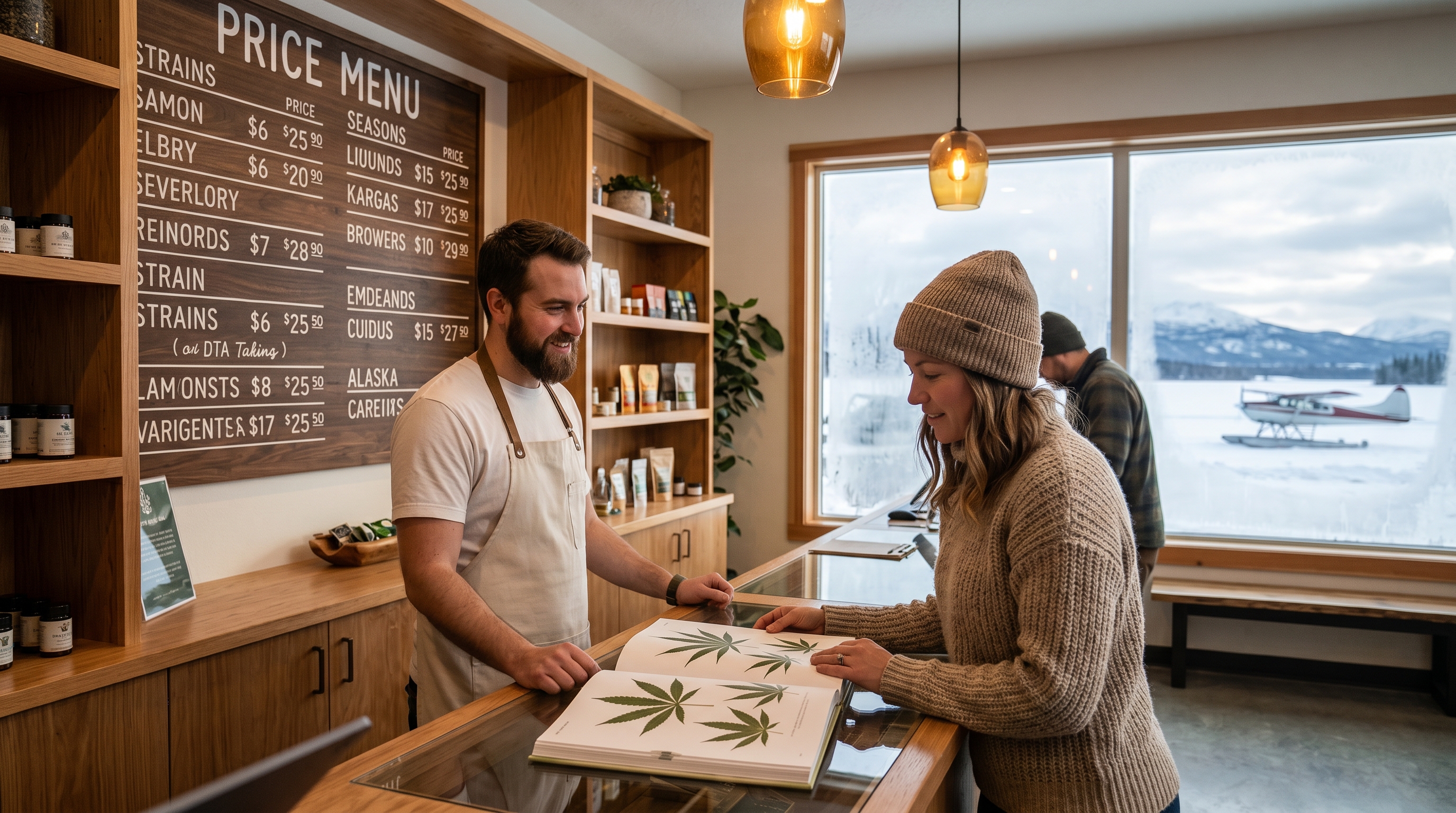
Picking a good store matters when prices are steep and selection varies. Our dispensary buyer’s guide helps you separate a great shop from a mediocre one, and why your dispensary labels are mostly wrong explains why you shouldn’t shop on THC percentage alone — a lesson that applies whether you’re in Anchorage or Atlanta.
Rural and bush access: the real Alaska story
Now the part that makes Alaska’s map different from every other legal state’s. A huge share of the state isn’t connected to a road system. Many communities are reachable only by plane, boat, or snowmachine. So even with legalization statewide, access is anything but uniform.
Alaska law lets local governments opt out. Cities, boroughs, and smaller communities can vote to ban commercial cannabis businesses within their borders. A number of villages have done exactly that — including some that already restrict alcohol under local-option laws. The result is a patchwork. There’s a thriving retail scene in Anchorage, Fairbanks, and Juneau. There are also large stretches of the state with no licensed store for hundreds of miles.
This is where the home-grow right and the Ravin privacy legacy do real work. Picture a bush community with no dispensary and no easy way to ship product. There, the legal ability to grow a few plants at home isn’t a luxury. It’s the only practical legal path to cannabis at all. Two Alaskans can stand on the same legal ground and live in completely different realities. One is a five-minute drive from a consumption cafe. The other is a charter flight away from the nearest licensed gram.
If you’re moving between communities, don’t assume the rules travel with you. And if you’re flying — even within Alaska — remember that air travel touches federal jurisdiction. Our guide on traveling with cannabis and the explainer on when cannabis can legally cross state lines are worth a read before you pack.
Public use: keep it private
The flip side of Alaska’s strong home protections is a firm rule about public space. Consuming cannabis in public is prohibited and is treated as a violation, generally carrying a fine of up to $100.
“Public” is broad: streets, sidewalks, parks, businesses, and other public places. The legal places to consume are private property (with the owner’s permission — your landlord may say no, and many do) and licensed on-site consumption cafes. Renting? Check your lease, because your landlord can restrict cannabis even where it’s legal.
And the one that catches people everywhere: don’t drive impaired. Cannabis-impaired driving is treated as a serious offense in Alaska. Being legal to use is not a defense for driving high. If you plan to consume, know how long to wait before driving. The honest answer is longer than most people think.
Frequently asked questions
Can tourists buy cannabis in Alaska? Yes. Any adult 21+ with a valid government ID can buy from a licensed retail store, up to 1 ounce per transaction. The catch is where to use it — public consumption is banned and most hotels prohibit it, which is exactly why Alaska’s on-site consumption cafes exist.
Is it really legal to grow my own? Yes. Each adult 21+ can grow up to 6 plants (3 flowering max), with a 12-plant household cap. Keep them out of public view and away from minors. In much of Alaska, this is the most reliable way to have legal cannabis at all.
Why is cannabis so expensive in Alaska? A weight-based cultivation tax of $50/oz on flower plus the enormous cost of shipping to and around a roadless state push prices above what you’d see in the Lower 48.
Can I fly between Alaska towns with cannabis? Air travel involves federal jurisdiction, where cannabis remains illegal, so flying with it is legally risky even on in-state hops. Don’t assume a quick bush flight is the same as a car ride.
Does my medical card matter? For buying, adult-use rules already cover anyone 21+, so most consumers don’t need one. Alaska maintains a separate medical registry, but the recreational market handles the day-to-day.
Key takeaways
Alaska legalized in the order that fits its character: privacy first, commerce second. Here’s the short version to carry with you:
- Possess up to 1 ounce in public, and buy that much per visit from a licensed store.
- Grow 6 plants per adult (3 flowering), capped at 12 per household.
- Consume only at home, on private property with permission, or at a licensed on-site cafe — never in public.
- Pay more than the Lower 48, thanks to a $50/oz cultivation tax and steep shipping costs.
- Plan ahead in rural Alaska, where many communities have opted out and home grow is often the only legal path.
- Don’t drive impaired, and don’t fly with cannabis even between Alaska towns.
A 1975 court decision protected the home, a 2014 vote opened the market, and a first-in-the-nation 2019 rule gave cannabis a legal place to be enjoyed. Wherever you are — a lounge in Anchorage or a cabin off the grid — the smartest move is the same. Pay attention to how cannabis actually affects you, not just what a label or a menu claims. That’s the whole idea behind tracking your sessions in High IQ. The strain name is the least interesting part of the story.
Sources
- Alaska Supreme Court, Ravin v. State, 537 P.2d 494 (Alaska 1975) — constitutional privacy protection for in-home personal use.
- Alaska Division of Elections — 2014 Ballot Measure 2 results and effective date (February 24, 2015).
- Alaska Statutes Title 17, Chapter 38 (AS 17.38) — possession, cultivation, and personal-use limits.
- Alaska Alcohol and Marijuana Control Office (AMCO) and Marijuana Control Board — licensing, on-site consumption regulations (3 AAC 306), and taxation.
- Alaska Department of Revenue — marijuana cultivation tax ($50/oz flower; $15/oz trim and leaves).
- NORML — Alaska penalties and legal status summary.
This article is educational and reflects general information as of 2026. It is not legal advice. Cannabis laws change and local rules vary across Alaska. Verify current rules with AMCO and consult a licensed Alaska attorney for your situation.


