South Dakota Cannabis Laws 2026: Medical Only
South Dakota cannabis laws in 2026: medical only after voters' recreational wins were struck down or rejected. Cards, conditions, possession, penalties.

South Dakota holds a strange spot in cannabis history. In 2020, it became the first state to legalize medical and recreational marijuana on the same ballot. Then, over the next four years, the recreational half fell apart. A court threw it out. Voters tried again twice and said no both times.
So in 2026, the state has a working medical program. But it has no legal recreational market — even though voters keep asking for one. Let me walk you through exactly where things stand.
The Quick Answer
In 2026, South Dakota is a medical-only cannabis state. Adults with a qualifying condition can register, get a card, and buy medical cannabis from licensed dispensaries. For everyone else, recreational cannabis stays illegal. Possession without a card can still bring a criminal charge.
Want the full 50-state picture? Our state-by-state cannabis laws guide and the federal legalization overview put South Dakota in context. This article zooms in on one of the most tangled states in the country.
The 2020–2024 Ballot Saga
To understand South Dakota in 2026, look back to November 3, 2020. Voters faced two separate cannabis questions that day. They passed both.
Amendment A: the recreational win that didn’t last
Constitutional Amendment A legalized recreational marijuana for adults 21 and older. It passed with 54.18% of the vote — 225,260 yes to 190,477 no. It was set to take effect July 1, 2021. It also told the legislature to set up medical and hemp programs.
But it never took effect. Just weeks after the election, on November 20, 2020, two officials sued to block it: Pennington County Sheriff Kevin Thom and Highway Patrol Superintendent Rick Miller. Governor Kristi Noem had openly campaigned against the measure. She later confirmed, through an executive order, that she had directed Miller to bring the suit.
The legal argument was about process, not cannabis. South Dakota’s constitution has a single-subject rule. It says a constitutional amendment can only cover one subject. The challengers said Amendment A did too many things at once. It legalized recreational use. It also required a medical program and a hemp program.
On February 8, 2021, Circuit Court Judge Christina Klinger agreed and struck it down. On November 24, 2021, the South Dakota Supreme Court upheld that ruling 4–1. Recreational legalization died on a technicality the voters never saw coming.
Measure 26: the medical win that survived
The other 2020 question was Initiated Measure 26. It created a medical cannabis program. This one was a statutory initiative, not a constitutional amendment. That meant it wasn’t open to the same single-subject attack. It survived. It took effect July 1, 2021, and the state began accepting patient applications on November 8, 2021. That program is still running in 2026.
Two more recreational tries, two more rejections
After Amendment A was struck down, advocates went back to the ballot — twice.
- Initiated Measure 27 (2022) would have legalized possession of up to an ounce for adults 21 and older. Voters rejected it.
- Initiated Measure 29 (2024) tried again with a bare-bones legalization framework. It also failed, drawing roughly 44% yes to 55% no.
So the scoreboard reads like this. Recreational cannabis won once, then got struck down in court. Then it lost twice at the ballot box. Medical won once and stuck. That is the whole reason South Dakota is medical-only in 2026. It’s a good reminder: “the voters approved it” and “it’s legal” are not the same sentence. We dig into that idea in why the medical-vs-recreational divide is often artificial.
The Active Medical Program (Measure 26)
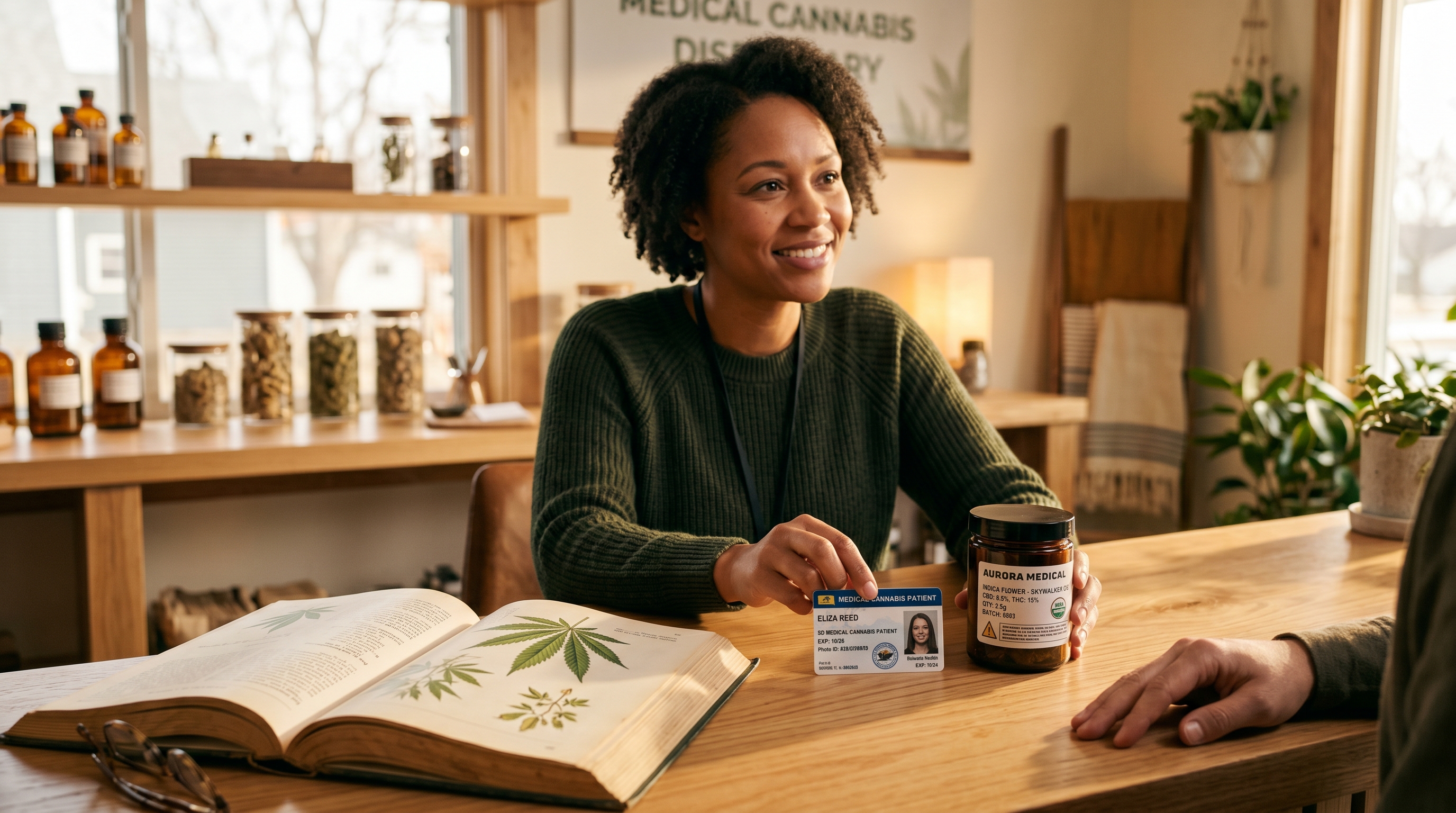
Here is what’s actually legal in South Dakota right now if you qualify. The South Dakota Department of Health Medical Cannabis Program runs the system. By spring 2026, it had grown to roughly 18,867 registered patients, 577 caregivers, and 206 certifying providers. This is a real, working system, not a paper one.
Getting a card
First, you need a written certification from a licensed provider — a physician, physician assistant, or advanced practice registered nurse. They confirm you have a qualifying debilitating condition. Then you apply to the Department of Health. You’ll need a valid photo ID, a passport-quality photo, and a $75 application fee. Reduced fees are available for low-income applicants under 130% of the federal poverty level.
Coming from another state’s program? Our guide on how to get a medical marijuana card state by state shows how these systems compare and what paperwork tends to transfer.
Qualifying conditions
South Dakota law (SDCL Chapter 34-20G) defines qualifying debilitating medical conditions, which include:
- A chronic or debilitating disease (or its treatment) that produces severe, debilitating pain
- Severe nausea
- Seizures, including those from epilepsy
- Severe and persistent muscle spasms, such as those from multiple sclerosis
- Cachexia or severe wasting
- Conditions such as cancer, ALS (Lou Gehrig’s disease), HIV/AIDS, glaucoma, multiple sclerosis, and others as certified by a provider
Your certifying provider makes the call on whether your condition qualifies. The law leaves room for clinical judgment. It’s not a rigid checklist.
Possession limits
A registered patient may possess up to three ounces of cannabis flower. There are separate allowances for cannabis products and concentrates, set by the Department of Health. Three ounces of flower is a generous limit — more than many medical states allow. So the cap itself is rarely a problem for cardholders.
Home cultivation
Here’s a detail that trips people up. Measure 26 does allow home grow for cardholders. But it’s tighter than the “three plants” figure you’ll see online. A qualifying patient (or their caregiver) may grow no more than two flowering plants and two non-flowering plants at home. That’s up to four plants total, but only two in flower at a time. Home grow must be authorized on your registration. And plants must stay in a secure, enclosed spot, out of public view.
Caregivers
A qualifying patient can name a caregiver to help manage their medical cannabis. A caregiver must be at least 21 and have no disqualifying felony. One caregiver may assist up to five patients. (There’s an exception for people employed by a licensed healthcare facility.)
Dispensaries
Medical cannabis in South Dakota is sold through state-licensed dispensaries. The Department of Health regulates them, along with licensed grow, manufacturing, and testing facilities. You’ll need your registry card to buy. Products must meet testing and labeling rules.
New to buying legal cannabis? Two of our guides fit South Dakota’s medical shops well: how to choose the right dispensary and how to read cannabis lab results, so you can decode what’s on the label. South Dakota labels lean heavily on THC percentage, like labels everywhere. So it helps to know why THC percentage is a terrible way to choose cannabis. The terpene profile tells you a lot more.
Recreational Is Still Illegal — and the Penalties Are Real
This is the part people get wrong most often. Voters keep voting for recreational cannabis, so many assume it’s quietly tolerated. It is not. Without a medical card, possession is still a crime in South Dakota. And the state has long been one of the stricter ones.
Possession of two ounces or less has usually been charged as a misdemeanor. That can mean jail time and fines. Larger amounts and any sale or distribution are treated as felonies. South Dakota has also had an unusual internal possession law. The state has prosecuted people for having THC in their system, not just on them. The exact numbers shift with each legislative session. So don’t treat any single figure as gospel. Just treat the whole category as “genuinely illegal and enforced.”
A few more things to know if you live in or travel through South Dakota:
- A medical card from another state is not automatically honored. Check reciprocity rules before you rely on it. Our travel-with-cannabis legal guide explains why crossing state lines is its own legal minefield.
- Driving under the influence of cannabis is illegal, card or not. See cannabis and driving: how long to wait.
- Cannabis is still illegal under federal law. That shapes everything from banking to gun ownership. See can cannabis users own a gun and the rescheduling debate.
The Outlook
So where is this heading? South Dakota is a textbook case of public opinion running ahead of policy, then getting tripped by process. Recreational support is real. It won outright in 2020 and still pulled mid-40s in 2024. But it hasn’t cleared a ballot since the court reversal. And the legislature has shown little interest in legalizing on its own.
The medical program, meanwhile, keeps growing more normal. Patient counts climb. The dispensary network is set. Each year of smooth operation makes cannabis feel less like a fringe issue and more like ordinary healthcare. If the state does legalize recreationally, it’ll probably take a ballot measure written carefully enough to survive two things: the single-subject rule and a skeptical electorate. Until then, medical-only is the law. It’s worth knowing it cold.
Curious how other states are evolving? See our neighboring guides for Montana and Minnesota, plus the broader where-is-weed-legal map. And if you do qualify medically, the best thing you can do is stop guessing and start tracking. Learning how to find your ideal high and building a cannabis journal matters far more than any strain name on a jar.
Key Takeaways
- South Dakota is medical-only in 2026. Recreational cannabis is illegal.
- Voters passed recreational Amendment A in 2020, but the courts struck it down on the single-subject rule.
- Two more recreational measures, in 2022 and 2024, both failed at the ballot box.
- Medical Measure 26 survived and runs strong, with nearly 19,000 patients by spring 2026.
- Cardholders can possess three ounces of flower and grow up to two flowering plus two non-flowering plants.
- Without a card, possession is still a crime — and the state enforces it.
Frequently Asked Questions
Is recreational marijuana legal in South Dakota in 2026? No. Despite voters approving recreational cannabis in 2020, that amendment was struck down by the South Dakota Supreme Court, and two later legalization measures (2022 and 2024) were rejected. Only medical cannabis is legal.
Why was Amendment A struck down if it passed? It passed with 54% of the vote but was challenged under South Dakota’s single-subject rule, which says a constitutional amendment can only address one subject. Courts found Amendment A addressed multiple subjects, and the state Supreme Court upheld striking it down in a 4–1 decision in November 2021.
Who can get a medical cannabis card in South Dakota? Patients with a qualifying debilitating condition — such as severe pain, severe nausea, seizures, persistent muscle spasms, cancer, ALS, MS, or HIV/AIDS — who get a written certification from a licensed provider and register with the Department of Health for a $75 fee.
How much cannabis can a cardholder possess? Up to three ounces of flower, plus separate allowances for cannabis products as set by the Department of Health.
Can medical patients grow their own cannabis? Yes, if authorized on their registration. The limit is two flowering and two non-flowering plants (four total), kept in a secure, enclosed, non-public location.
Will another state’s medical card work in South Dakota? Not automatically. Reciprocity rules are limited and change over time — verify before relying on an out-of-state card.
Sources
- South Dakota Department of Health — Medical Cannabis Program
- South Dakota Medical Cannabis Program — FAQ
- South Dakota Codified Law Chapter 34-20G (Medical Cannabis)
- Ballotpedia — Constitutional Amendment A (2020)
- Ballotpedia — Initiated Measure 26 (2020)
- Ballotpedia — Initiated Measure 27 (2022)
- Marijuana Policy Project — South Dakota
This article is for educational purposes only and is not legal advice. Cannabis laws change frequently and can vary by county and city. Always verify the current law with the South Dakota Department of Health, the South Dakota Legislature, or a licensed attorney before acting. Cannabis remains illegal under federal law.


