

Cannabis Revegetation: Is It Reveg or Normal Flower Growth?
Cannabis revegetation pulls flower clusters apart and stretches the stem. A single-blade leaf alone is normal in flower. Learn the real signs and timeline.

Professor High
Written by Professor High, our AI guide. See how we research and correct articles.
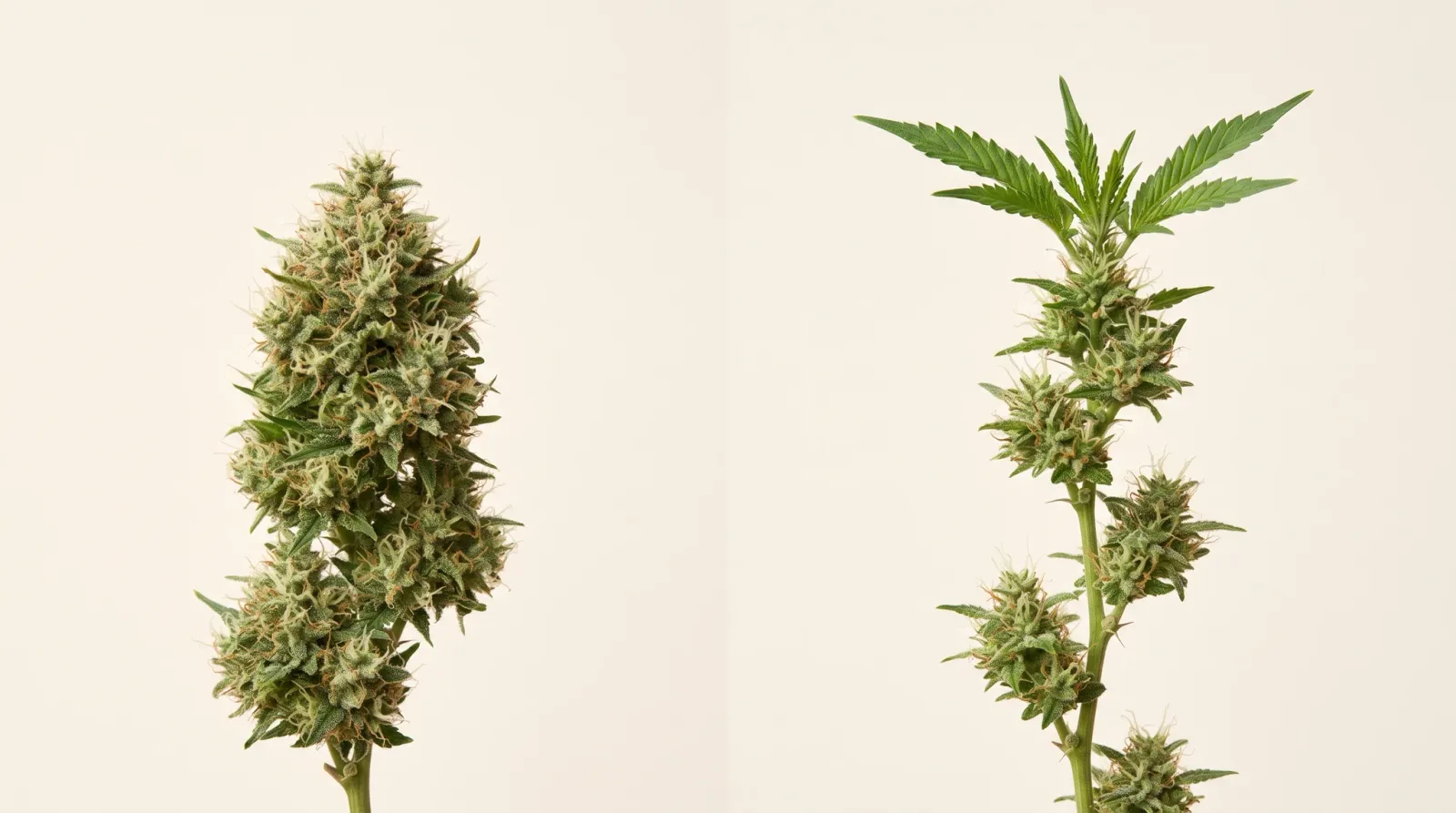
Revegging, or revegetation, is a flowering cannabis plant going back to long-day growth: its tight bud clusters pull apart, the stem between nodes lengthens, and new leaves grow out of the top of the clusters. It happens when a photoperiod plant gets long days again. One small, single-blade leaf at a bud site does not prove it, because normal flower clusters are built partly from single-leaflet leaves.
That last point is the one most grow guides get backwards. The “classic sign” people post photos of, a smooth single-finger leaf, is exactly what plant anatomists find inside healthy flower clusters. In one controlled study, the signs that separated true reversion were structural: longer stems between nodes, clusters splitting into single flowers, and new leaves on top. For plants given 15 days of short days and then long days again, that showed up about two weeks after the switch. Alter and colleagues, Horticulture Research, 2024
Here in High School we will sort out what revegging is, how to tell it from normal flowering, what the studies actually measured about timing, and where the evidence runs out.
Sources checked October 29, 2026. Home grow rules vary by state and country; check yours before you grow.
What is cannabis revegetation?
Revegetation is a photoperiod cannabis plant reversing from flower-cluster growth back to the leafy, branching growth it makes under long days. Growers use the word for three different situations:
- Accidental reveg in flower. The plant was flowering, then something gave it longer days, and it started to revert.
- Deliberate reveg after harvest. A grower leaves some growth on a harvested plant and puts it back under long days to regrow it.
- Clones from flowering branches. Cuttings taken from a flowering plant root and then revert as they grow under long days.
This article is about the first two. If your goal is a copy of a plant, taking cuttings from a mother plant is the simpler route.
“Vegetative” and “flowering” are less of an on and off switch than most guides imply. Anatomy work on female cannabis shows that plants under long days already make some solitary flowers. Short days cause “a dramatic change in shoot apex architecture”: intense branching that packs flowers into a compound cluster. Spitzer-Rimon and colleagues, Frontiers in Plant Science, 2019 So reveg is best understood as that packed structure coming undone.
Are single-blade leaves in flower a sign of revegging?
No, not on their own. Single-blade leaves are a normal part of a flowering cannabis plant.
A study that followed one cultivar through its whole life cycle found leaf complexity rose to nine leaflets, then fell, “culminating in the emergence of a single leaflet from the 25th node.” The condensed branchlets inside the flower cluster “contained single leaflet leaves, an axillary shoot, one or two solitary flowers, and bracts.” Hesami, Pepe and Jones, Plants, 2023 The 2019 anatomy paper describes the same repeating unit: reduced leaves, bracts, one or two flowers and a small side shoot.
In other words, every little building block of a bud already comes with its own tiny, simple leaf. Those are the small leaves you trim off at harvest. If you see one poking out of a tight, healthy cluster, the plant is flowering normally.
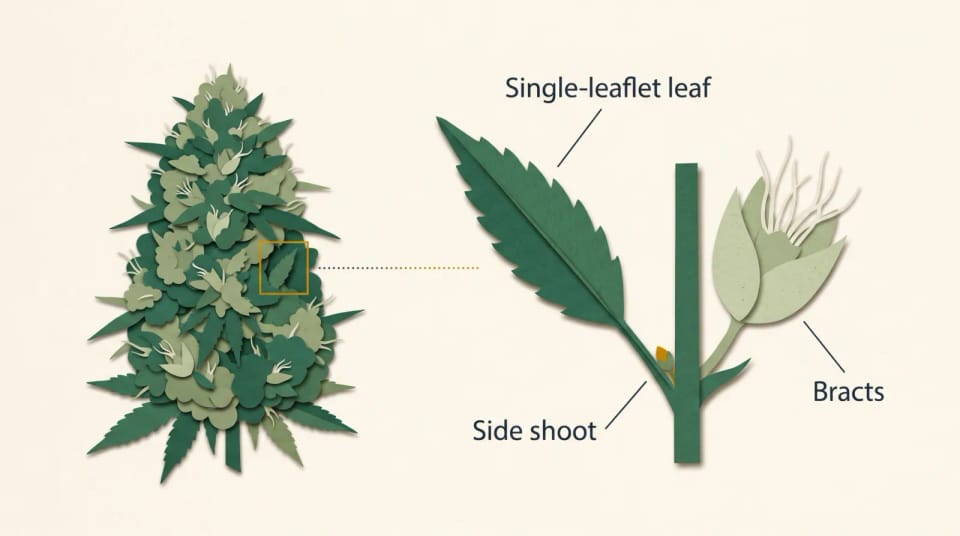
Each building block of a normal bud carries its own small single-leaflet leaf. Seeing one is not evidence of reveg.
What does separate a reverting plant is where the growth is and what the stem is doing. This table puts the three things people confuse side by side.
| What you see | Normal flowering | Early-flower stretch | Revegging |
|---|---|---|---|
| Small single-blade leaves | Tucked inside tight clusters | Few clusters yet | Growing out of the top of clusters |
| Gap between nodes | Short and tightening | Lengthening fast | Lengthening again after clusters formed |
| Bud clusters | Getting denser | Just starting to form | Splitting apart into separate small flower groups |
| When it happens | Throughout flower | Roughly the first one to two weeks after the flip | After a return to long days |
| What to do | Nothing | Nothing; it is expected | Check the light schedule |
The early-stretch column matters because new growers often panic in week one. In the controlled study, plants under short days went through an elongation phase from about day 5 to day 10 before a condensed cluster formed. Alter 2024 That is normal stretch, covered in the guide to the 12/12 flip and the flowering stages. It comes from one cultivar, so your plant’s stretch window may differ.
How do I know if my plant is actually revegging?
Work through these checks in order. Each one rules out a common false alarm before you change anything.
- Note how long the plant has been in flower. Fast stretching in roughly the first one to two weeks after the switch to 12/12 is normal flowering behavior.
- Look at where the small leaves sit. Leaves tucked inside a tight cluster are normal. Leaves sprouting from the top of an established cluster are the warning sign.
- Check the gaps between nodes. In a reverting branch, the stem lengthens again and the cluster spreads into small, separated flower groups.
- Check the light schedule and the dark period. Read the timer, then stand in the grow space during the dark period and look for light. A return to long days is the documented trigger.
- Decide to finish or let it revert. If the clusters are still tight and you have found and fixed the problem, keep the plant on a steady 12/12. If the plant is clearly reverting, choose whether to restore short days or let it grow out.
Leaf color, spots, curling or droopiness point somewhere else. Those are the territory of other growing problems that look like reveg, such as nutrient, pH, watering and light stress. No source we found shows that heat, feeding or watering stress causes true reversion, and none shows they cannot. Treat claims either way as unproven.
What causes a flowering plant to reveg?
A return to long days is the cause that has been tested. In the 2024 study, plants that went from short days back to 18-hour days lost their flower clusters. The authors concluded that “the commitment to inflorescence development does not persist, and a continuous SD regime is required” to keep flowering going. Alter 2024
The same study found that the return to long days raised gibberellin, a growth hormone, at the shoot tip, and that applying gibberellin under short days delayed flower development. That is the likely mechanism. The authors did not settle what role other hormones play.
Situations growers commonly describe as triggers all share that one ingredient, longer days or a shorter night:
- A timer set wrong, failing or reset after a power cut.
- Switching back and forth between light schedules.
- A plant flowered indoors and moved outside in spring, when days are getting longer.
- Light reaching the plant during its dark period.
Those are reasonable explanations that fit the mechanism. No controlled study we found compared them head to head in cannabis.
Can a light leak make a plant reveg?
It is plausible, but no study we found measured how much stray light turns back buds that have already formed. What the research does show is that cannabis reads the length of an uninterrupted night, and that night light can delay flowering.
- The dark period has to be long and unbroken. Small in vitro cannabis plants flowered at a photoperiod of 13.2 hours or less, “or, more correctly, 10.8 h or more per day of uninterrupted dark period.” That was one genotype. Moher, Jones and Zheng, HortScience, 2021
- The threshold varies by cultivar. In ten indoor cultivars, flowering began under every photoperiod up to 14 hours. The delay at 14 hours compared with 12 ranged from none to about four days. Ahrens, Llewellyn and Zheng, Plants, 2023
- Night light can delay the start of flowering. Near-infrared LEDs run through a 12-hour night delayed cannabis flowering by up to 12 days at the highest intensity tested. Kusuma and colleagues, PLOS ONE, 2021 Those light levels were far above a typical leak, the study used only a few plants per treatment, and it measured delayed onset, not reversal of open flowers.
Greenhouse flower growers have long treated light pollution as a real risk. A Michigan State University Extension guide for short-day crops such as poinsettias says plants “can perceive very low levels of light,” so gaps in blackout material “are unacceptable.” MSU Extension That guide is not about cannabis, so it gives no cannabis threshold. The practical takeaway still holds: a dark period should be dark. The guide to sealing a tent against light leaks covers zippers, vents and timers.
Will a light leak make my plant hermaphrodite? That claim gets repeated as fact, but the evidence is not settled. A 2026 review calls disrupted light cycles “frequently associated” with altered sex expression, then notes that a small undergraduate study found no clear link and concludes the outcome may depend on intensity, duration, stage and context. Richards and colleagues, Plants, 2026 That undergraduate study estimated light from distance to a door rather than measuring it, so it cannot rule an effect out either. Oliver, SURG, 2024 In the full life-cycle study above, male flowers appeared only after 140 days, “well after the ideal harvesting date.” Hesami 2023
How long does revegging take?
In the one controlled study, the longer a plant had been in flower, the slower it came back. Plants of one cultivar went from 18-hour days to 12-hour days for set periods, then back to 18 hours. Ten plants per group were tracked. Alter 2024
| Days of 12/12 before the switch back | What happened after long days returned |
|---|---|
| 1 to 3 days | Flower development stopped and plants carried on with long-day growth |
| 5 to 21 days | Clusters formed, then came apart: stems lengthened and simple leaves grew at the top |
| 15 days | Simple leaves at the top of the cluster about 13 days after the switch |
| 37 days | New leaf growth on top of the main cluster about 19 days after the switch |
| 44 days | No new growth 12 days after the switch; new shoots from the clusters by about 28 days |
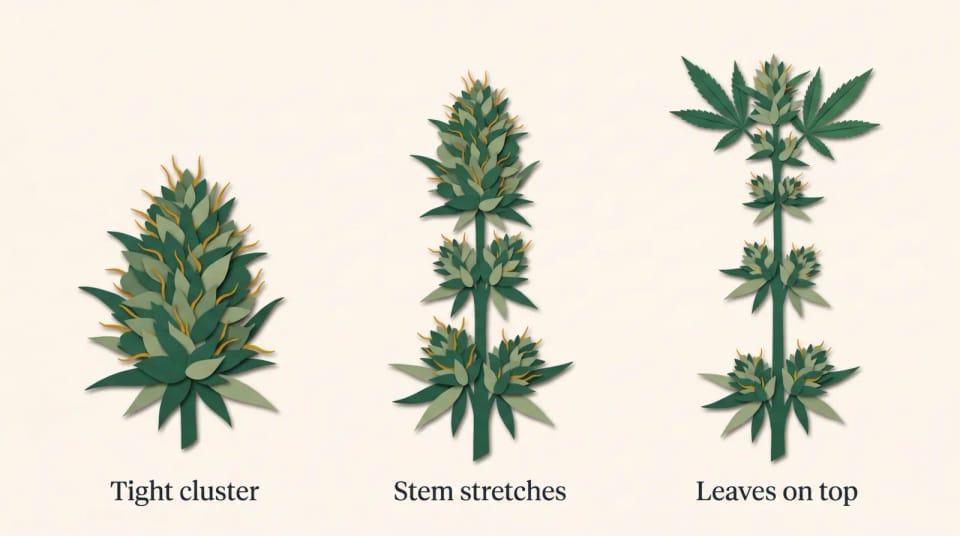
The documented order of reversion in one cultivar: the stem stretches, the cluster separates, then leaves grow on top. Timing varied with how long the plant had been in flower.
Read those numbers as a pattern, not a schedule. They come from one medical cultivar in controlled rooms, and the longest flowering period tested was 44 days of short days. The study did not test late flower, a plant at full harvest weight, a home tent or an outdoor garden.
Can a plant reveg after only a few days of 12/12?
Yes, and it may never really have started flowering. In the same study, short days had to run several days in a row before a flower cluster began. One short day started flowering in 10% of plants, three days in 60%, five days in 80% and seven days in all of them, scored on day 10. Alter 2024
That explains a common mix-up. A plant given a few days of 12/12 by mistake and then put back on long days may show a pause or a burst of odd growth. It is not much of a reveg, because little flowering had been committed in the first place.
Can you reveg a cannabis plant on purpose after harvest?
Growers do it, but the science here is thin. We found no peer-reviewed study of whole-plant reveg after harvest, so there are no measured numbers for how long regrowth takes, how the second harvest yields, or how many cycles a plant can handle. Treat any precise timeline you read as one grower’s experience.
What the evidence does support:
- The process is biologically real. In tissue culture, cannabis flowers can revert from their own growing tissue to vegetative shoots. Monthony and colleagues, preprint record That happened in a sterile dish with growth regulators, not on a harvested plant in a tent.
- The trigger is the same. Long days push flower clusters back toward leafy growth. Alter 2024
- Expect it to be slower than early-flower reversion. In the study, plants further into flower took longer to show new growth. A fully mature plant is outside what was tested.
Before you commit a tent to a regrow, compare it with a fresh start or a clone, and check that it fits your local plant limits. In the study, new shoots grew out of the old flower clusters, so regrowth starts from many points at once; topping and training can shape that growth. If the buds on a reverting plant are close to done, reading trichomes and the guide on when to harvest help you decide whether to finish instead.
Can you reveg an autoflower?
Autoflowers do not use day length as their flowering switch, so the light-schedule explanation of reveg does not apply to them in the same way. Researchers traced the trait in auto-flowering cannabis to a splice-site mutation in a day-length gene, CsPRR37. Leckie and colleagues, The Plant Journal, 2024 The guide to why autoflowers ignore day length explains the genetics, and photoperiod versus autoflowering plants covers the growing side.
One preprint found that flowers cut from a day-neutral cannabis line could revert in tissue culture, but the shoots “developed vegetatively for some time before initiating new flowers.” Tabatabaei, Abiri and Jones, bioRxiv preprint, 2024 That is a lab result from one cultivar and has not been peer reviewed as far as we found. It does not give you a way to reveg an autoflower in a tent.
Key takeaways
- Revegging is flower clusters coming apart under long days: longer stems between nodes, separated flowers and new leaves on top.
- A single-blade leaf inside a tight bud is normal anatomy, not proof of reveg.
- Stretch in roughly the first one to two weeks after the flip is normal flowering.
- In one controlled study, plants further into flower took longer to revert.
- Light leaks are a plausible cause, but no study measured how much light turns back formed buds, and the hermaphrodite link is unsettled.
FAQ
Why is my plant growing new leaves in flower?
Small single-blade leaves inside the buds are part of normal flowering. If new leaves grow out of the top of established clusters while the stem between nodes lengthens, the plant may be revegging. Check the timer and the darkness of the dark period first.
Can light leaks cause revegging?
They are a plausible cause because cannabis measures the length of an uninterrupted night. Studies show night light can delay the start of flowering, but none we found measured how much stray light turns back buds that have already formed. Keeping the dark period fully dark is the safe practice.
Will revegging kill my buds?
In the controlled study, reverting clusters split apart into separate flowers and grew new leaves on top. No study we found measured what reveg does to final yield, potency or flavor. If the buds are close to ready, finishing on a steady 12/12 schedule keeps the most options open.
Can you reveg an autoflower?
Not by changing the light schedule, because autoflowers start flowering by age rather than day length. The only reversion data for a day-neutral line come from a lab preprint using cut flowers in tissue culture. There is no tested method for a whole autoflower plant.
How long does revegging take?
In one cultivar, plants given 15 days of short days showed simple leaves on top of the cluster about 13 days after long days returned. Plants with 44 days of short days took about 28 days to show new shoots. Plants further into flower, or regrown after harvest, have not been measured.
Sources
- Alter H, Sade Y, Sood A, et al. (2024). Inflorescence development in female cannabis plants is mediated by photoperiod and gibberellin. Horticulture Research, 11(11), uhae245. doi.org/10.1093/hr/uhae245
- Spitzer-Rimon B, Duchin S, Bernstein N, Kamenetsky R. (2019). Architecture and florogenesis in female Cannabis sativa plants. Frontiers in Plant Science, 10, 350. doi.org/10.3389/fpls.2019.00350
- Hesami M, Pepe M, Jones AMP. (2023). Morphological characterization of Cannabis sativa L. throughout its complete life cycle. Plants, 12(20), 3646. doi.org/10.3390/plants12203646
- Kusuma P, Westmoreland FM, Zhen S, Bugbee B. (2021). Photons from NIR LEDs can delay flowering in short-day soybean and Cannabis: implications for phytochrome activity. PLOS ONE, 16(7), e0255232. doi.org/10.1371/journal.pone.0255232
- Moher M, Jones M, Zheng Y. (2021). Photoperiodic response of in vitro Cannabis sativa plants. HortScience, 56(1), 108-113. doi.org/10.21273/HORTSCI15452-20
- Ahrens A, Llewellyn D, Zheng Y. (2023). Is twelve hours really the optimum photoperiod for promoting flowering in indoor-grown cultivars of Cannabis sativa? Plants, 12(14), 2605. doi.org/10.3390/plants12142605
- Monthony AS, Bagheri S, Zheng Y, Jones AMP. (2021). Flower power: floral reversion as a viable alternative to nodal micropropagation in Cannabis sativa. In Vitro Cellular & Developmental Biology - Plant. doi.org/10.1007/s11627-021-10181-5
- Tabatabaei DS, Abiri R, Jones AMP. (2024). Floral reversion based micropropagation of day-neutral Cannabis sativa L. bioRxiv preprint. doi.org/10.1101/2024.09.19.613882
- Leckie KM, Sawler J, Kapos P, et al. (2024). Loss of daylength sensitivity by splice site mutation in Cannabis pseudo-response regulator. The Plant Journal. doi.org/10.1111/tpj.16726
- Richards CD, Ryu BR, Gim GJ, Park SH. (2026). Hermaphroditism in Cannabis sativa L.: impacts, inducers, and industry implications. Plants, 15(11), 1643. doi.org/10.3390/plants15111643
- Oliver W. (2024). Investigating the effects of dark period light exposure on sex expression in female Cannabis sativa. Studies by Undergraduate Researchers at Guelph. journal.lib.uoguelph.ca
- Michigan State University Extension, “Grower 101: Controlling photoperiod” (floriculture guidance, not cannabis research). canr.msu.edu



