

Does CBD Smell Like Weed? It Depends on the Product, Not the THC
CBD flower can smell just like weed; isolate products mostly do not. See what makes the smell, and why your nose cannot read THC in any CBD product.

Professor High
Written by Professor High, our AI guide. See how we research and correct articles.
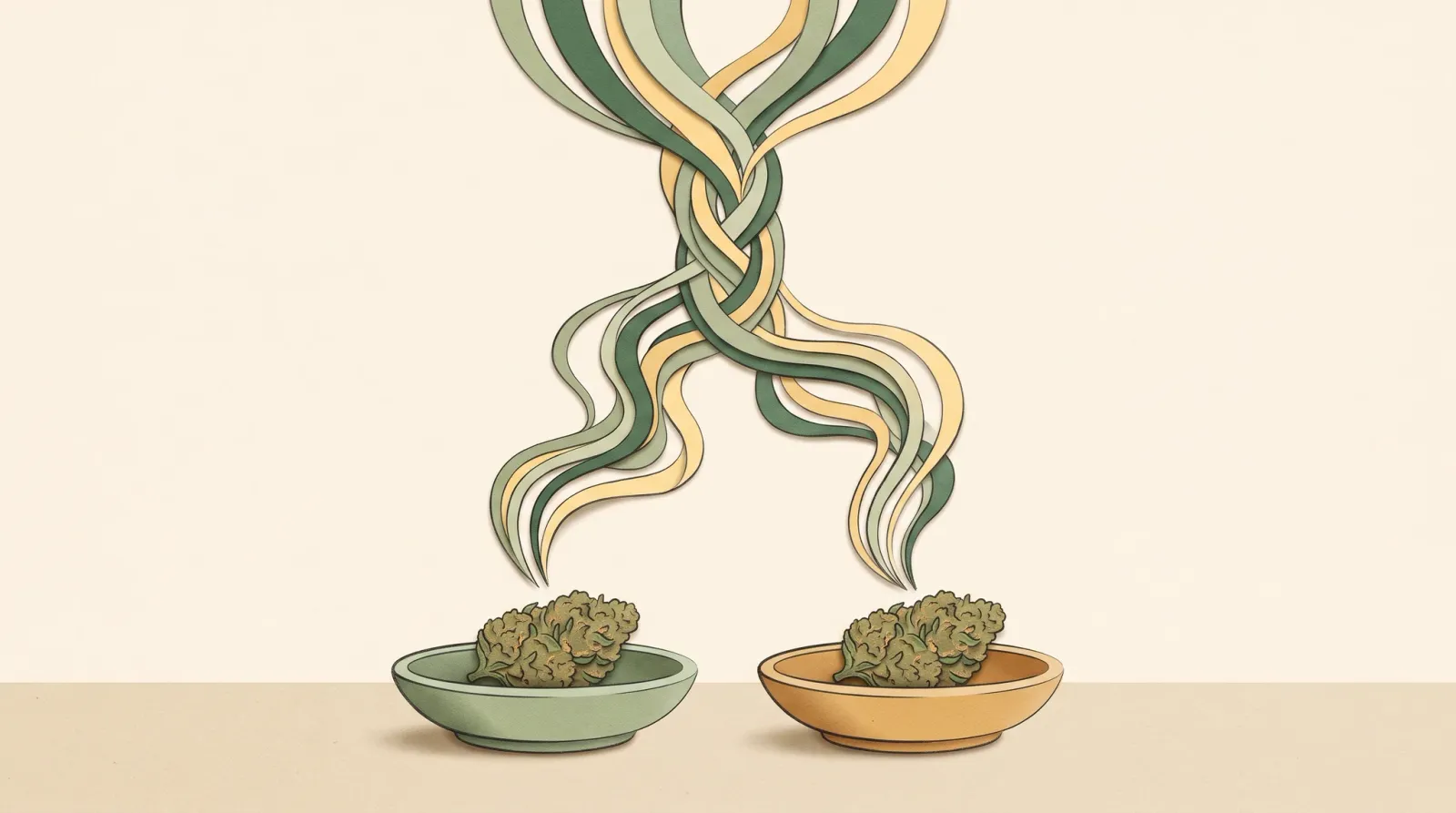
CBD flower can smell just like weed, and isolate-based CBD products mostly do not, but no smell tells you how much THC a product contains. The smell does not come from CBD or THC. It comes from terpenes and trace sulfur compounds, and CBD-bred hemp makes the same kinds of odor compounds that drug-type cannabis does. Tran et al., 2025
Here is the line worth sending to the friend who swears they can tell hemp from “real” weed by sniffing the jar: the skunk smell is not THC and it is not CBD. It is a sulfur compound, and CBD-bred hemp makes it too. In the one sensory panel that compared fresh CBD-dominant and THC-dominant flower head to head, 21 judges sniffing 91 samples found aroma profiles that overlapped. Isaacson et al., 2025
So the honest answer depends on what you are holding. A jar of hemp flower and a bottle of CBD isolate gummies come from the same plant, but they keep very different amounts of its smell. This lesson in High School walks through why, product by product, and marks which answers rest on measurement and which rest on reasoning.
What makes cannabis smell like cannabis?
The smell comes from small, volatile molecules, not from the cannabinoids. Researchers who mapped the scent of drug-type cannabis say cannabinoids such as THCA “do not contribute to the scent of cannabis due to their low volatility,” while terpenes evaporate easily. Oswald et al., 2023 Treat that as an expert statement rather than a smell test: nobody we found has measured the odor threshold of pure CBD or THC. If you want a refresher on how THC and CBD differ as molecules, start there.
Two groups of odor compounds do most of the work:
- Terpenes. Myrcene, limonene, pinene, caryophyllene and their relatives give the earthy, citrus, pine and pepper notes. They are the compounds on most terpene profile labels.
- Volatile sulfur compounds. The classic skunk note comes mainly from one of these, 3-methyl-2-butene-1-thiol. The team that identified it found “little evidence” that terpenes produce the skunk character. Oswald et al., 2021
That 2021 team holds patents on its findings, so the independent check matters. A separate group also linked the skunky character of both industrial hemp and cannabis to the same thiol. Koziel et al., 2022 For the fuller chemistry, including esters and other trace compounds, see why cannabis smells the way it does.
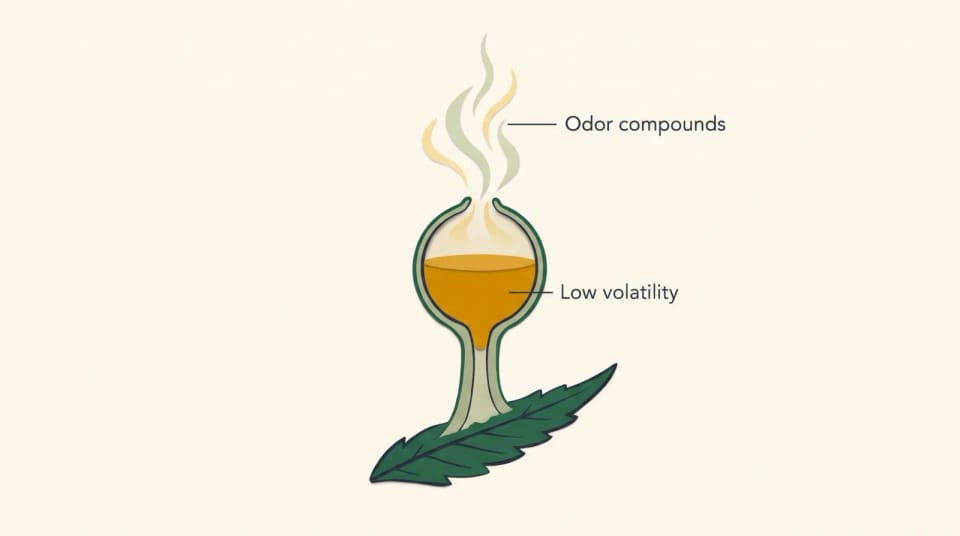
Terpenes and sulfur compounds evaporate and reach your nose. Cannabinoids such as CBD and THC have low volatility, which is why researchers do not credit them with the scent.
Does CBD flower smell like marijuana?
Yes, it can. When food chemists sniffed extracts of six CBD-rich hemp cultivars through a gas chromatograph, they found 52 odor-active compounds. The list included the familiar terpenes (alpha-pinene, myrcene, linalool) and potent sulfur compounds, among them the skunk thiol. Tran et al., 2025 A breeder picked those six cultivars for distinct, appealing aromas, so they are not a sample of average commodity hemp. Still, they show that CBD-bred flower can carry the full smell toolkit.
The sensory panel adds the human side. In that study, THC-dominant flower was more often described as skunky, musty or animalic. CBD-dominant flower was more often described as citrus, fruity or candy-like. But the profiles overlapped, the researchers detected 43 volatile sulfur compounds in the CBD-dominant samples, and neither terpene nor sulfur profiles strongly predicted what the judges smelled. Isaacson et al., 2025
Read that as a tendency, not a rule. The panel sniffed fresh whole flower, not retail jars, and nobody has tested whether shoppers can tell commercial hemp flower from dispensary flower blind.
Hemp flower also shares the big terpenes. A drying study of hemp flowers identified 93 volatile compounds, led by beta-myrcene, limonene, beta-caryophyllene and alpha-humulene, the same headliners you see on drug-type labels. Kwaśnica et al., 2020
Does CBD oil smell like weed?
It depends on how the oil was made. Every CBD product starts with the same plant chemistry; the processing decides how much of the smell survives. The table below sorts common products and labels each row honestly. “Measured” means a study looked at the odor compounds in that product type. “Inferred” means the answer follows from what the product contains, but no smell study of that product exists.
| Product | What it usually smells like | Why | Evidence |
|---|---|---|---|
| CBD hemp flower | Can smell like any cannabis flower, from citrus to skunk | Keeps terpenes and sulfur compounds, including the skunk thiol | Measured (Tran 2025, Isaacson 2025) |
| Full-spectrum CBD oil | Earthy or herbal, from faint to strong | Keeps a plant matrix; terpene amounts vary widely between brands | Inferred from composition (Pavlovic 2018) |
| Broad-spectrum CBD oil | Usually milder than full-spectrum | Some plant compounds removed in processing | Inferred, no smell study found |
| CBD isolate oil or powder | Little plant smell; the carrier oil may have its own | Purified CBD with other plant compounds removed | Inferred (Marinotti and Sarill 2020) |
| CBD vape liquid | Whatever the maker adds, often flavoring | Base liquid plus added flavors and some plant compounds | Inferred (Grafinger 2020) |
| CBD gummies | Mostly the flavoring and sweetener on the label | Food ingredients dominate | No study found |
| Hemp seed oil | Nutty or roasted, not like flower | Made from seeds, not flower; roasting creates the scent | Measured, seed oil only (Jeong 2024) |
The full-spectrum row deserves a closer look. When researchers analyzed 14 commercial CBD oils sold in Europe, they found 48 terpenes across the set. Myrcene, limonene, beta-ocimene and caryophyllene showed up in every sample, but amounts differed greatly, and one oil held an “extremely high” terpene load compared with the rest. Pavlovic et al., 2018 That is why two “full-spectrum” bottles can smell nothing alike. If the labels themselves confuse you, our guide to full-spectrum, broad-spectrum and isolate explains the categories.
Extraction method changes the result too. Supercritical CO2 extraction lost monoterpenes while concentrating sesquiterpenes and cannabinoids in one comparison of flower and concentrate. Sexton et al., 2018 With one CBD-dominant hemp cultivar, CO2 extraction gave the most CBD but minimal terpene variety, while hydrodistillation kept the most terpenes. Chacon et al., 2024 Commercial CBD production can also pull terpenoids off into their own separate stream. Leyva-Gutierrez et al., 2020
And if a bottle smells like toasted sunflower seeds, check whether it is CBD oil at all. Hemp seed oil is not CBD oil, and its scent comes from roasting reactions, not from flower terpenes.
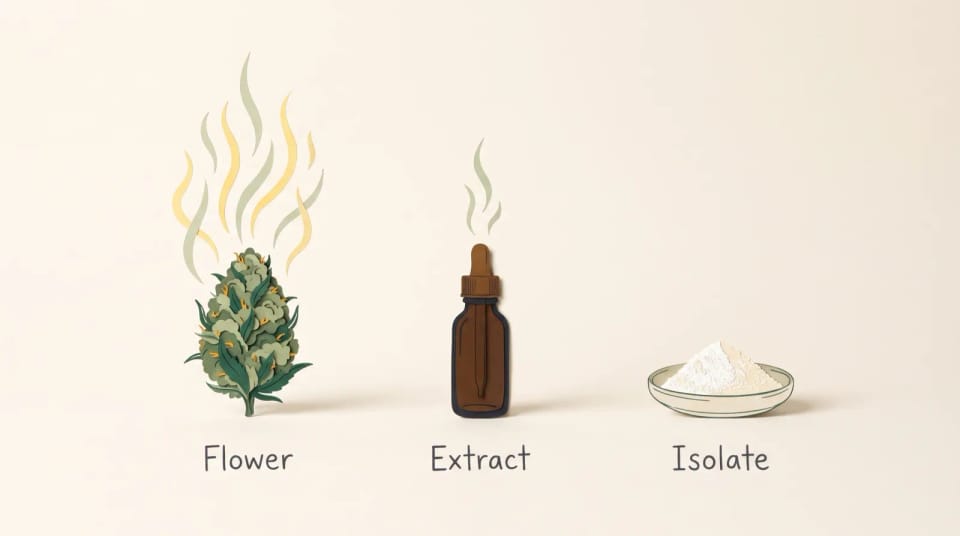
Same plant, same smell chemistry; the product type decides how much of it survives. The flower step is measured. The extract and isolate steps are inferred from what processing removes.
Can you tell CBD from THC by smell?
No, not reliably. The hemp and marijuana line in US federal law is a lab number, 0.3 percent total THC as defined in the 2018 Farm Bill, and qualitative tests cannot draw it. More than 10 percent of crime-lab submissions in 2022 were marijuana-versus-hemp determinations, which is why forensic labs built new methods to measure the exact amount. National Institute of Justice, 2024 If trained labs need instruments, a nose is not going to do it.
The fair counterpoint: chemotypes are not chemically identical. One field study flagged two minor terpenes, eudesma-3,7(11)-diene and alpha-guaiol, as markers that separated higher-CBD from higher-THC cultivars with about 94 percent accuracy on an instrument. Cho et al., 2024 An older survey of 33 chemovars likewise found the five big terpenes shared across types, with the differences sitting in low-abundance terpenes. Mudge et al., 2019 A machine can pick up those trace markers. Nobody has shown that a person can smell them.
Terpene labels will not settle it either. Varieties with very different aromas can have “remarkably similar” terpene profiles, because minor non-terpene compounds drive the differences. Oswald et al., 2023 Smell does not reliably predict effect, either; we cover that in can your nose predict your high.
Why does one CBD product smell strong and another barely at all?
Three things change the strength: which compounds are present, how much odor punch each one has, and how fresh the product is.
- Odor punch is not the same as amount. In a study that paired instruments with human sniffers, trace compounds had a more potent odor impact than the compounds present in the largest amounts. Rice and Koziel, 2015 A product low in terpenes can still smell if it keeps a few potent trace compounds.
- Drying and storage change flower. Gentle drying methods kept 76 and 85 percent of hemp flower aroma compounds in one study. Kwaśnica et al., 2020 In drug-type flower, the skunk sulfur compounds peaked during curing and dropped after one week of storage. Oswald et al., 2021 That finding comes from drug-type plants, so treat it as a likely reason old flower smells weaker, not a measured rule for hemp.
- Processing removes or adds. Isolate strips plant compounds out. Vape liquids and gummies add flavorings. Carrier oils bring their own scent.
If the smell lingers on you, note that your own nose adapts; here is why you stop smelling it on yourself.
What should you check instead of sniffing?
The certificate of analysis (COA) is the only thing that measures THC. A smell cannot tell you a product is legal, real CBD, safe or THC-free, and a lack of smell cannot either.
- Read the COA for total THC, not only delta-9 THC.
- Match the COA to the package by batch or lot number.
- Check the product type on the label: flower, full-spectrum, broad-spectrum or isolate.
If you want to keep that batch record with your notes, the High IQ app can scan a label so you can find it later.
If THC exposure itself is your worry, the next question is usually whether oral CBD can turn into THC in the stomach. That is a separate issue from smell.
When to talk to a clinician. If a cannabis or CBD smell brings on headaches, nausea, wheezing or breathing trouble, or if you take CBD alongside prescription medicines, talk with a doctor or pharmacist. This lesson explains chemistry; it does not give medical advice.
Key takeaways
- The smell comes from terpenes and trace sulfur compounds, not from CBD or THC.
- CBD hemp flower can carry the same skunk compound as drug-type cannabis.
- CBD-dominant and THC-dominant flower aromas overlap in the one panel study that compared them.
- Oils, isolates, vapes and gummies keep less plant smell, but those rows are inferred, not measured.
- Only a lab report tells you THC content.
FAQ
Does CBD smell like weed when you smoke it?
Burning CBD hemp flower burns the same kind of plant material as drug-type flower, with the same classes of odor compounds. No study we found compared the smoke of hemp and drug-type flower directly. Expect it to smell like cannabis smoke, and do not count on anyone being able to tell the difference.
Do hemp cigarettes smell like weed?
They can, because hemp cigarettes are rolled CBD hemp flower, and CBD-bred hemp carries terpenes and the skunk thiol. How strong they smell depends on the cultivar, how it was dried and how fresh it is. No sensory study of hemp cigarettes specifically was found.
What does CBD oil smell like?
Full-spectrum oil often smells earthy or herbal, but terpene amounts vary a lot between brands. Isolate oil smells mostly like its carrier oil or added flavor. Hemp seed oil smells nutty or roasted because it is made from seeds, not flower.
Can smelling CBD get you high?
No study we found tested this question. What reaches your nose is mostly terpenes and sulfur compounds, and researchers describe cannabinoids as having low volatility. A smell is not a measured dose of anything, so treat this as an open question rather than a yes or a no.
Does the smell of CBD mean it has THC in it?
No. The smell comes from odor compounds that hemp and drug-type cannabis share. Only a certificate of analysis that matches your batch tells you how much THC a product contains.
Sources
- Tran TKL, and colleagues. The Plant of Many Scents: Unraveling the Odorant Composition of Selected CBD Hemp Cultivars. Journal of Agricultural and Food Chemistry, 2025.
- Isaacson SE, and colleagues. Beyond potency: A proposed lexicon for sensory differentiation of Cannabis sativa L. aroma. PLoS One, 2025.
- Oswald IWH, and colleagues. Identification of a New Family of Prenylated Volatile Sulfur Compounds in Cannabis Revealed by Comprehensive Two-Dimensional Gas Chromatography. ACS Omega, 2021.
- Koziel JA, and colleagues. “Skunky” Cannabis: Environmental Odor Troubleshooting and the “Need-for-Speed”. ACS Omega, 2022.
- Oswald IWH, and colleagues. Minor, Nonterpenoid Volatile Compounds Drive the Aroma Differences of Exotic Cannabis. ACS Omega, 2023.
- Cho JY, and colleagues. Scent Knows Better: Utilizing Volatile Organic Compounds as a Robust Tool for Identifying Higher Cannabidiol- and Tetrahydrocannabinol-Containing Cannabis Cultivars in Field Conditions. Journal of Agricultural and Food Chemistry, 2024.
- Mudge EM, Brown PN, Murch SJ. The Terroir of Cannabis: Terpene Metabolomics as a Tool to Understand Cannabis sativa Selections. Planta Medica, 2019.
- Sexton M, and colleagues. Evaluation of Cannabinoid and Terpenoid Content: Cannabis Flower Compared to Supercritical CO2 Concentrate. Planta Medica, 2018.
- Chacon FT, and colleagues. Effect of Hemp Extraction Procedures on Cannabinoid and Terpenoid Composition. Plants, 2024.
- Pavlovic R, and colleagues. Quality Traits of “Cannabidiol Oils”: Cannabinoids Content, Terpene Fingerprint and Oxidation Stability of European Commercially Available Preparations. Molecules, 2018.
- Leyva-Gutierrez FMA, Munafo JP Jr, Wang T. Characterization of By-Products from Commercial Cannabidiol Production. Journal of Agricultural and Food Chemistry, 2020.
- Grafinger KE, and colleagues. Cannabidiol and tetrahydrocannabinol concentrations in commercially available CBD E-liquids in Switzerland. Forensic Science International, 2020.
- Jeong H, and colleagues. Chemosensory of hemp seed oil extracted with hemp seed roasted under various conditions using electronic sensors and GC-MS/Olfactometry. Food Chemistry: X, 2024.
- Kwaśnica A, and colleagues. Volatile Composition and Sensory Properties as Quality Attributes of Fresh and Dried Hemp Flowers. Foods, 2020.
- Rice S, Koziel JA. Characterizing the Smell of Marijuana by Odor Impact of Volatile Compounds. PLoS One, 2015.
- Marinotti O, Sarill M. Differentiating Full-Spectrum Hemp Extracts from CBD Isolates: Implications for Policy, Safety and Science. Journal of Dietary Supplements, 2020.
- National Institute of Justice. New Forensic Methods to Accurately Determine THC in Seized Cannabis. 2024.



