Does Oral CBD Turn Into THC in Your Stomach?
Does CBD convert to THC in the stomach? Human studies found no blood THC after tested oral doses, unlike experiments in prepared acidic fluid.

Human studies have not established that swallowed CBD turns into an intoxicating THC dose in the stomach, although conversion occurs in some prepared acidic laboratory fluids. Those findings concern different conditions. A reaction in a vessel cannot supply the missing result in a person. Crippa et al., 2020
The question is reasonable: if a paper says “simulated gastric fluid,” does that mean the same thing happens during digestion? Here in High School, we can answer it by keeping the recipe, the route, and the measurement together.
What did the experiments actually test?
This table compares the evidence. The human doses describe study conditions, not doses to copy.
| Study | Material or oral dose | Endpoint and result | Main limit |
|---|---|---|---|
| Merrick, 2016 | 40 mg CBD in 500 mL artificial acidic fluid with 1% SDS | Delta-8 and delta-9 THC formed in the vessel | No human exposure measured |
| Crippa, 2020 | Single 300 mg CBD dose in corn oil; fed and fasted healthy adults | No THC detected in analyzed blood samples | One formulation and dose; 120 enrolled, 100 completed |
| Franz, online 2022 / issue 2023 | Nine people swallowed 400 mg CBD in a water-compatible liquid with lecithin and ethanol | No THC or its tested metabolites detected in serum; two urine samples had low THC-COOH positives | Small study; urine finding did not establish where THC came from |
Sources: Merrick’s full experiment, Crippa’s full study, and Franz’s publisher abstract.
“Can happen in this fluid” and “happened after this oral dose” are separate claims. That distinction is the part to send someone when this argument comes up.
Why did CBD become THC in artificial stomach fluid?
Merrick and colleagues used an acidic, enzyme-free solution, warmed to 37°C and stirred. They added sodium dodecyl sulfate, or SDS, to help CBD dissolve. CBD was also introduced in methanol. This was a defined chemical system, rather than fluid collected from a person’s stomach. Merrick et al., 2016
About 85% of the CBD degraded by 60 minutes, and more than 98% by 120 minutes. CBD disappearing is not the same as all of it becoming THC. THC isomers were major products, alongside other substances. A neutral buffer control did not show conversion over six hours. Zynerba Pharmaceuticals supported the study; most authors were its employees or paid consultants. These results establish chemistry under those conditions, not an absorbed human dose.
Keep the surfactant in the sentence. Reporting only “stomach acid turns CBD into THC” removes a material part of the experiment. Yet calling the experiment fake would also miss the point. Laboratory models help researchers isolate a question. The problem comes when the answer travels beyond the model without another test.
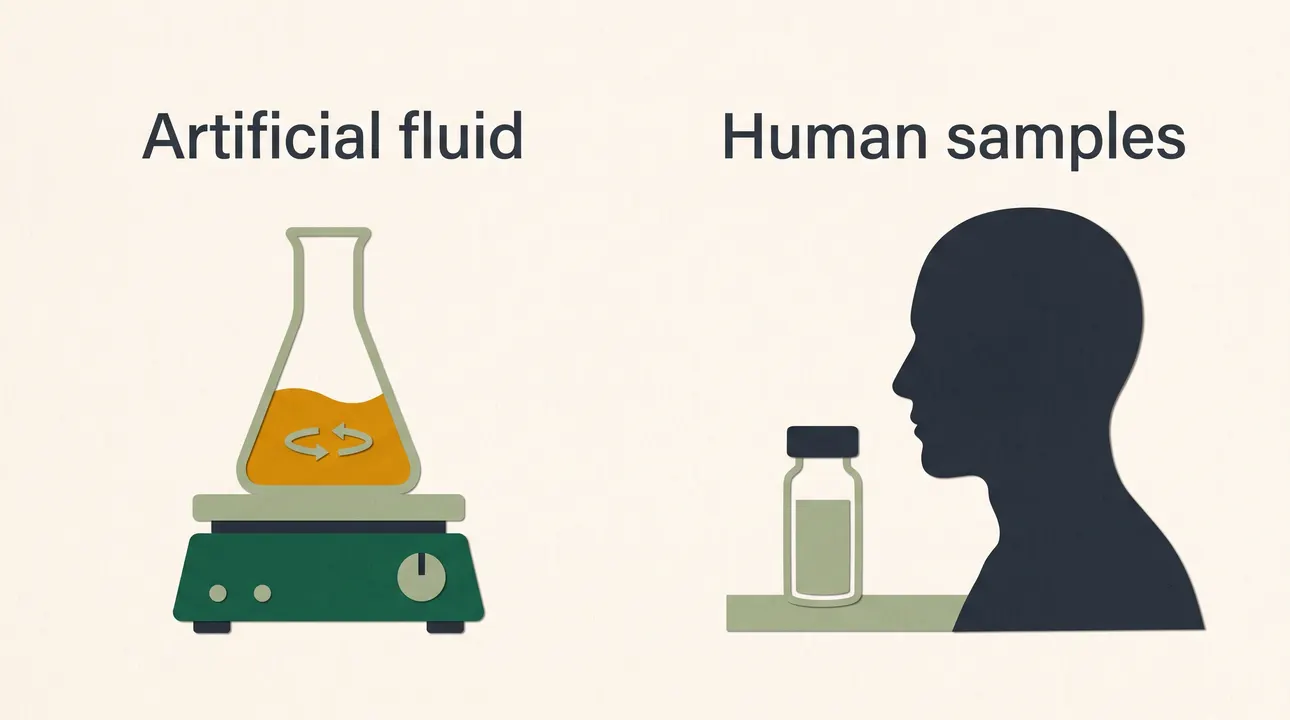
The vessel tests a chemical recipe. Human samples test exposure after a specified oral dose. Neither result covers every possible formulation.
What did the human blood tests find?
Crippa’s study looked for delta-8 and delta-9 THC after purified CBD in corn oil. Its analytical method separated CBD from THC; the authors reported no THC signal and no psychotropic adverse effects. Pharmaceutical support, company affiliations and CBD-related patents were disclosed. Crippa et al., 2020
There is an important measurement limit: the paper describes THC monitoring as semiquantitative. Its stated 1.5 ng/mL lower quantification limit belongs to the CBD validation. We should not turn that number into a fully validated THC detection cutoff.
The later Franz experiment broadened the formulation question beyond oil. Its serum results were negative, but two urine samples contained THC-COOH slightly above 10 ng/mL. The authors noted trace THC already in the liquid as a possible explanation. They declared no competing interests. The accessible abstract cannot resolve that origin. Franz et al., 2023
A negative blood result and a positive urine result are not interchangeable. They involve different samples, compounds and collection windows. The correct summary preserves both instead of turning the study into “everyone tested negative.”
Does “not detected” mean conversion is impossible?
No. It means the analysis did not identify the substance in the tested samples under those conditions. It does not promise zero molecules at every time, in every tissue, after every formulation.
But that limit does not erase the result either. “Not established in people” is different from “nobody tested people.” These studies did test oral exposure. Their negative findings constrain the claim that swallowing CBD routinely creates substantial THC exposure.
Think of three separate boxes: demonstrated in a model, not detected in tested human samples, and not tested for every possible condition. Keeping the third box open does not move an unsupported claim into the first two.
Does this mean a CBD product cannot contain THC?
The conversion question cannot settle a bottle’s contents. A trial of a specified CBD preparation is not a survey of products sold as CBD. Likewise, an unexpected feeling does not identify the chemical pathway that caused it.
For those separate questions, start with our THC and CBD comparison and full-spectrum, broad-spectrum and isolate lesson. Product names and a proposed stomach reaction should not substitute for evidence about the product itself.
This lesson also does not show that CBD cancels a THC high or escapes metabolism. Our CBD metabolite lesson, cannabis pharmacokinetics guide, and CBD prescription-interaction review cover related questions. Chemical conversion, absorption and drug interactions each need their own evidence.
Key takeaways
- Artificial acidic fluid can produce THC from CBD under specified laboratory conditions.
- The tested human oral preparations did not yield detectable blood THC.
- Negative findings have assay, dose, formulation and sampling limits.
- A product’s THC content and a proposed stomach conversion are separate questions.
FAQ
Does stomach acid turn CBD into THC?
Some prepared acidic solutions do. The human studies discussed here did not establish substantial THC exposure from that reaction after their tested oral preparations. Keep the laboratory recipe attached to the laboratory claim.
Does taking CBD on an empty stomach cause conversion?
Crippa included both fed and fasted groups and reported no detected THC. That finding applies to its tested preparation, rather than every possible product or eating pattern.
Why can a study find no THC in blood but a metabolite in urine?
Blood and urine measure different things at different times. The Franz study preserved that distinction, and trace THC in the starting liquid was a possible explanation. Its findings do not prove stomach conversion or guarantee a negative drug test.
Is CBD metabolism the same as CBD becoming THC?
No. “Metabolism” covers changes the body makes to a compound. A specific claim that those changes produce THC needs its own evidence; it cannot be inferred from the word alone.
Sources
- Merrick J, Lane B, Sebree T, Yaksh T, O’Neill C, Banks SL. Identification of Psychoactive Degradants of Cannabidiol in Simulated Gastric and Physiological Fluid. Cannabis and Cannabinoid Research. 2016;1(1):102–112. DOI: 10.1089/can.2015.0004.
- Crippa JAS, et al. Oral Cannabidiol Does Not Convert to Δ8-THC or Δ9-THC in Humans: A Pharmacokinetic Study in Healthy Subjects. Cannabis and Cannabinoid Research. 2020;5(1):89–98. DOI: 10.1089/can.2019.0024.
- Franz S, Herzog J, Skopp G, Musshoff F. Will tetrahydrocannabinol be formed from cannabidiol in gastric fluid? An in vivo experiment. International Journal of Legal Medicine. 2023;137:79–87; online 2022. DOI: 10.1007/s00414-022-02896-w.





