Can Cannabis Make You Forget to Carry Out a Plan?
Cannabis can impair prospective memory: remembering to act when a cue appears. See how this differs from losing your train of thought and what studies found.

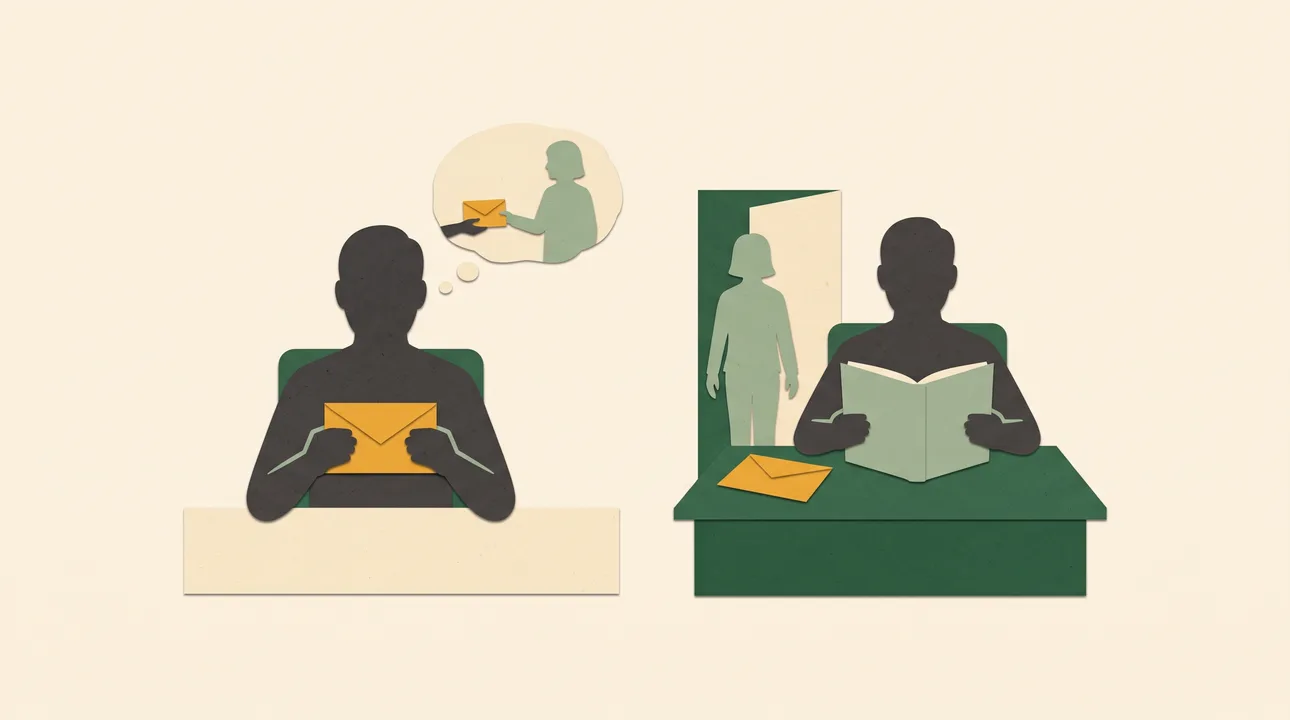
Cannabis can impair prospective memory: remembering to carry out a plan when the right cue appears. That is a different question from recalling yesterday’s conversation or losing your place mid-sentence. An acute THC experiment found poorer event-cued performance, while studies of regular users have produced mixed results. Cuttler and McLaughlin, 2026
Here in High School, the useful distinction is remembering the plan versus remembering to act on it. Knowing what you intended to do when someone asks later does not prove you remembered at the moment it mattered.
What is prospective memory?
Prospective memory concerns an intention you must carry out later. Researchers distinguish event-based tasks, triggered by an occurrence, from time-based tasks, due at a particular time. Remembering what the intended action was adds a retrospective memory demand. Cuttler, McLaughlin and Graf, 2012
Consider a fictional plan to give a visitor an envelope. You set it aside, then return to reading. When the visitor arrives, that arrival is the cue to hand it over. You might still know what the envelope contains but miss the handoff entirely.
These examples separate the questions; they are not symptoms that diagnose THC impairment.
| Memory question | Everyday example | What makes it distinct? |
|---|---|---|
| Event-based prospective memory | Give the envelope to the visitor on arrival | An event should bring the intention back |
| Time-based prospective memory | Send a message at a chosen time | The intended moment is defined by time |
| Retrospective memory | Recall which document belongs in the envelope | Remember the content of the plan |
| Working memory | Keep a number in mind while calculating | Hold and use information during the current task |
For the broader memory picture, see our short-term and long-term memory lesson. This class stays with intentions and their cues.
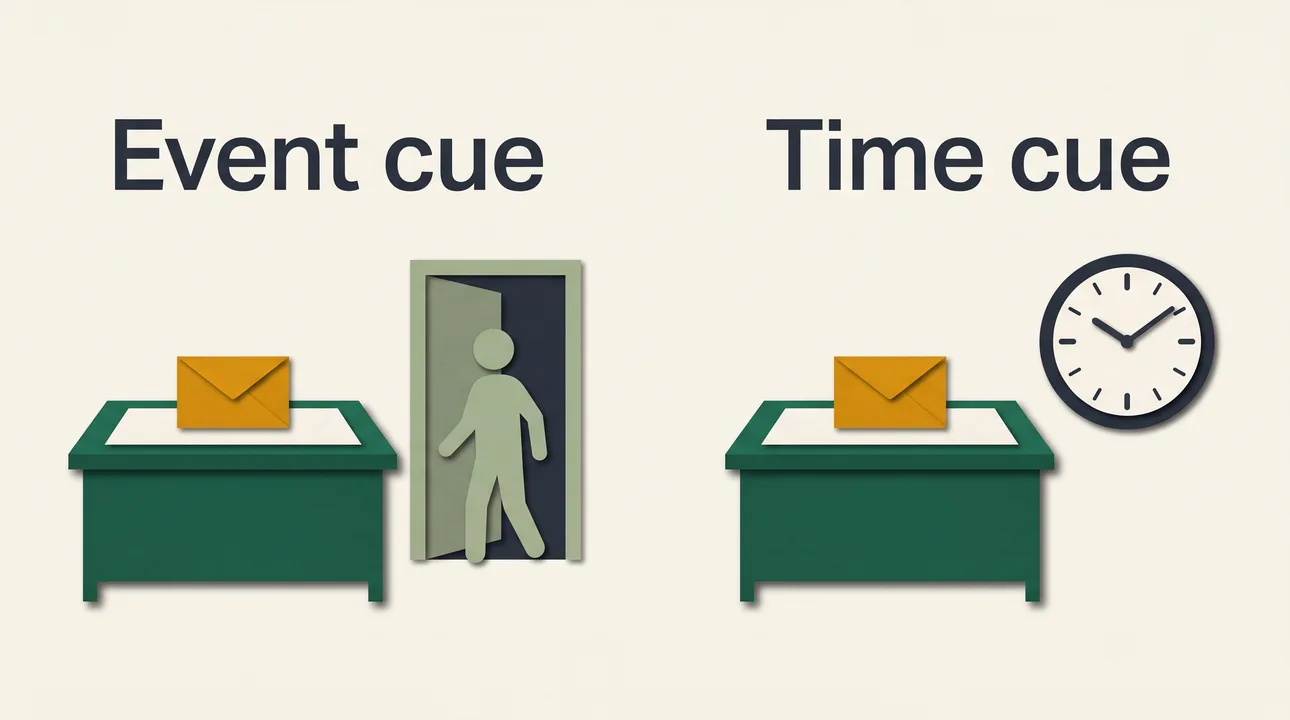
An event and a chosen time are different kinds of cue. Neither picture represents a measured treatment effect.
What did the acute cannabis experiment find?
The 2026 trial randomly assigned 120 cannabis-using participants to vaporized flower containing 0, 20 or 40 mg THC. Its blinded, placebo-controlled design compared memory performance after use. These are amounts in the flower, not measurements of THC absorbed into each person’s bloodstream. Cuttler and McLaughlin
| Endpoint or comparison | Reported finding | Main limit |
|---|---|---|
| Event-cued prospective memory | Worse after cannabis than placebo | Laboratory performance after vaporized flower |
| Time-cued prospective memory | Tested, but not among the abstract’s listed impaired outcomes | Full results are restricted; no detailed null estimate available here |
| 20 versus 40 mg THC | No significant difference between active groups | Does not establish identical effects or a dose ceiling |
The publisher’s abstract supports the event-cued finding. It cannot supply the task’s exact failure rate, individual risk, or a recovery time. Time-cued performance was tested, rather than ignored; its absence from the reported impairment list is also not proof of no possible effect.
Do not translate the active-dose comparison into “more THC cannot make forgetting worse.” A study that does not detect a difference has not demonstrated that two doses are equivalent. The findings also cannot be transferred directly to an edible schedule. Our consumption-method and absorption lesson explains why route matters.
Why do some studies of regular users find no difference?
They ask a different question from an experiment that administers THC immediately before testing.
In 2012, researchers compared 48 non-users, 48 experimenters and 48 chronic users. They found no significant group effect on three objective prospective-memory tests. Chronic users did report more internally cued failures; other memory complaints and alcohol or other drug use helped account for that pattern. Participants reporting current intoxication were excluded. Cuttler and colleagues
A 2018 study compared 18 dependent users, 18 non-dependent users and 18 controls on a virtual-week task. Groups did not differ in prospective-memory performance. Participants agreed to avoid drugs and alcohol on testing day. Mentally imagining future tasks also failed to improve performance. The small, largely educated young-adult sample limits generalization. Braidwood and colleagues
Those null findings deserve space. They do not certify that someone’s intentions will survive a fresh THC dose.
Can the difference show up during sober testing?
Yes, an observational study found a difference on one kind of intention task.
In 2023, researchers tested 198 adults: 98 non-users, 46 exclusive flower users and 54 concentrate users. Participants were tested sober; most users had last used the previous day. Both user groups performed worse on remembering to request their payment at a specified point in the session. Habitual prospective-memory performance did not differ significantly, and flower and concentrate users did not differ on the cognitive tests. Cuttler, Petrucci and LaFrance
This was a comparison of existing groups, not random assignment to years of cannabis use. It cannot establish that cannabis caused every difference or that the result represents permanent harm. The disagreement between studies is a reason to keep task details beside the headline.
What can you do when a plan matters?
For an ordinary task, make the intended action explicit: “Give the envelope to Sam on arrival,” rather than “Remember the envelope.” A calendar entry or reminder can hold that instruction outside your head. These are planning suggestions, not a tested remedy for cannabis impairment.
Separate a task that can wait from one with consequences you cannot easily correct. A reminder does not establish fitness for driving or another demanding responsibility. Likewise, how long a high lasts addresses timing; it cannot certify performance on a particular task.
Our High Families lesson describes product classification. An experience label is not evidence that a strain preserves prospective memory.
Key takeaways
- Remembering an intention and acting on its cue are separate demands.
- An acute event-cued deficit does not establish impairment on every intention task.
- Objective null findings and observational differences both belong in the evidence picture.
- A reminder is a planning tool, not proof that impairment has resolved.
FAQ
Is forgetting a plan the same as losing your train of thought?
No. A plan concerns a later action and its cue. Losing the thread during a current task raises a different memory question; the two descriptions should not be treated as interchangeable test results.
Does this mean you will forget every task while high?
No. A group difference does not predict every person’s next mistake. The laboratory endpoint is narrower than all the plans someone makes during a day.
Is a missed intention a false memory?
No. A missed intention concerns failing to act at the intended moment. Our false-memory lesson covers adding or accepting inaccurate details instead.
Can imagining the task stop cannabis-related forgetting?
The 2018 virtual-week study did not find improved performance after future-event simulation. It also did not test that strategy as an antidote to an experimentally administered THC dose. Braidwood and colleagues
Sources
- Cuttler, C., and McLaughlin, R. J. (2026). Mapping the acute effects of cannabis on multiple memory domains: A randomized, double-blind, placebo-controlled study. Journal of Psychopharmacology, 40(3), 410–421. DOI: 10.1177/02698811261416079. Publisher abstract; full text restricted.
- Cuttler, C., McLaughlin, R. J., and Graf, P. (2012). Mechanisms Underlying the Link between Cannabis Use and Prospective Memory. PLOS ONE, 7(5), e36820. DOI: 10.1371/journal.pone.0036820.
- Braidwood, R., Mansell, S., Waldron, J., Rendell, P. G., Kamboj, S. K., and Curran, H. V. (2018). Non-Dependent and Dependent Daily Cannabis Users Differ in Mental Health but Not Prospective Memory Ability. Frontiers in Psychiatry, 9, 97. DOI: 10.3389/fpsyt.2018.00097.
- Cuttler, C., Petrucci, A. S., and LaFrance, E. M. (2023). Cognitive test performance in chronic cannabis flower users, concentrate users, and non-users. Scientific Reports, 13, 8068. DOI: 10.1038/s41598-023-35217-1.





