

Does Weed Raise or Lower Blood Pressure? It Depends on Posture and Time
Weed and blood pressure: THC can push pressure up at rest and let it drop when you stand. See what lab studies, surveys and a 35-year cohort found.

Professor High
Written by Professor High, our AI guide. See how we research and correct articles.

Weed can do both: THC-rich cannabis tends to raise heart rate and nudge blood pressure up while you sit or lie still, and in some people pressure drops when they stand up. Which one you notice depends on your posture, how long it has been since you used, what you used, and how often you use. Over years, large studies have not found a consistent link between cannabis and high blood pressure.
Here is the part that settles most arguments. The CDC says cannabis “can raise blood pressure immediately after use.” Health Canada says it “can lower your blood pressure, especially when you change positions.” Both are describing something real. They are describing different measurements.
One small trial shows how an average can hide both. Male smokers sat for 90 minutes after one cannabis cigarette, and their average blood pressure showed no consistent change. Yet 22% of the men who smoked without a receptor-blocking drug had a symptomatic drop in pressure, with dizziness or lightheadedness (Gorelick et al., American Heart Journal). Up for some, down for others, flat on average.
This High School lesson walks through the time course, from the first minutes to decades, and says plainly where the evidence runs out. It is an evidence read, not medical advice.
Does weed raise blood pressure right after you use it?
Often a little, along with a clear jump in heart rate. In a 2024 lab study, 22 young, healthy cannabis users inhaled THC-predominant cannabis. Heart rate rose by about 17 beats per minute after smoking, and mean arterial pressure rose by about 7 mm Hg. Vaporized THC cannabis gave a similar result. A CBD-predominant vapor did not significantly change either one (Cheung et al., Journal of the American Heart Association).
Mean arterial pressure is a single average of the pressure across a heartbeat. It is not the familiar top or bottom number on a home monitor, so the 7 mm Hg does not translate directly into a systolic reading.
The American Heart Association’s scientific statement gives the same direction. THC may stimulate the “fight or flight” side of the nervous system and damp the “rest and digest” side, which can raise heart rate and blood pressure while lying down (AHA statement summary). A narrative review describes the classic pattern the same way: heart rate up, a slight rise in lying-down pressure, and on occasion a marked drop on standing (Jones, Journal of Clinical Pharmacology).
Not every experiment agrees. A 2020 systematic review of older experiments found low-strength evidence that cannabis speeds the heart, but only mixed results for blood pressure. One trial found a systolic drop, three found no effect, and one found a rise. The reviewers called the evidence on acute blood-pressure change insufficient. They also noted that those experiments used cigarettes of roughly 1.5% to 3.6% THC, far below today’s retail flower (Ghasemiesfe et al., Journal of General Internal Medicine).
A faster pulse and higher blood pressure are separate measurements. If your heart is racing after a strong dose, our guide to too much cannabis and a fast heart rate covers what that usually means and when it is an emergency.
Why can weed make your blood pressure drop when you stand up?
Because standing asks your body to push blood back up to your head quickly, and THC can blunt that adjustment in some people. In a double-blind study, 29 volunteers lay down and then stood for 10 minutes, before and after THC by infusion or by smoking. Both routes caused dizziness on standing. About 28% of them reported severe symptoms, and that group showed the largest drops in blood pressure and in blood flow speed to the brain (Mathew et al., 2003).
That 28% is the share of one 29-person sample with severe symptoms. It is not a rate for all cannabis users.
An earlier, smaller study adds a twist. Six of 10 men had moderate or severe dizziness on standing after a high-potency cigarette, but not after placebo. The men with severe dizziness had marked drops in blood pressure. The men with moderate dizziness had slower blood flow to the brain without a measured pressure drop (Mathew et al., 1992). So feeling dizzy and having a measurable pressure drop are not always the same event.
The head rush itself, the spins and what to do in the moment are covered in our guide on why standing up after weed causes a head rush. This lesson stays on the pressure question.
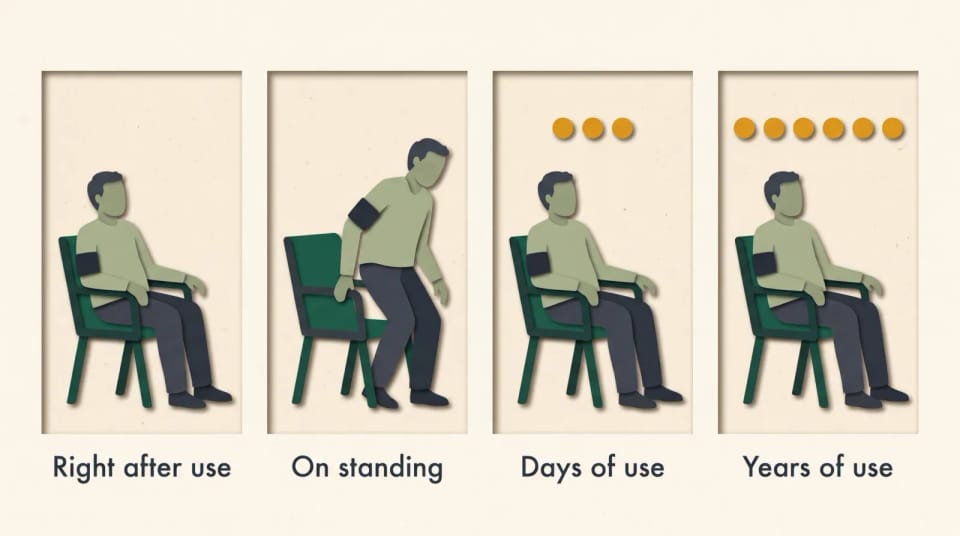
Each stage answers a different question. Lab studies cover the first minutes and standing up, small dosing studies cover days, and population studies cover years. No single study follows one person through all four.
Why does the same plant push pressure both ways?
The best evidence points to cannabinoid CB1 receptors and the nervous system, not to anything special about blood vessels in cannabis users. In the 2006 trial above, a drug that blocks CB1 receptors (rimonabant) prevented the symptomatic drops. The men who had symptoms also had higher peak THC levels in their blood (Gorelick et al., 2006).
That THC finding does not hold everywhere. In the 2003 standing study, dizziness was unrelated to blood THC levels (Mathew et al., 2003). Two careful studies, two different answers, so “more THC means a bigger drop” is not settled.
A pharmacology review sums up the human picture: THC often speeds the heart, sometimes with a modest pressure rise, and rarely lowers resting pressure. It also notes that the drop on standing was more marked in volunteers who already had high blood pressure (Malinowska et al., British Journal of Pharmacology). That is one reason people with heart or blood pressure conditions get extra caution in official advice.
What happens to blood pressure with daily or repeated use?
The pattern shifts, and it shifts unevenly. With repeated exposure, one review describes lying-down pressure falling slightly, the drop on standing fading, and the heart rate slowing. Tolerance to most first-time effects appears quickly (Jones, 2002).
Older inpatient work with prolonged oral THC found the same unevenness. Volunteers became tolerant to the drop on standing but not to a lower resting pressure. They also gained weight from fluid retention (Benowitz and Jones, Clinical Pharmacology and Therapeutics).
A 2012 study of 13 male daily smokers given very high oral THC doses on a locked research unit found tolerance to the “high” but not to the heart and pressure effects. Blood pressure stayed lower and heart rate higher across six days (Gorelick et al., Journal of Analytical Toxicology). Those doses are far above ordinary use. Our lesson on how tolerance can differ by effect explains why your high can fade while your body keeps responding.
Timing also stretches further than people expect. In a small exploratory study, people who had never used cannabis took 10 mg of oral THC at bedtime. The next morning, on a tilt table, they had more dizziness and a weaker pressure and heart-rate response than after placebo (Gonzalez et al., Physiological Reports). Edibles work on a slower clock than smoke; see our hour-by-hour guide to edible timing.
Does smoking weed cause high blood pressure long term?
The long-term studies do not show a consistent link, and they disagree on small effects in both directions. Every one of them is observational and relies on people reporting their own use, so none can prove cause.
| Study | Who and how | What it found | Main limit |
|---|---|---|---|
| NHANES survey, 2005 to 2012 | 12,426 US adults, one exam | Recent users’ systolic pressure about 1.6 mm Hg higher; no link to diagnosed hypertension (Alshaarawy and Elbaz) | One snapshot, self-reported use |
| NHANES survey, 2005 to 2014 | 10,709 US adults | After adjustment, only heavy current users had higher odds of elevated pressure (Vidot et al.) | One snapshot; “heavy” is the study’s own category |
| UK Biobank | 91,161 UK volunteers | Heavy lifetime use linked to slightly lower systolic pressure, about 1 to 2 mm Hg (Vallée) | Volunteers skew healthier; author calls the gap too small to matter clinically |
| MESA | 3,255 older adults with a history of regular smoking | No link to systolic or diastolic pressure or to hypertension (Corroon et al., Frontiers in Cardiovascular Medicine) | Smoked use only; survivors into older age |
| CARDIA cohort | 4,328 adults followed for 35 years | Cumulative cannabis use not linked to new hypertension (Hypertension, 2025) | Most participants used little; no data on potency or route |
Read the table as a range of small numbers around zero. The US surveys lean slightly higher, the UK survey leans slightly lower, and the two studies built to look at hypertension itself found nothing. The NHANES authors estimated that daily use might add about 3 mm Hg of systolic pressure and said its clinical meaning is unclear.
The CARDIA cohort is the strongest design here, because it followed the same people from young adulthood. Its limit is just as important: by year 35, the typical participant had very little lifetime exposure, so it says less about long-term heavy users of modern high-THC products.
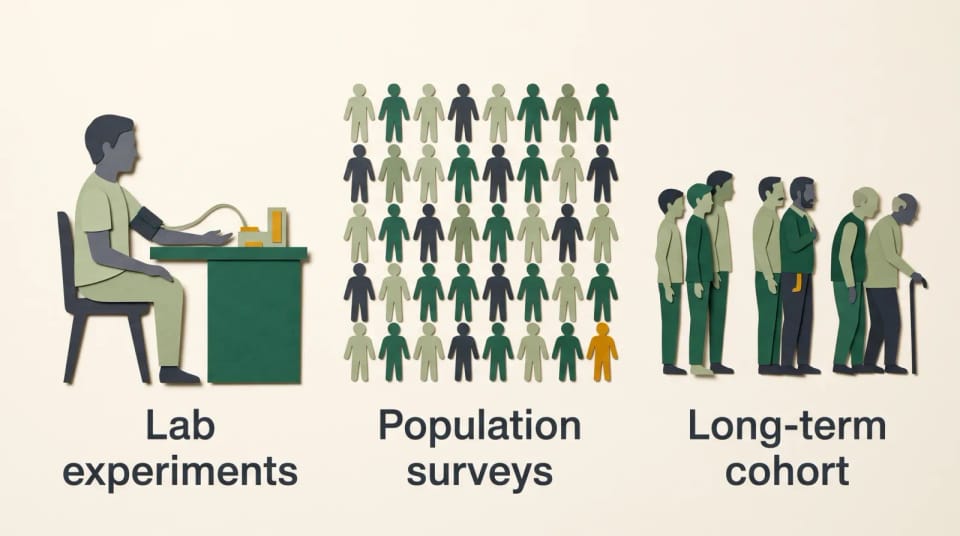
Lab experiments measure the first minutes. Surveys compare many people at one moment. A cohort follows the same people for decades. They answer different questions, which is why their results can look contradictory.
For what these readings mean for heart attack and stroke, see what the large heart-risk studies measure. Blood pressure is one input to heart risk, not the whole story.
Does CBD lower blood pressure?
In two small trials of healthy men, yes, briefly. A single oral dose of CBD lowered resting systolic pressure by about 6 mm Hg in nine men (Jadoon et al., JCI Insight). In a seven-day trial of 26 men taking 600 mg a day, resting pressure fell after the first dose but not after a week of dosing. The lower pressure during stress tests did persist (Sultan et al., British Journal of Clinical Pharmacology).
That contrasts with THC-predominant cannabis, which raised pressure in the 2024 inhalation study while the CBD-predominant product did not. Our explainer on how THC and CBD differ covers the wider picture. None of these trials makes CBD a blood-pressure treatment.
What about older adults and people with high blood pressure?
Here the evidence is thin and the stakes are higher. One study gave 24-hour pressure monitors to 26 adults aged 60 and over who had high blood pressure and a new medical cannabis prescription. Average 24-hour pressure was lower at three months (Abuhasira et al., European Journal of Internal Medicine). It had no control group, so other changes over those months could explain the result. It is a reason for more research, not a reason to use cannabis for blood pressure.
The AHA statement notes a lack of definitive evidence in older adults and in people with heart disease. Health Canada tells adults over 55 not to use cannabis if they have serious heart or blood vessel disease, and it warns that pressure can drop when you change position. Our guide for adults over 55 and cannabis covers falls and other age-related cautions.
Cannabis can also interact with other medicines. The details are in our guide to cannabis and blood-pressure medicines, and a pharmacist can check your specific list. Do not start, stop or change any prescribed medicine based on this article.
Does it matter if you smoke, vape or eat it?
For inhaled THC, the route did not change the basic pattern. Smoked and vaporized THC flower gave similar rises in heart rate and mean arterial pressure in the 2024 study. For the rest of the comparison, see our science-based guide to vaping versus smoking.
Edibles have far less direct data. The oral THC studies above are small lab studies, often at high doses, and they show lower pressure, a fading standing drop and next-morning effects in people new to cannabis. No study found here compared edibles and smoke head to head for blood pressure.
When should you talk to a clinician?
Get urgent medical care for chest pain or fainting after using cannabis. Talk with a clinician if you have high blood pressure or heart disease and use cannabis, if your home readings are unexpectedly high or low, or if you get dizzy or nearly faint when you stand.
Bring specifics: what you used, how much, by which route, when, and what you felt. If you already log sessions in the High IQ app, that record of how each strain worked for you makes the conversation easier. A smartwatch can show your pulse, but it cannot tell you why it changed; our piece on what a wearable can and cannot tell you explains the gap.
Key takeaways
- THC-rich cannabis usually raises heart rate and can nudge resting blood pressure up soon after use.
- Standing up can drop pressure in some people; severe drops showed up in a minority of small samples.
- Repeated use shifts the pattern: the standing drop fades and resting pressure can fall slightly.
- Long-term studies find no consistent link to hypertension, but they are observational and mostly low-exposure.
- CBD lowered resting pressure briefly in small trials of healthy men; it is not a treatment.
- Chest pain, fainting or unusual readings need a clinician, not a strain change.
FAQ
Is weed raising my blood pressure?
It might be, for a while after you use THC-rich cannabis, mainly alongside a faster heart rate. Lab studies show a modest rise soon after inhaling, but long-term studies do not show a consistent link to high blood pressure. If your readings are high, talk with a clinician and mention your cannabis use.
Does cannabis lower high blood pressure?
There is no good evidence that it does. The only study in older adults with hypertension had 26 people and no control group. The drop some people get on standing is a side effect that can cause falls, not a treatment.
Can I use weed with blood pressure medication?
Ask a pharmacist or your prescriber to check your specific medicines. Cannabis can interact with some drugs, and our medication interactions guide explains how. Do not change your medication on your own.
Is a high pulse after weed the same as high blood pressure?
No. Pulse is how fast your heart beats; blood pressure is the force in your arteries. THC raises the pulse more reliably than it raises pressure, which is why a racing heart can come with only a small pressure change.
Does regular use cause high blood pressure?
Studies do not show that it does. A 35-year cohort found no link between cumulative use and new hypertension, and an older-adult study found none either, though one US survey linked heavy current use to elevated readings. All of these studies are observational, so they cannot settle cause in either direction.
Sources
- Cheung CP, Coates AM, Baker RE, Burr JF. Acute effects of cannabis inhalation on arterial stiffness, vascular endothelial function, and cardiac function. Journal of the American Heart Association, 2024. doi:10.1161/JAHA.124.037731
- Ghasemiesfe M, Ravi D, Casino T, Korenstein D, Keyhani S. Acute cardiovascular effects of marijuana use. Journal of General Internal Medicine, 2020. doi:10.1007/s11606-019-05235-9
- Gorelick DA, Heishman SJ, Preston KL, et al. The cannabinoid CB1 receptor antagonist rimonabant attenuates the hypotensive effect of smoked marijuana in male smokers. American Heart Journal, 2006. doi:10.1016/j.ahj.2005.11.006
- Mathew RJ, Wilson WH, Davis R. Postural syncope after marijuana: a transcranial Doppler study of the hemodynamics. Pharmacology Biochemistry and Behavior, 2003. doi:10.1016/S0091-3057(03)00086-8
- Mathew RJ, Wilson WH, Humphreys D, et al. Middle cerebral artery velocity during upright posture after marijuana smoking. Acta Psychiatrica Scandinavica, 1992. doi:10.1111/j.1600-0447.1992.tb03247.x
- Jones RT. Cardiovascular system effects of marijuana. Journal of Clinical Pharmacology, 2002. doi:10.1002/j.1552-4604.2002.tb06004.x
- Benowitz NL, Jones RT. Cardiovascular effects of prolonged delta-9-tetrahydrocannabinol ingestion. Clinical Pharmacology and Therapeutics, 1975. PubMed 1164818
- Gorelick DA, Goodwin RS, Schwilke E, et al. Tolerance to effects of high-dose oral delta9-tetrahydrocannabinol and plasma cannabinoid concentrations in male daily cannabis smokers. Journal of Analytical Toxicology. doi:10.1093/jat/bks081
- Gonzalez JE, Stewart AV, Robinson LD, et al. Bedtime tetrahydrocannabinol ingestion reduces morning orthostatic cardiovascular reactivity in adults: an exploratory study. Physiological Reports, 2026. doi:10.14814/phy2.71076
- Malinowska B, Baranowska-Kuczko M, Schlicker E. Triphasic blood pressure responses to cannabinoids: do we understand the mechanism? British Journal of Pharmacology. doi:10.1111/j.1476-5381.2011.01747.x
- Alshaarawy O, Elbaz HA. Cannabis use and blood pressure levels: United States National Health and Nutrition Examination Survey, 2005-2012. Journal of Hypertension. doi:10.1097/HJH.0000000000000990
- Vidot DC, Powers M, Gonzalez R, et al. Blood pressure and marijuana use: results from a decade of NHANES data. American Journal of Health Behavior, 2019. doi:10.5993/AJHB.43.5.2
- Vallée A. Association between cannabis use and blood pressure levels according to comorbidities and socioeconomic status. Scientific Reports, 2023. doi:10.1038/s41598-022-22841-6
- Corroon J, Bradley R, Allison MA, Grant I. Blood pressure and hypertension in older adults with a history of regular cannabis use: findings from the Multi-Ethnic Study of Atherosclerosis. Frontiers in Cardiovascular Medicine. doi:10.3389/fcvm.2024.1432923
- Lifetime cannabis use and incident hypertension: the Coronary Artery Risk Development in Young Adults (CARDIA) Study. Hypertension, 2025. doi:10.1161/HYPERTENSIONAHA.125.25005
- Jadoon KA, Tan GD, O’Sullivan SE. A single dose of cannabidiol reduces blood pressure in healthy volunteers in a randomized crossover study. JCI Insight, 2017. doi:10.1172/jci.insight.93760
- Sultan SR, O’Sullivan SE, England TJ. The effects of acute and sustained cannabidiol dosing for seven days on the haemodynamics in healthy men: a randomised controlled trial. British Journal of Clinical Pharmacology, 2020. doi:10.1111/bcp.14225
- Abuhasira R, Haviv YS, Leiba M, et al. Cannabis is associated with blood pressure reduction in older adults: a 24-hours ambulatory blood pressure monitoring study. European Journal of Internal Medicine, 2021. doi:10.1016/j.ejim.2021.01.005
- Page RL 2nd, Allen LA, Kloner RA, et al. Medical marijuana, recreational cannabis, and cardiovascular health: a scientific statement from the American Heart Association. Circulation, 2020. doi:10.1161/CIR.0000000000000883
- Centers for Disease Control and Prevention. Cannabis and heart health.
- Health Canada. Health effects of cannabis on adults over 55.
Sources checked October 29, 2026.



