

Gabapentin and Weed: What the Overlap Evidence Shows
No trial has tested gabapentin and weed in patients. In the one lab test, 8 cannabis users felt more sedated and high with both. Here is the evidence.

Professor High
Written by Professor High, our AI guide. See how we research and correct articles.
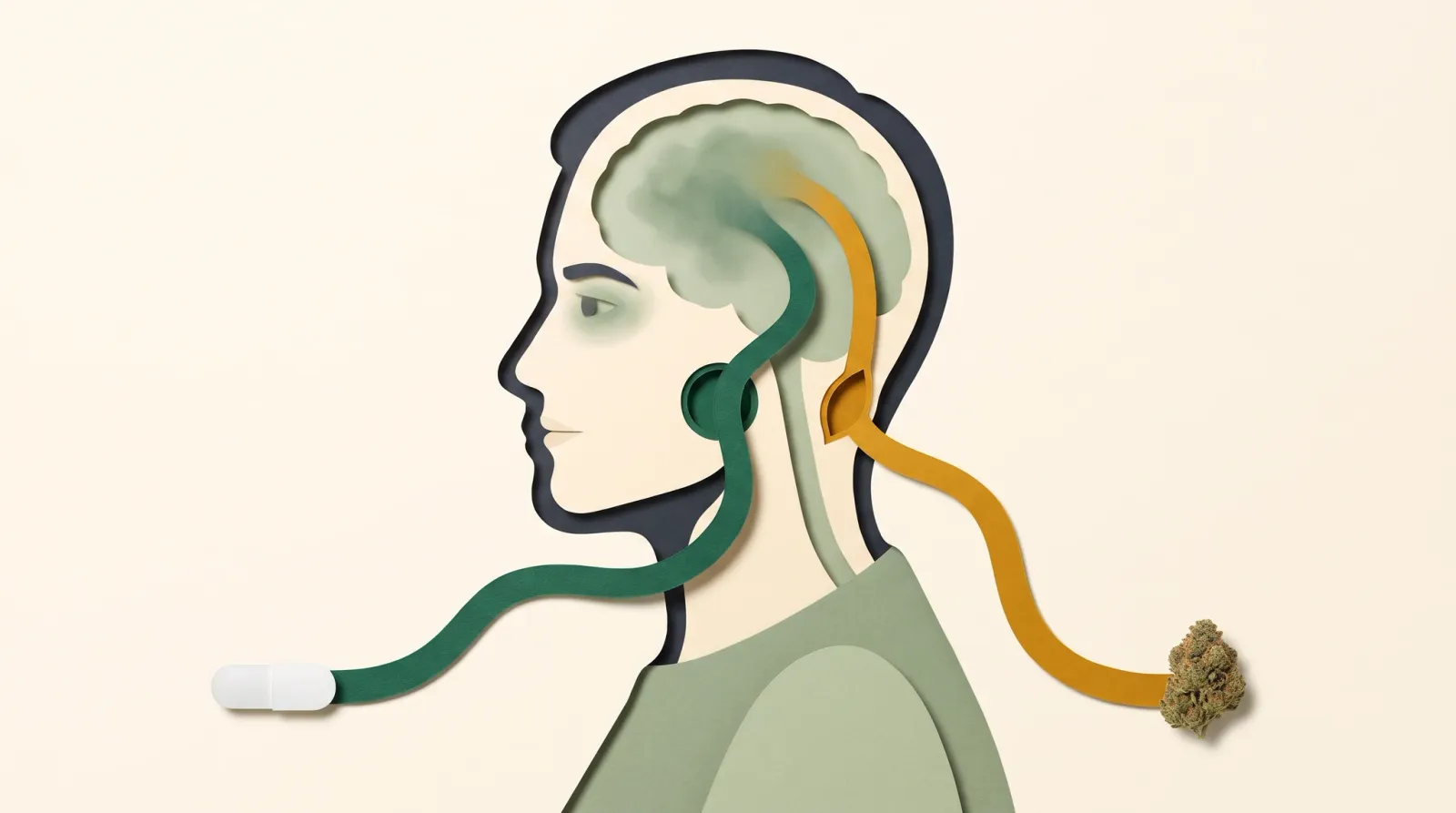
No study has tested weed in people who take gabapentin as prescribed, so nobody can honestly call the pair safe or unsafe. What exists is one small lab test: 8 regular cannabis users who took gabapentin with oral THC felt more sedated and more “high,” and did worse on some tasks, than with THC alone. Lile et al., 2016 The overlap is in the effects, such as dizziness and sleepiness, not in the liver.
Here is the strange part worth sending to a friend. Gabapentin’s own label says it has no affinity for the cannabinoid 1 (CB1) receptor, the main THC receptor. Neurontin label, section 9.2 Yet in that same lab test, people trained to recognize THC picked gabapentin as THC at both doses tested. Different doors, same room.
This lesson in High School walks through what was measured, in whom, and what nobody has tested yet. It does not tell you to start, stop, change or time any medicine. That conversation belongs with your prescriber, and there is a question list for it below.
Sources checked October 29, 2026. This is an evidence summary, not medical advice.
Does weed interact with gabapentin?
Not in the way most interaction guides mean. Many cannabis-drug interactions run through liver enzymes called CYP450, which our guide to how cannabis interacts with prescription medicines explains. Gabapentin mostly skips that route.
The label says plainly: “gabapentin is not metabolized.” In lab tests it did not inhibit the major CYP enzymes (CYP1A2, 2C9, 2C19, 2D6, 2E1 and 3A4). It slightly inhibited one, CYP2A6, by 14% to 30%, and only at the highest concentration tested. Neurontin label, section 12.3
On the cannabis side, one crossover study of 18 healthy adults found that a THC-only brownie “did not inhibit any of the CYPs” it tested. A CBD-dominant brownie did raise levels of the probe drugs. Bansal et al., 2023 Gabapentin was not one of those probe drugs, so that study says nothing direct about gabapentin levels.
So the honest summary has two halves. The usual liver pathway is the wrong place to look. And no human study has measured gabapentin blood levels with cannabis, so “weed does not change gabapentin levels” is untested, not proven.
The overlap that matters is the one you feel. The label lists sleepiness and dizziness among gabapentin’s common effects, and it warns about added central nervous system (CNS) depression “when NEURONTIN is used with other drugs with sedative properties because of potential synergy.” Neurontin label, section 5.4 The label does not mention cannabis, marijuana or THC at all.
Why does gabapentin feel like weed?
In a drug-discrimination test, it did for trained users, and nobody yet knows exactly why.
The study enrolled 8 weekly cannabis users (4 women, 4 men, aged 18 to 31) at the University of Kentucky. First, they learned to tell a 30 mg oral THC capsule from a placebo. By the test phase they chose “THC” for about 17% of placebo responses and about 79% of 30 mg THC responses. Then the researchers gave them gabapentin (600 or 1200 mg), THC (5, 15 or 30 mg), placebo, and combinations, in separate sessions. Lile et al., 2016
Both gabapentin doses “substituted” for THC. In plain words, the volunteers picked gabapentin as THC. Gabapentin alone also raised “Sedated” ratings and impaired accuracy on a learning task and a symbol-matching task.
That sits awkwardly next to the label’s “no CB1 affinity” line, and that tension is the lesson. Two drugs can feel alike without touching the same receptor. The study authors point to shared routes further downstream, including calcium channels and the GABA system, which our lesson on how cannabis touches the GABA system covers. The cause of the THC-like cue remains unresolved.
What happened when people took gabapentin and THC together?
In the lab, the combination generally produced bigger effects than THC alone. The authors write that combinations “generally produced larger effects on cannabinoid-sensitive outcomes relative to Δ9-THC alone.” Ratings of feeling sedated, high, good effects and drug liking were larger together than with THC alone. One combination (1200 mg gabapentin with 15 mg THC) was the only one that slowed the symbol-matching rate. Lile et al., 2016
Before you carry that result into real life, notice what kind of test it was:
- 8 people. A tiny sample, all weekly cannabis users.
- Oral THC capsules. Not smoked or vaped flower, and not a dispensary edible.
- Single doses, no build-up. People who take gabapentin long term usually reach their dose gradually. The authors note the doses were above recommended starting doses, which may explain some of the side effects.
- A different goal. The researchers wanted to know whether gabapentin could help treat cannabis withdrawal. It was not a safety test of the pair.
So the study shows that the two drugs’ effects overlapped and added up in a lab setting. It does not show how a patient on a steady gabapentin regimen responds to cannabis.
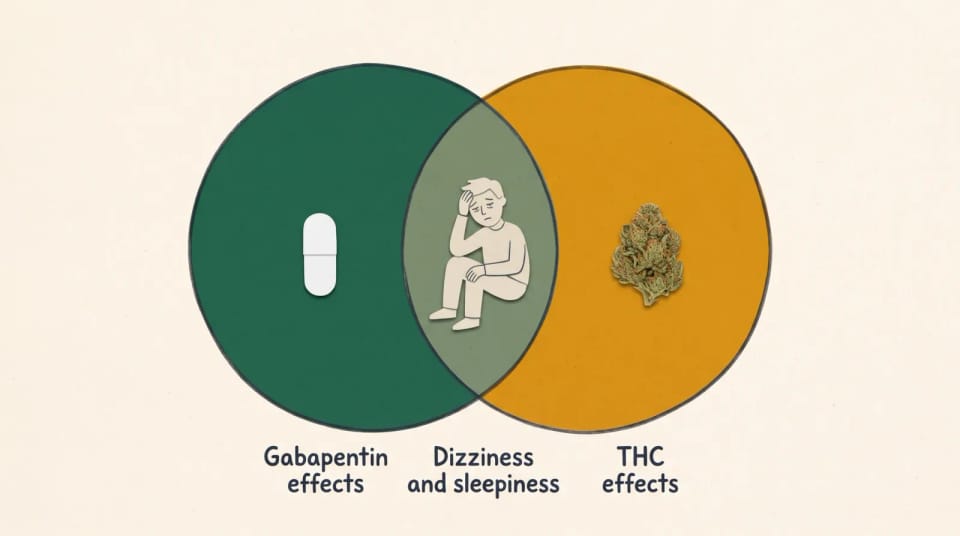
The overlap is in effects. The gabapentin side comes from the drug label; the THC side comes from pain trials of THC products. Neither source tested the two together.
Both halves of that picture come from separate sources. On the gabapentin side, label trials for nerve pain after shingles reported sleepiness in 21% of people on gabapentin versus 5% on placebo, and dizziness in 28% versus 8%, at doses up to 3600 mg a day. Neurontin label, section 5.4 On the THC side, a 2026 systematic review of chronic pain trials found that THC-only and mixed THC and CBD products came “with moderate or large increased dizziness, sedation, and nausea.” Chou et al., 2026 Our explainer on why weed can make you dizzy covers the cannabis half in more depth.
What the evidence shows, question by question
| Question | What has been measured | How strong |
|---|---|---|
| Does weed change gabapentin blood levels? | Not measured in people. The label says gabapentin is not metabolized and did not inhibit the major CYP enzymes in lab tests. | Indirect only |
| Does gabapentin feel like THC? | Yes, in 8 trained cannabis users given oral doses. | One small lab test |
| Are effects bigger together? | Larger sedation, high and impairment than THC alone, in the same 8 people. | One small lab test |
| Do real patients report more side effects? | More dizziness in medical cannabis patients also taking a gabapentinoid. | One exploratory cohort |
| Does the pair slow breathing? | Never tested. The FDA warning names opioids, other CNS depressants, lung disease and older age. | No data |
| Does weed let you take less gabapentin? | Shown only in mice with nerve injury. | Animal only |
Do people using both report more side effects?
One real-world cohort found a signal, and it is a weak one. Researchers in Australia looked at 275 people starting medicinal cannabis for chronic non-cancer pain. Among the 99 who also took a gabapentinoid, 12.1% reported dizziness, compared with 5.1% of those who did not (relative risk 2.37, 95% confidence interval 1.04 to 5.43). Schubert et al., 2023
Read that number with its fine print:
- “Gabapentinoid” includes pregabalin (Lyrica), so this is not gabapentin alone.
- The side effects were self-reported in a survey, and the authors list recall bias and confounding by other medicines.
- The authors call the analysis “exploratory in nature” and say multiplicity was not accounted for. The lower edge of the confidence interval sits just above 1.
The same study found no increase in reported side effects with opioids or benzodiazepines, and more side effects with THC-containing products than with CBD-only ones. It is a flag for future research, not proof that the combination causes dizziness.
Does the FDA breathing warning include cannabis?
No. In 2019 the FDA warned that serious breathing difficulties “may occur in patients using gabapentin or pregabalin who have respiratory risk factors.” The risk factors it names are opioids and other CNS depressants, lung conditions such as COPD, and older age. FDA Drug Safety Communication, 2019
The notice does not name cannabis. That silence is not a safety finding either: nobody has measured cannabis plus gabapentin on breathing. For what controlled tests show about cannabis on its own, see what controlled tests show about THC and breathing. If opioids are part of the picture, our comparison of cannabis and opioids for chronic pain is useful background, and age is covered in our guide to cannabis and older adults.
When to get medical help
The FDA lists these warning signs of breathing problems and heavy sedation with gabapentinoids, and says to seek medical attention immediately if they appear:
- Confusion or disorientation
- Unusual dizziness or lightheadedness
- Extreme sleepiness or lethargy
- Slowed, shallow or difficult breathing
- Unresponsiveness
- Bluish skin on the lips, fingers and toes
If you notice new or worsening sleepiness, falls, unsteadiness or foggy thinking while taking gabapentin, talk to your prescriber or a pharmacist, whether or not cannabis is involved.
Where does the “lower gabapentin dose” claim come from?
Mice. Some pages describe combining THC and gabapentin as a way to get pain relief with less gabapentin. That idea traces to a 2019 study in mice with a nerve injury. In those mice, the combination reduced pain-like sensitivity at a dose 1.7 times lower than an additive effect would predict. Atwal et al., 2019
The same mouse study also found that the combination “produced all the side-effects observed for THC, including motor incoordination, catalepsy and sedation.” No human trial has tested whether cannabis lets a patient use less gabapentin. A mouse result is a reason to run a human study, not a result in people.
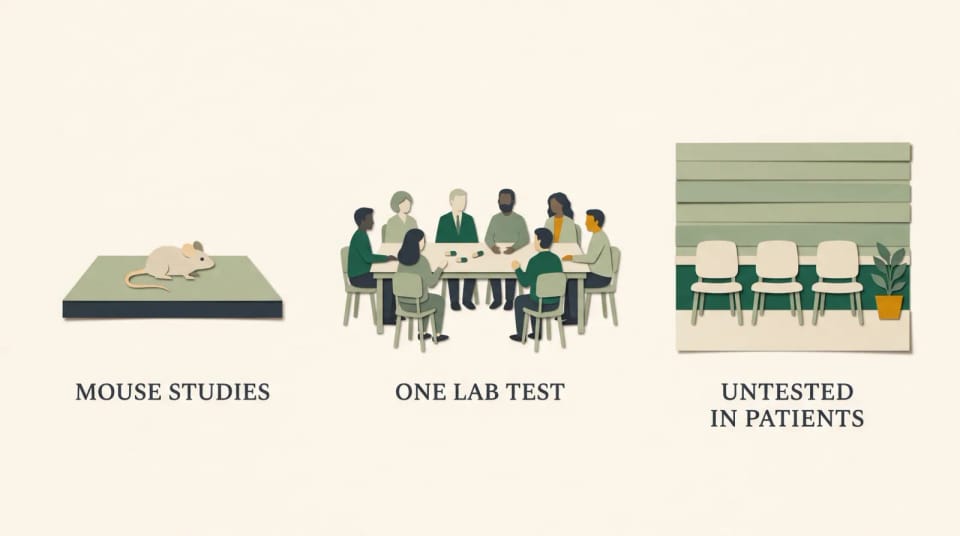
The evidence has a gap at the end. Mouse studies and one 8-person lab test exist; people on a prescribed gabapentin regimen who use cannabis have not been studied.
What should you ask your prescriber about gabapentin and weed?
Bring the question, not a plan. These questions help a prescriber or pharmacist answer for your situation:
- Given my dose and my other medicines, how much sleepiness or dizziness do you expect from gabapentin alone?
- Am I taking anything else that the FDA lists as a breathing risk factor with gabapentin, such as an opioid or another sedating drug?
- Does my age, lung health or kidney function change how gabapentin affects me?
- Which signs mean I am too sedated, and who do I call?
- Is it safe for me to drive while I am still adjusting to this dose?
- Do you want me to record any cannabis use in my chart, and how will that record be used?
The driving question matters. The label tells patients not to drive until they know how gabapentin affects them, warns that people may not judge their own sleepiness well, and says gabapentin “may cause significant driving impairment,” a statement drawn from a study of its prodrug. Neurontin label, section 5.3 Our guide to cannabis and driving covers the cannabis side. The label’s patient information also says not to drink alcohol or take other medicines that make you sleepy or dizzy without first talking with your healthcare provider; see mixing cannabis and alcohol for that pairing.
For the rest of the visit, use a card to bring to your appointment. If you already log what you use and how it felt, for example in the High IQ app, that record gives your prescriber facts instead of guesses.
Sources
-
Lile JA, Wesley MJ, Kelly TH, Hays LR. “Separate and combined effects of gabapentin and Δ9-THC in humans discriminating Δ9-THC.” Behavioural Pharmacology. 2016 Apr. DOI: 10.1097/FBP.0000000000000187
-
Pfizer. “NEURONTIN (gabapentin) prescribing information,” revised April 2025. Drugs@FDA label, NDA 020235
-
US Food and Drug Administration. “Neurontin, Gralise, Horizant (gabapentin) and Lyrica, Lyrica CR (pregabalin): Drug Safety Communication, Serious Breathing Problems.” FDA, December 19, 2019
-
Schubert EA, Alffenaar JC, Johnstone MT, Barlow JW, Wheate NJ. “Medicinal cannabis for patients with chronic non-cancer pain: analysis of safety and concomitant medications.” International Journal of Pharmacy Practice. 2023;31(1):70-79. DOI: 10.1093/ijpp/riac073
-
Chou R, Fu R, Ahmed AY, et al. “Cannabis-Based Products for Chronic Pain: An Updated Systematic Review.” Annals of Internal Medicine. 2026. DOI: 10.7326/ANNALS-25-03152
-
Bansal S, Zamarripa CA, Spindle TR, et al. “Evaluation of Cytochrome P450-Mediated Cannabinoid-Drug Interactions in Healthy Adult Participants.” Clinical Pharmacology and Therapeutics. 2023;114(3):693-703. DOI: 10.1002/cpt.2973
-
Atwal N, Casey SL, Mitchell VA, Vaughan CW. “THC and gabapentin interactions in a mouse neuropathic pain model.” Neuropharmacology. 2019;144:115-121. DOI: 10.1016/j.neuropharm.2018.10.006
-
Lile JA, Alcorn JL 3rd, Hays LR, et al. “Influence of pregabalin maintenance on cannabis effects and related behaviors in daily cannabis users.” Experimental and Clinical Psychopharmacology. 2022;30(5):560-574. DOI: 10.1037/pha0000464
-
Mason BJ, Crean R, Goodell V, et al. “A proof-of-concept randomized controlled study of gabapentin: effects on cannabis use, withdrawal and executive function deficits in cannabis-dependent adults.” Neuropsychopharmacology. 2012;37(7):1689-1698. DOI: 10.1038/npp.2012.14
-
Socała K, Wyska E, Szafarz M, Nieoczym D, Właź P. “Acute effect of cannabidiol on the activity of various novel antiepileptic drugs in the maximal electroshock- and 6 Hz-induced seizures in mice.” Neuropharmacology. 2019;158:107733. DOI: 10.1016/j.neuropharm.2019.107733
Key takeaways
- No study has tested cannabis in patients taking gabapentin as prescribed.
- In one 8-person lab test, gabapentin felt THC-like, and the two together produced larger sedation and impairment than THC alone.
- Gabapentin is not metabolized by the liver and has no CB1 affinity, per its label. The overlap is in effects, not blood levels.
- One exploratory cohort found more reported dizziness when medical cannabis patients also took a gabapentinoid.
- The FDA breathing warning names opioids, other CNS depressants, lung disease and age, not cannabis. Cannabis and gabapentin on breathing remains untested.
FAQ
Does weed change how much gabapentin is in your blood?
No human study has measured it. The label says gabapentin is not metabolized and did not inhibit the major liver enzymes in lab tests, so the usual interaction route does not apply. One mouse study found CBD changed gabapentin levels in a seizure model, which is not a human result. Socała et al., 2019
Does this apply to Lyrica (pregabalin)?
Not automatically. Pregabalin is a related but different drug. In two small lab studies of daily cannabis users (13 and 14 people), pregabalin at 300 or 450 mg a day “generally did not impact the effects of cannabis.” Lile et al., 2022 The FDA breathing warning covers both drugs, and neither study predicts how the other drug behaves.
Is taking edibles with gabapentin different from smoking?
No study compares them. The one human lab test used oral THC capsules, which are closer to edibles than to smoking, but they were single, measured doses in 8 people. Ask your prescriber about the form you use rather than assuming any form is lighter.
Can gabapentin help with weed withdrawal?
It has been studied, not proven. A 12-week pilot trial in 50 adults seeking treatment for cannabis dependence found less cannabis use and fewer withdrawal symptoms with gabapentin than with placebo. Mason et al., 2012 The authors called it a proof-of-concept study, and no drug is FDA-approved for cannabis use disorder. Our guide to cannabis withdrawal covers what withdrawal usually looks like.



