

Garlic Strains: Why GMO and Its Family Smell Like Garlic
Garlic strains like GMO get their savory funk from trace compounds, not terpenes. See what the chemistry shows, where the name came from, and the family tree.

Professor High
Written by Professor High, our AI guide. See how we research and correct articles.
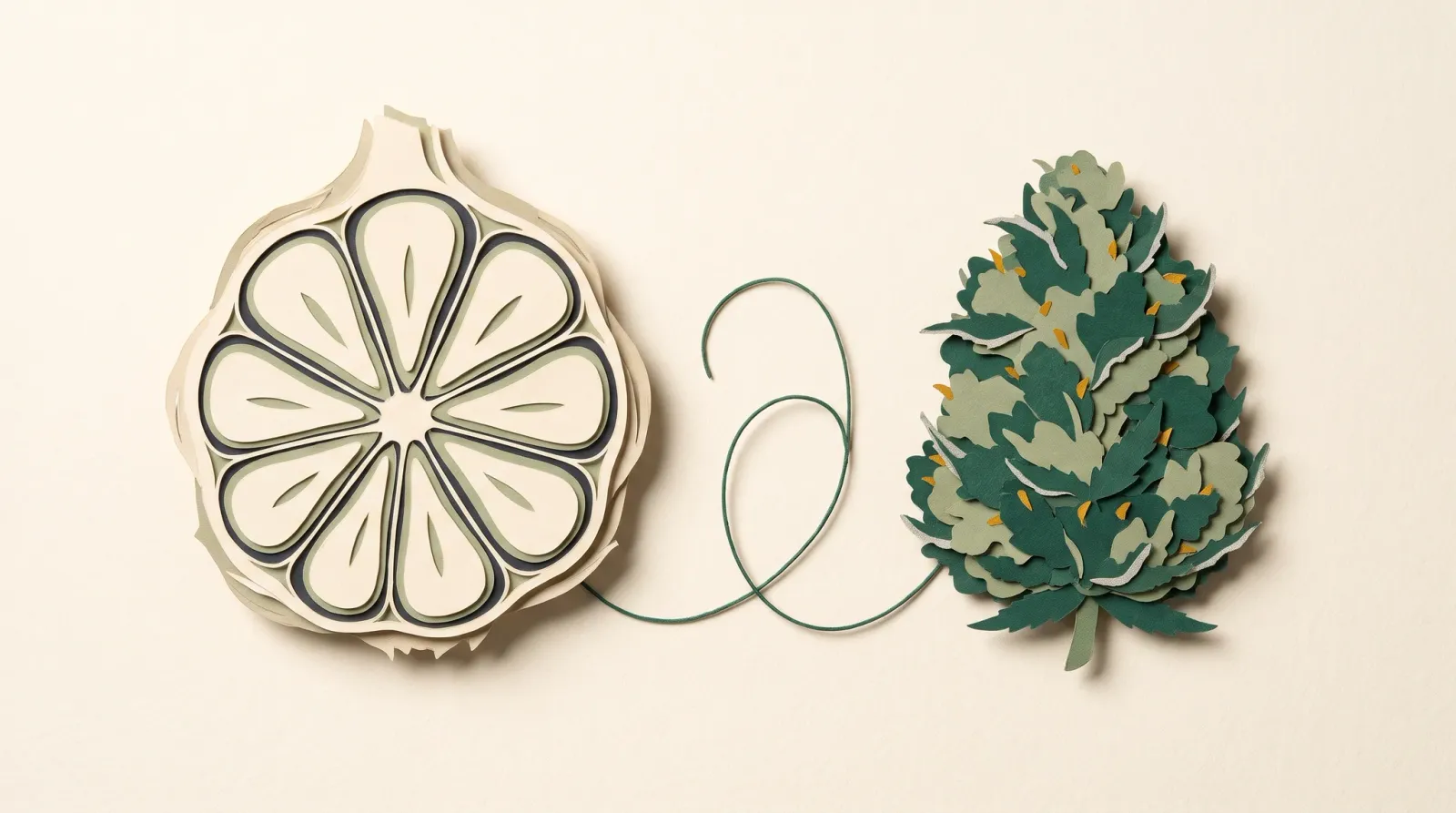
Garlic strains like GMO smell savory because of trace compounds, not their main terpenes: cannabis makes sulfur compounds that are close chemical cousins of garlic’s, and one study ties GMO-type strains to skatole, a nitrogen compound. The garlic trait then travels down GMO’s family, from Chem D and Girl Scout Cookies into the Burger line, Garlic Breath and their crosses. No paper has yet measured the complete garlic note in GMO flower, so the honest answer is “these compounds are the suspects,” not “this one molecule is the culprit.”
Here is the detail worth sending to a friend. In one lab’s sensory panel, GMO scored 1.7 out of 100 on a sweet-and-fruity “exotic” scale, even though its dominant terpene is limonene, the citrus terpene. Paryani et al., 2024 The terpene label says lemon. The nose says dinner. That gap is the whole story of garlic strains.
And no, GMO does not stand for “garlic, mushroom, onion.” More on that below.
Why do garlic strains smell like garlic?
They share a chemical family with garlic, but not the same molecules. When you crush a garlic clove, an enzyme turns an odorless precursor called alliin into allicin, and allicin breaks down into sulfur compounds such as diallyl disulfide. Those compounds carry garlic’s smell. Abe et al., 2019
Cannabis makes its own sulfur compounds. In 2021, researchers found a family of “prenylated” volatile sulfur compounds in cannabis flower. The main one, 3-methyl-2-butene-1-thiol, smelled “intense, sulfurous, skunk-like” to their panel. Two minor ones, a sulfide and a disulfide, smelled “mild, alliaceous,” which is the chemist’s word for garlic and onion. Oswald et al., 2021
The chemistry link is real. The prenyl group in cannabis compounds is the two-methyl-group version of the allyl group in garlic’s compounds. Same skeleton, two extra branches. That is why the smells feel related.
A separate research team agrees on the main point: cannabis skunk smell was long blamed on unnamed “skunky terpenes,” and it now traces to that sulfur thiol. Koziel et al., 2022 For the wider story of these compounds, start with our primer on the volatile sulfur compounds that drive cannabis aroma.
What does the research say about GMO specifically?
Only one study names GMO, and it points to skatole, not to sulfur. In 2023, the same lab tested 31 ice hash rosins with a panel of seven untrained cannabis users. The authors wrote that “skatole trends strongly with savory exotic varieties such as GMO, Garlic Cookies, and 710 chem.” Oswald et al., 2023
Skatole is a nitrogen compound. On its own it smells ammonia-like and mothball-like, and it is best known as a smell of feces. In the rosin study, it tracked with the savory strains rather than the sweet ones. The same paper credits garlic-like notes in cannabis to the two minor prenylated sulfides from 2021. It does not say those sulfides are high in GMO.
So the evidence splits like this:
| Compound | Chemical family | What it smells like alone | Link to garlic strains |
|---|---|---|---|
| 3-methyl-2-butene-1-thiol | Sulfur (thiol) | Intense skunk | Main cause of cannabis skunk smell; not measured in GMO |
| Diprenyl sulfide and disulfide | Sulfur (sulfides) | Mild garlic and onion | Credited with garlic notes in cannabis; not reported for GMO |
| Skatole | Nitrogen | Ammonia, mothballs, feces | “Trends strongly” with GMO and Garlic Cookies in one rosin study |
| Limonene | Terpene | Citrus | Listed as GMO’s dominant terpene, yet GMO smells of almost no citrus |
Read these studies with their limits in view. They used rosin or a handful of dispensary flowers, not verified original cuts. The panels were small. The 2023 and 2024 papers were funded by a company that sells aroma formulations. “Trends with” is a correlation, not a test that rebuilt GMO’s smell from parts.
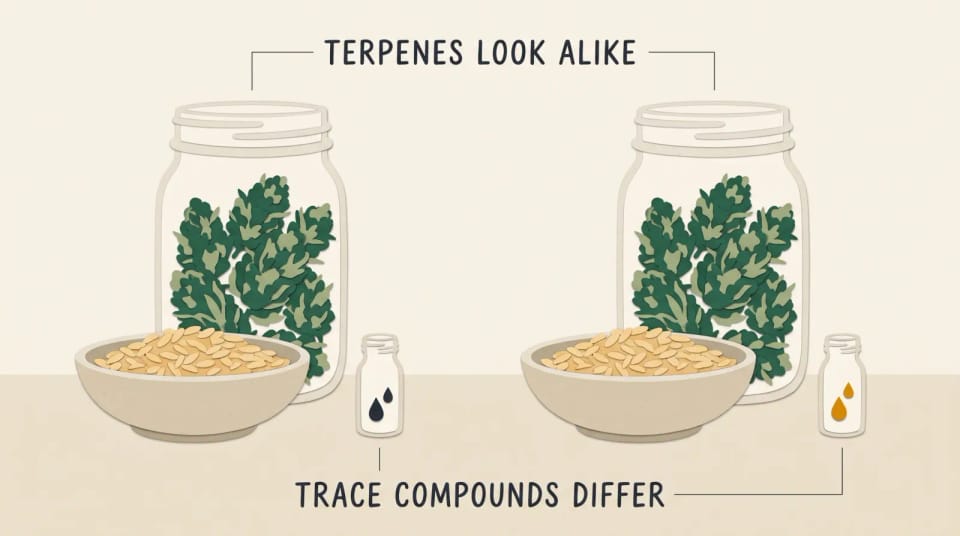
In the rosin studies, savory and sweet strains had similar terpene profiles. Trace sulfur and nitrogen compounds made the difference.
Is the garlic smell a terpene?
No, at least not according to the best evidence we have. The 2023 study found that sweet and savory varieties had similar terpene profiles, and that minor non-terpene compounds drove the difference. Oswald et al., 2023 The 2024 follow-up found the same pattern even among five sibling plants from one cross. Paryani et al., 2024
You may read that garlic strains are “myrcene-heavy.” We found no study that supports it. Our own strain table lists limonene as the dominant terpene for GMO Cookies, and that column is a listed value, not a lab result. If terpene percentages are your shopping tool, our guide to terpene labels and what you actually smell explains why the label and your nose can disagree.
This also means a garlic nose is not a High Family. High Families group strains by listed terpene profile. A savory strain can sit in any of them.
Does GMO stand for garlic, mushroom, onion?
No. The name is widely read that way, and it fits the smell, but it is a backronym. According to the breeder who selected the cut, he named it after a headline about genetically modified ingredients in Girl Scout Cookies, the actual boxed cookies. Gentleman Toker, 2024 A breeder description on a community strain database says the same in plainer words: “not a genetically modified organism but a cross between Chemdawg D and a GSC Forum cut.” GMO Cookies entry
The joke works because GMO’s parents are Chemdawg, through the Chem D cut, and Girl Scout Cookies, through the Forum cut. That is why you also see it sold as GMO Cookies or Chem Cookies. Girl Scout Cookies in turn traces to OG Kush, which our article on OG Kush ancestry behind Girl Scout Cookies covers in depth.
One complication: a second seed line, also called Chem Cookies, used Chemdog #4 instead of Chem D, and both circulate under the GMO name. The same source notes that, short of DNA testing, there is no absolute way to prove a jar is the original cut. Gentleman Toker, 2024
Which strains belong to the GMO family?
GMO’s best-documented descendants come from two directions: a run of backcrosses called the Burger line, and outcrosses such as Garlic Breath. All of the crosses below are breeder-reported. None has been confirmed with a published genetic test.
- Han Solo Burger: GMO Cookies crossed with Larry OG. The database marks Larry OG as “probably.” Genealogy
- Donny Burger: GMO crossed back to Han Solo Burger. Because GMO appears twice, it is a backcross.
- Double Burger: GMO crossed back to Donny Burger. Triple Burger is GMO crossed back to Double Burger. Each step returns to GMO again. Our guide to backcrossing explains why breeders do this to lock in a parent’s traits.
- Hash Burger: the breeder lists a Han Solo Burger and hash plant cross as the mother and Double Burger as the father. Breeder page The database lists a vaguer mother, so treat the exact mother as disputed. Our story on Hash Burger, GMO’s best-known descendant covers it in full.
- Garlic Breath: generally given as GMO crossed with Mendo Breath, though the database notes “some debate,” with some sources naming Chemdawg and Hogsbreath instead. Garlic Breath entry
- Garlic Cookies crosses: several appear among GMO’s direct descendants in the database, though the name itself is often used loosely for GMO. GMO Cookies entry
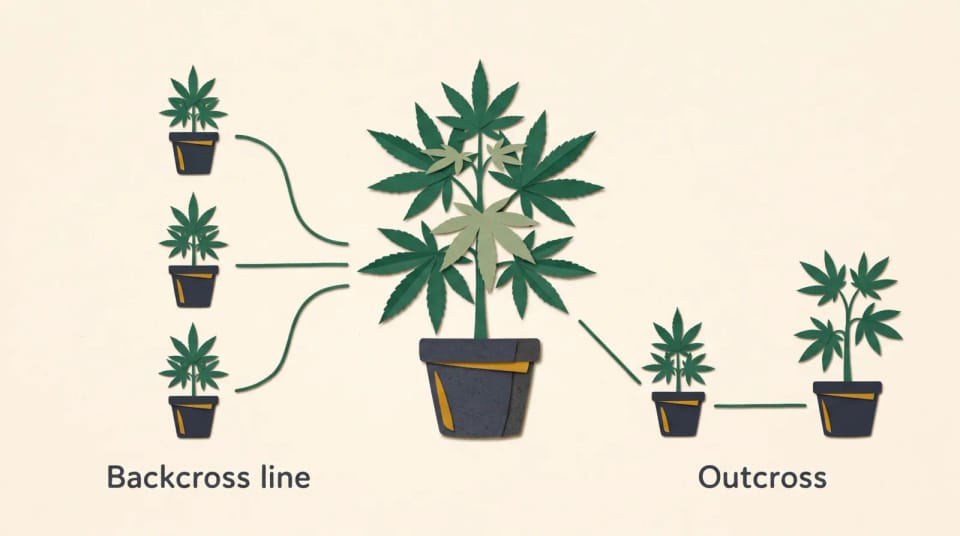
The Burger line keeps crossing back to GMO; Garlic Breath adds a new parent once. Every link here is breeder-reported, not DNA-tested.
Why keep the “breeder-reported” label on every line? Because names and pedigrees often do not match DNA. A study of 30 named strains found significant genetic differences between samples sold under the same name. Schwabe and McGlaughlin, 2019 An earlier genotyping study concluded that strain names “often do not reflect a meaningful genetic identity.” Sawler et al., 2015 Our guide to how strain family trees are built, and where they fail goes deeper.
Does every descendant smell like garlic?
No. Smell is not guaranteed to pass down. Even five sibling plants from a single cross smelled measurably different because their trace compounds differed. Paryani et al., 2024 That is the reason growers go phenotype hunting through a seed pack to find one keeper, which is how GMO itself was picked out of a pack of Chem Cookies.
Names promise even less. In the 2023 rosin panel, a sample called Garlic Cocktail #7 smelled of citrus and tangerine, driven by tropical thiols, not garlic. Oswald et al., 2023 That is one sample from one batch, but it shows how far a name can drift from a jar.
How can you tell if a garlic strain is really GMO family?
You cannot prove it without DNA, but you can avoid the common traps. Use these steps:
- Find who states the cross. Look for the breeder’s own description of the parents, not a menu nickname.
- Trace one generation at a time. Follow each parent back until you reach GMO, Chem D, the GSC Forum cut, or a dead end. A dead end means the link is unproven.
- Treat the word “garlic” as no evidence. It is a marketing name, as the tangerine-smelling Garlic Cocktail sample shows.
- Smell it fresh. In the 2021 study, the sulfur compounds rose late in flowering, peaked during cure, and dropped after about a week of storage. Oswald et al., 2021 An old jar can smell flatter than its family. Our guide to storing flower so the aroma lasts helps.
If you want to compare two garlic strains over time, the High IQ app lets you log how each one smelled and worked for you, so your notes outlast the jar.
Does a garlic or sulfur smell mean the weed is bad?
Not by itself. The 2021 study found that prenylated sulfur compounds are a normal part of cannabis aroma, and they peak at cure. Oswald et al., 2021 A savory, garlicky nose is what this family is known for, not a sign of a grow defect.
That said, smell alone cannot certify a specific jar. The sources here do not cover mold, contamination or a bad dry, and a garlic note does not rule those out. If you see fuzz or anything off, do not use it. If a product made you feel unwell, stop using it and talk to a clinician or pharmacist.
Garlic strains are also loud. If you live with others, see why you cannot smell it on yourself and how to get loud weed smell out of your home. On the broad palate map, they sit on the savory side of the gas and candy flavor families.
Key takeaways
- Garlic strains smell savory because of trace compounds, not their dominant terpenes.
- Cannabis sulfur compounds are chemical cousins of garlic’s; two minor ones smell garlicky.
- The only study that names GMO ties it to skatole, a nitrogen compound.
- GMO was named after a headline about genetically modified cookie ingredients, not “garlic, mushroom, onion.”
- GMO’s family tree, from Chem D and GSC to the Burger line and Garlic Breath, is breeder-reported, not DNA-proven.
- A garlic name does not guarantee a garlic smell, and aroma fades in storage.
FAQ
Why does GMO smell like garlic?
Research points to trace compounds rather than terpenes. Cannabis makes sulfur compounds related to garlic’s, and one rosin study found skatole trends strongly with GMO. No study has yet measured the full garlic note in GMO flower.
What strains smell like garlic?
GMO and its relatives are the best-known group: the Burger line, Garlic Breath and Garlic Cookies crosses. Smell varies by plant and batch, so check the stated parents and smell the jar rather than trusting the name.
Is GMO related to Girl Scout Cookies and Chemdawg?
Yes, by breeder account. GMO is described as a cross of the Chem D cut of Chemdawg and the Forum cut of Girl Scout Cookies. No published genetic test confirms it.
Does garlic weed smell go away?
It fades over time. In the 2021 study, the sulfur compounds behind cannabis funk peaked during cure and dropped after about a week of storage. A fresh jar is the best test of what a strain smells like.
Did breeders make strains smell bad on purpose?
Breeders choose which plants to keep, and smell is one of the traits they can select for. The Burger line repeatedly crossed back to GMO, which tends to keep a parent’s traits. Smell still varies between siblings, so selection never guarantees the result.
Sources
- Oswald IWH, Ojeda MA, Pobanz RJ, et al. “Identification of a New Family of Prenylated Volatile Sulfur Compounds in Cannabis Revealed by Comprehensive Two-Dimensional Gas Chromatography.” ACS Omega, 2021. PMC full text
- Oswald IWH, Paryani TR, Sosa ME, et al. “Minor, Nonterpenoid Volatile Compounds Drive the Aroma Differences of Exotic Cannabis.” ACS Omega, 2023. PMC full text
- Paryani TR, Sosa ME, Page MFZ, et al. “Nonterpenoid Chemical Diversity of Cannabis Phenotypes Predicts Differentiated Aroma Characteristics.” ACS Omega, 2024. PMC full text
- Koziel JA, Guenther A, Vizuete W, et al. “‘Skunky’ Cannabis: Environmental Odor Troubleshooting and the ‘Need-for-Speed’.” ACS Omega, 2022. PMC full text
- Abe K, Hori Y, Myoda T. “Volatile compounds of fresh and processed garlic (Review).” Experimental and Therapeutic Medicine, 2019. PMC full text
- Schwabe AL, McGlaughlin ME. “Genetic tools weed out misconceptions of strain reliability in Cannabis sativa: implications for a budding industry.” Journal of Cannabis Research, 2019. PMC full text
- Sawler J, Stout JM, Gardner KM, et al. “The Genetic Structure of Marijuana and Hemp.” PLOS ONE, 2015. PMC full text
- Tierney J. “GMO.” Gentleman Toker, December 2, 2024. Strain guide
- Skunk House Seeds. HashBurger clone product description. Breeder page
- SeedFinder strain records: GMO Cookies, Garlic Breath, Double Burger genealogy, Donny Burger



