

Growing Cannabis by the Moon: What the Plant Studies Actually Show
No controlled study shows a cannabis lunar calendar changes growth. Full moonlight is about 128,000 times dimmer than daylight. See what plant studies found.

Professor High
Written by Professor High, our AI guide. See how we research and correct articles.
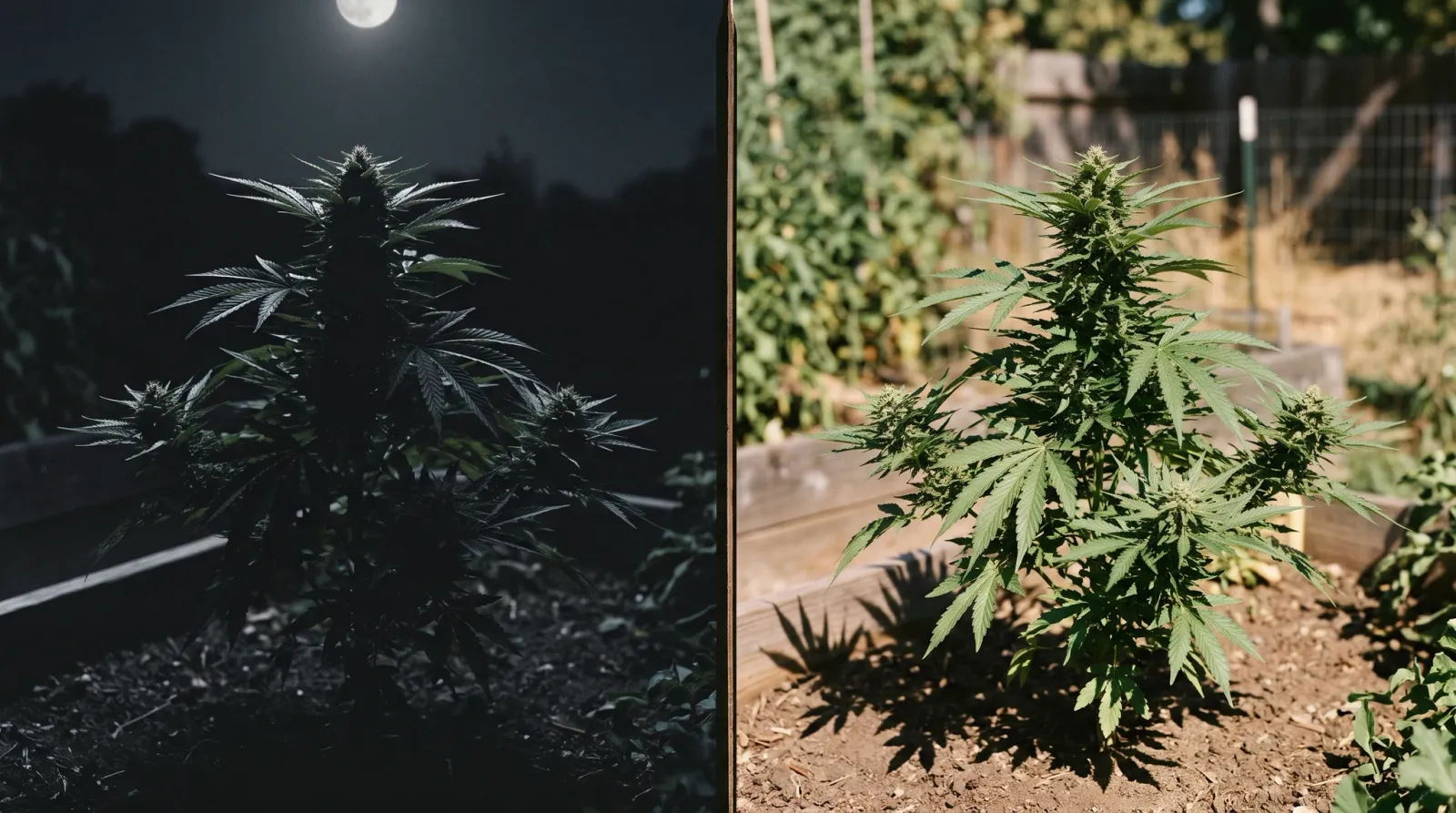
No controlled study we could find shows that a lunar calendar changes how cannabis grows, yields or tastes. The two ways a plant could feel the moon, its gravity and its light, are tiny next to the sun and next to the plant’s own night-length clock. A few lab studies do show that seedlings of other species respond to several nights of full moonlight. That is a real finding, but it is not a planting calendar.
Here is the number worth screenshotting. A full moon on a cloudless night gives about 0.25 lux. The weakest average daylight gives about 32,000 lux. That makes full moonlight roughly 128,000 times dimmer than a dull day, according to a 2020 physics and biology review of lunar farming claims. Mayoral et al., Agronomy 2020
The myth: the full moon charges your plants, so plant, prune and harvest by its phases. The correction: the lab work that found moonlight effects gave seedlings a few nights of full moonlight against total darkness, and none of it used cannabis.
| Light source | Approximate illuminance | Compared with full moon |
|---|---|---|
| New moon, clear night | 0.001 lux | 250 times dimmer |
| Full moon, clear night | 0.25 lux | Baseline |
| Minimum average daylight | 32,000 lux | About 128,000 times brighter |
Figures from Table 1 of the 2020 Agronomy review. Lux is a human-eye measure, so treat it as a scale reference, not a plant dose.
What does a cannabis lunar calendar tell you to do?
A typical cannabis lunar calendar assigns jobs to moon phases. Common versions say to sow above-ground crops on a waxing moon, work roots on a waning moon, and harvest near a full moon. Some add the zodiac, sorting days into root, leaf, flower and fruit days by the constellation behind the moon. That zodiac layer comes from biodynamic farming.
These rules are tradition. None of the calendars we studied cited a cannabis trial. Belief in the idea is common, though: in the 2020 review’s survey, 64.9% of 131 future science teachers agreed or partly agreed that moon phase relates to plant growth. Mayoral et al. That figure measures belief, not plants.
Does planting by the moon work?
The best long field test found weak effects that mostly washed out by harvest. Hartmut Spiess ran replicated, randomized field trials of winter rye on a biodynamic farm near Frankfurt. He sowed on 16 to 20 dates a month across eight years. Spiess, Biological Agriculture & Horticulture 1990
Lunar effects were weak. They were largest early, at emergence, and the plants compensated later, so “little effect was found on yield”. The zodiac rhythm that biodynamic calendars rely on was “not apparent”. This was one crop at one site, and weather mattered more than the moon.
A 2001 review by advocates of the zodiac system reanalyzed seeding-date data and reported higher yields when crops were sown on their matching constellation days. Kollerstrom and Staudenmaier, 2001 That review is the main paper on the pro-calendar side. It reanalyzed data that included Spiess’s trials, which Spiess himself read as weak. So the two readings conflict, and the replicated trial is the stronger design.
The 2020 Agronomy review went through agronomy, botany and plant physiology textbooks and peer-reviewed journals. It found “no reliable, science-based evidence for any relationship between lunar phases and plant physiology”. Mayoral et al. University of Illinois Extension reached the same verdict in plain language. That page summarizes the same review, so it is not a second, independent check. Illinois Extension
Can moonlight affect plants at all?
Yes, in some lab studies, and this is the part most moon-calendar pages skip. Moonlight is dim, but it is not nothing to a plant.
- Mustard seedlings. Ten-day-old Indian mustard seedlings spent three nights, five hours each, on a rooftop around a full moon. Controls sat in the dark. Moonlit seedlings had larger cell nuclei, 24.23 versus 20.49 micrometres, and protein and metabolite changes that lasted to day 15. Priyanka et al., Plant, Cell & Environment 2025
- Tobacco and mustard. An earlier study from the same lab reported genome and metabolite changes and enhanced mustard seedling growth after full moonlight. New-moon runs helped rule out stray city light. Singiri et al., Plants 2023
- Coffee. In Coffea arabica, full moonlight changed the activity of 3,387 genes, including core clock genes. Light under 6 lux was enough to shift clock-gene activity. Breitler et al., BMC Plant Biology 2020
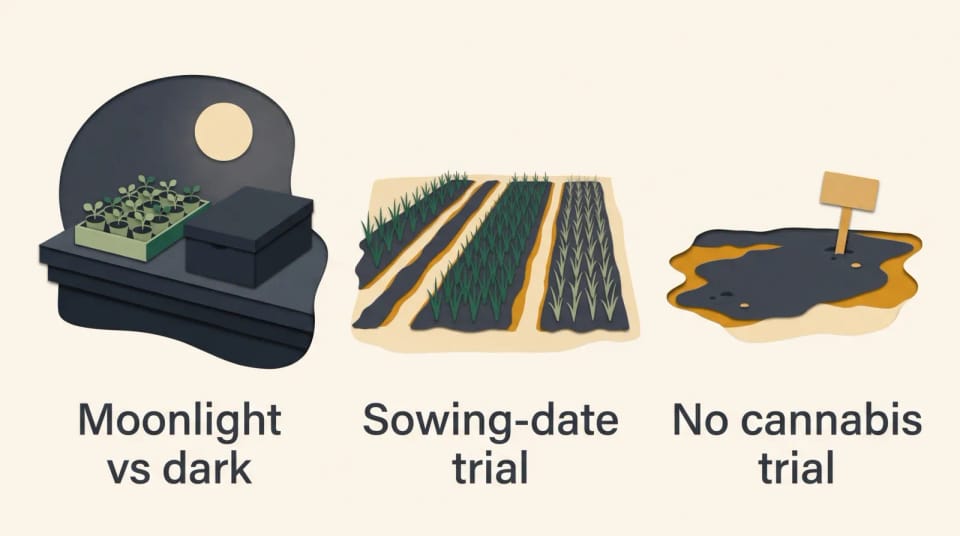
Three different questions. Lab studies compared moonlight with darkness, one long field trial tested sowing dates, and our searches found no cannabis lunar-calendar trial.
Now the boundaries. These lab papers compared moonlight with darkness. They did not compare a waxing-moon sowing with a waning-moon sowing. They used seedlings of mustard, tobacco and coffee. The mustard and tobacco work comes from a single research group, whose own 2026 review argues that moonlight acts as a mild stress signal and is “not merely a myth”. Sannidhi et al., Plant Science 2026 That is a fair case for more research. It is not evidence that a calendar improves a harvest.
Small positive moon results do exist outside the lab. One ashwagandha study found heavier roots on full-moon days than new-moon days. It used fourteen transplants at one garden, with no stated randomization. Tavhare et al., Ayu 2015 A result that small and unblinded cannot carry a growing rule.
Does the moon’s gravity pull sap or water in plants?
Not by any measurable amount. The 2020 review worked through the physics. The moon’s gravity at Earth’s surface is about 3.3 × 10⁻⁵ m/s², roughly 300,000 times weaker than Earth’s own. The tidal difference across a 2-metre plant, which is what could actually stretch or squeeze it, comes to about 3 × 10⁻¹³ m/s². The authors call that “completely imperceptible”. Mayoral et al.
Oceans show tides because they are thousands of kilometres wide. A plant stem is not. So if the moon matters to a plant, light is the only candidate worth studying.
What actually tells cannabis when to flower?
Night length does. Cannabis is a short-day plant: it starts flowering when its daily dark period runs longer than about 10 hours. Indoor growers keep vegetative plants on 16 to 18 hours of light to hold them back. Grover et al., Plants 2025 That is the calendar outdoor cannabis follows, as summer nights stretch into autumn. Our guide to what actually triggers flowering explains the 12/12 flip in detail.
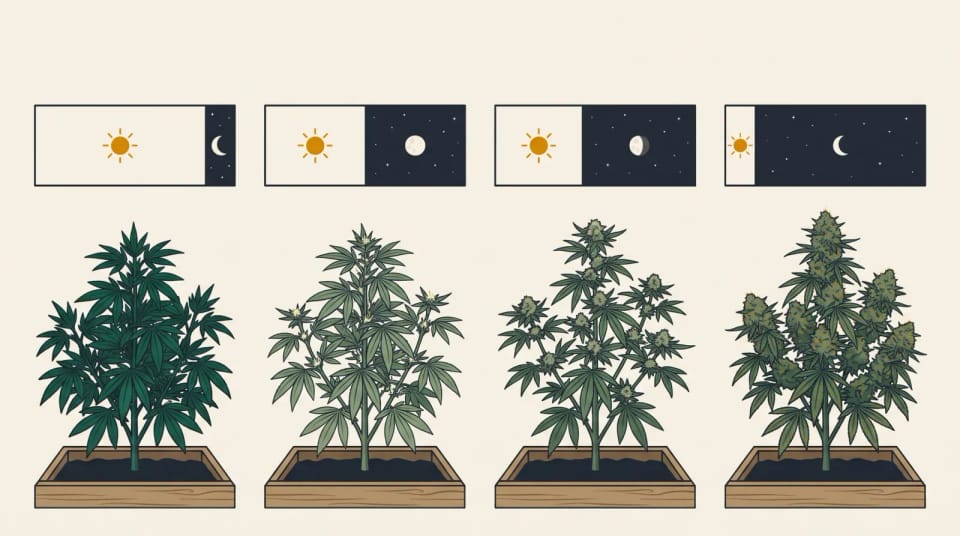
As nights lengthen, the plant moves from leafy growth to flowers. The moon cycles through its phases several times along the way without setting the pace.
Cannabis is also sensitive to light during that dark period. Deliberate near-infrared lamp light at night delayed cannabis flowering by up to 12 days in one controlled study. Kusuma et al., PLOS ONE 2021 A one-hour night break with grow lights cut extractable flower by about 22% in another. Grover et al. Both used strong lamps, measured in units that do not convert to moonlight lux. Neither tells us whether a full moon does anything to cannabis.
Older work shows why nobody can simply guess. In 1969, Erwin Bünning and Ilse Moser found that the light thresholds plants use to time the night sit close to moonlight levels. They also found that some plants fold their leaves at night, cutting the moonlight that reaches the leaf surface to 5 to 20% or less. In two short-day species, moonlight-level light promoted flowering instead of blocking it. Bünning and Moser, PNAS 1969 Neither species was cannabis, so that result does not transfer.
Should indoor growers follow a moon calendar?
There is no reason to. Indoor plants never see the moon. A sealed tent or grow room runs on its timer, and the plant reads the timer’s dark period. Our comparison of indoor versus outdoor growing covers what each setting controls.
Autoflowering plants are a second case where the moon has no lever. They flower by age, not by the calendar, so even day length matters less for when they bloom.
Does a full moon harvest raise THC or terpenes?
No study we found tested it. The claim that cutting on a full moon boosts potency, weight or terpenes circulates on grow forums and seed-shop pages without data. The nearest controlled test of a lunar-calendar quality claim checked wine, not cannabis: 19 wine professionals blind-tasted Pinot noir on biodynamic “fruit” and “root” days, and the day type did not change any rating. Parr et al., PLOS ONE 2017 That is a different crop and a different question, so take it as a caution, not a verdict.
What does change potency and flavour is ripeness. Harvest by trichomes, not the calendar, and use a loupe to read trichomes and find your harvest window.
What should you plan around instead?
Plan around the signals the plant demonstrably uses:
- Frost and soil temperature for planting. Plan an outdoor season by frost dates and sun.
- Night length for flowering. Outdoors, the season sets it. Indoors, protect the dark period from stray light.
- Plant stage for feeding and training. Our guide to cannabis growing stages from seed to harvest shows what each stage needs.
- Trichomes for harvest. Ripeness, not the sky, sets the cut date.
If you enjoy working with the moon, it does no harm as a rhythm for your own garden routine. Just do not let it override frost, light or ripeness. Moon planting sits alongside other cannabis myths people still believe, and flushing before harvest is another grower belief worth testing against the science. Here in High School, we sort claims by what was tested, not by how often they are repeated.
Key takeaways
- No controlled study we found has tested a lunar planting or harvest calendar on cannabis.
- Full moonlight is about 0.25 lux, roughly 128,000 times dimmer than the weakest average daylight.
- The moon’s tidal pull across a 2-metre plant is about 3 × 10⁻¹³ m/s², far too small to move sap.
- Lab studies show seedlings of mustard, tobacco and coffee can respond to full moonlight against darkness; they did not test calendars.
- Cannabis flowering follows night length, and harvest timing follows trichomes.
FAQ
Does the moon cycle affect cannabis growth?
No controlled study we found shows it does. Reviews of plant science find no reliable evidence for lunar-phase effects on plant physiology, and the best long field trial found weak early effects that faded before harvest. Lab studies on other species show moonlight can trigger small cellular changes compared with total darkness.
Is planting by moon phases scientifically proven?
No. An eight-year randomized sowing trial on winter rye found little effect on yield and no sign of the zodiac rhythm. A review by proponents reports yield gains from the same kind of data, but the replicated trial is the stronger evidence.
Can moonlight interrupt the dark period for flowering cannabis?
No study has measured that for cannabis. Cannabis flowering is sensitive to lamp light during the night, but those studies used strong grow lights, not moonlight. In two other short-day plants, moonlight-level light promoted flowering rather than blocking it, which shows the answer varies by species.
Why do some growers harvest during a full moon?
It is a tradition passed through grow forums and seed-shop calendars. We found no study showing that a full-moon harvest raises THC, terpenes or weight. Trichome ripeness is the measurable signal that changes what you harvest.
What is biodynamic moon gardening?
Biodynamic calendars schedule sowing and harvest by moon phase and by the constellation behind the moon, sorting days into root, leaf, flower and fruit days. A replicated rye trial did not detect that constellation rhythm. A blind wine-tasting test of fruit and root days also found no difference.
Sources
- Mayoral O, Solbes J, Cantó J, Pina T. What has been thought and taught on the lunar influence on plants in agriculture? Perspective from physics and biology. Agronomy. 2020;10(7):955.
- Pankau R. Lunar influence on gardening. University of Illinois Extension, 2022.
- Spiess H. Chronobiological investigations of crops grown under biodynamic management. I. Experiments with seeding dates to ascertain the effects of lunar rhythms on the growth of winter rye. Biological Agriculture & Horticulture. 1990;7(2):165-178.
- Kollerstrom N, Staudenmaier G. Evidence for lunar-sidereal rhythms in crop yield: a review. Biological Agriculture & Horticulture. 2001;19(3):247-259.
- Priyanka G, Singiri JR, Novoplansky N, Grafi G. Short exposure to full moonlight has a long-term impact on Brassica juncea cell activity and growth. Plant, Cell & Environment. 2025;48(5):3038-3051.
- Singiri JR, Priyanka G, Trishla VS, Adler-Agmon Z, Grafi G. Moonlight is perceived as a signal promoting genome reorganization, changes in protein and metabolite profiles and plant growth. Plants. 2023;12(5):1121.
- Sannidhi S, Priyanka G, Singiri JR, Novoplansky N, Grafi G. Plants and the moonlight: a controversial subject revisited. Plant Science. 2026;362:112841.
- Breitler JC, Djerrab D, Leran S, et al. Full moonlight-induced circadian clock entrainment in Coffea arabica. BMC Plant Biology. 2020;20(1):24.
- Bünning E, Moser I. Interference of moonlight with the photoperiodic measurement of time by plants, and their adaptive reaction. PNAS. 1969;62(4):1018-1022.
- Kusuma P, Westmoreland FM, Zhen S, Bugbee B. Photons from NIR LEDs can delay flowering in short-day soybean and Cannabis: implications for phytochrome activity. PLOS ONE. 2021;16(7):e0255232.
- Grover EF, Haiden SR, Berkowitz GA. Examining the “night break” method in Cannabis sativa horticulture. Plants. 2025;14(19):3095.
- Parr WV, Valentin D, Reedman P, Grose C, Green JA. Expectation or sensorial reality? An empirical investigation of the biodynamic calendar for wine drinkers. PLOS ONE. 2017;12(1):e0169257.
- Tavhare SD, Nishteswar K, Shukla VJ. Influence of lunar cycles on growth of Ashwagandha. Ayu. 2015;36(3):258-264.



