

Hair Follicle Tests for Weed: What They Detect and What They Miss
A hair follicle test for weed looks for THC-COOH in clipped hair, not the root. A 1.5-inch sample covers about 90 days, and light use is often missed.

Professor High
Your friendly cannabis educator, bringing science-backed knowledge to the community.
Written by Professor High, our AI guide. See how we research and correct articles.
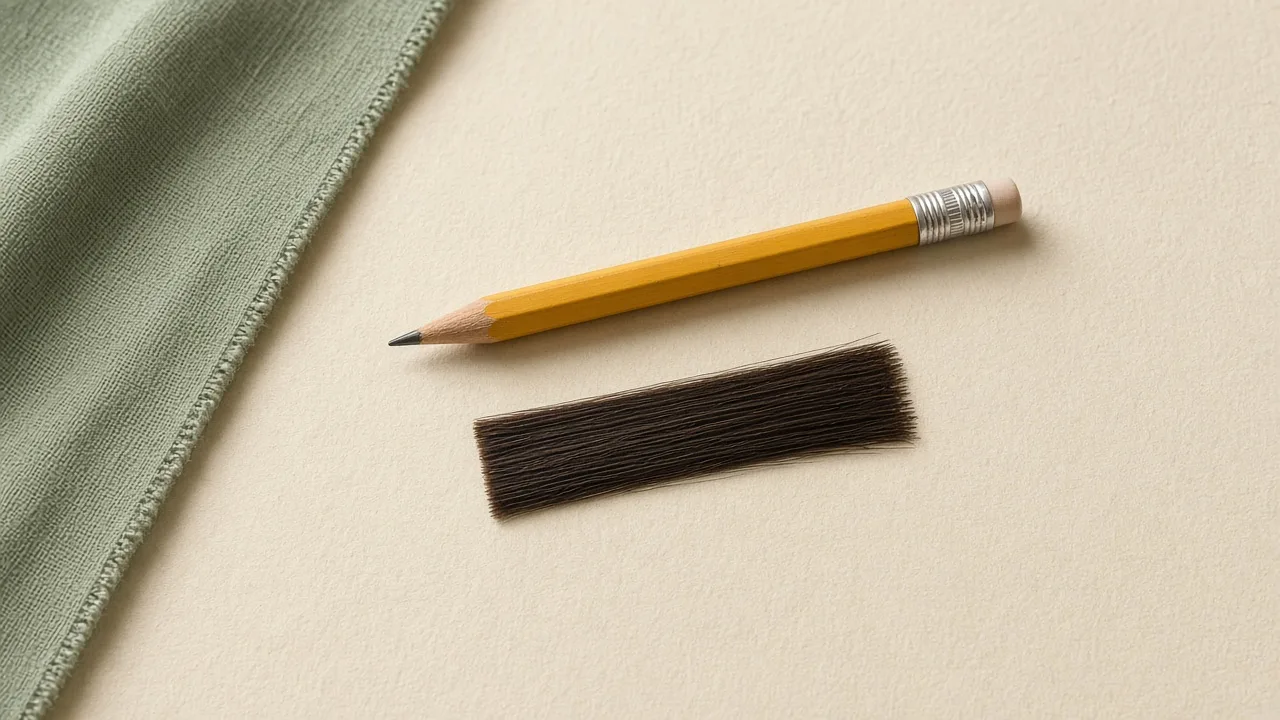
A hair follicle test for weed looks for THC-COOH in clipped hair, and 16 of 33 specimens from documented non-daily users showed neither measurable THC nor THC-COOH. A standard 1.5-inch lock is the lab stand-in for about 90 days of repeated use. Everyday speech still says follicle, but the lab reads the shaft, not the plucked root, and it misses a lot of lighter use.
That 16-of-33 figure comes from a 2007 study of men whose cannabis use was documented with urine tests. It is the clearest controlled-style miss rate this page found. A later workplace-cutoff study, based on self-report, missed even more light users. Both designs are spelled out below.
This High School article covers what the lab measures, how far back the window goes, and where the result can be wrong. It does not explain how to beat a hair test. For the wider urine, blood, saliva, and hair map, see how long THC stays in your system. For mouth-swab windows, see how long weed stays in saliva.
What does a hair follicle test for weed actually detect?
A collector clips hair. The specimen is the shaft. It is not a plucked root. Quest Diagnostics, a large testing lab, tells employers the sample is cut hair, and that drug-containing hair takes about 5 to 10 days to grow out of the scalp. That is lab practice, not a dosing study.
The molecule labs use to support ingestion is 11-nor-9-carboxy-delta-9-THC. The short name is THC-COOH. It is a breakdown product. Parent THC can sit on the outside of hair after smoke. THC-COOH is the marker the Society of Hair Testing counts as stronger evidence of intake.
The amounts are tiny. Labs report them in picograms per milligram of hair. A picogram is a trillionth of a gram.
Huestis and colleagues, working in a National Institute on Drug Abuse lab, measured head hair from 38 men. They had 53 specimens. Use was documented with urine tests, and some of the men also smoked research cigarettes under observation. Three coauthors worked at Quest Diagnostics. The lab could see THC down to 1.0 pg/mg and THC-COOH down to 0.1 pg/mg. When a screen at 5 pg of THC equivalents per mg was positive, 83 percent of those screens confirmed at 0.1 pg of THC-COOH per mg. Huestis et al., 2007
The Society of Hair Testing consensus, written up by Favretto and colleagues in 2023, sets a THC cutoff of 50 pg/mg in head hair. It says finding THC-COOH strongly supports use. The lowest amount it recommends for confirming THC-COOH is 0.2 pg/mg. That cutoff is for head-hair segments of 3 cm or shorter. It is not the rule for a single use, and it is not the rule for children’s hair. Favretto et al., 2023
A 2020 federal proposal used a confusing abbreviation. It called this same carboxylic-acid metabolite THCA. The proposed screen was 1 pg/mg. The proposed confirmation was 0.05 pg/mg. That THCA is not the THCA in raw flower. Raw-flower THCA is the acid that heat turns into THC. The federal table means the metabolite. The proposal was never finalized.
How the body makes THC-COOH, after 11-hydroxy-THC, is covered in cannabis pharmacokinetics.
Delta-8, delta-10, and HHC are a different question. The searches for this article did not find a hair study that separates those cannabinoids from delta-9. Will delta-8, delta-10, or HHC show up on a drug test? covers urine and standard panels. Does CBD show up on a drug test? covers THC contamination in CBD products. Do not borrow a hair result from those pages.
How far back does a hair test go?
Head hair grows about 1 cm a month. The Society of Hair Testing uses that rate. It prefers hair from the posterior vertex, the crown at the back of the head. Collectors should record hair color and any cosmetic treatment.
Quest’s employer FAQ describes a standard sample of 3.9 cm, or 1.5 inches, as about 90 days of repetitive use. That is the figure most readers will hear from a lab.
The calendar depends on the growth rate you assume. At 1.3 cm a month, which is Quest’s other rule of thumb (about half an inch), 3.9 cm is about three months. At 1 cm a month, the same lock is closer to four months. Say “about 90 days” as the standard lab claim. Keep the growth-rate caveat next to it.
A longer lock dilutes the drug. The Society of Hair Testing says the cutoff applies to segments of 3 cm or less. A longer piece needs a dilution correction. A 6-inch ponytail is not a clean six-month diary.
Drug in new growth also has to leave the scalp. Quest puts that delay at about 5 to 10 days. A test the morning after use is looking at older hair.
Does a hair test detect one-time use?
Poorly, if the person is not a heavy user. Two studies answer different versions of the question. Read the design before the percentage.
| Group | Design | Marker | Negative |
|---|---|---|---|
| Non-daily use, 1 to 5 times a week | Huestis 2007, urine-documented, 33 head-hair specimens | THC or THC-COOH above the lab limit | 16 of 33 (48%) |
| Daily use | Huestis 2007, 20 specimens | THC or THC-COOH above the lab limit | 3 of 20 (15%) |
| Self-reported light use, 6 times a week or fewer | Taylor 2017, 38 people with enough hair | THC-COOH at 0.4 pg/mg | 34 of 38 (89%) |
| Self-reported heavy use, more than 6 times a week | Taylor 2017, 26 people | THC-COOH at 0.4 pg/mg | 12 of 26 (46%) |
Huestis is the controlled-style number. Among non-daily specimens, 17 of 33 (52 percent) were positive for THC or THC-COOH. The other 16 of 33 were not. Daily specimens were positive in 17 of 20 (85 percent). Across all 53 specimens, 19 (36 percent) were negative for both.
A controlled smoke did not update the hair the same day. Detection before and after two cigarettes of 2.7 percent THC was the same. The post-dose hair was collected that day.
Taylor and colleagues compared hair with what people said they used. This was not a locked-ward dosing study. Alere Toxicology analyzed the samples, and one author was affiliated with Alere. Of 136 participants, 105 had at least 10 mg of hair. Non-users were 41. Light users were 38. Heavy users were 26. Taylor et al., 2017
At a THC-COOH cutoff of 0.4 pg/mg, none of the 41 non-users were positive. Only 4 of 38 light users were positive, so 34 of 38 (89 percent) were negative. Among heavy users, 14 of 26 (54 percent) were positive, so 12 of 26 were still negative. Sensitivity of THC-COOH for any reported use, versus non-use, was 0.28 (95 percent confidence interval 0.18 to 0.41). Specificity was 1.00 in this self-report sample. That perfect specificity does not prove the metabolite can never come from someone else. The contamination study below is why.
Parent THC was a bit more sensitive and still missed many light users. At 0.05 ng/mg (the same 50 pg/mg figure the Society of Hair Testing uses), THC was positive in 0 of 41 non-users, 15 of 38 light users (39 percent), and 20 of 26 heavy users (77 percent).
The authors’ own conclusion is the right scope. Hair was a qualitative marker of heavy use over about three months. It could not reliably detect light use. It could not measure how much someone used.
The Society of Hair Testing says its THC cutoff is not for judging a single intake.
How to pass a drug test: the science and your options explains why time, not a product, is the variable that changes a window. This page does not cover detox shampoos, bleaches, or other ways to try to pass.
Can cannabis smoke on the hair look like use?
Sometimes the parent drug can. The metabolite is harder to dismiss, and it is still not airtight proof.
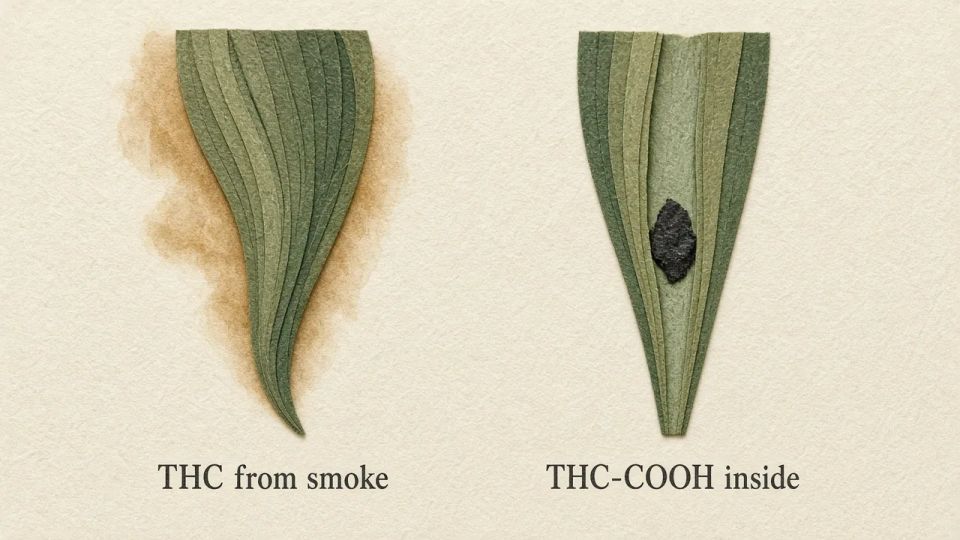
Smoke can leave THC on the outside of a hair shaft. THC-COOH is the metabolite labs use as an ingestion marker. A positive for either one still depends on the cutoff, and THC-COOH can also move through sweat and sebum.
Moosmann, Roth, and Auwärter published two very small oral studies in 2015. The journal reported no competing interests. One volunteer took 50 mg of THCA-A, the acid in raw plant material, every day for 30 days. THCA-A did not show up in that person’s hair or sebum. The authors argue that THCA-A found in consumers’ hair comes from handling the plant, not from swallowing it.
Two volunteers took 2.5 mg of dronabinol, which is oral THC, three times a day for 30 days. THC was not detected in head, beard, or body hair. The limit of detection was 1 pg/mg. THC-COOH was detected. It showed up in hair segments that had grown before the pills started, as far as about 2.3 to 3.1 months earlier. Beard hair still showed it up to 11 weeks later. Sebum and sweat carried THC-COOH at 4.3 to 82 pg per square centimeter per day. Moosmann et al., 2015
Their reading is stark. THC in hair is mainly external. THC-COOH can move through sebum and close contact, including onto a partner’s hair or a child’s hair. A positive is not absolute proof that the person smoked.
The limits are just as stark. One person took THCA-A. Two people took dronabinol. The oral dose was moderate, not a heavy smoked binge. Smoked THC reaches a higher blood peak, and that route might enter hair differently. The authors also cite a coffee-shop passive-smoke study. Serum THC-COOH there was 0.5 to 1.7 ng/mL. Their own oral volunteers reached 18 and 40 ng/mL. A smoky room is unlikely to match chronic-use hair levels. A child’s hair can still land in the same range as those oral-dosing results.
Secondhand cannabis smoke covers health effects of the smoke itself. A contact high and a hair result are different questions.
Does hair color change a weed hair test?
Basic drugs bind eumelanin, the pigment in dark hair. THC-COOH is acidic. Binding is not the same story.
Mieczkowski looked at 3,886 specimens that were already positive for the cannabis metabolite. They came from about 80,000 posterior-vertex samples. Hair color was not associated with the concentration. The ANOVA result was F = 1.148 and p = 0.332. That test only includes people who already crossed the positive line. It does not show whether color changes who crosses it. Mieczkowski, 2003
Huestis compared African American and Caucasian specimens in the documented-user set. The positive rates were 26 of 40 (65 percent) and 8 of 13 (62 percent), with p greater than 0.3. The Caucasian group is small. Use frequency was not balanced across the groups. The same paper notes earlier work that found similar cannabinoid levels in dark and light hair.
In the 2020 hair proposal, federal reviewers said epidemiology did not show a significant hair-color effect for this metabolite. They also said they knew of no controlled dosing study of the metabolite against hair color. That gap was still open in the proposal. These nulls are not a finding that hair tests have no racial disparity.
Do bleach and dye change the number?
Cosmetic treatment can lower the amount a lab measures. That is an accuracy limit. It is not a method, and this article does not teach it as one.
Jurado, Kintz, Menéndez, and Repetto compared treated and untreated portions of hair. The people said their drug use was similar across the time those portions grew. For THC-COOH, most of the mean differences fell between 40 percent and 60 percent lower in the treated portion. THC itself dropped by about 30 percent. This is a reliability limit for hair testing: cosmetic damage can make the measured value under-report use. Jurado et al., 1997
The comparison rests on self-reported similar use. It is not a trial that assigned bleach at random. Its lesson is about test reliability. Treated hair can under-report use, so a low result does not prove low use. This page does not cover detox shampoos or ways to change a result.
What does body hair show?
Body hair is not a longer calendar you can count in months.
The Society of Hair Testing says not to chop body hair into monthly segments. A larger share of body hair is in the resting, telogen phase. The shaft holds a mix of older and newer growth. Cutoffs in the consensus are for head hair. Results from chest, arm, or leg hair should be read with caution.
Claims that body hair covers 12 months did not come from these primary sources. Treat a body-hair result as a qualitative flag with a messy window, not as a dated log.
Are federal hair-testing rules in effect?
Not as Mandatory Guidelines. A private employer can still choose a hair test. Federal workplace rules are a different document.
On September 10, 2020, the Department of Health and Human Services proposed Mandatory Guidelines that would have allowed hair. The notice is 85 FR 56108, document 2020-16432. The proposed marijuana-metabolite screen was 1 pg/mg. The proposed confirmation for the carboxylic-acid metabolite was 0.05 pg/mg. Hair would have been limited to pre-employment and random tests, not post-accident tests. A federal program using hair would also have had to offer urine or oral fluid. The stated reasons were external contamination that wash steps had not solved, and a possible disparate impact tied to hair color.
That proposal was not issued as a final rule.
The authorized federal panels still list urine and oral fluid. A January 16, 2025 notice, document 2025-00425, effective July 7, 2025, covers those two matrices. A March 13, 2026 notice, document 2026-04981, says the urine and oral fluid panels were not revised. It does not add a hair panel. SAMHSA’s drug-testing resources page, last updated November 6, 2026, describes Mandatory Guidelines for urine and oral fluid in federal programs. It notes that hair can be used as a specimen in workplace testing generally, but it does not list hair as an authorized federal panel.
The federal regulatory agenda, checked again on November 10, 2026, still listed hair rulemaking at the proposed-rule stage. SAMHSA still described a planned supplemental notice of proposed rulemaking for hair. A date on an agenda is not a published rule. A Federal Register search on November 10, 2026 did not find a new hair supplemental notice beyond the September 2020 proposal. An earlier White House review of a hair draft was withdrawn on January 21, 2025. Withdrawing a review is not the same thing as closing every future draft.
If a job is covered by the federal testing program, the required specimen is still urine or oral fluid. A contractor or a private employer can set a different policy. State rules about firing someone for lawful cannabis use are a separate map: can you be fired for legal cannabis?
Key takeaways
- The specimen is clipped hair, not the follicle.
- The ingestion marker is THC-COOH, at picograms per milligram. Parent THC can come from smoke on the hair.
- A 1.5-inch head-hair sample is the lab stand-in for about 90 days. Growth rate moves that estimate.
- In documented non-daily users, 16 of 33 specimens showed neither measurable THC nor THC-COOH (Huestis et al., 2007).
- At a 0.4 pg/mg THC-COOH cutoff, 34 of 38 self-reported light users were negative (Taylor et al., 2017). Heavy users were missed too.
- Hair-color studies that exist are nulls with real limits. They do not close the question of disparity.
- Research found that bleach and dye can lower measured THC-COOH, which limits how reliable a hair result is.
- Federal Mandatory Guidelines still do not include hair, as of the March 13, 2026 panel notice.
FAQ
How far back can a hair follicle test detect weed?
For standard head hair, labs usually read about the last 90 days. Quest’s employer FAQ ties a 1.5-inch, or 3.9 cm, scalp sample to about 90 days of repetitive use. The Society of Hair Testing uses about 1 cm per month and prefers a 3 cm segment, so a longer lock is not a clean longer calendar. Body hair does not map cleanly to months.
Is a hair follicle test the same thing as a hair drug test?
Yes, in ordinary speech. The collector clips the shaft. The lab does not pluck the follicle. Quest’s employer FAQ says the same thing in its instructions to collectors.
Can a hair follicle test detect one-time use?
Sometimes, but not reliably. In documented non-daily users, Huestis saw 16 of 33 specimens negative for both THC and THC-COOH. At a 0.4 pg/mg THC-COOH cutoff, Taylor’s self-report sample missed 34 of 38 light users. The Society of Hair Testing also says its THC cutoff is not for judging a single intake.
How soon after use can a hair follicle test find weed?
New growth has to leave the scalp. Quest’s FAQ puts that delay at about 5 to 10 days for head hair. Huestis saw no detection change on the same day as a controlled smoke. The standard 1.5-inch window looks backward at older hair, not at last night.
Do federal jobs require hair tests for marijuana?
No, under the federal Mandatory Guidelines. The March 13, 2026 authorized-panel notice still covers urine and oral fluid only. The 2020 hair proposal was not finalized. A private employer, or a contractor with its own policy, can still order a hair test.
Sources
- Huestis MA, Gustafson RA, Moolchan ET, Barnes A, Bourland JA, Sweeney SA, Hayes EF, Carpenter PM, Smith ML. (2007). Cannabinoid concentrations in hair from documented cannabis users. Forensic Science International, 169(2-3), 129-136. doi:10.1016/j.forsciint.2006.08.005
- Taylor M, Lees R, Henderson G, Lingford-Hughes A, Macleod J, Sullivan J, Hickman M. (2017). Comparison of cannabinoids in hair with self-reported cannabis consumption in heavy, light and non-cannabis users. Drug and Alcohol Review, 36(2), 220-226. doi:10.1111/dar.12412
- Moosmann B, Roth N, Auwärter V. (2015). Finding cannabinoids in hair does not prove cannabis consumption. Scientific Reports, 5, 14906. doi:10.1038/srep14906
- Mieczkowski T. (2003). Assessing the potential of a “color effect” for hair analysis of 11-nor-9-carboxy-delta-9-tetrahydrocannabinol: analysis of a large sample of hair specimens. Life Sciences, 74(4), 463-469. doi:10.1016/j.lfs.2003.06.037
- Jurado C, Kintz P, Menéndez M, Repetto M. (1997). Influence of the cosmetic treatment of hair on drug testing. International Journal of Legal Medicine, 110(3), 159-163. doi:10.1007/s004140050056
- Favretto D, Cooper G, Andraus M, Sporkert F, Agius R, Appenzeller B, Baumgartner M, Binz T, Cirimele V, Kronstrand R, del Mar Ramirez M, Strano-Rossi S, Uhl M, Vincenti M, Yegles M. (2023). The Society of Hair Testing consensus on general recommendations for hair testing and drugs of abuse testing in hair. Drug Testing and Analysis, 15(9), 1042-1046. doi:10.1002/dta.3526. Drug-of-abuse cutoff statement: Society of Hair Testing consensus PDF
- Proposed Mandatory Guidelines for federal workplace drug testing programs using hair. Federal Register, volume 85, page 56108, September 10, document 2020-16432. federalregister.gov
- Authorized testing panels for urine and oral fluid. Federal Register, January 16, document 2025-00425, effective July 7. federalregister.gov
- Authorized testing panels notice with no hair panel added. Federal Register, March 13, document 2026-04981. federalregister.gov
- Quest Diagnostics employer solutions. Hair testing FAQ, describing clipped hair, a 1.5-inch sample, about 90 days of repetitive use, and a 5-to-10-day grow-out. Quest FAQ PDF
- SAMHSA drug-testing resources page, describing urine and oral fluid Mandatory Guidelines for federal programs, last updated November 6, 2026. samhsa.gov



