Does CBD Show Up on a Drug Test? The THC-Per-Dose Math
CBD itself does not trip a THC drug test, but THC in the bottle can. See which THC doses caused confirmed positives and how to check your own product.

CBD itself is not what a urine drug test looks for, and pure CBD did not cause a confirmed positive in short controlled studies, but many CBD products carry trace THC, and that THC can. In a 2025 double-blind trial, a single dose of 100 mg CBD with 1 to 3.7 mg of THC produced confirmed positives in 1 to 7 of 10 people. With CBD alone or with 0.5 mg THC, nobody tested positive after one dose. Wolinsky et al., J Anal Toxicol 2025
Here is the number worth sending to a friend. Same 100 mg of CBD, different THC: zero confirmed positives at 0.5 mg THC, seven out of ten at 3.7 mg. And in that study, the THC groups did not feel or perform measurably differently from the CBD-only group. You can fail a test on a dose you never notice.
Most pages stop at “tests don’t look for CBD, but products can contain THC.” That is true and not much help. This lesson in High School gives you the milligrams, shows the bottle arithmetic, and tells you where the studies disagree.
Studies and agency notices checked October 29, 2026. This article covers urine tests. Hair, sweat and blood tests are outside its scope.
What does a drug test actually look for?
A standard urine test looks for THC-COOH, an inactive breakdown product of THC, not for CBD. The American College of Medical Toxicology states that CBD “is not metabolized to THC-COOH” and will not by itself cause a positive screen. ACMT position statement, 2020
Federal workplace testing has two steps. A cheap immunoassay screen flags urine at or above 50 ng/mL. A lab then confirms with chromatography and mass spectrometry, and THC-COOH above 15 ng/mL counts as positive. The same statement notes that a result cannot tell anyone where the THC came from, how much was taken, when, or whether the person was impaired. ACMT, 2020
So the real question is never “does CBD show up?” It is “how much THC is in what I take?” For how long a positive can last after THC, see our guide to how long THC stays in your urine.
What about CBD turning into THC inside you? Controlled studies of pure CBD found no sign of it. Sholler et al., 2022 We cover that mechanism in whether stomach acid turns CBD into THC, so we will not repeat it here.
Can CBD oil make you fail a drug test?
Yes, if the oil contains enough THC, and “enough” is smaller than most people expect. The clearest evidence comes from one 2025 study that held CBD constant and changed only the THC.
Researchers gave 60 healthy adults, 10 per group, 1.5 mL of MCT oil with 100 mg CBD and one of six THC amounts. Everyone took one dose, then the same dose twice a day for 14 days, then stopped for a 7-day washout. A positive meant a screen at or above 50 ng/mL plus lab confirmation at or above 15 ng/mL, the federal workplace standard. Wolinsky et al., 2025
| THC per dose (with 100 mg CBD) | THC per day in the 14-day phase (our math) | Confirmed positive after one dose | Confirmed positive during 14 days |
|---|---|---|---|
| 0 mg (CBD only) | 0 mg | 0 of 10 | 1 of 10 |
| 0.5 mg | 1.0 mg | 0 of 10 | 1 of 10 |
| 1.0 mg | 2.0 mg | 1 of 10 | 4 of 10 |
| 2.0 mg | 4.0 mg | 4 of 10 | 6 of 10 |
| 2.8 mg | 5.6 mg | 6 of 10 | 9 of 10 |
| 3.7 mg | 7.4 mg | 7 of 10 | 10 of 10 |
Per-dose figures and positive counts are from Wolinsky et al. 2025. The per-day column is our arithmetic: the 14-day phase dosed twice daily.
Three details matter:
- It is a gradient, not a line. At 1 mg per dose, one person in ten tested positive and nine did not. There is no single milligram number that guarantees a pass.
- Daily use raises the odds. Every group with THC had as many or more positives during the 14 days as after one dose. One person in the 2.0 mg group was still positive after the 7-day washout.
- The CBD-only group had one positive during the 14-day phase. The paper does not explain it. Treat it as an unexplained single case, and as one reason not to call any product risk-free.
Limits: one oil formula, healthy volunteers, 10 people per group. The study was funded by SAMHSA. One author works for a CBD company and two report consulting for cannabis companies. Wolinsky et al., 2025
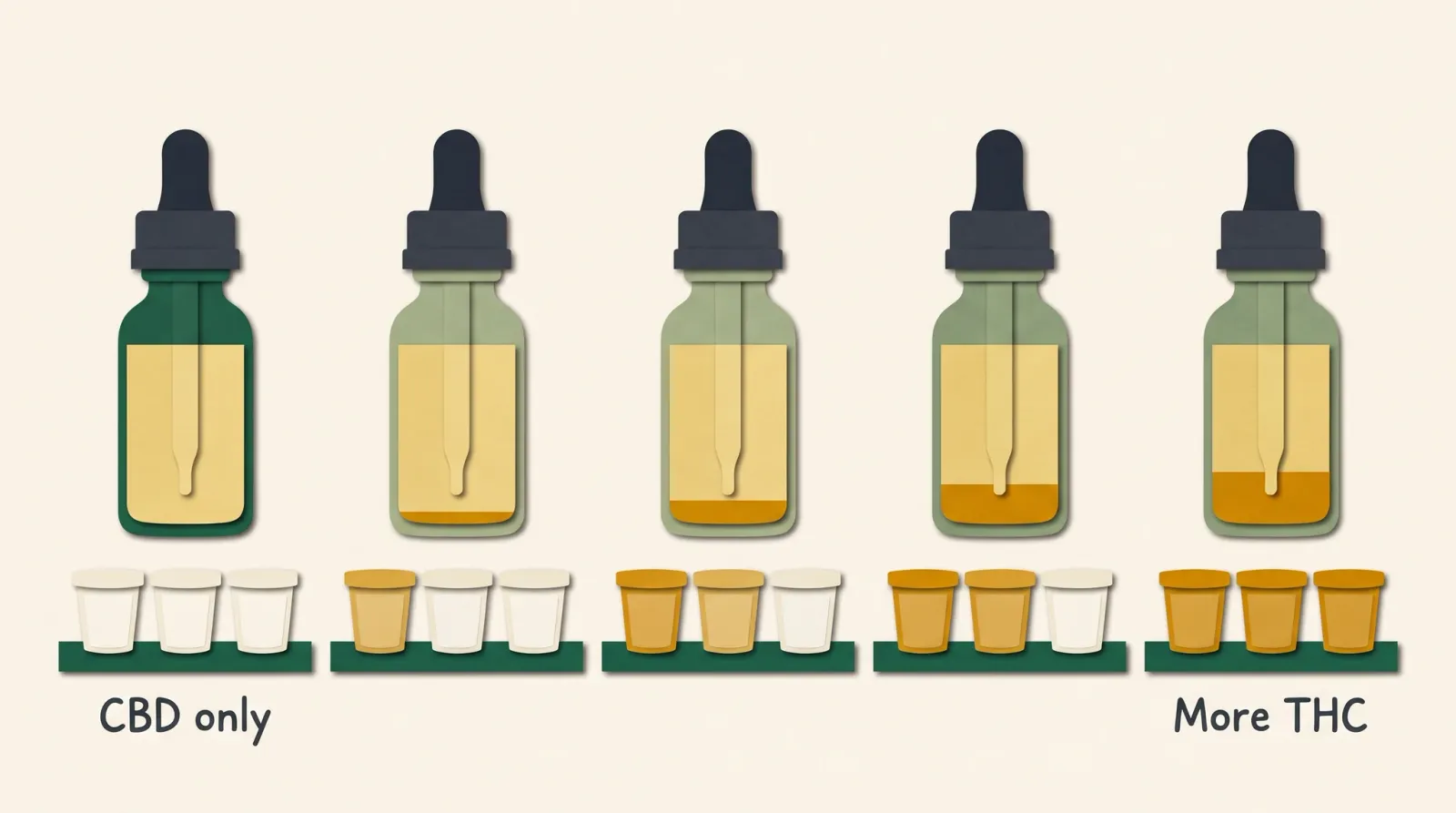
Same CBD, rising THC. In the 2025 dose study, positives climbed with THC per dose, but people at the same dose differed. The cup tints show the direction of the trend, not the study counts.
Do other studies agree?
Mostly, with one surface conflict worth knowing about.
Pure CBD, single dose. Six healthy adults took 100 mg of pure CBD by mouth or by vaporizer. Of 218 urine samples, one screened positive at a sensitive 20 ng/mL setting and none confirmed above 15 ng/mL. The same people then vaped CBD-dominant cannabis with 3.7 mg THC, and two of six confirmed positive. Spindle et al., J Anal Toxicol 2020 A follow-up with 18 adults found the same pattern. Sholler et al., 2022
Full-spectrum, four weeks. Fourteen adults with anxiety took a full-spectrum extract every day for four weeks, averaging 34.7 mg CBD and 0.80 mg THC per day. Seven of 14 screened positive, with GC-MS confirmation reported by the authors. Positive status was linked only to creatinine, a marker of how concentrated the urine was. Dahlgren et al., JAMA Psychiatry 2021
That 0.8 mg per day sits below the 2.0 mg per day that gave 4 of 10 positives in the 2025 trial. The studies differ in population (patients versus healthy volunteers), test kit, product, duration and hydration. The sources do not settle which difference explains the gap, so we will not pretend to. The safe reading is that regular use of a full-spectrum product with under 1 mg THC a day has produced positives. On why hydration changes results, see why detox drinks mostly dilute.
Broad-spectrum, two weeks. Twenty healthy adults took a broad-spectrum product daily for 14 days, about 34 mg CBD and roughly 0.04 mg THC a day by our math. No THC or THC metabolites were detected in their urine. This was one product, a small exploratory study, funded by the product’s maker. Zvorsky et al., Exp Clin Psychopharmacol 2025
A 2026 systematic review of 12 studies drew the same overall picture. Most human studies found no positives above cutoffs, and the positives that did occur traced mainly to THC in the product, mislabelling, contamination and test sensitivity. Ovat et al., Int J Legal Med 2026
Does full-spectrum CBD show up on a drug test? What about broad-spectrum or isolate?
The product type matters only because it predicts how much THC is present. Here is what the studies above found. If the terms are new, start with full-spectrum, broad-spectrum and isolate CBD.
| Product type | What it is meant to contain | THC per day in the study | What the study found | The catch |
|---|---|---|---|---|
| Isolate (pure CBD) | CBD only | 0 mg (lab-grade CBD) | No confirmed positives after a single 100 mg dose | Studies used lab-grade CBD, not retail bottles; retail labels are often wrong |
| Broad-spectrum | Plant compounds with THC removed | About 0.04 mg (measured) | No THC detected in urine after 14 days | One product, 20 people, maker-funded |
| Full-spectrum | Plant compounds including THC | 0.80 mg | 7 of 14 screened positive after 4 weeks | Small open-label study; hydration linked to results |
Labels are the weak link. In a lab analysis of 84 CBD products bought online, THC was found in 18 of them (21 percent), at up to 6.43 mg/mL, and about 69 percent were mislabelled on CBD content. Bonn-Miller et al., JAMA 2017 That study did not sort products by type, so it cannot rank isolate against full-spectrum. It does show why the word on the front of the bottle is not proof.
How much THC is in a CBD product?
You can work it out in one line, if you have the batch lab report:
THC per day = THC per millilitre (from the lab report) × millilitres you take per day.
Two real products from the studies above:
- The full-spectrum extract contained 0.23 mg THC per mL. At 1 mL a day, that is 0.23 mg. The study participants averaged 0.80 mg a day. Dahlgren et al., 2021
- The broad-spectrum product contained about 0.04 mg THC per mL. At 1.09 mL a day, that is about 0.04 mg. Zvorsky et al., 2025
If a label gives only a CBD-to-THC ratio, divide instead. A 50 mg CBD dose at a 43:1 ratio carries about 1.2 mg THC. At 100:1 it is 0.5 mg, and at 27:1 it is about 1.9 mg. Those are worked examples, not claims about any real product.
What about “under 0.3 percent THC”? That federal figure limits THC in the hemp plant on a dry-weight basis. It does not promise anything about your bottle. For scale only: a hypothetical oil at 0.3 percent THC by weight would carry 3 mg of THC per gram (0.003 × 1,000 mg). That is close to the single doses of 2.8 and 3.7 mg that gave positives in 6 and 7 of 10 people in the 2025 trial. SAMHSA hemp memo, 2019 For how total THC differs from delta-9 on a lab report, see total THC versus delta-9.
The federal definition is also scheduled to change. The FY2026 agriculture appropriations law adds a cap of 0.4 mg total THC per container for final hemp-derived products, with most of the change delayed to December 11, 2026. Congressional Research Service, updated September 2026 Our guide to the coming federal hemp definition change covers what that means for shoppers.
Will “I only used CBD” explain a positive test?
Not in federally regulated testing. The Department of Transportation says plainly that “CBD use is not a legitimate medical explanation for a laboratory-confirmed marijuana positive result,” and medical review officers will verify the positive. DOT CBD notice, 2020
SAMHSA’s memo for federal workplace programmes says the same. It notes that the FDA does not certify THC levels in CBD products and that a CBD product can cause a positive result. Under that programme, the only accepted medical explanation is a verified prescription for an approved THC medicine such as Marinol. SAMHSA, 2019
These rules cover federal employees and DOT-regulated safety-sensitive jobs. Private employers and state laws vary, and we did not research them, so check your own employer’s written policy.
Saliva tests are not a loophole either. In the same 60 people from the 2025 trial, one in ten had a positive oral fluid test after a single dose with only 0.5 mg THC. Vikingsson et al., J Anal Toxicol 2026 Adjacent cannabinoids carry their own risk: see delta-8, delta-10 and HHC on a drug test.
How do you check a CBD product before a test?
Use the batch lab report, not the front label. These steps show you where a product sits. They do not guarantee a result.
- Find the batch lab report. Get the certificate of analysis (COA) for the exact batch or lot printed on your bottle. A brand’s sample report for a different batch tells you little. Our guide to matching the lab report to your batch shows how.
- Read the THC line. Look for delta-9 THC, and total THC if listed, in mg/mL, mg/g or percent. “Not detected” only means below that lab’s detection limit, so note the limit too. Also check the test date on the lab report.
- Multiply by your daily amount. THC per mL times the mL you take each day gives THC per day in milligrams.
- Compare with the dose studies. Use the tables above as a rough position on a gradient, not a pass or fail line.
- Tell the testing programme what you take. If you take a prescribed CBD medicine such as Epidiolex, or any regular CBD product, tell the medical review officer.
If a product has no batch lab report, you cannot know its THC. Our guide to reading a CBD label explains the numbers that are on the package. If you use the High IQ app, you can scan a product label to keep its details beside your notes, which makes the batch easy to find later.
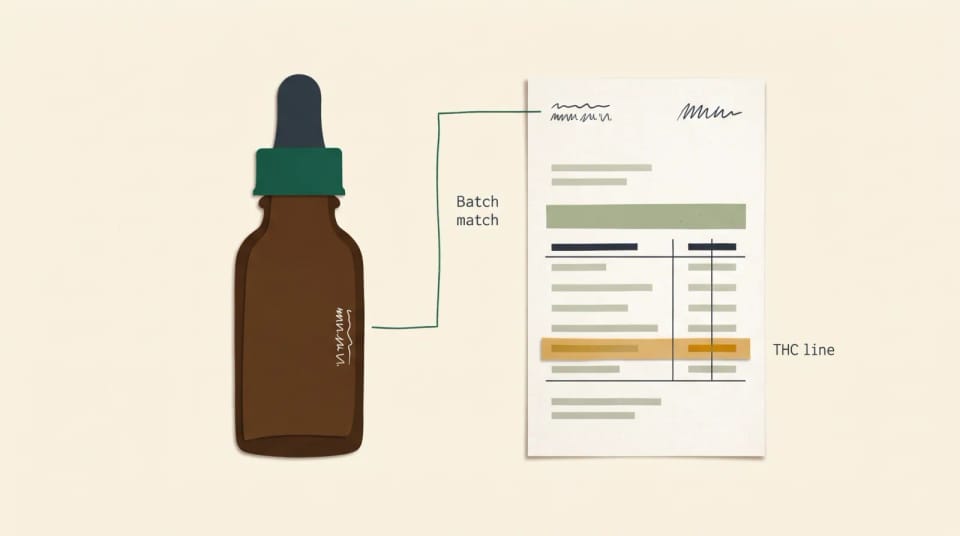
The front label rarely states THC. The batch lab report does, but only when its batch matches your bottle. The marks here are abstract on purpose.
When to talk to a clinician. If you use CBD for a health symptom such as pain, anxiety or sleep trouble and you face testing, talk with a clinician or pharmacist about your options. Do not stop a prescribed medicine on your own because of a test. For a newcomer’s overview, see how THC and CBD differ.
Key takeaways
- Urine tests look for a THC metabolite, not CBD. The THC in a CBD product is the risk.
- With 100 mg CBD, one dose with 1 to 3.7 mg THC gave confirmed positives in 1 to 7 of 10 people. Daily use raised the counts.
- Regular full-spectrum use at under 1 mg THC a day has produced positives.
- Pure CBD did not confirm positive in short studies, but retail labels are often wrong.
- Read THC from the batch lab report and multiply by your daily amount.
- In federal and DOT testing, a CBD claim does not explain a positive.
FAQ
Can CBD gummies make you fail a drug test?
They can if they contain THC. The format does not change the rule: what matters is THC per gummy times the number you eat. None of the studies here tested gummies, so check the batch lab report for THC per gummy and do the same multiplication.
Can I tell my employer or medical review officer I only used CBD?
You can tell them, but in federally regulated testing it does not explain a confirmed positive. DOT and SAMHSA both say CBD use is not a legitimate medical explanation. Private employers set their own policies, so read yours in writing.
Does CBD turn into THC in your body?
Controlled studies of pure CBD found no evidence that it converts to THC in the body. One saliva study found a small amount converting during lab analysis, which is a lab artefact rather than something in the body. Positives in the research trace to THC that was already in the product.
Is 0.3 percent THC a lot?
It is a plant limit, not a dose. For scale, a hypothetical oil at 0.3 percent THC by weight would carry 3 mg THC per gram, and single doses of 2.8 to 3.7 mg gave positives in 6 to 7 of 10 people in the 2025 trial. Your product’s actual THC comes from its batch lab report.
Sources
- Wolinsky D, Zamarripa CA, Spindle TR, et al. The acute and chronic pharmacokinetics and pharmacodynamics of oral cannabidiol with and without low doses of delta-9-tetrahydrocannabinol. Journal of Analytical Toxicology, 2025.
- Spindle TR, Cone EJ, Kuntz D, et al. Urinary pharmacokinetic profile of cannabinoids following administration of vaporized and oral cannabidiol and vaporized CBD-dominant cannabis. Journal of Analytical Toxicology, 2020.
- Sholler DJ, Spindle TR, Cone EJ, et al. Urinary pharmacokinetic profile of CBD, delta-9-THC and their metabolites following oral and vaporized CBD and vaporized CBD-dominant cannabis administration. Journal of Analytical Toxicology, 2022.
- Dahlgren MK, Sagar KA, Lambros AM, et al. Urinary tetrahydrocannabinol after 4 weeks of a full-spectrum, high-cannabidiol treatment in an open-label clinical trial. JAMA Psychiatry, 2021.
- Zvorsky I, Kulpa J, Mechtler LL, et al. Urinalysis and perceived effects following 2-week use of a commercial broad-spectrum cannabidiol product. Experimental and Clinical Psychopharmacology, 2025.
- Ovat DY, Bezci E, Balica K, et al. Impact of CBD and hemp oil use on drug test results: a systematic review. International Journal of Legal Medicine, 2026.
- Vikingsson S, Zamarripa CA, Spindle TR, et al. The acute and chronic pharmacokinetic oral fluid profile of oral CBD with and without low doses of delta-9-THC. Journal of Analytical Toxicology, 2026.
- Connors N, Kosnett MJ, Kulig K, et al. ACMT position statement: interpretation of urine for tetrahydrocannabinol metabolites. Journal of Medical Toxicology, 2020.
- Bonn-Miller MO, Loflin MJE, Thomas BF, et al. Labeling accuracy of cannabidiol extracts sold online. JAMA, 2017.
- SAMHSA Division of Workplace Programs. Hemp products memo, 2019.
- US Department of Transportation, ODAPC. DOT “CBD” notice, 2020.
- Congressional Research Service. Changes to the statutory definition of hemp and implications for agricultural policy, updated September 2026.





